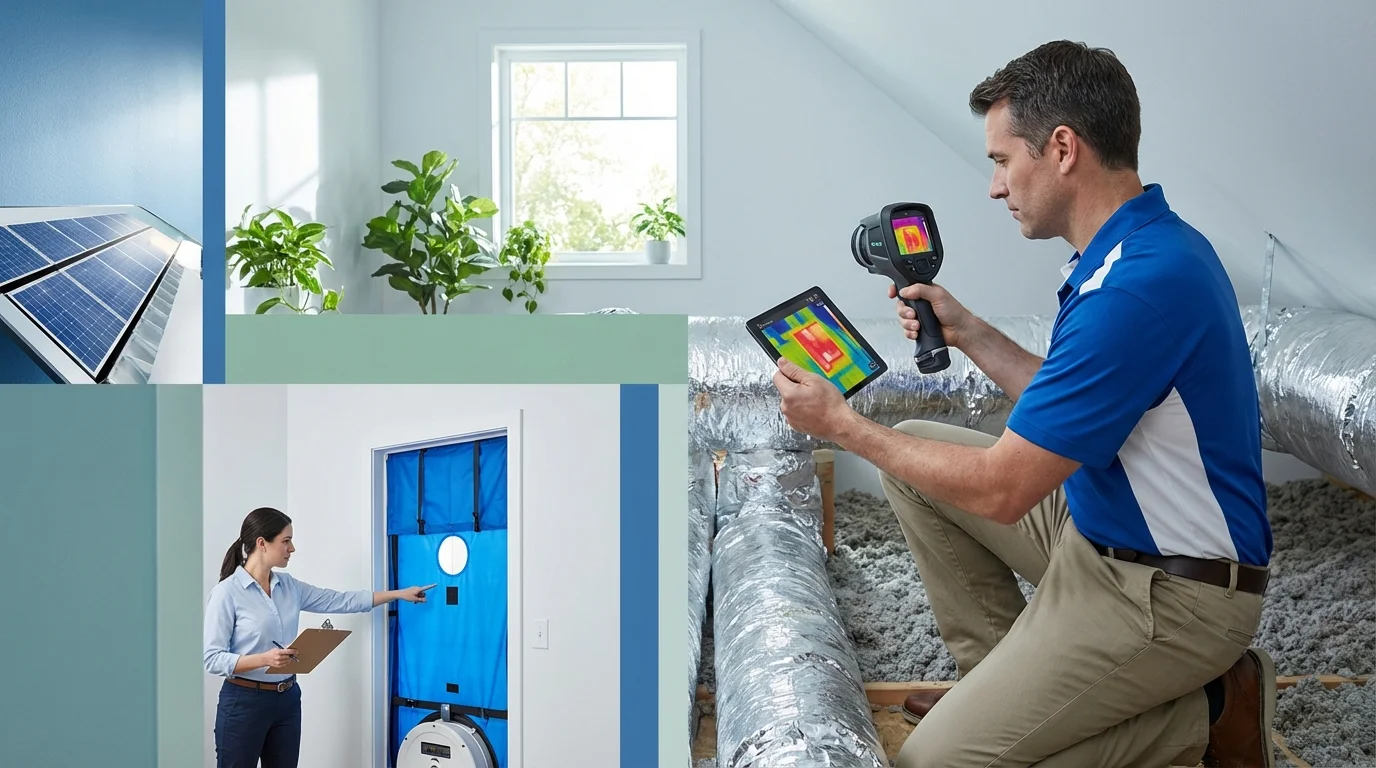
Up to 30% of the conditioned air moving through the duct system in a typical home is lost due to leaks, holes, and poor connections. This escaping air never reaches its intended destination, forcing your HVAC system to run longer and harder just to maintain a comfortable temperature. So this constant energy waste directly translates into higher utility bills month after month, with homeowners paying to heat and cool their attic, crawlspace, or walls instead of their living space.
How Much Can I Save on a Ductwork Inspection Energy Audit, and Am I Eligible for Rebates?
A ductwork inspection energy audit rebate typically provides homeowners with between $100 and $500 in 2026, depending on the specific utility program. And eligibility for these rebates requires being a customer of the sponsoring utility, owning the property, and sometimes meeting income requirements for enhanced, 100% free audits.
Rebate amounts for a ductwork inspection energy audit vary based on your utility provider and state. So some programs offer a flat-rate rebate of $150, while others cover up to 75% of the total inspection cost. And eligibility is almost always tied to your utility account; you must be a residential customer in good standing. But some states offer enhanced rebates for low-to-moderate-income (LMI) households, often covering the full $400-$600 cost of a comprehensive audit and blower door test. Following the audit, any recommended duct sealing or insulation work often qualifies for additional energy tax credits under the 2026 Inflation Reduction Act framework, which provides a tax credit covering 30% of project costs, up to $600 annually for these specific improvements.
"Leaky ducts can reduce heating and cooling system efficiency by as much as 20 percent. Sealing and insulating ducts increases efficiency, lowers your energy bills, and can often pay for itself in energy savings." — ENERGY STAR
What is the Application Process and What are the Deadlines for Ductwork Inspection Rebates?
The application process for a 2026 ductwork inspection rebate involves finding a program-approved contractor, scheduling the audit, and submitting the final invoice and application form to the utility. So homeowners must complete this process before the program's annual deadline, typically December 31, 2026, to receive their incentive.
Applying for a ductwork inspection rebate follows a clear, multi-step path. First, homeowners must identify a certified contractor from their utility's pre-approved list. And after the inspection is complete, this contractor provides a detailed report and an itemized invoice. So the homeowner then submits the rebate application, along with the invoice, directly to the utility or state energy office. But deadlines are strict; most 2026 programs require all paperwork to be submitted by December 31, 2026. Funding for these programs is finite and allocated on a first-come, first-served basis, making early application critical. You can find local program deadlines and potential savings using our free rebate calculator. This ensures you don't miss out on the $100-$500 available for improving your home's efficiency.
What Are the Contractor Requirements and Can I Stack Multiple Energy Efficiency Incentives?
Contractors performing a rebate-eligible ductwork inspection must hold specific certifications, such as from the Building Performance Institute (BPI), and be listed as an approved partner with the local utility. And yes, homeowners can stack these ductwork rebates with other 2026 incentives, such as those for new heat pump rebates.
Utility companies mandate that all subsidized energy audits are performed by qualified professionals to ensure accurate results. So they maintain a public list of contractors who hold credentials like BPI's "Building Analyst" or RESNET's "Home Energy Rater" certifications. And using an uncertified contractor will disqualify you from receiving a rebate. A key benefit is the ability to stack incentives. For example, a $150 rebate for a ductwork audit can be combined with a $1,000 rebate for attic insulation and a $2,000 federal tax credit for a new heat pump. But the total value of stacked incentives cannot exceed 100% of the total project cost. This strategy maximizes your return on investment for a whole-home energy upgrade, which can also include improvements like a geothermal system.
How Do Ductwork Inspection Programs Vary by State and Utility Provider?
Ductwork inspection programs exhibit 10x variations by state and utility, with rebate amounts ranging from $50 in some regions to over $500 in others. And eligibility criteria, contractor networks, and application procedures are unique to each program, such as California's PG&E programs versus New York's NYSERDA initiatives.
The landscape of energy rebates is highly localized. For instance, in 2026, Massachusetts' Mass Save program offers a no-cost home energy assessment that includes ductwork evaluation for eligible customers. So this is a 100% subsidy. But a smaller municipal utility in Texas offers a simple $75 bill credit after a homeowner submits proof of a paid inspection. And some states integrate ductwork testing into a broader home energy audit package, while others treat it as a standalone, incentivized service. The key is that a homeowner in one state has access to a completely different set of financial incentives and program rules than a homeowner just one state over. Therefore, verifying the specific details with your local electric or gas provider is the first step.
"DSIRE is the most comprehensive source of information on incentives and policies that support renewables and energy efficiency in the United States." — DSIRE
Ductwork Inspection Rebate Program Comparison (2026)
| Program / Utility | Rebate Amount | Eligibility Highlights | 2026 Deadline |
|---|---|---|---|
| SoCal Edison (CA) | Up to $250 | Must be a residential electric customer; home must be 5+ years old. | Dec 31, 2026 |
| Con Edison (NY) | 75% of cost, up to $400 | Must use a BPI-certified contractor from their network. | Nov 30, 2026 |
| Mass Save (MA) | 100% covered ($0 cost) | Income-based; must meet LMI thresholds or live in designated area. | Rolling |
Official Sources
- ENERGY STAR — A U.S. Environmental Protection Agency program providing credible, objective information on energy-efficient products and practices.
- Database of State Incentives for Renewables & Efficiency (DSIRE) — The most comprehensive U.S. database for state and utility energy efficiency rebates and tax credits. (note: the federal 25C and 25D credits ended for projects completed after December 31, 2025)
Related Reading: Learn more about Energy Audit Log Cabin and Energy Audit Myths Debunked.
Frequently Asked Questions
What are the eligibility requirements for a ductwork inspection energy audit rebate?
Eligibility for a 2026 ductwork inspection rebate primarily requires you to be a residential customer of the sponsoring utility or state energy program. And you must own the home being audited. Some programs also have property-specific requirements, such as the home being at least five years old. Enhanced or no-cost audits often have income-based qualifications, requiring household income to be below 80% of the area median income.
How much can I expect to save with a ductwork inspection energy audit rebate?
Homeowners can expect to save between $100 and $500 with a ductwork inspection rebate in 2026. The exact amount depends on your specific utility program. Some offer a flat rebate, such as $150, while others cover a percentage of the cost, often up to 75%. Low-income programs sometimes cover 100% of the audit cost, which can be a $400-$600 value, making the service entirely free for qualified households.
How does a ductwork inspection energy audit compare to a general home energy audit?
A ductwork inspection energy audit specifically focuses on the integrity of your HVAC duct system using tools like a duct blaster to measure air leakage. So it's a specialized test. A general home energy audit is more comprehensive, evaluating insulation levels, air sealing, appliance efficiency, and windows. While a general audit often includes a visual duct inspection, it doesn't always include the detailed, pressurized testing of a dedicated ductwork audit.
Stop Wasting Money on Leaky Ducts
Leaky ducts can cost you over $500 per year. Find out exactly how much you can save on duct sealing and other energy-efficient upgrades.
Calculate Your Savings NowLast updated: April 14, 2026. Reviewed by the DuloCore Editorial Team. About our authors.