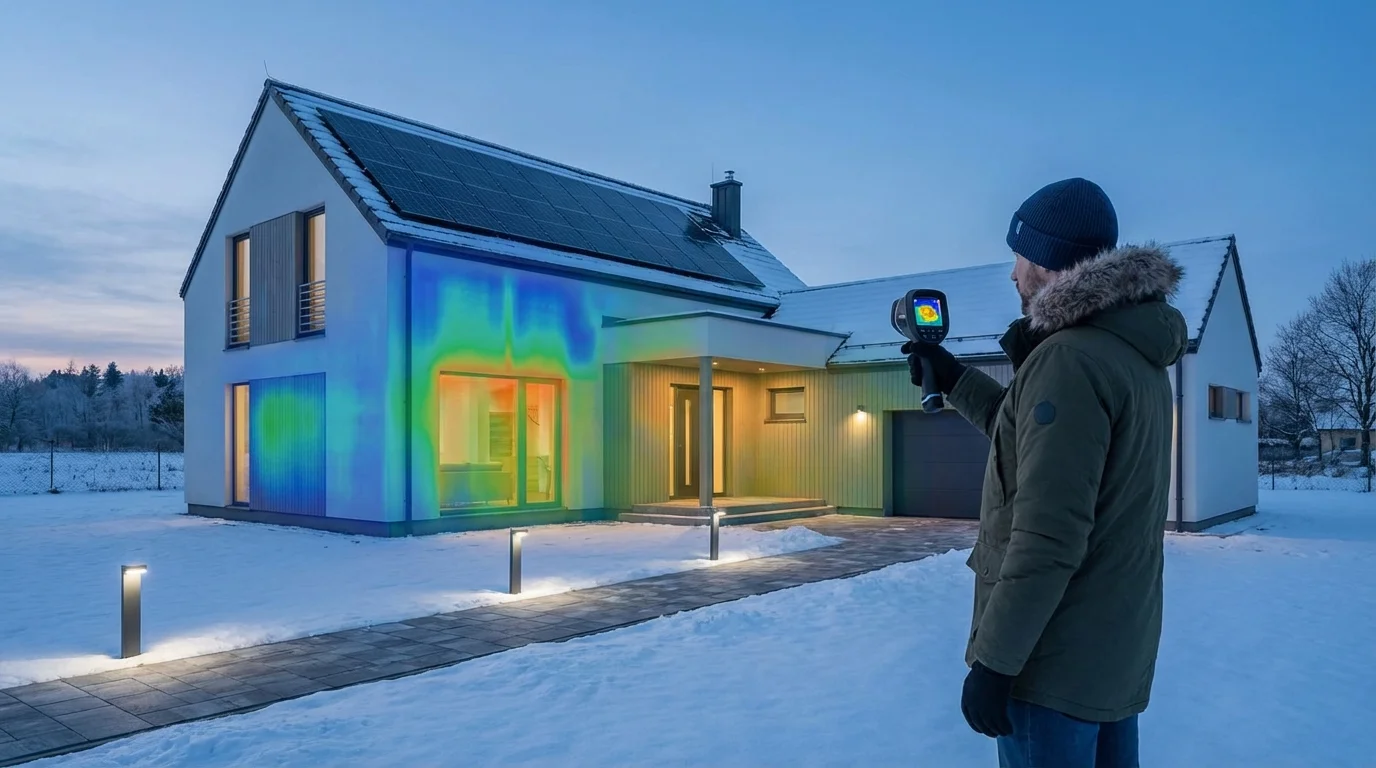
In homes across the northern U.S., drafts and poor insulation account for up to 45% of total annual heating costs. Without a professional assessment, homeowners are unknowingly paying to heat the outdoors, a problem that intensifies every winter as energy prices climb. So this isn't just about comfort; it's a direct financial drain that occurs 24/7 during the coldest months of the year.
How Much Can I Save on a Cold Climate Energy Audit, and What Upgrades Qualify for Rebates?
A cold climate energy audit is a diagnostic service that identifies specific sources of heat loss in a home, with savings on the audit itself reaching up to $500 through state programs in 2026. Rebates for subsequent upgrades cover 30-80% of project costs, prioritizing air sealing and insulation.
The core tension for homeowners is balancing the upfront cost of an audit against the long-term, compounding losses from energy waste. For a typical home in a cold climate state like Wisconsin or New Hampshire, the Department of Energy estimates that air leaks alone waste between 15% and 25% of the energy used for heating. So this translates to an annual loss of $400 to $650 for a home with a $2,600 heating bill. A professional home energy audit pinpoints these leaks with precision tools like blower doors and infrared cameras. But the real value is unlocking rebates for upgrades. These incentives target high-impact improvements like attic insulation (up to $2,200 in rebates), air sealing ($1,600), and upgrading to high-efficiency windows ($600). And these upgrades not only reduce heating bills by up to 30% but also qualify for federal energy tax credits.
Am I Eligible for Cold Climate Home Energy Audit Rebates Based on My Income, State, or Utility?
Eligibility for cold climate energy audit rebates is determined by state, utility provider, and sometimes household income, with programs in 2026 offering up to 100% coverage for low-to-moderate income households. Homeowners in states like Minnesota, Maine, and New York have access to dedicated cold climate programs.
Eligibility criteria vary widely, creating a complex landscape for homeowners. And most state-level programs, like those administered by NYSERDA in New York or Efficiency Maine, are available to all residents served by participating utilities, regardless of income. But income level often determines the rebate amount. For example, households earning below 80% of the Area Median Income (AMI) frequently qualify for free audits and increased rebate amounts for insulation and air sealing, sometimes covering the entire project cost. Utility-specific programs add another layer. So a National Grid customer in Massachusetts has access to different incentives than an Xcel Energy customer in Colorado. Verifying eligibility requires checking with both state energy offices and local utility providers for 2026 program details.
"The Database of State Incentives for Renewables & Efficiency® (DSIRE) is the most comprehensive source of information on incentives and policies that support renewables and energy efficiency in the United States." — DSIRE
What's the Application Process and What Are the Deadlines for Cold Climate Energy Audit Programs?
The application process for cold climate energy audit rebates typically involves pre-authorization through a state or utility portal, followed by work from a certified auditor, and submission of invoices by a 2026 program deadline. Most programs require applications to be filed within 90 days of the audit's completion.
Navigating the application process is a critical step. So homeowners must first find a program-approved or BPI (Building Performance Institute) certified auditor. And before any work begins, an application is usually submitted online through the utility or state energy program's website, often requiring an account and proof of residence. Once the audit is complete, the auditor provides a detailed report and an invoice. This documentation, along with the completed rebate form, must be uploaded to the program portal. Deadlines are strict; many 2026 programs operate on a calendar-year basis with a final submission deadline of December 31, 2026, or until funds are exhausted. Missing the 90-day post-work submission window is a common reason for denial.
Is Funding Still Available for Cold Climate Energy Audits, and Can I Stack Different Rebates?
Funding for 2026 cold climate energy audits is available through state and utility programs, replenished annually, though it is finite and awarded on a first-come, first-served basis. Homeowners can stack utility rebates with federal IRA tax credits, but typically cannot stack two utility rebates for the same upgrade.
Funding availability is a primary concern. And while state programs receive new budgets each fiscal year, popular incentives can be depleted before year-end. So acting early in the calendar year is advantageous. The ability to stack incentives is where homeowners maximize savings. For example, a homeowner can receive a $1,600 utility rebate for air sealing and also claim the 30% federal tax credit (up to $1,200) for the same project. But stacking two rebates from the same utility or a state rebate on top of a utility rebate for the exact same measure is often prohibited. The best strategy involves pairing a local rebate with a federal credit. Use our free rebate calculator to find all the incentives you qualify for.
What Contractor Requirements Must Be Met for My Cold Climate Energy Audit to Qualify for Incentives?
For a cold climate energy audit to qualify for incentives, the work must be performed by a contractor with specific certifications, most commonly from the Building Performance Institute (BPI). Many 2026 state and utility rebate programs maintain a list of pre-approved, certified energy auditors and contractors.
Using an unqualified contractor is the fastest way to have a rebate application rejected. So state energy offices and utility companies mandate that auditors hold credentials like BPI Building Analyst or BPI Energy Auditor. These certifications ensure the professional is trained in building science and proficient with diagnostic tools like blower doors and thermal imaging cameras, which are essential for cold climate assessments. Before hiring, homeowners must verify the contractor’s status on their utility’s or state’s official list of approved providers. And for subsequent upgrades like insulation or installing heat pump rebates, the installing contractor often needs to be certified by the manufacturer or be on a program-approved list to ensure the work meets quality standards required for the rebate.
Cold Climate Energy Upgrade Rebate Comparison (2026 Programs)
| Upgrade/Service | Typical Rebate Amount | Common Eligibility Requirement | Application Deadline |
|---|---|---|---|
| Energy Audit | $150 - $500 (or free) | Must use a BPI-certified auditor | Within 90 days of service |
| Attic Insulation | $0.50 - $2.00 per sq. ft. (up to $2,200) | Minimum R-value increase (e.g., R-49) | Dec 31, 2026 |
| Air Sealing | 50-75% of cost (up to $1,600) | Must achieve a specific CFM reduction | Dec 31, 2026 |
| Heat Pump | $2,000 - $8,000 | Must be a qualified cold-climate model | Varies by program |
"Weatherization services can help you reduce your energy bills. The Weatherization Assistance Program has served more than 7 million households since 1976." — U.S. Department of Energy
Official Sources
- ENERGY STAR — Federal guidance on energy-efficient products and practices, including home sealing and insulation.
- Database of State Incentives for Renewables & Efficiency (DSIRE) — The most comprehensive database of state, local, and utility incentives for energy efficiency.
- U.S. Department of Energy (DOE) — Information on federal programs, tax credits, and energy-saving tips directly from the source. (note: the federal 25C and 25D credits ended for projects completed after December 31, 2025)
Related Reading: Learn more about Phantom Load Energy Audit and Radiant Floor Heating Energy Audit.
Frequently Asked Questions
Who qualifies for an energy audit specifically designed for cold climate homes?
Most homeowners in states with cold winters qualify for an energy audit through their local utility or state energy office. Eligibility is typically tied to residency and being a customer of a participating utility. For enhanced, income-based programs offering free audits, qualification depends on household income, often set at or below 80% of the Area Median Income (AMI) for 2026.
What is the typical process for an energy audit in a cold climate residence?
The process involves a certified auditor performing a visual inspection and diagnostic testing. Key tests for cold climates include a blower door test to measure air leakage (CFM50) and an infrared thermal scan to identify insulation gaps and cold spots in the building envelope. The audit takes 2-4 hours, and the homeowner receives a detailed report prioritizing cost-effective upgrades.
Are there specific rebates or grants available to cover the cost of an energy audit in cold regions?
Yes, many states and utilities in cold regions offer rebates that cover a portion or all of the audit cost. In 2026, these rebates typically range from $150 to $500. Some programs, particularly those for low-to-moderate income households, offer the audit completely free of charge. These incentives are designed to lower the barrier to identifying critical energy-saving improvements.
What kind of improvements are usually recommended following a cold climate energy audit?
The most common recommendations are attic insulation and air sealing, as these offer the quickest payback by preventing heat from escaping. Other typical suggestions include sealing ductwork, upgrading to high-performance windows, and installing a high-efficiency cold-climate heat pump. These improvements directly address the 30-45% of heat loss that occurs through the building envelope.
How much can I save on heating bills after an energy audit in a cold climate?
Homeowners can save between 15% and 30% on their annual heating bills after implementing the recommendations from a professional energy audit. For a home with an annual heating cost of $2,500, this translates into savings of $375 to $750 every year. The exact savings depend on the initial condition of the home and the scope of the upgrades performed.
Find Your Cold Climate Rebates Instantly
Don't guess how much you can save. Use DuloCore's free rebate calculator to see every state, federal, and utility incentive available for your home energy audit and upgrades in minutes.
Calculate Your Savings NowUpdated: April 14, 2026 — fact-checked by DuloCore Research. About our editorial process.