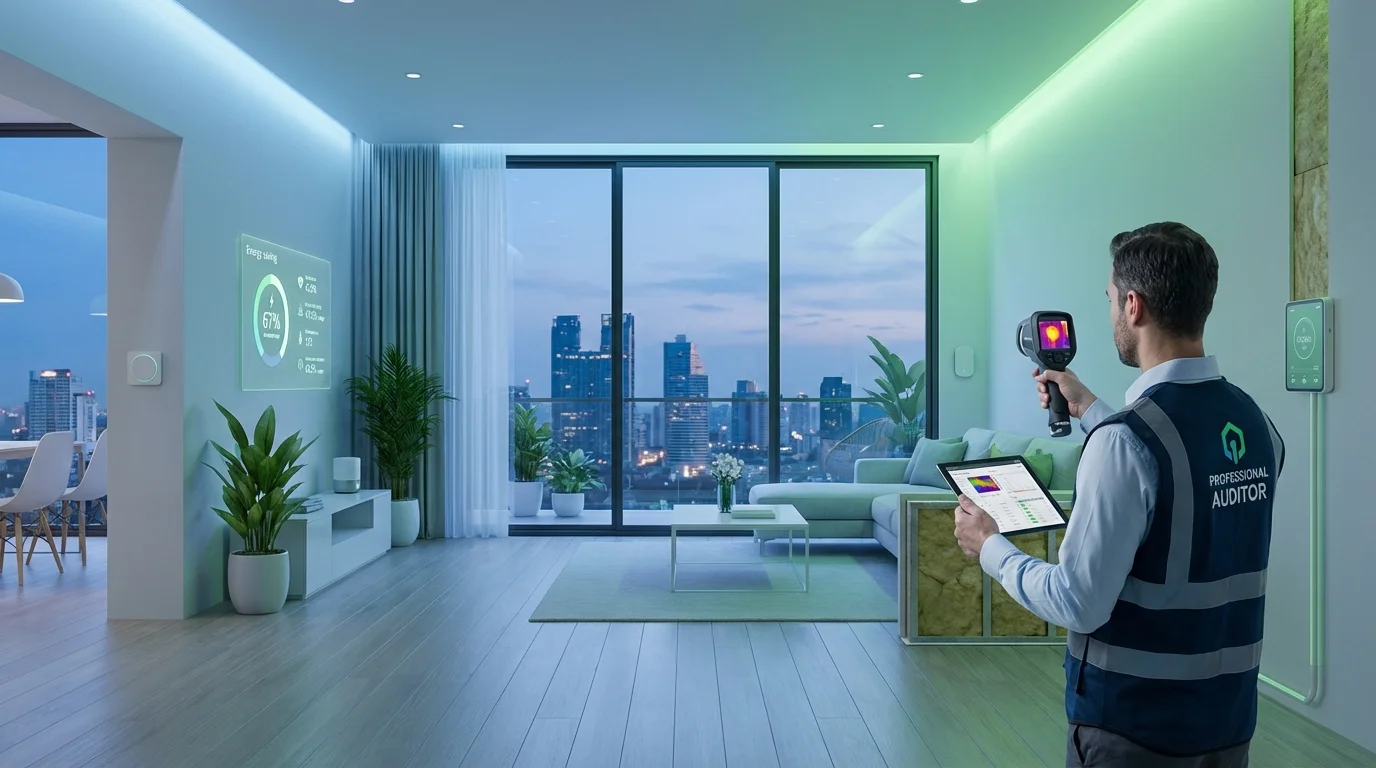
Up to 35% of the energy used for heating and cooling in multi-family buildings is wasted due to air leakage through uncontrolled cracks and openings. For condo and apartment dwellers, this translates directly into hundreds of dollars in lost savings every year. So with utility rates increasing an average of 5% annually, identifying these energy drains is no longer just about comfort—it's a financial necessity.
What Rebates and Incentives Are Available for Condo & Apartment Energy Audits in My State and Through My Utility?
An energy audit for a condo or apartment is a professional assessment identifying air leaks, insulation gaps, and inefficient systems, qualifying for rebates up to $350 from state programs in 2026. And many local utilities offer an additional $150 incentive, effectively covering over 75% of the audit's cost.
State energy offices and local utility providers are the primary sources for these 2026 incentives. For example, programs like NYSERDA in New York or Mass Save in Massachusetts offer direct rebates to homeowners who hire a certified professional for a comprehensive assessment. And these programs often provide a clear pathway to further rebates on upgrades identified during the audit, such as air sealing or new insulation. But funding is allocated annually and often runs out before the year's end. So residents must check their utility's website or the DSIRE database for current program availability and application forms. The federal government also provides energy tax credits for the improvements recommended by an audit, which can be combined with local incentives. These audits pinpoint where your unit is losing the most energy, with blower door tests quantifying air leakage rates that often exceed 7 ACH50 (air changes per hour at 50 Pascals).
Do I Qualify? Understanding Income Limits and Specific Equipment Eligibility for Condo Energy Audit Programs.
Eligibility for 2026 condo energy audit rebates often depends on income, with many programs setting limits at 80% or 120% of the Area Median Income (AMI). So homeowners must verify their utility provider and residency status, as programs are geographically restricted and require an approved assessment.
Qualification rules are strict. And most programs are restricted to owner-occupied units, although some pilot programs for renters exist. Income verification is typically required for enhanced rebates, which can cover up to 100% of the audit cost for low-to-moderate income households. For standard rebates, proof of homeownership and a recent utility bill suffice. The audit itself must be performed by a certified professional, often one from a pre-approved list provided by the utility. So the assessment's findings pave the way for further incentives on specific equipment, such as heat pump rebates or window replacements. But eligibility for these subsequent rebates depends on the new equipment meeting specific ENERGY STAR or CEE Tier efficiency ratings. It’s critical to confirm all requirements before scheduling the service to ensure rebate approval.
How Do I Apply for Energy Audit Rebates and What's the Step-by-Step Process?
The 2026 application process for condo energy audit rebates involves finding a certified auditor, scheduling the assessment, and submitting the final report with a rebate form to the utility. So applicants must provide proof of residence and the auditor's certification number for processing, which takes 4-6 weeks.
The application journey begins with confirming your eligibility through your utility's online portal. And once confirmed, you select a BPI or RESNET-certified auditor from their approved list. After the audit, which costs between $250 and $500, the auditor provides a detailed report and an itemized invoice. So you'll complete the utility's rebate application form, attaching the invoice and a copy of the report. Submissions are typically done online or via mail. But missing signatures or incomplete information are the top reasons for denial, causing delays of 30-60 days. To avoid this, double-check that all fields are filled and all required documents are attached before submission. Use our free rebate calculator to see the total potential savings from both the audit and the recommended upgrades.
What Are the Deadlines, Funding Status, and Stacking Rules for Condo Energy Audit Incentives?
Most 2026 state and utility energy audit rebates operate on a first-come, first-served basis with annual funding cycles ending December 31. But homeowners can stack a $150 federal tax credit with a $200 utility rebate, provided total incentives don't exceed 100% of the audit cost.
Program funding is finite. And popular state rebate programs often exhaust their budgets by Q3, so applying early in the year is crucial. Always check the program's website for a "funding status" indicator. Stacking, or combining incentives, is a key strategy for maximizing savings. For instance, a homeowner can claim a $200 state rebate and a $150 utility rebate for the same $400 audit. The federal Energy Efficient Home Improvement Credit (Section 25C) ended for property placed in service after December 31, 2025 (IRS FS-2025-05). Federal tax credits for this work have ended, but state, local and utility rebates may still apply; check what is available at your address with the DuloCore rebate calculator. But some utilities prohibit stacking their rebates with state-level incentives, a rule that will be clearly stated in the program's terms and conditions. Reviewing these stacking rules prevents rebate application rejection and ensures you receive the maximum financial benefit, which can total over $5,000 when including subsequent upgrades.
How Do I Find a Qualified Contractor for My Condo Energy Audit, and What Are Their Requirements?
Qualified contractors for condo energy audits must hold BPI (Building Performance Institute) or RESNET certification. And utilities maintain lists of approved auditors for their 2026 rebate programs, ensuring the assessment meets specific standards required for incentive eligibility and federal tax credit documentation.
Your local utility is the best starting point. Most have an online "Find a Contractor" tool that lists pre-vetted, certified professionals who are familiar with the rebate application process. So using a contractor from this list guarantees the home energy audit will meet the program's technical specifications. These contractors are required to use specific diagnostic tools, like blower doors and infrared cameras, to generate a comprehensive report.
"A home energy assessment, also known as a home energy audit, can help you understand the whole picture of your home's energy use... A professional can do a more thorough assessment than you can do yourself." — U.S. Department of Energy
And their certification (e.g., BPI Building Analyst) ensures they follow industry standards for safety and accuracy. But always verify their license and insurance before signing a contract. A qualified contractor not only identifies energy loss but also provides a prioritized list of improvements with estimated costs and savings.
| Program Feature | Mass Save (MA) | NYSERDA (NY) | ComEd (IL) |
|---|---|---|---|
| Rebate Amount | Up to $350 | Up to $300 | $150 |
| Eligibility | Owner-occupied 1-4 unit buildings | Owner-occupied, income limits apply | All residential customers |
| 2026 Deadline | December 31, 2026 | Rolling, until funds are depleted | December 31, 2026 |
Official Sources
- Database of State Incentives for Renewables & Efficiency (DSIRE) — A comprehensive database of state, local, utility, and federal incentives that promote renewable energy and energy efficiency.
- ENERGY STAR — A U.S. Environmental Protection Agency (EPA) program providing rebate finders and information on energy-efficient products and practices.
"ENERGY STAR is the simple choice for energy efficiency. For more than 30 years, EPA’s ENERGY STAR program has been America’s resource for saving energy and protecting the environment." — ENERGY STAR
Frequently Asked Questions
Are condo owners eligible for energy audit rebates?
Yes, condo owners are frequently eligible for energy audit rebates, typically through their local utility or state energy programs. In 2026, many programs offer between $150 and $350 for a professional assessment. Eligibility usually requires the unit to be owner-occupied and the audit to be performed by a BPI or RESNET-certified professional from a pre-approved list.
What is the typical cost of an energy audit for an apartment unit?
The typical cost for a professional energy audit on an individual apartment or condo unit ranges from $250 to $500 in 2026. The price depends on the size of the unit and the comprehensiveness of the assessment, which includes a blower door test and infrared thermal imaging. Rebates from utilities often cover 50-75% of this cost.
What does an energy audit involve for a high-rise condo?
An energy audit for a high-rise condo focuses on the building envelope components within the owner's control. It involves a blower door test to measure air leakage from windows, balcony doors, and penetrations in shared walls. An auditor also uses an infrared camera to identify insulation voids and thermal bridging. The assessment provides a report detailing how to improve comfort and reduce energy bills by 15-30%.
How do I apply for rebates after an energy audit on my apartment?
To apply for rebates after an audit, you must submit a completed application form to your utility or state program administrator. This package typically requires the paid invoice from the certified auditor, a copy of the full energy assessment report, and proof of residence. Most applications can be submitted online through a dedicated portal, with processing times of 4-8 weeks.
Are there deadlines to claim energy efficiency rebates for condo improvements?
Yes, nearly all energy efficiency rebate programs have strict deadlines. For most 2026 utility and state programs, the deadline to submit applications for work completed during the year is December 31, 2026. Funding is also limited and distributed on a first-come, first-served basis, so it's best to apply as early in the year as possible before the program's budget is exhausted.
Stop Guessing, Start Saving
Find every energy audit rebate and tax credit available for your condo in seconds. Use DuloCore's free Rebate Calculator to see how much you can save on your energy bills.
Calculate Your Savings NowLast updated April 14, 2026 — reviewed by DuloCore Editorial. About our authors.