Homes in hot, humid climates lose up to 40% of their conditioned air through unseen leaks in ductwork and the building envelope. This isn't a minor drip; it's a constant financial drain that inflates your utility bills every single month. And as cooling costs continue to rise by 5-8% annually, a professional energy audit becomes the essential first defense against this invisible waste of energy and money.
What Rebates and Incentives Are Available for Energy Audits in Hot, Humid Climates by State and Utility?
State and utility energy audit rebates provide homeowners in hot, humid climates with direct financial incentives, offering between $100 and $500 in 2026. These programs are designed to offset the initial cost of a professional assessment, encouraging adoption of energy-efficient home improvements like insulation and air sealing.
In 2026, numerous rebates are available to offset the cost of a professional home energy assessment. For example, Florida Power & Light (FPL) offers a Home Energy Survey at no direct cost to customers, while utilities like Duke Energy provide rebates up to $150 for comprehensive audits. So homeowners in Texas can access programs through utilities like Oncor or CenterPoint Energy, which often partner with local municipalities to fund these initiatives. The federal government also supports energy efficiency through Inflation Reduction Act (IRA) provisions, which provide energy tax credits for the improvements recommended by an audit. But these programs vary, so checking your specific utility's website is the first step. The Database of State Incentives for Renewables & Efficiency (DSIRE) lists hundreds of local programs, with funding amounts updated quarterly.
| Program / Utility | Rebate Amount (2026) | Key Eligibility | Application Deadline |
|---|---|---|---|
| Duke Energy (FL) | Up to $150 | Must be a Duke Energy electric customer | Rolling |
| Austin Energy (TX) | Up to $300 | Single-family home in service area | Annually, check website |
| Entergy (LA, MS) | Varies by program | Must be an Entergy customer | Program-specific |
What Are the Eligibility Requirements, Including Income Limits and Equipment Specifications, for Energy Audit Rebates?
Eligibility for 2026 energy audit rebates typically requires the home to be a primary residence and meet utility service area criteria. Income limits apply for enhanced rebates, often set at 80% of the Area Median Income (AMI), while equipment specifications mandate the use of certified auditors.
To qualify for most utility rebates, the property must be a single-family home, duplex, or townhome, and you must be a current customer of the sponsoring utility. And for income-qualified programs, such as the federal Weatherization Assistance Program (WAP), household income cannot exceed 200% of the federal poverty level, providing audits and upgrades at no cost to the homeowner. Many programs also specify that the audit must be performed by a contractor holding a Building Performance Institute (BPI) or RESNET certification. This ensures the use of calibrated diagnostic equipment like blower doors and infrared cameras, which are essential for accurately identifying air leaks and insulation gaps in hot, humid climates. So homeowners must verify these contractor credentials before scheduling an audit to ensure rebate eligibility. Use our free rebate calculator to find your savings.
How Do I Apply for Energy Audit Rebates, and What Are the Key Application Deadlines?
Applying for 2026 energy audit rebates involves submitting a completed application form, a copy of the audit report, and a paid invoice from a certified contractor. Most utility programs maintain rolling deadlines, but state-funded initiatives often close by Q4 or when funds are exhausted for the year.
The application process is straightforward. First, confirm your eligibility and find a participating, certified contractor through your utility's online portal. After the audit is complete, you will receive a detailed report and an itemized invoice. So you'll submit these documents along with the utility's rebate application form, which is typically a one- or two-page PDF. Most utilities now offer online submission portals, reducing processing time to 4-6 weeks. But it's critical to check deadlines. While many utility programs accept applications year-round, state-level grants funded by the IRA often have specific application windows that close once the allocated $5 to $10 million in funding is claimed. The key is to submit all required documentation promptly after the audit is performed to secure your rebate.
Can I Combine Energy Audit Rebates, and Is Funding Still Available for These Programs?
Homeowners can often combine a utility rebate for an energy audit with federal tax credits for subsequent upgrades like insulation or windows in 2026. Funding for state and utility programs is allocated annually, so checking program websites for current availability is essential before funds are depleted.
Stacking incentives is a primary strategy for maximizing savings. For instance, you can receive a $150 rebate from your utility for the initial energy audit. The federal Energy Efficient Home Improvement Credit (Section 25C) ended for property placed in service after December 31, 2025 (IRS FS-2025-05). Federal tax credits for this work have ended, but state, local and utility rebates may still apply; check what is available at your address with the DuloCore rebate calculator. This combination makes the entire project more affordable.
"Many states and utilities offer rebates or other incentives for certain energy-saving products and improvements." — U.S. Department of Energy
Funding for these programs is renewed annually. Utility programs are generally stable, but state-level funds, especially those from federal block grants, are awarded on a first-come, first-served basis. So it's wise to check the program's status online, as many portals display a real-time funding tracker. Getting a rebate for new heat pump rebates is another common post-audit upgrade.
What Contractor Requirements Should I Look For When Getting an Energy Audit in a Hot, Humid Climate?
Homeowners in hot, humid climates need contractors with Building Performance Institute (BPI) or RESNET Home Energy Rater certifications for rebate eligibility in 2026. These certifications ensure the auditor uses diagnostic tools like blower doors and infrared cameras to accurately identify air and moisture intrusion.
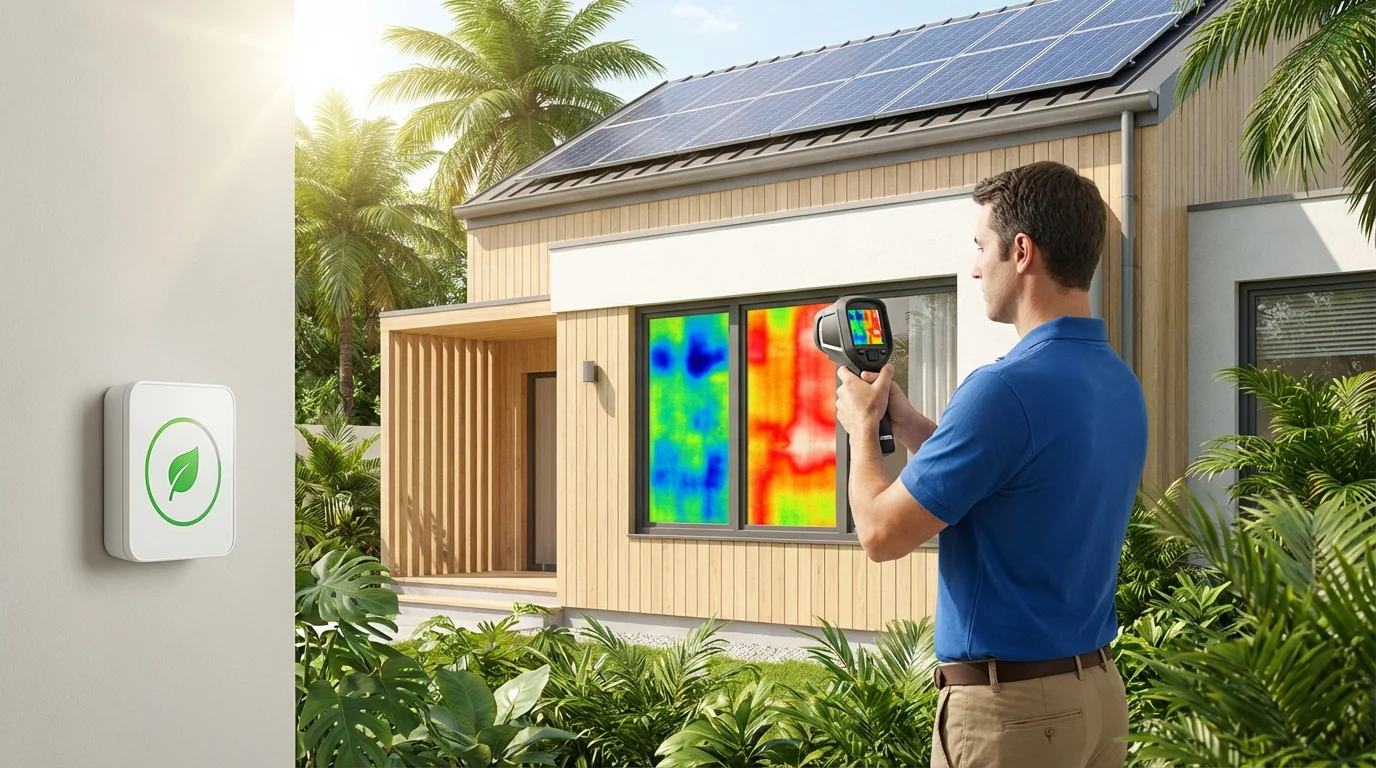
In a hot, humid environment, an energy audit must focus on more than just temperature; it must address moisture control. A certified auditor understands how to manage latent heat (humidity) and prevent conditions that lead to mold and poor indoor air quality. So they will perform a blower door test to measure air leakage and use an infrared camera to pinpoint insulation voids and moisture infiltration.
"A home energy audit can help you understand the whole picture of your home's energy use." — ENERGY STAR And these professionals are trained to analyze ductwork, a common source of up to 30% of energy loss in southern homes. Verifying a contractor's BPI or RESNET credentials on the organization's website is a non-negotiable step before hiring them for a home energy audit.
Official Sources
- DSIRE (Database of State Incentives for Renewables & Efficiency) — A comprehensive database of state, local, utility, and federal incentives for energy efficiency.
- ENERGY STAR Rebate Finder — An official U.S. government tool to find rebates on ENERGY STAR certified products.
- U.S. Department of Energy (DOE) Energy Saver — Federal guidance and information on home energy audits and efficiency upgrades.
Related Reading: Learn more about Spring Energy Audit Maintenance and Vapor Barrier Energy Audit.
Frequently Asked Questions
What makes a home eligible for an energy audit in a hot, humid climate?
Eligibility for a rebated energy audit typically requires the property to be a primary residence located within the service territory of a participating utility. Many programs, like those offered by Austin Energy, are restricted to single-family homes built before a certain year, often 10 years prior to the current date. For enhanced, no-cost programs, income limits, such as earning below 80% of the Area Median Income, are a common requirement for 2026.
How does an energy audit process differ for homes in a hot, humid climate?
In hot, humid climates, an audit places a greater emphasis on air leakage, ductwork integrity, and moisture control. Auditors use a blower door test to quantify air changes per hour (ACH), aiming for a target below 5.0 ACH50. They also use infrared cameras to detect not just insulation gaps but also moisture intrusion around windows and foundations. So the focus shifts from just heating efficiency to a comprehensive assessment of cooling and dehumidification performance.
What are the typical costs and potential rebate amounts for an energy audit in a hot, humid region?
A comprehensive energy audit in a hot, humid region typically costs between $300 and $700 in 2026. Utility rebates are designed to reduce this upfront cost, commonly offering between $100 and $300. For example, some Texas utilities provide a $150 instant rebate. Income-qualified households may be eligible for a no-cost audit and weatherization services through federally-funded programs
Last updated April 14, 2026 — reviewed by DuloCore Editorial. About our authors.