Update (2026): The federal Energy Efficient Home Improvement Credit (Section 25C) expired December 31, 2025, following the passage of the OBBBA. Check state and local programs for current incentives.
Homes built before 1970 consume up to 50% more energy for heating and cooling than modern homes, a direct result of outdated building codes and materials. So this isn't just about comfort; it's about a persistent drain on your finances, with uninsulated walls and single-pane windows acting as open doors for energy loss. The financial incentives available in 2026 are specifically designed to address this inefficiency, turning a historical liability into a modern, energy-efficient asset.
Why is an Energy Audit Crucial for My Pre-1970 Home?
An energy audit for a pre-1970 home is a diagnostic assessment identifying specific energy loss points, like air leaks and poor insulation, which account for up to 40% of energy waste. This 2026 analysis provides a prioritized roadmap for upgrades, ensuring rebate funds target the most impactful improvements.
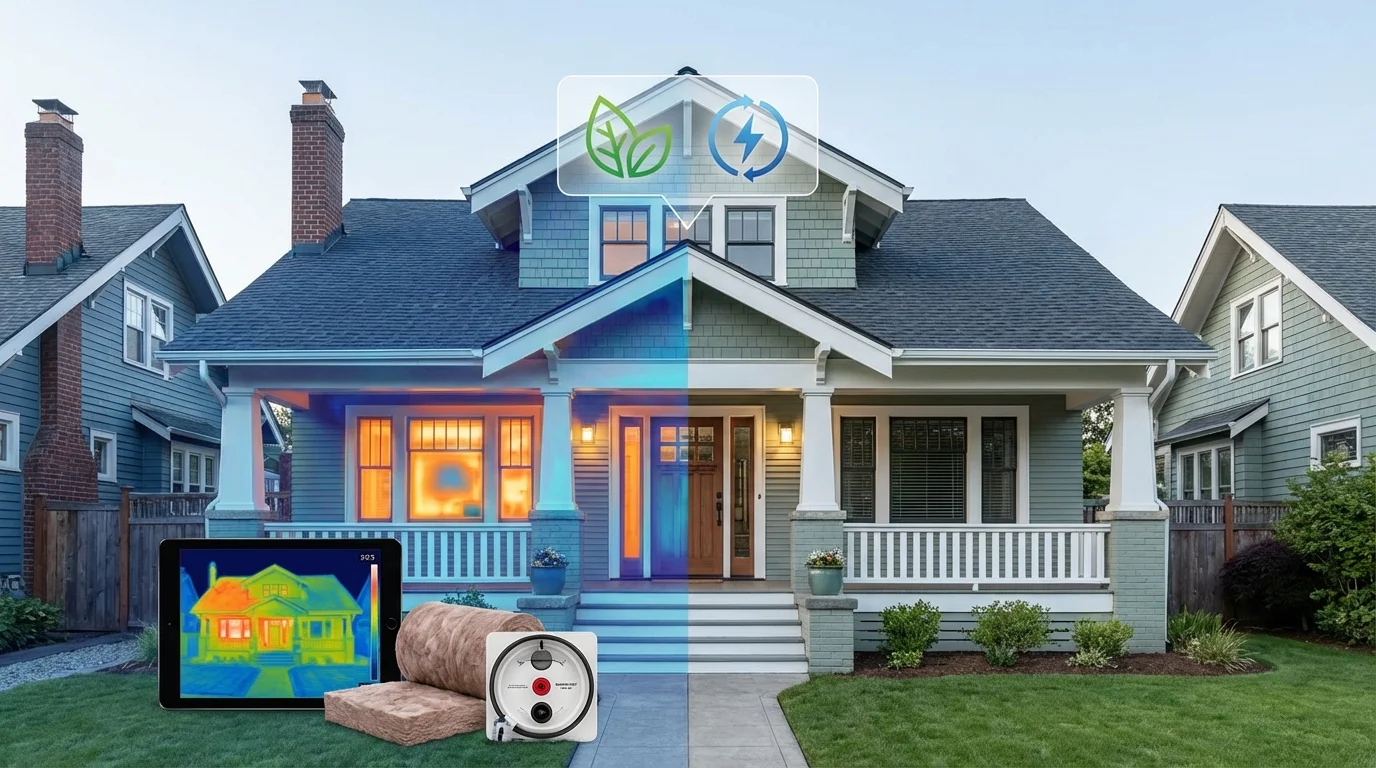
An energy audit is the foundational step for modernizing a vintage home's performance. And homes from this era often lack any wall insulation, use single-pane windows, and have unsealed attics and crawl spaces. A certified auditor uses tools like a blower door test to depressurize the house, revealing every crack and gap where air escapes. But they also use infrared cameras to visualize heat loss through walls and ceilings, pinpointing exactly where insulation is needed. So this data-driven approach moves beyond guesswork. The final report quantifies the air leakage rate—often 2-3 times higher than in new homes—and models the potential energy savings from specific upgrades, which is a requirement for securing thousands in 2026 rebates. You can learn more about the process in our complete guide to home energy audits.
The core issue is that pre-1970 homes were built when energy was cheap and insulation standards were minimal or non-existent. So homeowners are paying for energy that provides zero benefit, literally heating or cooling the outdoors. The U.S. Department of Energy estimates that air leaks alone can account for the same energy loss as leaving a window wide open all year long. This translates to an average of $200-$400 in wasted energy costs annually for many older homes, a problem a professional audit is designed to solve.
What State & Utility Rebates are Available for Energy Audits and Upgrades on Pre-1970 Homes?
State and utility energy audit rebates for pre-1970 homes in 2026 often cover 50-100% of the audit cost, with amounts ranging from $150 to $500. And subsequent upgrade rebates for insulation or air sealing can provide an additional $1,000 to $5,000, depending on the program.
In 2026, dozens of state and local utility programs offer incentives specifically for owners of older, less efficient properties. And these programs recognize the outsized impact that weatherizing a pre-1970 home has on grid stability and emissions. For example, a state energy office may offer a $300 rebate for the initial audit, while the local utility provides a separate rebate of $0.50 per square foot for attic insulation. But eligibility and amounts vary by location. The Database of State Incentives for Renewables & Efficiency (DSIRE) is a critical resource for identifying these localized programs. So homeowners must check with their specific utility provider and state energy office for current 2026 funding levels and application details, as these programs often have limited annual budgets.
| Program Type | Typical Rebate Amount (2026) | Eligibility Focus | Common Deadline Structure |
|---|---|---|---|
| State Energy Office | $250 - $500 for audit; up to $4,000 for upgrades | Income-qualified or all residents | Fiscal Year (e.g., June 30) |
| Utility Provider | $150 - $300 for audit; performance-based for upgrades | Must be a customer of the utility | Calendar Year (e.g., Dec 31) |
| Federal IRA Credits | Ended Dec 31, 2025 | — | Annual, through December 31, 2025 |
Do I Qualify? Understanding Income Limits and Eligible Equipment for Old Home Energy Programs.
Qualification for 2026 energy programs for pre-1970 homes often depends on household income, with enhanced rebates available for those earning below 80% of the Area Median Income (AMI). Eligible equipment typically includes insulation, air sealing, high-efficiency windows, and modern heat pumps, which directly address common older home deficiencies.
Many state and utility rebates are tiered to provide greater assistance to low- and moderate-income (LMI) households. And these programs define income limits based on the Area Median Income, a statistic published annually by HUD. For example, a family of four earning less than $75,000 in a specific county may qualify for a free energy audit and up to $8,000 in weatherization grants. But market-rate programs are also widely available for all income levels, though with smaller rebate amounts. Eligible equipment focuses on the building envelope—the shell of the house. This includes attic, wall, and crawl space insulation, air sealing materials like caulk and spray foam, and replacement windows. These foundational fixes must often be completed before qualifying for rebates on new HVAC systems. Find details on federal energy tax credits to see how they pair with local programs.
How Do I Apply for Energy Audit & Upgrade Rebates: Process, Deadlines, and Funding Status?
The 2026 application process for energy audit rebates typically requires pre-approval before the audit, followed by submitting the auditor's report and paid invoices. Deadlines are strict, often tied to the calendar or fiscal year, and funding is first-come, first-served, so applying early is critical.
Navigating the rebate application process requires careful attention to detail. The first step is to confirm your eligibility and the program's 2026 funding status on the utility or state website. And then, you must select a program-approved, certified auditor. After the audit, you'll receive a detailed report; this document is essential for the application. For upgrade rebates, you'll likely need to submit contractor invoices and proof that the installed equipment meets program efficiency standards. But be aware that many programs have rolling deadlines or close once annual funds are exhausted, which can happen by late fall. So initiating the process in the spring or summer is a strategic advantage. Use our free rebate calculator to estimate your potential savings and find local programs.
Can I Combine Rebates? Understanding Stacking Rules for Maximum Savings.
Yes, stacking multiple rebates from federal, state, and utility sources for a 2026 energy upgrade is frequently allowed and encouraged. This layering of incentives can cover 50-100% of project costs, especially for income-qualified households, by combining grants, rebates, and tax credits for the same project.
Maximizing savings on a pre-1970 home renovation involves a strategy called "rebate stacking." For instance, a homeowner can receive a $400 rebate from their utility for attic insulation. The federal Energy Efficient Home Improvement Credit (Section 25C) ended for property placed in service after December 31, 2025 (IRS FS-2025-05). Federal tax credits for this work have ended, but state, local and utility rebates may still apply; check what is available at your address with the DuloCore rebate calculator. If that homeowner is income-qualified, they may also be eligible for a state weatherization grant that covers the rest of the expense. But program rules are specific about which incentives can be combined.
So it is essential to read the terms for each program. Some utility rebates, for example, are calculated based on the out-of-pocket cost after other discounts are applied.
What Are the Contractor Requirements for Energy Audits and Upgrades in Vintage Homes?
Most 2026 rebate programs mandate that energy audits be performed by a Building Performance Institute (BPI) or RESNET-certified professional. And any subsequent upgrades must be installed by licensed and insured contractors to ensure the work is safe, effective, and qualifies for the financial incentive.
Rebate programs don't just pay for upgrades; they ensure the work is done correctly. And this is especially important in pre-1970 homes, which can have hidden issues like knob-and-tube wiring or asbestos-containing materials. BPI-certified auditors are trained to understand whole-house dynamics, ensuring that an upgrade in one area (like air sealing) doesn't create a problem in another (like back-drafting a furnace).
"DSIRE is the most comprehensive source of information on incentives and policies that support renewables and energy efficiency in the United States." — DSIRE
So programs maintain a list of approved or "participating" contractors who meet their standards for training, licensing, and insurance. Using a contractor from this list is often a non-negotiable requirement for rebate eligibility. It protects the homeowner and ensures the public funds achieve the intended energy savings. This also applies to complex installations like new HVAC systems, where a homeowner may be looking for heat pump rebates.
Official Sources
- ENERGY STAR — A U.S. Environmental Protection Agency (EPA) program providing credible, objective information on energy-efficient products and practices.
- Database of State Incentives for Renewables & Efficiency (DSIRE) — The most comprehensive national database of state and utility energy efficiency rebate programs.
- IRS.gov Energy Credits Page — Official guidance from the Internal Revenue Service on federal tax credits for home energy improvements. (note: the federal 25C and 25D credits ended for projects completed after December 31, 2025)
Frequently Asked Questions
Are pre-1970 homes eligible for energy audit rebates?
Yes, pre-1970 homes are primary targets for most 2026 energy audit rebate programs. And utilities and state governments offer these incentives specifically because older homes present the most significant opportunity for energy savings. Eligibility typically depends on your location and utility provider, with rebates often covering $150 to $500 of the audit cost.
What does an energy audit specifically involve for a house built before 1970?
An audit for a pre-1970 home focuses on the building envelope. And it includes a blower door test to measure air leakage and infrared thermography to identify insulation gaps in walls and ceilings—areas often completely uninsulated in older construction. The auditor also inspects vintage HVAC systems, ductwork, and single-pane windows, which are common sources of 30-50% energy loss.
How much can I expect to save on an energy audit for an older home?
Rebates in 2026 can reduce the upfront cost of an energy audit by 50-100%. The audit itself, which costs between $300 and $600, identifies upgrades that can lower annual energy bills by 20-30%, or $400-$600 per year for a typical older home. The return on investment is often realized within 1-2 years.
Last updated April 14, 2026 — reviewed by DuloCore Editorial. About our authors.