Update (2026): The federal Energy Efficient Home Improvement Credit (Section 25C) expired December 31, 2025, following the passage of the OBBBA. Check state and local programs for current incentives.
Drafty, outdated windows are silent money pits, responsible for up to 30% of a home's heating and cooling energy loss. With residential electricity rates climbing another 4% in 2026, that escaping air translates directly into hundreds of dollars vanishing from your bank account each year. An energy-efficient windows audit is the first step in plugging these financial leaks and reclaiming control over your utility bills.
What is an Energy-Efficient Windows Audit and How Does it Identify Potential Savings?
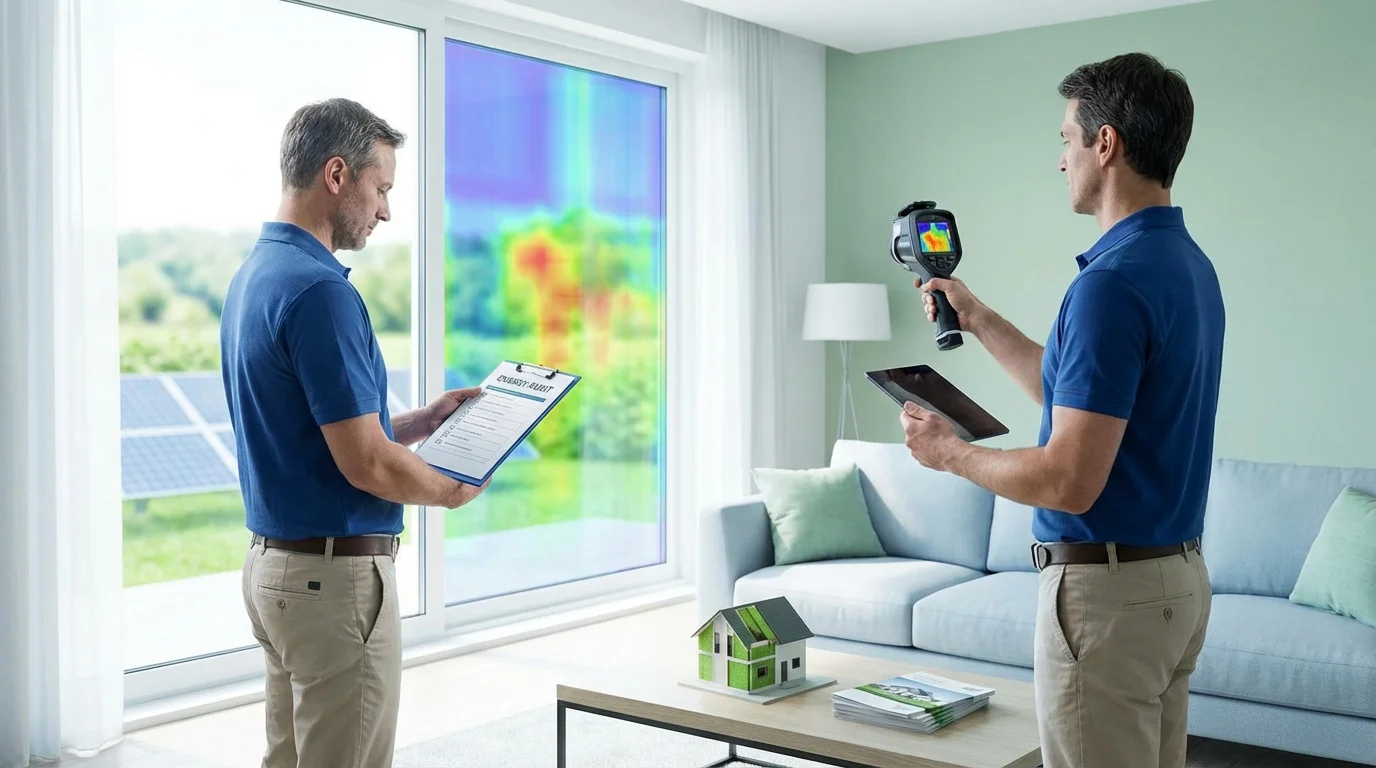
An energy-efficient windows audit is a professional assessment identifying thermal performance gaps in a home's windows. So, it uses tools like infrared cameras to pinpoint air leaks and heat loss, quantifying potential annual energy savings of 10-25% for homeowners in 2026 by upgrading window components and seals.
The core tension for homeowners is understanding if a $10,000+ window replacement project is a sound financial decision or an unnecessary expense. So, an audit provides the data to answer that question. Without it, you’re guessing. A professional audit moves beyond simple visual checks, employing diagnostic tools like blower door tests and infrared thermography. And these tools create a quantifiable map of your home's energy loss, pinpointing failed seals between glass panes, air infiltration around frames, and the poor R-value of single-pane glass. This data directly identifies where your energy dollars are escaping, allowing for targeted upgrades that offer the fastest return. A comprehensive home energy audit will cover windows as a key component of the building envelope.
What Are the Typical Costs of a Window Audit and Investing in New Energy-Efficient Windows?
A professional window audit costs between $200 and $650 in 2026, depending on home size and the depth of the analysis. And the investment in new ENERGY STAR certified windows ranges from $450 to $2,000 per window, including installation, with total project costs often exceeding $8,000.
The initial audit fee is a small fraction of the total potential investment. But it’s a critical one that prevents overspending on unnecessary replacements. So, the cost of new windows themselves varies based on several factors. Vinyl frames are the most affordable, typically costing 15-20% less than wood or fiberglass. And upgrading from double-pane to triple-pane glass adds another $150-$400 per window but delivers superior insulation in cold climates. Installation labor accounts for approximately $100-$300 per window. These costs are offset by federal and local incentives, which can cover up to 30% of the project total.
Which Window Efficiency Ratings and Brands Qualify for Rebates and Incentives?
Windows qualifying for 2026 federal energy tax credits and utility rebates require ENERGY STAR certification with specific U-factor and Solar Heat Gain Coefficient (SHGC) ratings for the climate zone. So, brands like Andersen, Pella, and Marvin consistently produce models that meet these strict performance criteria.
To access rebates, the window's performance label is more important than its brand name. The key metrics are the U-factor, which measures heat loss (lower is better), and the SHGC, which measures solar heat gain (lower is better in hot climates). For example, to qualify for the maximum IRA tax credit in a northern climate, a window often needs a U-factor of 0.27 or less.
"ENERGY STAR certified windows can lower electric bills by an average of 12 percent nationwide." — ENERGY STAR
Leading manufacturers like Jeld-Wen and Milgard also offer extensive lines of qualifying windows. So, homeowners must check the specific U-factor and SHGC requirements for their local utility rebates and the federal tax credit before purchasing.
What is the ROI and Payback Period for Energy-Efficient Windows, and How Long Do They Last?
Energy-efficient windows offer a return on investment of 70-75% through increased home value and direct energy savings. So, the payback period ranges from 10 to 20 years, while high-quality windows have a functional lifespan of 20 to 30 years before their performance degrades.
The return on investment for new windows is twofold. First, the U.S. Department of Energy estimates that replacing old single-pane windows with ENERGY STAR models saves homeowners between $126 and $465 per year. But the second part of the ROI comes from property value. The National Association of Realtors' Remodeling Impact Report consistently shows that vinyl window replacement projects recoup over 70% of their cost at resale. Modern windows with vinyl or fiberglass frames are built to last, with insulated glass units guaranteed for 20 years or more. Use our free rebate calculator to find your potential savings and shorten that payback period.
How Do I Choose Energy-Efficient Windows Suitable for My Climate Zone and What Are Their Maintenance Needs?
Homeowners select windows based on ENERGY STAR climate zone maps, prioritizing low U-factors (≤0.27) in cold climates and low SHGC (≤0.25) in hot climates. And maintenance involves annual inspection of seals, cleaning tracks, and washing glass, with vinyl frames requiring the least upkeep.
Choosing the right window is a climate-specific decision. In cold regions like the Northeast and Midwest, the priority is preventing heat from escaping, making a low U-factor essential. So, in hot, sunny regions like the Southwest, the goal is to block solar heat from entering, which demands a low SHGC. Maintenance needs vary by frame material. Vinyl frames are the lowest maintenance, requiring only occasional cleaning. And wood frames offer a classic aesthetic but demand periodic painting or sealing every 3-5 years to prevent rot and degradation. Fiberglass frames offer a durable, low-maintenance middle ground.
How Do Energy-Efficient Windows Compare to Other Home Energy Upgrade Alternatives?
New windows provide a 10-25% energy savings, while attic insulation offers up to 20% savings for a lower initial cost of $1,500-$3,500. So, high-efficiency heat pump rebates lead to systems that can reduce heating costs by 50%, representing a more impactful but costlier upgrade than windows alone.
When prioritizing home energy projects, homeowners weigh cost against impact. Attic insulation often provides the fastest payback, typically in 2-4 years, for a relatively low upfront cost. And windows are a mid-tier investment, offering both aesthetic and efficiency benefits with a payback period of 10-20 years. A full HVAC replacement with a high-efficiency heat pump represents a top-tier investment of $15,000-$25,000. But it also delivers the most dramatic savings, especially when replacing oil or propane systems. A balanced approach often involves sealing air leaks and adding insulation first, then addressing windows and HVAC systems.
| Program/Credit | Maximum Amount (2026) | Key Eligibility Requirement | 2026 Application Deadline |
|---|---|---|---|
| Federal IRA Tax Credit | Ended Dec 31, 2025 | — | December 31, 2025 |
| State Clean Energy Grant | $500 - $1,500 per project | Must be primary residence; income limits apply | Varies by state (e.g., Sept 30) |
| Utility Rebate Program | $25 - $75 per window | Must be customer of participating utility | Often first-come, first-served |
Official Sources
- ENERGY STAR — Official government-backed symbol for energy efficiency providing credible, unbiased information.
- DSIRE — The most comprehensive source of information on incentives and policies that support renewables and energy efficiency in the United States.
Related Reading: Learn more about Humidity Control Energy Audit and Ice Dam Prevention Energy Audit.
Frequently Asked Questions
Is there a cost for an energy efficient window audit?
Yes, a standalone professional window audit typically costs between $200 and $650 in 2026. And the price depends on the size of the home and the equipment used, such as infrared cameras. Some utility companies, however, offer subsidized or free energy audits as part of broader home energy assessment programs.
Who qualifies for a subsidized or free energy efficient window audit?
Eligibility for subsidized or free audits is generally tied to specific programs. Low-income households often qualify through the federal Weatherization Assistance Program (WAP). And customers of certain utility providers may be eligible for discounted audits as part of demand-side management programs designed to reduce overall energy consumption in their service area.
What does an energy efficient window audit involve?
An audit involves a multi-step inspection. First, a visual check for obvious damage like cracked glass or decaying frames. Next, a professional uses an infrared camera to detect temperature differences that indicate heat loss or air leaks. So, a blower door test is often performed to depressurize the home, making it easier to pinpoint exact locations of air infiltration around window seals and frames.
How does an energy efficient window audit help with rebate eligibility?
An audit provides the documentation needed for many rebate programs. The report quantifies existing window performance (or lack thereof) and recommends specific upgrades that meet ENERGY STAR or local utility standards. This documentation serves as proof of need and ensures that the replacement windows selected have the required U-factor and SHGC ratings to qualify for incentives worth up to $600 or more.
Are there deadlines to schedule an energy efficient window audit?
There are no federal deadlines for the audit itself, but rebate programs have firm deadlines. For instance, many 2026 state and utility rebate programs have application deadlines in the 3rd or 4th quarter. So, completing an audit early in the year allows ample time to select qualifying products and complete installation before program funds are exhausted or deadlines pass.
Ready to Stop Wasting Money on Drafty Windows?
An energy-efficient windows audit is your first step toward lower utility bills and a more comfortable home. Find out exactly how much you can save on new windows with federal, state, and utility incentives.
Calculate Your Window Rebates Now
Updated on April 14, 2026. Fact-checked by DuloCore Editors. About our research team.
Check your California insulation rebate eligibility — see the programs you qualify for and the dollar amounts on our California insulation rebate finder.