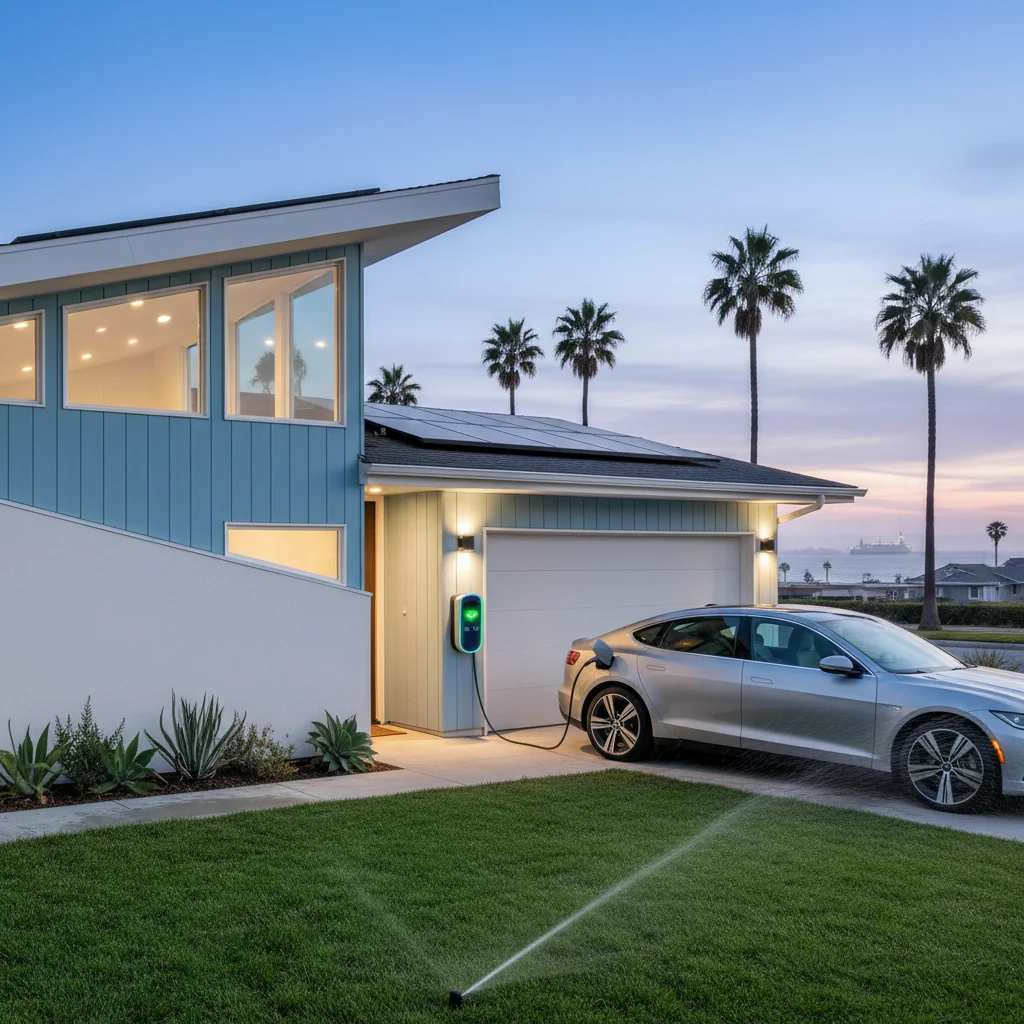
Long Beach drivers installing Level 2 EV chargers in 2026 can stack up to $2,400 in federal, state, and local rebates—but most homeowners miss the Southern California Edison (SCE) Charge Ready program that covers 100% of installation costs for income-qualified residents. With California's Advanced Clean Cars II mandate requiring all new vehicle sales to be zero-emission by 2035, the window to claim installation incentives before program caps get hit is narrowing fast.
What EV Charger Rebates Are Available in Long Beach Right Now?
Long Beach homeowners installing residential EV chargers in 2026 access three stacking incentive layers through the federal Inflation Reduction Act Alternative Fuel Vehicle Refueling Property Credit, California's Clean Vehicle Rebate Project infrastructure component, and Southern California Edison's Charge Ready Home program. The federal 30C charger credit ended for chargers placed in service after June 30, 2026 (IRS FS-2025-05). Federal tax credits for this work have ended, but state, local and utility rebates may still apply; check what is available at your address with the DuloCore rebate calculator. And SCE's Charge Ready program provides up to $1,400 in rebates for Level 2 charger equipment plus full installation cost coverage for income-qualified customers. California's CVRP infrastructure allocation adds another $500 for installations paired with solar systems or battery storage.
The California Air Resources Board reports that Long Beach has 2,847 registered electric vehicles as of January 2026—a 214% increase since 2023. So demand for home charging infrastructure is outpacing utility program budgets, with SCE allocating just $12.5 million for 2026 residential installations across its service territory.
How Much Money Can You Save With EV Charger Rebates in Long Beach?
Total available rebates for Long Beach EV charger installations range from $1,000 to $3,900 depending on income qualification and installation complexity. A standard Level 2 charger installation costs $1,200-$2,500 including equipment and electrical work. The federal 30C charger credit ended for chargers placed in service after June 30, 2026 (IRS FS-2025-05). And Southern California Edison's Charge Ready program covers the remaining installation labor costs for customers in disadvantaged communities as mapped by CalEnviroScreen 4.0 scoring tools.
But income-qualified households—those earning below 80% of area median income ($83,200 for a family of four in Long Beach)—receive the full $1,400 SCE equipment rebate plus 100% installation cost coverage worth an additional $800-$1,500. So a typical income-qualified homeowner pays zero out-of-pocket for a complete Level 2 charging system. Non-income-qualified customers still save $1,360-$2,150 through the stacked federal and utility incentives.
For accurate personalized savings based on your installation quote, use the rebate calculator to model federal, state, and utility incentives.
What Are the Eligibility Requirements for Long Beach EV Charger Rebates in 2026?
The federal 30C charger credit ended for chargers placed in service after June 30, 2026 (IRS FS-2025-05). The property must be owned by the taxpayer claiming the credit—rental properties qualify only if the landlord installs the charger. And the charger must meet UL 2594 safety certification standards for residential electric vehicle supply equipment.
Southern California Edison's Charge Ready Home program requires active SCE electric service at the installation address plus purchase of a Level 2 charger from SCE's pre-approved equipment list including ChargePoint Home Flex, JuiceBox 40, and Wallbox Pulsar Plus models. Income-qualified tier benefits require household income documentation showing earnings below 80% of Los Angeles County area median income thresholds. But all SCE residential customers qualify for base rebates regardless of income status.
California CVRP infrastructure rebates require simultaneous installation of solar panels rated at 5 kilowatts or higher, or battery storage systems with minimum 10 kilowatt-hour capacity. Installations must use California-licensed C-10 electrical contractors and pass local building department inspections.
What's the Deadline for Applying for EV Charger Rebates in Long Beach?
The federal 30C charger credit ended for chargers placed in service after June 30, 2026 (IRS FS-2025-05). Homeowners installing chargers in 2026 claim the credit on their 2026 tax return filed by April 15, 2027. And amended returns can claim the credit for installations made up to three years prior.
Southern California Edison's Charge Ready Home program operates on a first-come, first-served funding allocation model with the current 2026 budget cycle ending June 30, 2026. Applications submitted after the funding cap is reached get waitlisted for the next fiscal year allocation. So SCE recommends submitting rebate applications within 30 days of installation completion to secure current-year funding.
California CVRP infrastructure rebates follow the state fiscal year running July 1, 2025 through June 30, 2026, with a hard application deadline of August 31, 2026 for installations completed during that period. Applications must be submitted within 18 months of the installation completion date documented on building department inspection records.
The California Energy Commission reports that SCE's Charge Ready budget reached 73% utilization by March 2026, suggesting the program will hit capacity limits by early May. But funding is expected to renew for the 2027 fiscal year starting July 1, 2026.
Can You Stack Multiple Rebates for Your EV Charger Installation?
The IRS explicitly allows combining the 30% federal credit (this federal credit ended for chargers placed in service after June 30, 2026) with state and local incentives for the same installation. And the federal credit calculates on gross installation costs before applying state rebates, maximizing total savings.
Southern California Edison's Charge Ready rebates stack with both federal IRA credits and California CVRP infrastructure incentives. But homeowners cannot combine SCE's income-qualified tier benefits with standard tier rebates—only one SCE program tier applies per installation. Customers must choose either the $1,400 equipment rebate plus partial installation coverage, or the full income-qualified package covering 100% of installation costs.
California CVRP infrastructure rebates stack with federal and utility programs but cannot combine with other state-level installation incentives like the Solar on Multifamily Affordable Housing program. And CVRP requires the solar or storage system installed alongside the charger to be newly purchased—existing solar installations don't qualify for the stacked benefit. So optimal stacking combines federal IRA credit, SCE Charge Ready, and CVRP only when installing new solar plus EV charging simultaneously.
The Database of State Incentives for Renewables & Efficiency confirms that California allows unlimited stacking of federal, state, and utility incentives with no aggregate cap. But homeowners should verify current program rules as stacking policies change annually.
What's the Process for Claiming Your EV Charger Rebate in Long Beach?
The federal 30C charger credit ended for chargers placed in service after June 30, 2026 (IRS FS-2025-05). And Line 2 calculates the 30% credit amount capped at $1,000. Homeowners must retain itemized installation invoices, electrical contractor licenses, and building permit documentation for IRS verification requests.
Southern California Edison's Charge Ready application starts with an online eligibility check at sce.com/chargeready confirming active SCE service and equipment compatibility. After installation completion, homeowners submit the rebate claim form within 30 days including installation invoice, contractor license verification, building department final inspection certificate, and photos of the installed charger. So SCE processes standard rebates within 6-8 weeks of complete application submission, with income-qualified applications requiring additional 2-3 weeks for income documentation review.
For California CVRP infrastructure rebates, applications submit through the Clean Vehicle Rebate Project portal with required attachments including solar or battery storage installation invoices, interconnection approval from SCE, EV charger installation invoice, and proof of residence. And CVRP requires all installations to use equipment listed on the California Solar Initiative eligible products list.
"Rebate applications must be submitted within 18 months of purchase or installation date and include all required documentation to avoid processing delays." — DSIRE Database of State Incentives
Most homeowners complete the full federal, utility, and state rebate claim process within 90 days of installation, recovering $1,360-$3,900 in total incentive value. Check current energy tax credits for other stackable home efficiency incentives.
Official Sources
- Department of Energy Electric Vehicles Tax Credits — Federal EV charging infrastructure incentives and eligibility requirements
- DSIRE USA Database — Comprehensive state and utility rebate program tracking and application resources
- California Air Resources Board Clean Vehicle Rebate Project — State-level EV infrastructure funding and application guidelines
Related Reading: Learn more about Ev Charger Utility Rebate and Federal Ev Charger Rebate.
Frequently Asked Questions
What are the eligibility requirements for EV charger rebates in Long Beach?
Long Beach homeowners must own their primary residence and install UL 2594-certified Level 2 charging equipment to qualify for federal IRA credits. Southern California Edison's Charge Ready program requires active SCE electric service and purchase of pre-approved charger models. Income-qualified benefits require household earnings below 80% of Los Angeles County area median income ($83,200 for a family of four in 2026). And California CVRP infrastructure rebates require simultaneous installation of minimum 5-kilowatt solar systems or 10-kilowatt-hour battery storage.
How much can I save with an EV charger rebate in Long Beach?
Total stackable rebates range from $1,000 to $3,900 depending on income qualification. The federal 30C charger credit ended for chargers placed in service after June 30, 2026 (IRS FS-2025-05). Southern California Edison's Charge Ready program adds $1,400 in equipment rebates plus up to $1,500 in installation cost coverage for income-qualified customers. And California CVRP infrastructure rebates contribute $500 when installing EV charging with new solar or battery storage systems. Standard installations costing $1,800 reduce to $440-$0 out-of-pocket after all rebates apply.
What is the process for applying for an EV charger rebate in Long Beach?
The federal 30C charger credit ended for chargers placed in service after June 30, 2026 (IRS FS-2025-05). Southern California Edison rebates apply online at sce.com/chargeready within 30 days of installation completion, requiring installation invoices, contractor licenses, and building inspection certificates. And California CVRP applications submit through the Clean Vehicle Rebate Project portal within 18 months of installation with solar/storage system documentation and interconnection approvals. Processing timelines run 6-12 weeks for complete applications with all required documentation.
When is the deadline to apply for EV charger rebates in Long Beach in 2026?
The federal IRA credit has no application deadline but must be claimed when filing taxes for the installation year—installations completed in 2026 claim on returns filed by April 15, 2027. Southern California Edison's Charge Ready program operates on first-come, first-served funding that typically exhausts by early May 2026 for the current fiscal year ending June 30, 2026. And California CVRP infrastructure rebates require applications by August 31, 2026 for installations completed between July 1, 2025 and June 30, 2026. Early application submission in January-March maximizes funding availability.
How do Long Beach EV charger rebates compare to California state incentives?
Long Beach residents access identical state-level rebates as all other California customers including the $500 CVRP infrastructure incentive. But Southern California Edison's Charge Ready program provides superior utility rebates compared to other California utilities—Pacific Gas & Electric's equivalent program offers only $1,000 maximum versus SCE's $1,400 equipment rebate plus full installation cost coverage for income-qualified customers. And Long Beach's designation as a disadvantaged community under CalEnviroScreen 4.0 scoring expands income-qualified benefit access compared to higher-income California cities. Compare with other home efficiency programs like heat pump rebates to maximize total household savings.
Ready to calculate your total EV charger rebate savings? Use our free rebate calculator to model your specific federal IRA credit, SCE Charge Ready rebate, and California CVRP incentive amounts based on your installation quote and income qualification. Get personalized results in 60 seconds showing your exact out-of-pocket cost after all available Long Beach EV charger rebates apply.
Updated on April 14, 2026. Fact-checked by DuloCore Editors. About our research team.
Check your California EV charger rebate eligibility — see the programs you qualify for and the dollar amounts on our California EV charger rebate finder.