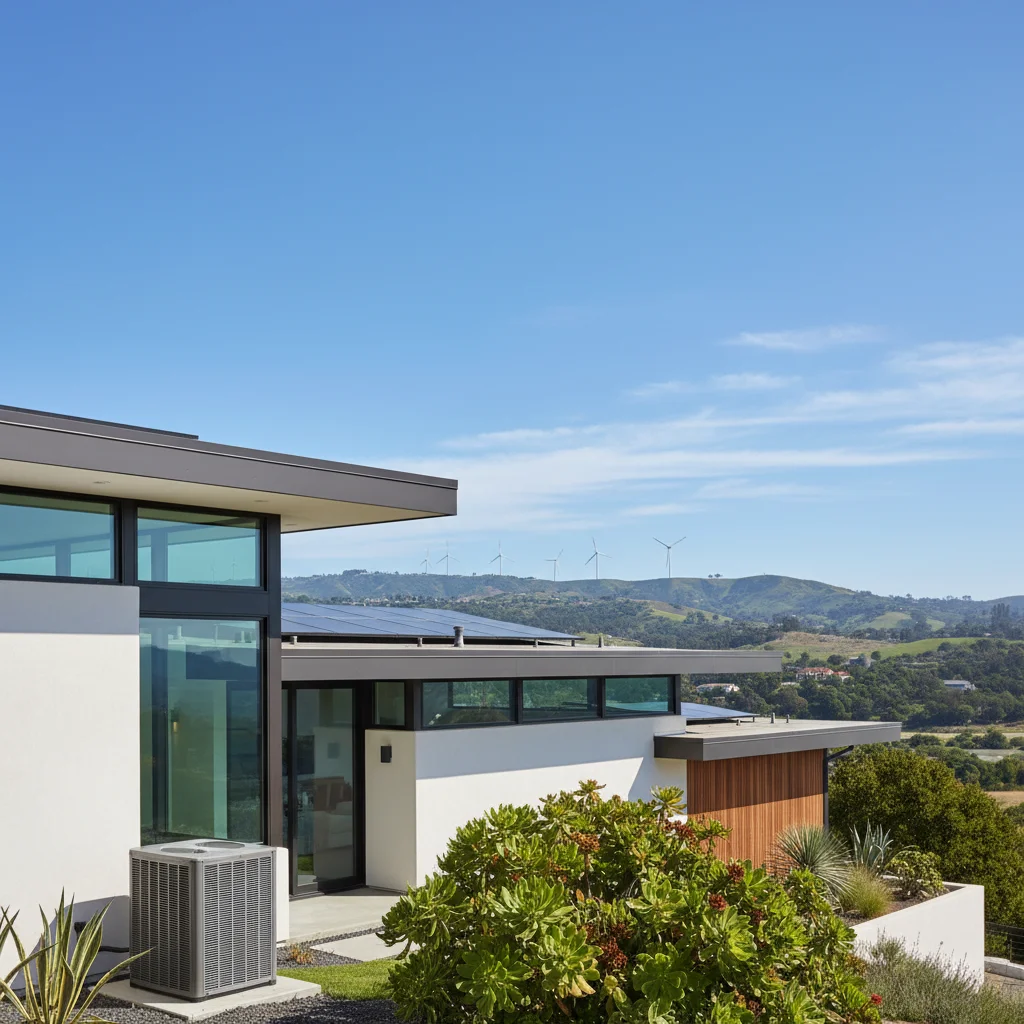
San Diego homeowners replaced 4,200 gas furnaces with electric heat pumps in 2025, a 67% increase from 2024, driven by California's Building Decarbonization Initiative and revised Title 24 energy codes that took effect January 1, 2026. The shift accelerated after San Diego Gas & Electric doubled heat pump rebates to $3,000 per installation and the California Air Resources Board announced phased restrictions on natural gas appliances in coastal counties. And property values in neighborhoods with heat pump adoption rose 3.2% faster than comparable gas-heated areas.
What Does a Heat Pump System Cost in San Diego and What's the ROI Payback Period?
Heat pump installation in San Diego costs $8,500 to $18,000 for whole-home systems depending on capacity, efficiency rating, and existing ductwork condition. Central ducted heat pumps average $12,500, while ductless mini-split systems range $6,000 to $14,000 for multi-zone configurations. ROI payback period spans 6 to 11 years based on energy savings of $85 to $140 monthly, federal tax credits covering 30% of equipment costs through 2032, and SDG&E rebates up to $3,000 per qualifying system installed in 2026.
But installation complexity varies significantly. Homes with existing central HVAC ductwork require minimal structural modifications, reducing labor costs to $2,800 to $4,200. Properties without ducts face additional expenses of $4,500 to $9,000 for new distribution infrastructure. And electrical panel upgrades to 200-amp service add $1,800 to $3,500 when current systems can't support heat pump loads of 30 to 60 amps.
"The average heat pump system in California saves homeowners 30% to 50% on heating costs and 15% to 25% on cooling costs compared to traditional furnace and air conditioner combinations." — U.S. Department of Energy
Energy efficiency ratings directly impact operating costs. SEER2 ratings above 18 and HSPF2 ratings above 9 reduce monthly utility bills by $15 to $25 compared to minimum-efficiency 14 SEER2 models. So upgrading from a 15-year-old gas furnace with 80% AFUE to a heat pump with 10 HSPF2 saves $1,280 annually at San Diego's average electricity rate of $0.38 per kWh. Use our free rebate calculator to estimate your system-specific savings and payback timeline.
How Do Heat Pumps Compare to Traditional HVAC Alternatives in San Diego?
Heat pumps deliver both heating and cooling from one system, eliminating the need for separate furnace and air conditioner installations that cost $14,000 to $22,000 combined. Traditional split systems require two maintenance contracts, two sets of replacement parts, and dual utility connections. And heat pumps operate on electricity alone, avoiding natural gas infrastructure fees of $18 to $32 monthly that SDG&E charges regardless of usage volume.
Operational efficiency favors heat pumps in San Diego's mild climate. Gas furnaces convert 80% to 96% of fuel into heat, but electric heat pumps achieve 300% to 400% efficiency by transferring existing thermal energy rather than generating it through combustion. So a 3-ton heat pump consumes 3,500 watts while delivering 36,000 BTU of heating capacity, equivalent to 10,500 watts from electric resistance heating. The coefficient of performance (COP) of 3.5 means the system produces 3.5 units of heat for every unit of electricity consumed.
| System Type | Upfront Cost | Annual Operating Cost | Lifespan | Dual Function |
|---|---|---|---|---|
| Heat Pump | $8,500-$18,000 | $820-$1,140 | 15-20 years | Yes |
| Gas Furnace + AC | $14,000-$22,000 | $1,280-$1,680 | 15-18 years | Requires both |
| Electric Resistance | $3,500-$7,000 | $2,100-$2,800 | 20-25 years | Heating only |
But heat pumps face performance limits below 25°F ambient temperature, a threshold San Diego rarely reaches. The region's average winter low of 48°F maintains heat pump efficiency above 85% of rated capacity. And coastal microclimates in La Jolla, Point Loma, and Coronado never drop below 40°F, making heat pumps optimal for year-round climate control without supplemental heating systems.
What Are the Current Rebates and Tax Credits Available for Heat Pump Installation?
The federal Energy Efficient Home Improvement Credit (Section 25C) ended for property placed in service after December 31, 2025 (IRS FS-2025-05). Federal tax credits for this work have ended, but state, local and utility rebates may still apply; check what is available at your address with the DuloCore rebate calculator. The credit requires ENERGY STAR certification, SEER2 rating of 16 or higher, and HSPF2 rating of 9 or higher for air-source models. Form 5695 only covers qualifying work completed by December 31, 2025 and claimed on a 2025 return; the federal 25C and 25D credits ended after that date (IRS FS-2025-05).
The federal Energy Efficient Home Improvement Credit (Section 25C) ended for property placed in service after December 31, 2025 (IRS FS-2025-05).
California state incentives layer on top of federal credits. The Tech Clean California program offers $3,000 rebates for ducted heat pump installations and $2,000 for ductless mini-splits when replacing gas heating systems. SDG&E adds utility rebates of $1,500 to $3,000 for ENERGY STAR Most Efficient models installed in 2026. And income-qualified households earning below 80% of San Diego County median income ($89,600 for four-person households) receive enhanced rebates up to $8,000 through the TECH Clean California Plus initiative.
Local air quality incentives provide additional funding. The San Diego Air Pollution Control District grants $1,000 to $2,500 for heat pump installations that eliminate natural gas combustion in disadvantaged communities identified by CalEnviroScreen 4.0. So a qualifying household in Barrio Logan or National City stacks federal tax credits, state rebates, utility incentives, and air district grants to reduce net system cost from $14,000 to $4,500. Check the heat pump rebates page for current program availability and application deadlines.
What's the Process for Hiring a Qualified Heat Pump Contractor in San Diego?
Licensed contractors in California must hold C-20 Warm-Air Heating, Ventilating, and Air-Conditioning classification issued by the Contractors State License Board. The license requires 4 years of journeyman-level experience, passing a 2-part examination covering trade knowledge and business law, and maintaining $15,000 contractor bond coverage. And contractors performing electrical work on heat pump installations need C-10 Electrical classification or must subcontract to licensed electricians.
Verify contractor credentials through the CSLB online license search at cslb.ca.gov. Active licenses display current bond and workers' compensation insurance status, disciplinary action history, and complaint records from the past 5 years. So homeowners avoid unlicensed operators who can't pull building permits, may void manufacturer warranties, and disqualify installations from rebate programs requiring licensed contractor documentation.
Obtain 3 to 5 written estimates before selecting a contractor. Detailed proposals specify equipment brand and model numbers, SEER2 and HSPF2 efficiency ratings, warranty coverage periods, projected energy savings, and rebate eligibility confirmation. And proposals itemize costs for equipment, labor, permits, electrical upgrades, ductwork modifications, and refrigerant line installation rather than single lump-sum quotes.
Contractors participating in rebate programs must complete training through TECH Clean California or SDG&E Energy Marketplace. Approved contractors submit rebate applications directly to program administrators, reducing homeowner paperwork and ensuring compliance with equipment specifications. But verify contractor enrollment status before signing contracts, as non-participating contractors require homeowners to file rebate claims independently with extended processing timelines.
How Much Can You Save Monthly on Energy Bills With a Heat Pump System?
San Diego homeowners save $85 to $140 monthly switching from gas furnace and air conditioner combinations to heat pumps, based on SDG&E's residential electricity rate of $0.38 per kWh and natural gas rate of $2.87 per therm in 2026. Savings vary by home size, insulation quality, thermostat settings, and existing HVAC system efficiency ratings. And homes with solar panels paired with heat pumps eliminate 60% to 85% of heating and cooling costs by offsetting electricity consumption during peak production hours.
Winter heating costs drop $75 to $110 monthly. A 15-year-old gas furnace with 80% AFUE consumes 850 therms annually for a 2,000-square-foot home, costing $2,440. An equivalent heat pump with 10 HSPF2 uses 6,200 kWh at $2,356 annual cost, saving $84. But newer 95% AFUE furnaces narrow the gap to $35 to $55 monthly savings, extending payback periods for homes with recently installed gas systems.
Summer cooling expenses decrease $20 to $40 monthly. Heat pumps with 18 SEER2 ratings consume 15% to 25% less electricity than 13 SEER air conditioners during San Diego's May through October cooling season. And programmable thermostats with 7-day scheduling reduce runtime by 12% to 18%, adding $18 to $25 monthly savings. So total annual utility cost reductions range $1,020 to $1,680 depending on usage patterns.
Peak demand charges affect savings for homes on time-of-use rate plans. SDG&E's TOU-DR1 plan charges $0.68 per kWh during 4 PM to 9 PM weekday periods versus $0.32 off-peak. Heat pumps with smart controls shift heating and cooling loads to off-peak hours, reducing monthly bills by $30 to $50 compared to systems without automated scheduling. And battery storage paired with solar and heat pumps maximizes savings by discharging stored energy during peak periods.
Heat Pump vs. Air Conditioning vs. Furnace: Which Option Is Right for Your San Diego Home?
Climate conditions determine optimal HVAC configurations. San Diego's 266 annual cooling degree days and 1,180 heating degree days favor systems providing both heating and cooling capacity. Heat pumps deliver year-round climate control with single equipment installation, while separate furnace and air conditioner systems require dual units occupying more space and involving two sets of maintenance schedules.
Home age and existing infrastructure influence system selection. Properties built before 1990 often have undersized electrical panels rated at 100 amps, insufficient for heat pump loads plus modern appliances. Upgrading to 200-amp service adds $1,800 to $3,500 to installation costs. So homes with recent panel upgrades or new construction wiring accommodate heat pumps without electrical modifications.
Natural gas availability affects long-term operating costs. Homes in areas without gas service eliminate $18 to $32 monthly connection fees by installing heat pumps. And California's SB 1477 prohibits gas line extensions to new developments, making heat pumps the default heating solution for 68,000 housing units planned in San Diego County through 2029. But existing gas customers face minimal conversion costs when replacing end-of-life furnaces with heat pump alternatives.
Environmental goals prioritize decarbonization. SDG&E's 2045 carbon neutrality target includes residential building electrification as a core strategy. Heat pumps powered by California's 63% renewable electricity grid reduce greenhouse gas emissions by 2.4 to 3.8 tons CO2 equivalent annually compared to 95% AFUE gas furnaces. And homeowners offsetting consumption with rooftop solar achieve net-zero carbon heating and cooling. Learn more about available energy tax credits supporting electrification upgrades.
Official Sources
- U.S. Department of Energy - Heat Pump Systems — Federal guidance on heat pump efficiency, savings calculations, and technology comparisons
- ENERGY STAR Heat Pumps — Certification requirements, most efficient model directory, and rebate finder tool
- DSIRE USA - California Incentives — Comprehensive database of state, utility, and local rebate programs with current program details
Frequently Asked Questions
What qualifications does a heat pump contractor need to have in San Diego?
Heat pump contractors in San Diego must hold active C-20 Warm-Air Heating, Ventilating, and Air-Conditioning license from the California Contractors State License Board, requiring 4 years of experience and passing state examinations. Licenses display at cslb.ca.gov with bond and insurance verification. And contractors performing electrical work need C-10 classification or must subcontract to licensed electricians. Rebate program participation requires additional training through TECH Clean California or SDG&E Energy Marketplace, with approved contractor lists available through program websites.
How much does a heat pump installation cost in San Diego?
Heat pump installation costs $8,500 to $18,000 for whole-home systems in San Diego, with central ducted models averaging $12,500 and ductless mini-splits ranging $6,000 to $14,000 for multi-zone configurations. Homes without existing ductwork pay $4,500 to $9,000 additional for distribution infrastructure. Electrical panel upgrades to 200-amp service add $1,800 to $3,500. But federal tax credits reduce net costs by 30% up to $2,000, state rebates provide $2,000 to $3,000, and SDG&E utility incentives add $1,500 to $3,000 for qualifying 2026 installations.
Are there rebates available for heat pump installation in San Diego?
San Diego homeowners access federal tax credits covering 30% of costs up to $2,000 through 2032, TECH Clean California rebates of $2,000 to $3,000 for gas heating replacement, and SDG&E utility rebates of $1,500 to $3,000 for ENERGY STAR Most Efficient models in 2026. Income-qualified households earning below 80% of county median income ($89,600 for four-person households) receive enhanced rebates up to $8,000. And the San Diego Air Pollution Control District grants $1,000 to $2,500 for installations in disadvantaged communities, stacking with other programs to reduce net system cost by $6,000 to $12,000.
How long does it take to install a heat pump in San Diego?
Standard heat pump installations in homes with existing ductwork take 6 to 10 hours for single-day completion by 2-person crews. Ductless mini-split systems install in 4 to 8 hours depending on the number of indoor units and refrigerant line routing complexity. But properties requiring ductwork fabrication, electrical panel upgrades, or structural modifications extend timelines to 2 to 4 days. Permit processing through San Diego County Building Division adds 3 to 7 business days before installation begins, though some contractors obtain permits within 24 to 48 hours using expedited review services.
What is the difference between a heat pump and an air conditioner in San Diego?
Heat pumps provide both heating and cooling by reversing refrigerant flow direction, while air conditioners only cool and require separate heating systems like gas furnaces or electric resistance heaters. Both use identical cooling technology with refrigerant evaporation and condensation cycles. And heat pumps achieve 300% to 400% heating efficiency by transferring thermal energy rather than generating heat through combustion or resistance. San Diego's mild winters maintain heat pump efficiency above 85% of rated capacity at average 48°F lows, eliminating the need for supplemental heating systems required in climates below 25°F ambient temperature.
Ready to calculate your heat pump savings? Use our rebate calculator to estimate federal tax credits, state rebates, and utility incentives based on your home's specifications and energy usage. Get personalized payback timelines and monthly savings projections in under 3 minutes.
Last reviewed: April 14, 2026. Reviewed by DuloCore Energy Specialists. About the team.
Check your California heat pump rebate eligibility — see the programs you qualify for and the dollar amounts on our California heat pump rebate finder.