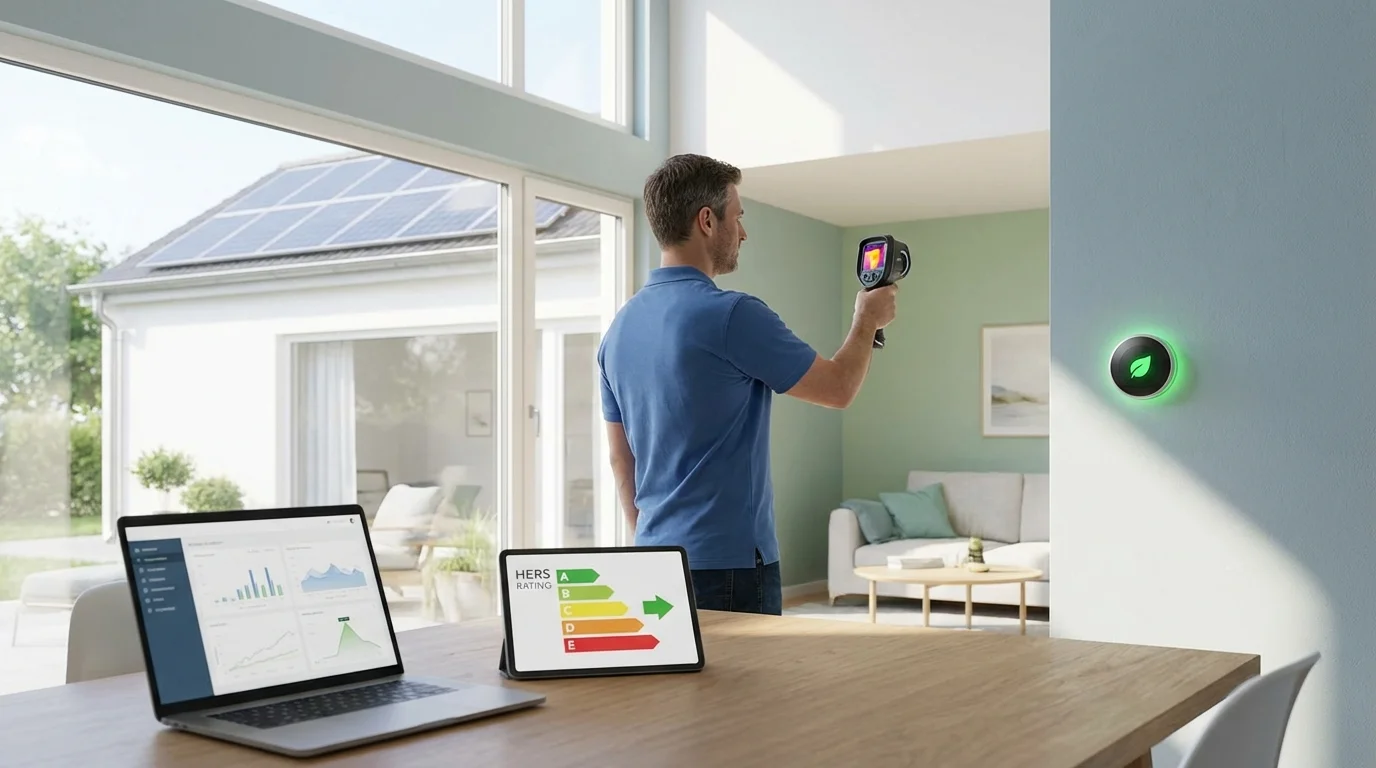
The average U.S. household spends over $2,200 per year on energy bills, with up to 35% of that energy wasted through air leaks, outdated equipment, and poor insulation. As utility costs continue to rise into 2026, homeowners are increasingly turning to a powerful, yet often overlooked, tool to slash that waste and unlock thousands in cash back. It isn't just about saving money; it’s about proving your home's efficiency with a number that state and federal programs recognize.
So what? Why does this matter? A standard home leaks money through every unsealed crack and inefficient appliance, but a HERS (Home Energy Rating System) Index Score puts a precise number on that performance. A HERS Index Score of 70, for instance, means a home is 30% more energy-efficient than a standard new home built to code. And that 30% improvement isn't just a number on a certificate; it's the key that unlocks access to over $14,000 in combined federal and state rebates for upgrades that permanently lower your energy costs.
How Can a HERS Rating Unlock Rebates and Financial Incentives for My Home?
A HERS rating is a certified home energy assessment that generates a HERS Index Score, a numerical value from 0 to 150+ that quantifies a home's energy efficiency. State and utility rebate programs in 2026 use this score as a prerequisite for high-value incentives, often requiring a specific score improvement to qualify.
A certified HERS rater analyzes your home's energy features, including insulation, windows, HVAC systems, and air leakage rates, using tools like a blower door test. The resulting score serves as official documentation for rebate applications. For example, a program may offer a $2,000 rebate for a new heat pump, but only if the installation, verified by a post-upgrade HERS rating, improves the home's score by at least 20 points. So this rating acts as the official proof that your home meets the efficiency standards required for thousands of dollars in funding. This process transforms a standard home energy audit into a gateway for cashing in on government-backed efficiency programs.
What Specific Rebate Amounts and Eligible Equipment Qualify for HERS-Based Energy Upgrades?
Specific rebate amounts for HERS-verified upgrades in 2026 range from $500 to over $8,000, depending on the equipment and your state's program. These incentives target high-impact improvements that directly lower a home's HERS score, such as insulation, air sealing, and high-efficiency HVAC systems.
Eligible equipment typically includes ENERGY STAR certified heat pumps, which qualify for rebates up to $8,000 under programs like the Home Electrification and Appliance Rebate (HEAR). And insulation and air sealing projects can receive up to $1,600. Some utilities offer tiered rebates; for example, achieving a 15-point HERS score reduction may unlock a $1,500 bonus, while a 30-point reduction provides a $3,000 bonus. But these amounts are tied directly to the verified efficiency gains. You can find precise local incentives using our free rebate calculator. So the lower your final HERS score, the higher the financial reward from these programs.
"Many utilities and states offer financial incentives for building or renovating homes to be more energy efficient. A low HERS Index Score is often required to qualify for these programs." — U.S. Department of Energy
| Program / State | Eligible Upgrade | Max Rebate (2026) | HERS Score Requirement |
|---|---|---|---|
| NYSERDA (NY) | Whole-Home Retrofit | $5,000 | 20% Energy Reduction |
| Mass Save (MA) | Insulation & Air Sealing | $3,500 | Pre/Post Rating Required |
| HEAR Program (Federal) | Heat Pump HVAC | $8,000 | Varies by State Plan |
Am I Eligible? Understanding Income Limits and Local Program Requirements by State and Utility.
Eligibility for HERS-based rebates in 2026 is determined by income level, location, and specific utility provider rules. Many programs, especially those funded by the Inflation Reduction Act, use Area Median Income (AMI) to structure their incentives, offering the largest rebates to low- and moderate-income households.
For instance, the federal HEAR program offers rebates covering up to 100% of project costs for households earning less than 80% of AMI. And households earning between 80% and 150% of AMI can get up to 50% of their costs covered, with a total cap of $14,000. But state-level programs have their own distinct requirements. California’s TECH Clean California initiative, for example, has specific incentive levels for residents in disadvantaged communities. So before proceeding, homeowners must verify their eligibility based on their specific county's AMI and their utility's 2026 program guidelines. Check your state's energy office website for the most current income thresholds and availability of heat pump rebates.
How Do I Apply for HERS-Related Rebates, What Are the Deadlines, and What's the Current Funding Status?
The application process for HERS-related rebates in 2026 follows a clear, multi-step sequence: pre-approval, installation, and verification. Homeowners first select a participating contractor who helps them apply for pre-approval from the local utility or state program administrator, securing the funds.
After approval, the contractor completes the energy efficiency upgrades. Then, a certified HERS rater performs a post-installation assessment to verify the new, lower HERS score. And this final report is submitted with the rebate claim. Deadlines are critical; many state programs operate on a fiscal year, with application windows closing as early as September 30, 2026, or when funds are exhausted. Funding status is updated regularly on program websites. For example, the New York State Clean Heat program often has a publicly available dashboard showing remaining funds. So prompt action is necessary, as these programs are first-come, first-served and popular incentives are depleted before the official deadline.
Can I Stack HERS Rebates with Other Programs, and What Are the Contractor Requirements?
Homeowners can stack HERS-based rebates with other federal, state, and local incentives in 2026 to maximize savings, provided the program rules allow it. The most common combination involves pairing a state or utility rebate with federal energy tax credits, which cover 30% of the cost for qualifying equipment like geothermal systems.
For example, a homeowner receiving a $4,000 state rebate for a heat pump installation can also claim the federal tax credit on the remaining project cost. But programs explicitly state their stacking rules; some utility rebates can't be combined with other utility offers. Contractor requirements are strict. Most rebate programs mandate that all work be performed by a licensed and insured contractor, often one with specific certifications like Building Performance Institute (BPI) or one listed on the program's approved network. So using an uncertified contractor will automatically disqualify an otherwise eligible project from receiving any rebate funds.
"DSIRE is the most comprehensive source of information on incentives and policies that support renewables and energy efficiency in the United States." — DSIRE
Official Sources
- ENERGY STAR Rebate Finder — A tool from the U.S. Environmental Protection Agency to find local rebates on certified products.
- Database of State Incentives for Renewables & Efficiency (DSIRE) — A comprehensive database of energy-related incentives and policies managed by the N.C. Clean Energy Technology Center.
- IRS Credits and Deductions Under the IRA — Official guidance from the Internal Revenue Service on federal energy tax credits. (note: the federal 25C and 25D credits ended for projects completed after December 31, 2025)
Related Reading: Learn more about Home Energy Scoring Tool and Home Performance With Energy Star.
Related Reading: Learn more about Resnet Hers Rater Find.
Frequently Asked Questions
What HERS score is considered good for home energy rebate eligibility?
For most 2026 rebate programs, a HERS score below 85 is considered good, while a score under 55 is excellent and often qualifies for the highest incentive tiers. Many retrofit programs don't require a specific starting score but mandate a minimum point reduction, typically 15-20 points, to be eligible for funding. For new construction, ENERGY STAR certification requires a score of around 65 or lower, depending on the climate zone.
How do I schedule and complete a HERS rating for my property?
To schedule a HERS rating, you must contact a RESNET (Residential Energy Services Network) certified HERS Rater. These professionals are found through the RESNET provider directory. The process involves an on-site inspection lasting 2-4 hours, where the rater performs diagnostic tests like a blower door test. After the assessment, you receive a detailed report with your HERS Index Score and recommendations within 5-10 business days.
What are the potential financial rebates or savings linked to my HERS rating?
Financial rebates tied to a HERS rating can be substantial, ranging from $500 for basic air sealing to over $14,000 for comprehensive retrofits under programs like the 2026 Home Electrification and Appliance Rebate (HEAR). A 20-point improvement in your HERS score can unlock an additional $2,000-$4,000 in tiered state rebates. Beyond rebates, a lower HERS score directly translates to annual utility bill savings of 20-40%.
How does a HERS rating differ from a standard home energy audit?
A HERS rating is a
Last updated April 14, 2026 — reviewed by DuloCore Editorial. About our authors.