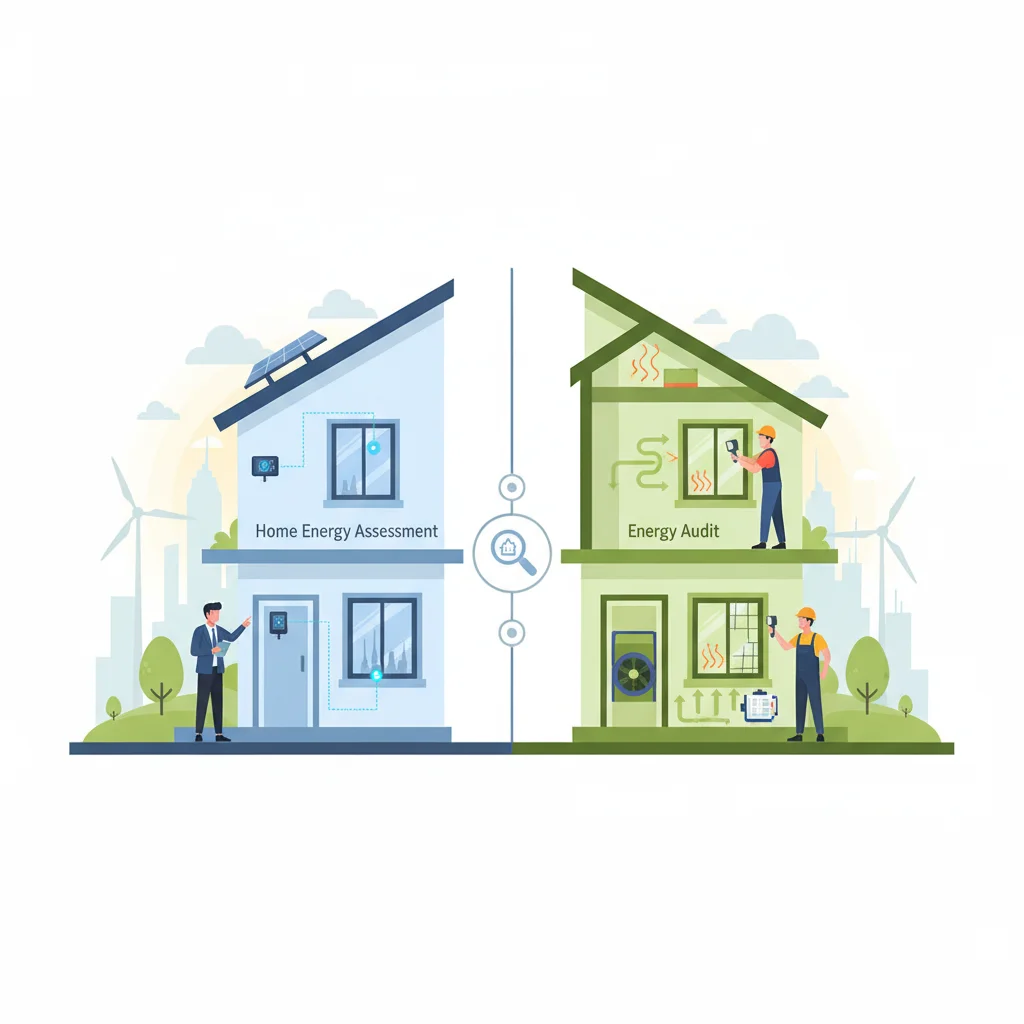
Nearly 40% of U.S. homeowners who request a "home energy audit" end up receiving a basic assessment instead—unaware that the two services differ in scope, cost, and rebate eligibility. And in California, where the California Public Utilities Commission (CPUC) oversees multiple energy efficiency programs, the distinction determines whether homeowners qualify for $4,000 to $8,000 in rebates or walk away with a checklist and no financial aid.
What's the Difference Between a Home Energy Assessment and an Energy Audit?
A home energy assessment is a visual walkthrough performed by a utility-sponsored contractor who identifies obvious inefficiencies—drafty windows, aging HVAC systems, outdated insulation—and provides basic recommendations. A home energy audit is a comprehensive diagnostic test that uses blower door tests, thermal imaging cameras, and combustion safety analysis to quantify air leakage rates, measure insulation R-values, and pinpoint heat loss zones. Assessments typically cost $0 to $100 and take 30 to 60 minutes, while audits cost $200 to $600 and require 2 to 4 hours of equipment-based testing.
So why does this matter? Because California's Energy Savings Assistance Program (ESA) and the Home Upgrade Program require a qualifying energy audit—not a basic assessment—to unlock rebates of $4,000 for moderate-income households and $8,000 for low-income households. Homeowners who schedule an assessment instead of an audit forfeit access to these funds, even if they install eligible heat pumps, insulation, or duct sealing later.
How Much Can You Save with Rebates and Incentives for Energy Assessments?
California's Home Upgrade Program offers $500 to $1,000 rebates for energy audits when bundled with qualifying upgrades like heat pump rebates or attic insulation. But the real savings come after the audit: homeowners who complete recommended upgrades receive $4,000 to $8,000 in total incentives, depending on household income and equipment installed. And federal energy tax credits through the Inflation Reduction Act (IRA) cover 30% of audit costs—up to $150—when claimed on 2026 tax returns.
"Home energy audits save an average of 25% on annual heating and cooling costs." — U.S. Department of Energy
But audits alone don't generate savings. Homeowners who act on audit findings reduce energy bills by $400 to $1,200 annually, while those who skip implementation see zero return on the $200 to $600 audit fee.
Who Qualifies for Home Energy Assessments and What Equipment Is Eligible?
California's Energy Savings Assistance Program (ESA) serves households earning up to 250% of the federal poverty level—$75,000 for a family of four in 2026—and covers free energy assessments plus installation of weather stripping, LED bulbs, and low-flow showerheads. The Home Upgrade Program serves households earning up to 400% of the federal poverty level—$120,000 for a family of four—and rebates audits plus upgrades to heat pumps, heat pump water heaters, attic insulation (minimum R-38), duct sealing, and smart thermostats.
And here's the critical distinction: ESA provides free assessments but limits equipment upgrades to pre-approved contractors, while the Home Upgrade Program requires homeowners to hire BPI-certified auditors and pay upfront for audits before rebate reimbursement. So low-income households qualify for free assessments, while moderate-income households pay $200 to $600 for audits then claim rebates post-installation.
What Are the Income Limits and Application Process for Energy Assessment Programs in California?
The Energy Savings Assistance Program (ESA) caps eligibility at 250% of the federal poverty level: $37,500 for individuals, $50,625 for couples, and $75,000 for families of four in 2026. The Home Upgrade Program extends eligibility to 400% of the federal poverty level: $60,000 for individuals, $81,000 for couples, and $120,000 for families of four. Homeowners apply through their electric utility—PG&E, SCE, SDG&E, or SoCalGas—by submitting income documentation (W-2s, pay stubs, or tax returns) and scheduling a no-cost initial screening.
But the application process diverges after screening. ESA participants receive free assessments and contractor-installed upgrades within 30 to 60 days, while Home Upgrade Program applicants must hire a BPI-certified auditor, pay $200 to $600 upfront, complete recommended upgrades within 12 months, and submit receipts for rebate processing. Use our free rebate calculator to estimate your household's eligibility and maximum rebate amounts.
What Are the Deadlines and Current Funding Status for Home Energy Rebates?
California's Energy Savings Assistance Program operates year-round with no application deadline, but funding is allocated on a first-come, first-served basis until annual budgets are exhausted—typically by October or November each year. The Home Upgrade Program accepted applications through December 31, 2025, and was renewed for 2026 with $300 million in new funding, though the California Public Utilities Commission has not yet announced the 2026 application launch date as of April 2026.
The federal Energy Efficient Home Improvement Credit (Section 25C) ended for property placed in service after December 31, 2025 (IRS FS-2025-05). Federal tax credits for this work have ended, but state, local and utility rebates may still apply; check what is available at your address with the DuloCore rebate calculator. So state rebates operate on limited annual budgets with rolling deadlines. The federal Energy Efficient Home Improvement Credit (Section 25C) ended for property placed in service after December 31, 2025 (IRS FS-2025-05).
| Program | Audit Rebate | Total Equipment Rebate | Income Limit (Family of 4) | Application Deadline |
|---|---|---|---|---|
| Energy Savings Assistance Program | $0 (free audit) | $0 (free installation) | $75,000 (250% FPL) | Year-round, funds limited |
| Home Upgrade Program | $500–$1,000 | $4,000–$8,000 | $120,000 (400% FPL) | TBD for 2026 |
| Federal IRA Credit (Form 5695) | Ended Dec 31, 2025 | Ended Dec 31, 2025 | — | Ended Dec 31, 2025 |
How Do Energy Assessment Rebates Stack with Other Federal and State Incentives?
California's Home Upgrade Program rebates stack with federal IRA tax credits, allowing homeowners to claim both the $500 to $1,000 state audit rebate and the 30% federal credit (this federal credit ended for property placed in service after December 31, 2025) (up to $150) on the same audit. And state rebates for equipment upgrades—$4,000 to $8,000—stack with federal heat pump credits of $2,000, heat pump water heater credits of $2,000, and insulation credits of $1,200, creating a maximum combined incentive of $13,350 for a comprehensive home energy retrofit.
But stacking rules vary by utility. PG&E and SCE allow homeowners to combine Energy Upgrade California rebates with Technology Incentive Program rebates for battery storage, while SDG&E prohibits stacking TECH Clean California incentives with Home Upgrade Program funds. So homeowners must verify stacking eligibility with their utility before committing to equipment purchases.
Official Sources
- U.S. Department of Energy - Energy Saver — Federal energy efficiency guidance and rebate information
- DSIRE USA - California Incentives — Database of state and utility energy rebate programs
- California Public Utilities Commission - Energy Savings Assistance Program — Official state program rules and income limits
Related Reading: Learn more about Infrared Thermography Home Audit and Is A Home Energy Audit Worth It.
Frequently Asked Questions
What is the difference between a home energy assessment and a home energy audit?
A home energy assessment is a 30- to 60-minute visual inspection that identifies obvious inefficiencies like drafty windows or aging HVAC systems, while a home energy audit is a 2- to 4-hour diagnostic test using blower door tests, thermal imaging, and combustion analysis to quantify air leakage rates and measure insulation R-values. Assessments cost $0 to $100, while audits cost $200 to $600 and are required to unlock California's $4,000 to $8,000 Home Upgrade Program rebates.
How much does a home energy assessment cost compared to an audit?
A basic home energy assessment costs $0 to $100—often provided free by California utilities like PG&E, SCE, or SDG&E—while a comprehensive energy audit costs $200 to $600 depending on home size and equipment used. And federal IRA tax credits reimburse 30% of audit costs (up to $150) on 2026 tax returns, reducing the effective cost of a $500 audit to $350 after the credit.
Do I need an energy audit to qualify for rebates?
California's Home Upgrade Program requires a BPI-certified energy audit to qualify for $4,000 to $8,000 in equipment rebates, while the Energy Savings Assistance Program provides free assessments and installations for households earning below $75,000 (family of four, 250% FPL). Form 5695 only covers qualifying work completed by December 31, 2025 and claimed on a 2025 return; the federal 25C and 25D credits ended after that date (IRS FS-2025-05).
Can a home energy assessment help me identify where I'm losing money on heating and cooling?
A home energy assessment identifies obvious inefficiencies like single-pane windows, uninsulated attics, or failing HVAC systems, but cannot quantify heat loss or air leakage rates without diagnostic equipment. A full energy audit uses blower door tests to measure air changes per hour (ACH) and thermal imaging to pinpoint heat loss zones, providing actionable data that reduces heating and cooling costs by 25% to 40% when homeowners act on recommendations.
Is a home energy audit required before applying for the 25D tax credit?
The old Section 25D tax credit expired January 1, 2026, and was replaced by IRA Residential Clean Energy Credits that do not require an energy audit to claim the 30% credit for solar panels, battery storage, or geothermal heat pumps. But California's Home Upgrade Program—which offers $4,000 to $8,000 in state rebates—mandates a BPI-certified energy audit before approving equipment rebates for heat pumps, insulation, or duct sealing.
Ready to find out how much you can save? Use our free rebate calculator to estimate your eligibility for California's Home Upgrade Program, Energy Savings Assistance Program, and federal IRA tax credits. Enter your household income, equipment upgrades, and location to see your maximum rebate amounts in under 60 seconds.
Last updated: April 14, 2026. Reviewed by the DuloCore Editorial Team. About our authors.