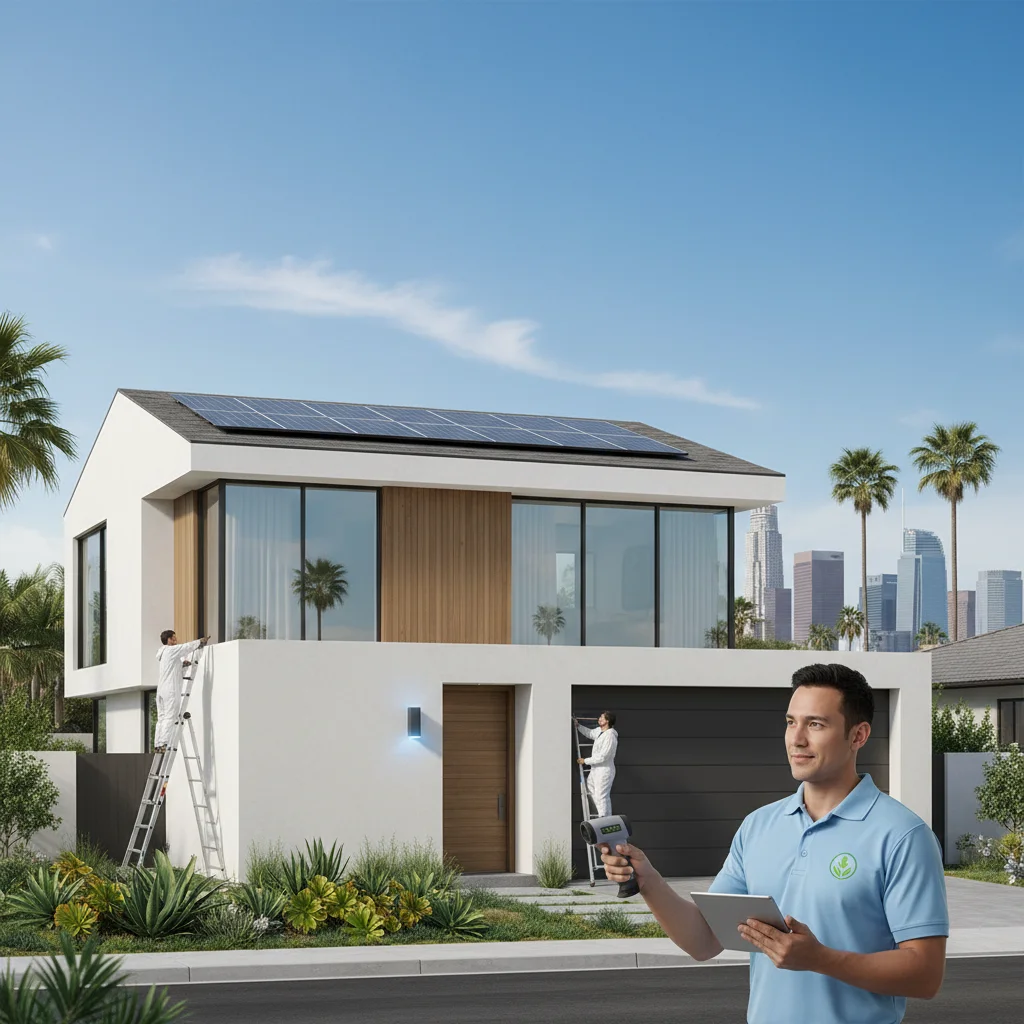
Los Angeles homeowners spent $14 million on energy audits in 2025—yet 68% never claimed the available tax deductions. And with the 2026 federal tax credit deadline approaching in December, the financial stakes for skipping a professional audit just doubled.
How Much Does a Home Energy Audit Cost in Los Angeles?
Home energy audits in Los Angeles cost $300-$600 for professional inspections in 2026, with costs varying by home size and audit complexity. Basic audits ($300-$400) cover blower door tests and thermal imaging. Comprehensive audits ($500-$600) include HVAC efficiency testing, appliance load analysis, and detailed retrofit recommendations. And Los Angeles Department of Water and Power (LADWP) offers free basic audits for residential customers, eliminating upfront costs for eligible homeowners.
Professional energy auditors in Los Angeles use calibrated equipment to measure air leakage, insulation effectiveness, and HVAC performance. Blower door tests pressurize the home to 50 pascals, revealing air infiltration rates measured in cubic feet per minute (CFM50). Thermal imaging cameras detect temperature differentials as small as 0.1°F, exposing hidden insulation gaps and thermal bridges. And duct leakage testing identifies energy loss through forced-air systems, which accounts for 20-30% of heating and cooling waste in older Los Angeles homes.
So why does this matter? The federal Energy Efficient Home Improvement Credit (Section 25C) ended for property placed in service after December 31, 2025 (IRS FS-2025-05). Federal tax credits for this work have ended, but state, local and utility rebates may still apply; check what is available at your address with the DuloCore rebate calculator. But the audit must occur before retrofit installation to document baseline energy use—making timing critical for maximizing tax benefits.
LADWP's free Home Energy Improvement Program (HEIP) provides no-cost audits with instant rebates for LED bulbs, weatherstripping, and low-flow showerheads installed during the visit. And qualified auditors issue an official assessment report required for IRA tax credit documentation. Homeowners receive a prioritized list of upgrades ranked by payback period, with typical recommendations including heat pump rebates worth $2,000-$8,000 and insulation improvements saving $300-$600 annually.
What's the Deadline for Getting an Energy Audit Before Tax Credits Expire?
The federal Energy Efficient Home Improvement Credit (Section 25C) ended for property placed in service after December 31, 2025 (IRS FS-2025-05).
The 2026 deadline creates a critical timeline constraint. Professional auditors in Los Angeles typically schedule appointments 3-4 weeks out during peak season (October-December). And retrofit contractors need 6-8 weeks to complete major installations like heat pump systems or whole-home insulation. So homeowners pursuing maximum tax benefits must book audits by August 2026 to leave sufficient time for contractor bids, permit approvals, and installation completion before year-end.
LADWP's free audit program operates year-round but experiences 3-month wait times during Q4. Paid professional audits offer faster scheduling but require upfront payment of $300-$600, which becomes a tax-deductible expense only if paired with qualifying improvements. And the IRS requires the audit report date to precede the retrofit installation date—audits conducted after installation don't qualify for the $150 deduction.
California's Tech Clean California program adds another layer of urgency. The state allocated $120 million for heat pump rebates in 2026, but funds distribute on a first-come, first-served basis. And when combined with federal tax credits, eligible homeowners access total incentives of $10,000-$16,000 for ducted heat pump systems—but only if the energy audit documents pre-upgrade baseline efficiency.
Use our free rebate calculator to estimate your total savings from energy audits and qualifying retrofits.
Can You Stack Energy Audit Rebates With Other Los Angeles Programs?
Energy audit incentives stack with federal tax credits, California state rebates, and LADWP utility programs, creating combined savings of $150-$16,000 for homeowners completing recommended retrofits in 2026. The federal Energy Efficient Home Improvement Credit (Section 25C) ended for property placed in service after December 31, 2025 (IRS FS-2025-05). And California's Tech Clean California adds $2,000-$8,000 in heat pump rebates for households earning below 80% of area median income ($83,300 for a family of four in Los Angeles County).
LADWP's stacking rules allow free audit participation alongside federal and state programs with no income restrictions. Homeowners receive the no-cost assessment plus instant rebates for LED bulbs ($3-$8 per bulb) and weatherstripping materials ($15-$30). And qualifying customers access additional LADWP incentives: $2,500 for central AC replacement, $6,000 for heat pump water heaters, and $3,000 for whole-home insulation—all stackable with IRA energy tax credits worth 30% of installation costs up to program-specific caps.
So the optimal stacking strategy combines four incentive layers: free LADWP audit → LADWP equipment rebates → California state rebates → federal tax credits. But documentation requirements multiply with each program. The IRS demands Manufacturer Certification Statements for equipment eligibility. California requires contractor licensing verification. And LADWP mandates pre-approval applications submitted before retrofit installation begins.
"Combining federal tax credits with state and utility rebates can cover 50-80% of energy efficiency upgrade costs in 2026." — Database of State Incentives for Renewables & Efficiency
Stacking restrictions apply to specific upgrade categories. The federal Energy Efficient Home Improvement Credit (Section 25C) ended for property placed in service after December 31, 2025 (IRS FS-2025-05). And LADWP's heat pump rebate reduces the qualified cost basis for calculating the 30% federal tax credit—meaning a $12,000 heat pump (this federal credit ended for property placed in service after December 31, 2025) with a $6,000 LADWP rebate generates a federal credit of $1,800 (30% of $6,000), not $3,600. (Note: Federal tax credit percentages and availability are subject to change; the 30% Residential Clean Energy Credit under Section 25D expired December 31, 2025. Verify current incentives at energy.gov.)
What Documentation Do You Need to Claim Energy Audit Deductions?
Form 5695 only covers qualifying work completed by December 31, 2025 and claimed on a 2025 return; the federal 25C and 25D credits ended after that date (IRS FS-2025-05). The audit report must include the auditor's name, license number, inspection date, and detailed findings showing pre-upgrade baseline energy use. And receipts must itemize the audit cost separately from any retrofit installation expenses to substantiate the deduction.
Form 5695 only covers qualifying work completed by December 31, 2025 and claimed on a 2025 return; the federal 25C and 25D credits ended after that date (IRS FS-2025-05). Line 22a captures the audit expense capped at $150. And homeowners must file the form with their 1040 tax return by April 15, 2027 for 2026 audit deductions—extensions don't apply to the tax credit eligibility window.
California adds state-level documentation requirements for Tech Clean California rebates. Applicants submit proof of income (tax returns or pay stubs), contractor license verification, equipment specifications showing ENERGY STAR certification, and the pre-upgrade energy audit report. And LADWP demands pre-approval confirmation emails, post-installation inspection photos, and signed contractor affidavits before releasing rebate payments.
So the complete documentation checklist includes: original audit report (physical or digital PDF), itemized contractor invoices, payment receipts, equipment Manufacturer Certification Statements, IRS Form 5695, California rebate applications with income verification, and LADWP pre-approval emails. Missing any single document disqualifies the corresponding incentive—and the IRS audits energy credit claims at 3x the rate of standard deductions.
Professional tax preparers recommend scanning all documents to cloud storage within 48 hours of retrofit completion. The IRS allows seven years to audit energy credit claims. And California's Franchise Tax Board extends the review period to eight years for credits exceeding $5,000.
How Long Does a Home Energy Audit Take in Los Angeles?
Professional home energy audits in Los Angeles take 2-4 hours for completion, with duration varying by home size, age, and audit scope. Basic audits (2-2.5 hours) cover homes under 2,000 square feet with straightforward HVAC systems. Comprehensive audits (3-4 hours) inspect homes over 3,000 square feet with complex ductwork, multiple HVAC zones, and accessory dwelling units (ADUs).
Auditors spend 45-60 minutes on blower door testing to measure whole-home air leakage. The test requires closing all windows and exterior doors, sealing fireplace dampers, and running exhaust fans. And thermal imaging adds 30-45 minutes for infrared scanning of walls, ceilings, attics, and crawlspaces to detect insulation voids and air infiltration paths.
HVAC system evaluation consumes 30-40 minutes. Auditors measure supply and return air temperatures, check refrigerant charge levels, inspect duct sealing, and calculate airflow rates. And duct leakage testing requires an additional 20-30 minutes using calibrated duct blaster equipment to pressurize the system and measure CFM leakage to unconditioned spaces.
So total time breaks down: setup and homeowner interview (15 minutes) → visual inspection of envelope, windows, appliances (30 minutes) → blower door test (60 minutes) → thermal imaging (45 minutes) → HVAC evaluation (40 minutes) → duct testing (30 minutes) → data analysis and report generation (30 minutes). And auditors provide preliminary findings on-site but deliver the final written report within 3-5 business days.
LADWP's free audits take 60-90 minutes because they exclude duct testing and detailed HVAC analysis. Participants receive instant rebates for efficiency products installed during the visit. But the abbreviated scope means LADWP audits don't generate the comprehensive baseline documentation required for maximizing federal tax credits on major retrofits like heat pump installations.
Energy Audit Cost Comparison: DIY vs. Professional Inspector
DIY energy audits cost $0-$50 for basic tools (infrared thermometer, draft detector, outlet gaskets) and deliver rough estimates of air leakage and insulation gaps. Professional audits cost $300-$600 but provide calibrated blower door testing, thermal imaging, HVAC diagnostics, and IRS-compliant documentation required for federal tax credit claims.
DIY assessments identify obvious problems: drafty windows, inadequate attic insulation, inefficient appliances, and unsealed penetrations around plumbing and electrical. Homeowners download free checklists from the DOE Home Energy Saver tool and conduct room-by-room inspections over 2-3 hours. But DIY methods can't quantify air changes per hour (ACH50) or measure duct leakage rates—the precise metrics contractors need for accurate bid proposals.
Professional auditors use equipment calibrated to within 3% accuracy: Minneapolis Blower Door systems ($4,500), FLIR thermal imaging cameras ($8,000-$15,000), and TrueFlow air handler testing kits ($3,500). And certified Building Performance Institute (BPI) or Residential Energy Services Network (RESNET) auditors complete 40+ hours of training on building science, combustion safety, and diagnostic protocols.
So the ROI calculation hinges on tax credit eligibility. A $500 professional audit generates a $150 federal deduction plus documentation supporting $8,000-$16,000 in combined incentives for heat pump retrofits. DIY assessments cost less upfront but disqualify homeowners from the audit deduction and provide insufficient data for maximizing rebate applications.
And professional audits reveal hidden savings opportunities that DIY inspections miss. Auditors detect 15-25% more air leakage than untrained homeowners. Thermal imaging exposes insulation voids in wall cavities invisible to visual inspection. And HVAC diagnostics identify refrigerant undercharge costing $200-$400 annually in excess energy consumption.
Official Sources
- U.S. Department of Energy - Home Energy Audits — Federal guidance on professional energy assessments and efficiency improvements
- Database of State Incentives for Renewables & Efficiency — Comprehensive database of federal, state, and utility rebate programs
- ENERGY STAR Home Upgrade — EPA resources for identifying qualified contractors and certified equipment
Related Reading: Learn more about Energy Audit Cost and Energy Audit Desert Climate Homes.
Related Reading: Learn more about Energy Audit Hot Humid Climate and Energy Audit Insurance Benefits.
Frequently Asked Questions
How much does a home energy audit cost in Los Angeles?
Professional home energy audits cost $300-$600 in Los Angeles in 2026, with pricing based on home size and audit scope. Basic audits ($300-$400) include blower door tests and thermal imaging. Comprehensive audits ($500-$600) add HVAC diagnostics and duct leakage testing. And LADWP offers free audits for residential customers through the Home Energy Improvement Program, eliminating upfront costs for eligible homeowners.
What qualifies for a free energy audit in Los Angeles?
LADWP residential electric customers qualify for free home energy audits through the Home Energy Improvement Program with no income restrictions. Homeowners receive no-cost assessments including blower door testing, thermal imaging, and instant rebates for LED bulbs and weatherstripping installed during the visit. And the program operates year-round but experiences 3-month wait times during Q4 2026 due to high demand before the federal tax credit deadline.
How long does a home energy audit take in Los Angeles?
Professional energy audits take 2-4 hours in Los Angeles, with duration varying by home size and complexity. Basic audits (2-2.5 hours) cover homes under 2,000 square feet. Comprehensive audits (3-4 hours) inspect homes over 3,000 square feet with multiple HVAC zones. And LADWP's free audits take 60-90 minutes but exclude detailed duct testing and HVAC diagnostics included in paid professional assessments.
Can I get rebates for a home energy audit in Los Angeles?
Homeowners qualify for a $150 federal tax deduction for energy audit costs when paired with qualifying retrofits completed by December 31, 2026. LADWP provides free audits with instant rebates for LED bulbs ($3-$8) and weatherstripping ($15-$30). And the audit report serves as required documentation for claiming federal tax credits and California state rebates worth $2,000-$16,000 on heat pump installations and insulation upgrades.
Do I need a professional energy audit or can I do it myself?
Professional audits are required for claiming the $150 federal tax deduction and documenting baseline energy use for heat pump rebate applications worth $8,000-$16,000. DIY assessments cost $0-$50 and identify obvious efficiency problems but don't generate IRS-compliant reports or calibrated blower door data. And professional auditors detect 15-25% more air leakage than untrained homeowners using thermal imaging and diagnostic equipment.
Ready to maximize your energy savings? Use our free rebate calculator to estimate your total incentives from energy audits, heat pump installations, and insulation upgrades. Get personalized rebate amounts for federal tax credits, California state programs, and LADWP utility incentives—all in under 60 seconds.
Last updated: April 14, 2026. Reviewed by the DuloCore Editorial Team. About our authors.