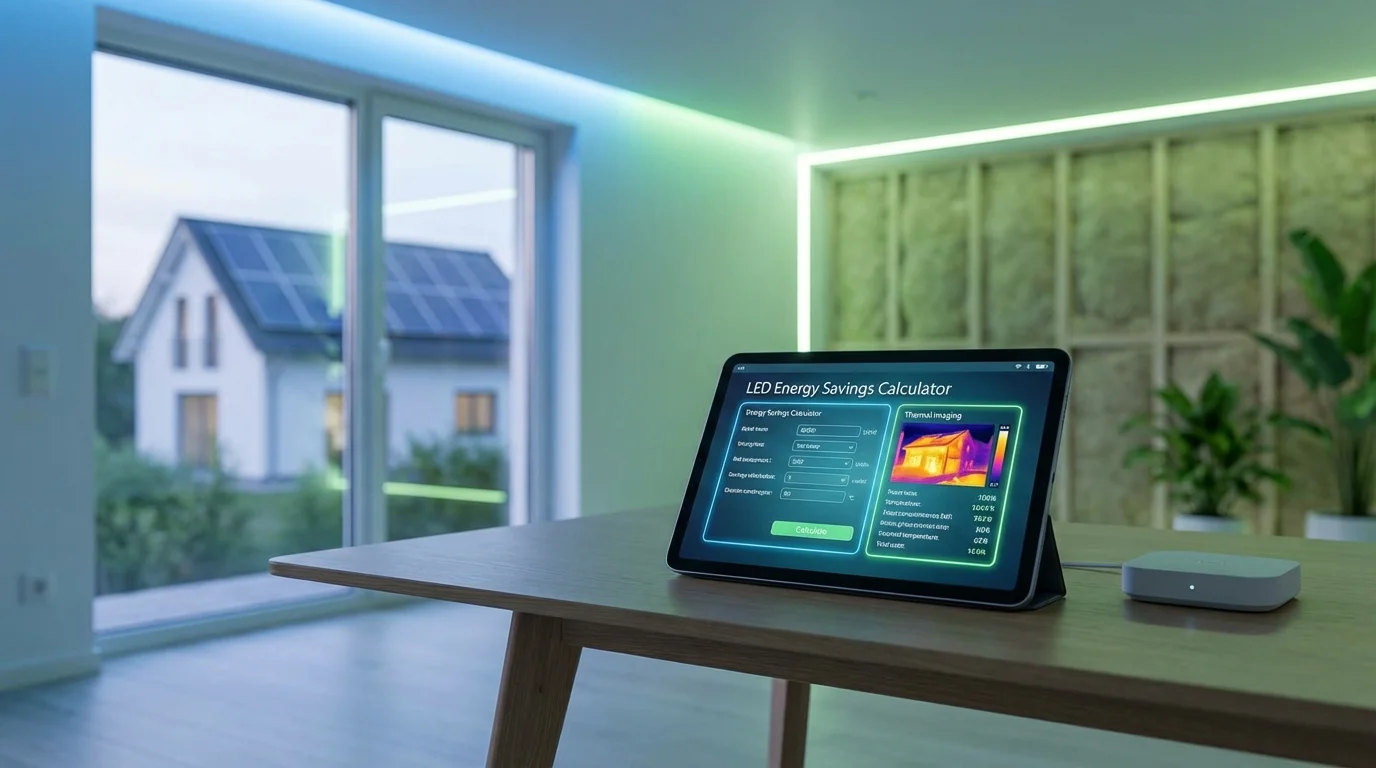
Lighting accounts for nearly 15% of the average U.S. household's electricity consumption, a persistent drain on both wallets and the power grid. As utility rates continue to climb in 2026, the financial penalty for using outdated incandescent or halogen bulbs grows each month. Homeowners are now actively seeking tools that translate the abstract concept of "energy efficiency" into concrete dollar amounts, making the switch to modern lighting a quantifiable financial decision rather than a guess.
How Much Can You Really Save with an LED Lighting Energy Savings Calculator?
An LED lighting energy savings calculator is a digital tool that projects annual cost reductions by comparing incandescent or CFL bulbs to modern LEDs. It calculates potential savings of up to $225 per year for a typical home by analyzing bulb wattage, daily usage hours, and local electricity rates for 2026.
These calculators provide a precise financial forecast by modeling your home's specific lighting habits. So you input the number of old bulbs, their wattage (e.g., 60W), the wattage of the LED replacement (e.g., 9W), and how many hours per day they operate. And the tool cross-references this data with your local cost per kilowatt-hour (kWh) to generate an estimated annual savings figure. For instance, replacing a single 60-watt incandescent bulb used four hours daily with a 9-watt LED saves approximately $12.15 per year when electricity costs $0.22/kWh. But the real value emerges when you multiply this across the 20-30 bulbs in a typical home. A comprehensive calculation reveals the full financial impact of a complete lighting upgrade. Use our free rebate calculator to find your exact savings.
How Do I Find and Qualify for LED Lighting Rebates and Incentives in My State?
Homeowners find 2026 LED lighting rebates by searching utility company websites and state energy office databases like DSIRE. Qualification typically requires purchasing ENERGY STAR certified products and residing within the utility's service area, with per-bulb rebates ranging from $2 to $10, or up to $30 for fixtures.
The search for incentives begins with your local electric utility. And most providers, from Con Edison in New York to PG&E in California, offer instant or mail-in rebates for ENERGY STAR certified LED bulbs and fixtures. But state-level energy programs also provide support, often listed on a state's Department of Energy website or aggregated on platforms like the DSIRE database. Qualification is straightforward: the purchaser must be a residential customer of the sponsoring utility, and the products must appear on the program’s approved list. So verifying product eligibility via the ENERGY STAR or DesignLights Consortium (DLC) product lists before purchase is a critical step. A home energy audit can identify additional opportunities beyond lighting.
What's the Application Process for LED Rebates, and Are There Income or Equipment Limits?
The 2026 application process for LED rebates involves submitting a completed form, proof of purchase (itemized receipts), and product UPC codes online or via mail. Income limits are uncommon for standard lighting rebates, but equipment must be ENERGY STAR certified, with program deadlines often set for December 31, 2026.
Most utility rebates for LED bulbs are instant, applied as a discount at the point of sale at participating retailers like Home Depot or Lowe's. But for mail-in rebates or fixture incentives, a formal application is necessary. This typically requires the homeowner to fill out a one-page form from the utility's website and attach a copy of the sales receipt. So it's crucial to buy the correct, qualified products, as non-certified bulbs are ineligible for any financial incentive. While there are generally no income restrictions for these specific product rebates, larger, whole-home retrofit programs that include lighting upgrades often do have income-based qualification tiers.
"Many states and utilities offer rebates or other incentives for purchasing ENERGY STAR certified products. These offers can be found on the ENERGY STAR Rebate Finder." — ENERGY STAR
2026 State and Utility LED Rebate Program Comparison
| Program / Utility | Rebate Amount | Eligible Equipment | Key Deadline |
|---|---|---|---|
| Focus on Energy (WI) | $3–$8 per fixture | ENERGY STAR certified fixtures, recessed can kits | December 31, 2026 |
| Con Edison (NY) | $2 per bulb (instant) | ENERGY STAR certified A-line, globe, candelabra | While funds last |
| PG&E (CA) | Up to $15 per fixture | DesignLights Consortium (DLC) qualified fixtures | December 31, 2026 |
How Do Contractor Requirements and Stacking Rules Affect My LED Lighting Rebate Amount?
Most 2026 LED bulb rebates don't require professional installation, so contractor requirements are zero for simple retrofits. Stacking rules, however, prevent combining multiple utility rebates for the same bulb, though homeowners can still claim separate federal energy tax credits for larger, eligible home improvement projects.
For simple screw-in bulb replacements, no contractor is needed, and homeowners can purchase and install them directly. But if the project involves replacing entire light fixtures or requires new wiring, a licensed electrician is almost always required by both local building codes and the rebate program's terms. Stacking rules are another key factor. So you can't receive a $2 rebate from your utility and another $2 rebate from a state program for the same light bulb. However, an LED lighting upgrade can be part of a larger energy efficiency project that qualifies for other incentives, such as those for insulation or heat pump rebates, without conflict.
What Are the Current Deadlines, Funding Status, and Utility-Specific Rules for LED Rebates?
Most 2026 utility LED rebate programs operate on a calendar-year basis with application deadlines of December 31, 2026, or whenever program funds are depleted. Funding status is announced in Q1, and homeowners must check their specific utility's website for real-time availability and rules.
Rebate programs are not permanent; they are funded annually, and the money often runs out before the official deadline. So acting early in the year is advantageous. And funding status is a critical data point, usually displayed prominently on the utility's rebate portal. Utility-specific rules dictate everything from the maximum number of bulbs a household can claim (often capped at 25-50 per year) to the specific retailers where instant discounts are honored. But these rules can change without notice. The only way to guarantee eligibility is to review the program's 2026 terms and conditions directly on the provider's website before making a purchase. The federal Inflation Reduction Act guide provides more detail on national energy funding.
Official Sources
- ENERGY STAR — A U.S. Environmental Protection Agency (EPA) program providing credible, unbiased information on energy-efficient products and practices.
- DSIRE — The most comprehensive source of information on incentives and policies that support renewable energy and energy efficiency in the United States.
"DSIRE is a comprehensive source of information on state, local, utility and federal incentives and policies that promote renewable energy and energy efficiency. Established in 1995, DSIRE is operated by the N.C. Clean Energy Technology Center at N.C. State University and is funded by the U.S. Department of Energy." — DSIRE
Related Reading: Learn more about Radiant Barrier Energy Savings.
Frequently Asked Questions
How accurate are LED lighting energy savings calculators?
Their accuracy is very high, typically within 5% of actual savings, provided the user inputs are correct. So the calculation's precision depends entirely on the accuracy of your home's data: the exact wattage of old and new bulbs, the number of hours they are used per day, and your specific electricity rate in cents per kilowatt-hour, which is found on your utility bill.
What information do I need to use an LED lighting energy savings calculator?
To use a calculator, you need four key pieces of information for each bulb type you plan to replace. You need the number of bulbs, the wattage of the old bulb (e.g., 60W), the wattage of the new LED bulb (e.g., 9W), and the estimated hours of use per day. You also need your electricity rate, found on your utility bill (e.g., $0.18/kWh).
What kind of monetary savings can an LED lighting calculator project for my home?
An LED lighting calculator projects annual savings ranging from $75 to over $225 for a typical U.S. household. A single incandescent 60W bulb replaced with a 9W LED used 3 hours a day saves about $9 per year. So multiplying that by the 10-25 most-used bulbs in a home quickly results in these three-figure annual savings.
Can an LED lighting energy savings calculator help me qualify for rebates?
A calculator itself doesn't qualify you for rebates, but it provides the financial justification for making the upgrade. So it models the return on investment, showing how rebates reduce your upfront cost and accelerate your payback period. The actual qualification process
Last updated April 14, 2026 — reviewed by DuloCore Editorial. About our authors.