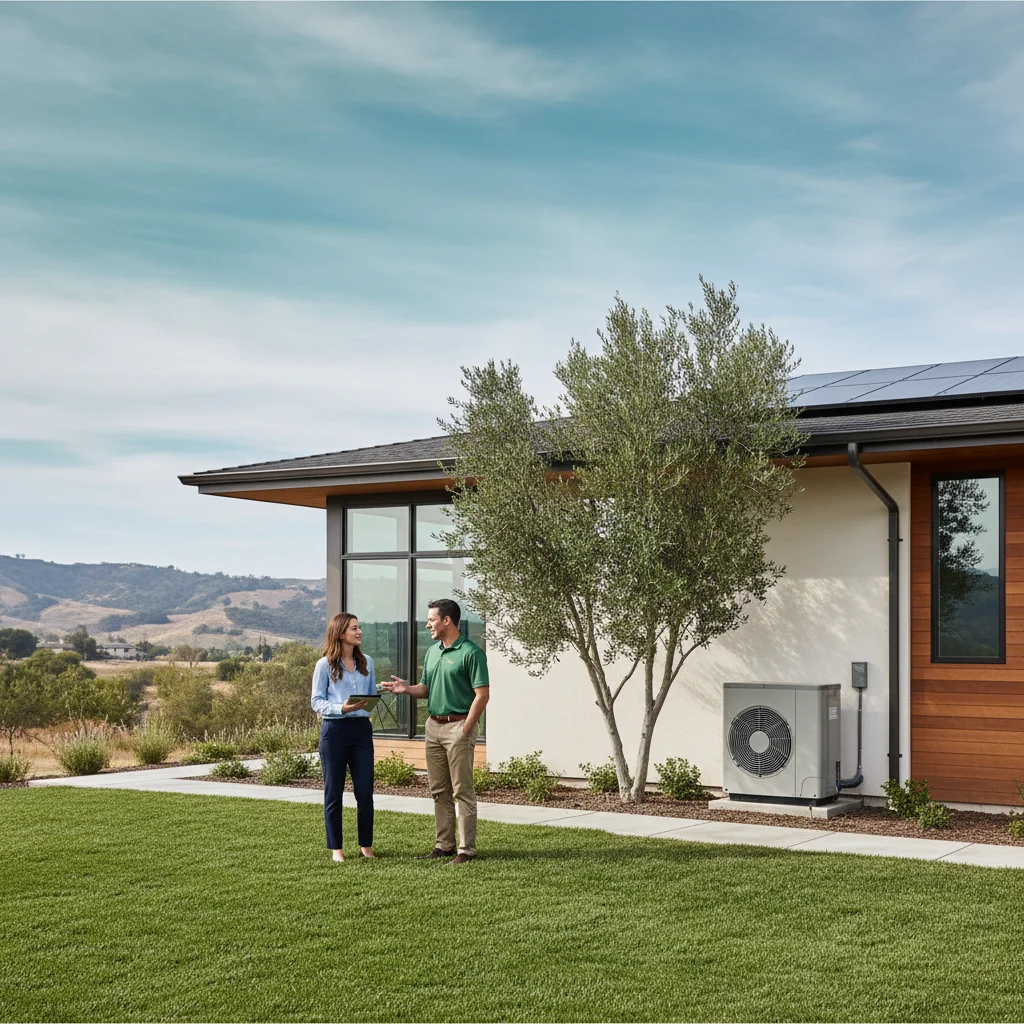
Homeowners in Riverside and San Bernardino counties paid between $12,000 and $24,000 for Lennox heat pump installations in 2025, with local utility rebates cutting $3,000 to $5,000 from that cost; federal tax credits no longer apply (IRS FS-2025-05). But the total price varies wildly depending on system size, efficiency tier, and whether the existing ductwork needs replacement.
How much does a Lennox heat pump cost in the Inland Empire?
Lennox heat pump systems in the Inland Empire cost $12,000 to $24,000 installed in 2026, with 2-ton units starting at $12,000 and 5-ton high-efficiency models reaching $24,000. Southern California Edison offers $3,000 to $5,000 in rebates for qualified systems. The federal Energy Efficient Home Improvement Credit (Section 25C) ended for property placed in service after December 31, 2025 (IRS FS-2025-05). And installation labor adds $3,000 to $6,000 depending on ductwork modifications.
The base equipment cost for Lennox units ranges from $4,000 for a 14 SEER2 model to $9,000 for a 24 SEER2 variable-speed system. But most contractors quote total installed prices that include permits, refrigerant lines, electrical upgrades, and thermostat installation. So homeowners replacing existing HVAC systems with compatible ductwork pay toward the lower end, while new construction or full duct replacement pushes costs to $20,000 or higher.
Lennox offers three primary residential heat pump series: the XP25 (24 SEER2, variable-speed), SL25XPV (23 SEER2), and ML14XP1 (14.3 SEER2). And the XP25 qualifies for maximum rebates from SCE because it exceeds ENERGY STAR Most Efficient thresholds. Or homeowners prioritizing upfront cost over efficiency choose the ML14XP1, which receives smaller utility rebates.
"Heat pumps can reduce electricity use for heating by approximately 50% compared to electric resistance heating such as furnaces and baseboard heaters." — U.S. Department of Energy
Ductwork modifications represent the largest variable cost. Homes built before 1990 often require duct sealing, resizing, or complete replacement to handle heat pump airflow requirements, adding $2,500 to $8,000 to the project. But newer homes with existing HVAC systems typically need only minor adjustments, keeping installation costs below $15,000 for mid-tier Lennox units.
What is the payback period and ROI for a Lennox heat pump investment?
Inland Empire homeowners replacing gas furnaces and central AC with Lennox heat pumps see payback periods of 6 to 12 years in 2026, with annual energy savings of $800 to $1,400 depending on climate zone and usage patterns. The federal Energy Efficient Home Improvement Credit (Section 25C) ended for property placed in service after December 31, 2025 (IRS FS-2025-05). SCE rebates cut $3,500 off upfront costs. So the effective payback period shortens when SCE rebates are applied.
The ROI calculation depends on three factors: baseline energy costs, heat pump efficiency, and local electricity rates. And Inland Empire residents pay $0.32 to $0.38 per kWh during peak summer hours under SCE's tiered rate structure, making high-efficiency heat pumps more cost-effective than in cheaper electricity markets. Or homeowners using gas heating pay $1.80 to $2.20 per therm for natural gas, which favors heat pumps in moderate climates but narrows the advantage during extreme cold snaps below 25°F.
Lennox XP25 systems achieve 440% heating efficiency (COP 4.4) at 47°F outdoor temperature, meaning they deliver $4.40 worth of heating for every $1.00 of electricity consumed. But efficiency drops to 250% at 17°F, which rarely occurs in Riverside or San Bernardino counties. So annual heating costs for a 2,000-square-foot home fall from $1,200 with a gas furnace to $400 with an XP25 heat pump, generating $800 in yearly savings.
Use our free rebate calculator to estimate your specific payback period based on home size, current HVAC system, and utility rates.
The net present value over a 15-year equipment lifespan reaches $8,000 to $14,000 for Inland Empire homeowners when accounting for energy savings, avoided furnace replacements, and improved home resale value. And homes with heat pumps sell for 4% to 7% more than comparable properties with traditional HVAC systems in California markets, according to Zillow data from 2025.
How does a Lennox heat pump compare to other brands in the Inland Empire?
Lennox heat pumps cost 8% to 15% more than Carrier, Trane, and Goodman equivalents in the Inland Empire, with premium models priced at $18,000 to $24,000 versus $15,000 to $20,000 for competing brands. But Lennox offers longer warranty coverage (10 years parts, 5 years labor through registered dealers) and qualifies for the same SCE rebates as other ENERGY STAR certified systems. So the price premium reflects build quality and inverter technology rather than rebate advantages.
Carrier Infinity and Trane XV systems match Lennox efficiency ratings at 23 to 24 SEER2 but cost $1,500 to $3,000 less installed. And Goodman GSZB4 models deliver 18 SEER2 performance for $12,000 to $14,000 total, making them the budget leader among major brands. Or Mitsubishi and Daikin ductless mini-splits achieve 27 to 33 SEER2 ratings for $15,000 to $20,000 but require zone-by-zone installation rather than whole-home coverage.
Lennox distinguishes itself through Precise Comfort technology, which modulates compressor speed in 1% increments compared to 5% steps for most variable-speed competitors. And this results in tighter temperature control (±0.5°F versus ±2°F) and 15% lower operating costs during shoulder seasons when partial heating or cooling loads dominate. So homeowners prioritizing comfort and efficiency over upfront cost favor Lennox, while budget-conscious buyers choose Goodman or Rheem.
"ENERGY STAR certified heat pumps have higher seasonal energy efficiency ratio (SEER) and heating seasonal performance factor (HSPF) ratings, which means they use less energy than standard models." — ENERGY STAR
Local contractor availability matters more than brand performance for most Inland Empire installations. And Lennox maintains 47 Premier Partner dealers in Riverside and San Bernardino counties, compared to 62 for Carrier and 38 for Trane. Or homeowners in rural areas like Yucca Valley or Blythe may find only one or two qualified installers, limiting brand choice regardless of preference.
What financing options and rebates are available for Lennox heat pumps?
Inland Empire homeowners can access SCE rebates of $3,000 to $5,000 and potential local air quality incentives of $500 to $1,000 for Lennox heat pump installations in 2026; federal tax credits no longer apply (IRS FS-2025-05). And qualifying low-income households receive additional $8,000 rebates through California's TECH Clean California program.
The federal Energy Efficient Home Improvement Credit (Section 25C) ended for property placed in service after December 31, 2025 (IRS FS-2025-05). Federal tax credits for this work have ended, but state, local and utility rebates may still apply; check what is available at your address with the DuloCore rebate calculator. Form 5695 only covers qualifying work completed by December 31, 2025 and claimed on a 2025 return; the federal 25C and 25D credits ended after that date (IRS FS-2025-05).
Southern California Edison offers tiered rebates based on heat pump efficiency: $3,000 for 16 SEER2 systems, $4,000 for 18 SEER2, and $5,000 for 20+ SEER2 models meeting ENERGY STAR Most Efficient criteria. And rebates apply at the point of sale through participating contractors, reducing upfront payment rather than requiring reimbursement applications. So Lennox XP25 and SL25XPV systems qualify for the maximum $5,000 rebate, while ML14XP1 units receive only $3,000.
Learn more about available incentives on our heat pump rebates guide.
TECH Clean California provides $8,000 incentives for income-qualified households (below 80% area median income) replacing gas appliances with electric heat pumps. And this program stacks with SCE rebates. Or moderate-income households (80% to 150% AMI) receive $4,000 through the same program.
Financing options include: - Lennox 0% APR for 60 months through participating dealers (requires 680+ credit score) - SCE On-Bill Financing at 0% for qualified efficiency upgrades up to $15,000 - PACE (Property Assessed Clean Energy) loans through Ygrene or Renew Financial at 6.5% to 8.5% APR - Home equity lines of credit at 7% to 9% APR as of March 2026
And On-Bill Financing repays through monthly utility bills over 5 years, making it the lowest-cost option for homeowners without equity or high credit scores.
How do Lennox heat pumps compare to traditional AC and furnace systems?
Lennox heat pumps cost $12,000 to $24,000 installed versus $8,000 to $14,000 for separate AC and furnace systems in the Inland Empire, but heat pumps eliminate dual fuel costs and qualify for larger rebates. The federal Energy Efficient Home Improvement Credit (Section 25C) ended for property placed in service after December 31, 2025 (IRS FS-2025-05). So the incremental cost premium of $4,000 to $10,000 for heat pumps shrinks after SCE rebates.
Operating costs favor heat pumps in Inland Empire climate zones, where winter lows rarely drop below 35°F and summer highs reach 105°F to 115°F. And a Lennox XP25 heat pump consumes $1,200 annually for combined heating and cooling in a 2,000-square-foot home, compared to $1,800 for a 16 SEER AC plus 80% AFUE gas furnace. Or homes using electric resistance heating pay $2,400 annually, making heat pumps the cheapest option for all-electric households.
But gas furnaces outperform heat pumps during sustained cold weather below 25°F, when heat pump efficiency drops and backup electric resistance heating activates. And this matters little in Riverside or San Bernardino, where temperatures fall below freezing only 5 to 15 nights per year. So dual-fuel systems pairing heat pumps with gas furnace backup cost $18,000 to $28,000 but provide optimal efficiency across all conditions.
Maintenance requirements differ significantly: heat pumps need annual filter changes, coil cleaning, and refrigerant checks ($150 to $250 per visit), while furnace-plus-AC setups require separate service calls for each system ($300 to $400 total annually). And heat pump lifespan averages 15 years versus 20 years for furnaces, meaning replacement occurs sooner despite higher upfront investment.
For more on the ended federal credits, see our energy tax credits overview.
What factors affect the total installation cost in the Inland Empire?
Lennox heat pump installation costs in the Inland Empire vary by $8,000 to $12,000 depending on six factors: home size (1,200 to 4,000 square feet), existing ductwork condition (new, repair, or replace), electrical panel capacity (100A, 200A, or upgrade needed), refrigerant line length (20 to 80 feet), permit fees ($200 to $800), and contractor labor rates ($75 to $150 per hour). And homes requiring electrical panel upgrades from 100A to 200A add $2,000 to $4,000, while duct replacement costs $2,500 to $8,000 on top of equipment and labor.
System sizing follows Manual J load calculations: 2-ton units for 1,200 to 1,500 square feet, 3-ton for 1,500 to 2,000 square feet, 4-ton for 2,000 to 2,800 square feet, and 5-ton for homes above 2,800 square feet. But poorly insulated homes or those with high ceilings require oversized units, increasing costs by 20% to 30%. Or undersized systems run continuously, fail to maintain comfort, and void manufacturer warranties.
Refrigerant line length directly impacts installation labor and material costs. And homes with outdoor units located 20 feet from air handlers pay $500 to $1,000 for line sets, while those requiring 60-foot runs across crawl spaces or attics pay $1,500 to $2,500. So second-story installations or detached garage placements add $1,000 to $3,000 versus ground-level installations near existing equipment.
Permit fees in Riverside County average $350 to $600 for HVAC replacements, while San Bernardino County charges $400 to $800 depending on city jurisdiction. And contractors typically bundle permit costs into total quotes, but homeowners pulling their own permits save $200 to $400 at the expense of losing contractor warranties.
Local labor rates vary by 35% between urban and rural areas: Riverside and Ontario contractors charge $95 to $150 per hour, while Beaumont and Yucca Valley installers charge $75 to $110 per hour. And travel fees apply for remote locations, adding $200 to $500 for homes more than 30 miles from contractor headquarters. So homeowners in Blythe or Needles pay 15% to 25% more than Riverside residents for identical installations.
Official Sources
- U.S. Department of Energy - Heat Pump Systems — Federal guidance on heat pump technology, efficiency ratings, and energy savings
- ENERGY STAR Heat Pumps — Certification requirements, rebate programs, and qualified product listings
- DSIRE USA - California Incentives — Comprehensive database of state and utility rebate programs for energy efficiency upgrades
Related Reading: Learn more about Daikin Heat Pump Cost Inland Empire.
Frequently Asked Questions
What is the average cost of a Lennox heat pump in the Inland Empire?
Lennox heat pump installations in Riverside and San Bernardino counties average $16,500 for 3-ton systems in 2026, with prices ranging from $12,000 for basic 14 SEER2 models to $24,000 for high-efficiency 24 SEER2 variable-speed units. And this includes equipment, labor, permits, electrical connections, and thermostat installation. Or homes requiring ductwork replacement pay $20,000 to $28,000 total.
How much can I save with rebates on a Lennox heat pump installation in Riverside County?
Riverside County homeowners save $3,000 to $5,000 through Southern California Edison rebates in 2026; federal tax credits no longer apply (IRS FS-2025-05). And qualifying low-income households receive additional $8,000 incentives through TECH Clean California. So a $18,000 installation costs $13,000 to $15,000 after SCE rebates for most residents, or $5,000 to $7,000 for income-qualified households.
Am I eligible for Inland Empire heat pump rebates with a Lennox system?
Lennox heat pump systems with 16+ SEER2 ratings receive Southern California Edison rebates of $3,000 to $5,000. The federal Energy Efficient Home Improvement Credit (Section 25C) ended for property placed in service after December 31, 2025 (IRS FS-2025-05). And homeowners must replace existing HVAC equipment or install heat pumps in new construction to claim SCE incentives. Or TECH Clean California requires household income below 150% area median income ($112,000 for family of four in Riverside County as of 2026).
What is the timeline for receiving heat pump rebates in the Inland Empire?
Southern California Edison processes rebates at point of sale through participating contractors, reducing upfront payment immediately in 2026. Form 5695 only covers qualifying work completed by December 31, 2025 and claimed on a 2025 return; the federal 25C and 25D credits ended after that date (IRS FS-2025-05). Or TECH Clean California rebates require pre-approval applications processed within 30 to 60 days, with funds distributed 45 to 90 days after installation verification.
How does a Lennox heat pump compare to other brands for rebate programs in the Inland Empire?
Lennox heat pumps qualify for identical Southern California Edison rebates as Carrier, Trane, Goodman, and other ENERGY STAR certified brands in 2026. And all 16+ SEER2 systems receive $3,000 to $5,000 SCE rebates based on efficiency tier, regardless of manufacturer. So rebate eligibility depends on performance ratings rather than brand name, making Lennox, Carrier, and Trane interchangeable for incentive purposes.
Ready to calculate your total savings? Use our free rebate calculator to estimate SCE rebates and TECH Clean California incentives based on your home size, existing HVAC system, and household income. And get matched with Lennox Premier Partner contractors serving Riverside and San Bernardino counties for accurate installation quotes.
Updated: April 14, 2026 — fact-checked by DuloCore Research. About our editorial process.
Check your California heat pump rebate eligibility — see the programs you qualify for and the dollar amounts on our California heat pump rebate finder.