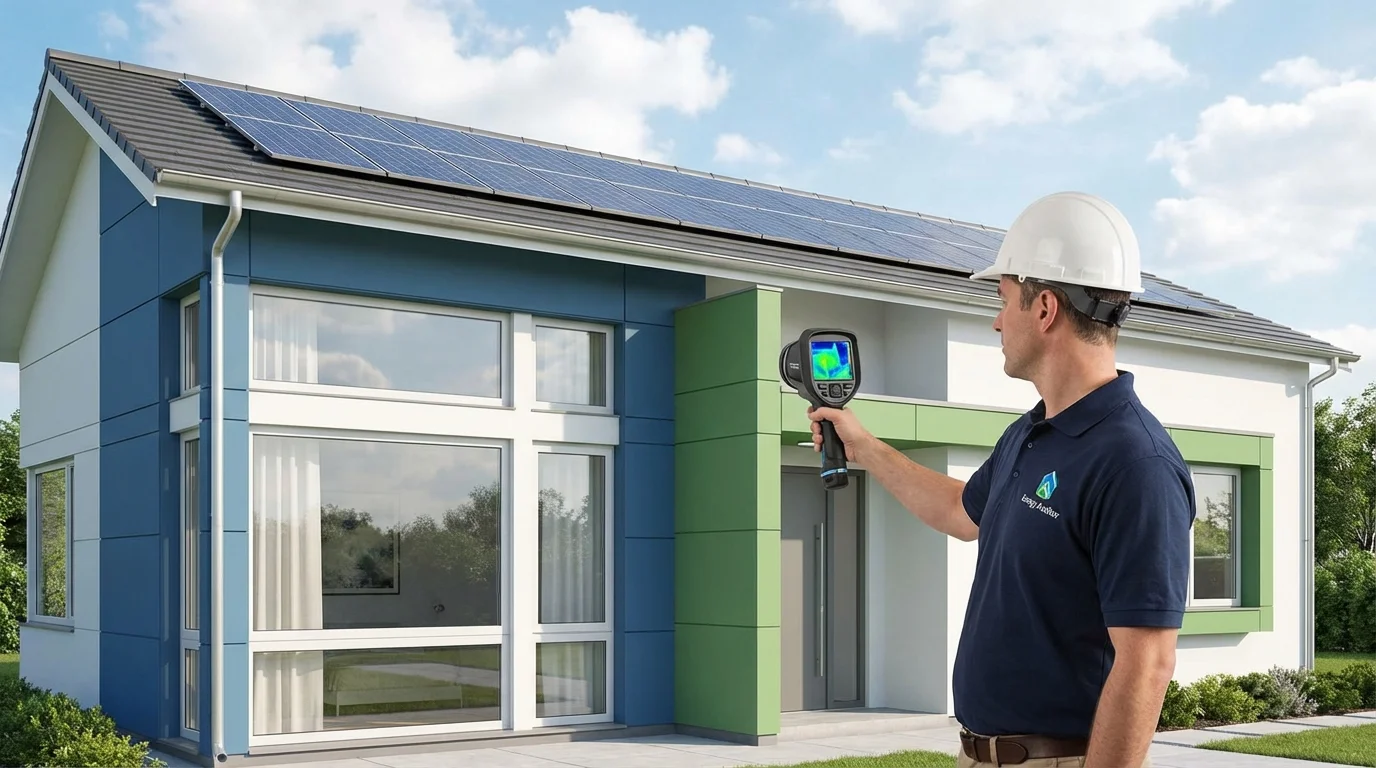
With some low-income households spending over 8.6% of their total income on energy costs, the financial strain from inefficient homes is a crushing reality. High utility bills aren't just an inconvenience; they force families to make impossible choices between heating their homes and other necessities. So the need for effective, no-cost energy efficiency solutions has never been more urgent.
What is the LIHEAP Energy Audit Program and How Can It Save You Money?
The LIHEAP Energy Audit Program is a federally-funded, state-administered initiative that provides no-cost home energy assessments for low-income households in 2026. It identifies specific sources of energy waste and recommends improvements, often covering 100% of the cost for upgrades like insulation and air sealing.
So the core tension is clear: millions of families live in homes that leak energy, driving up bills they already struggle to pay. This program directly addresses that problem. But it's not just about a one-time payment assistance check. It's about a long-term fix. The Department of Energy reports that households receiving these weatherization services save an average of $372 annually on their energy bills. And these improvements, which are installed at no cost to the resident, provide savings year after year. The goal is to reduce a household's energy burden permanently. A professional home energy audit is the first step in this process.
Who Qualifies for LIHEAP Energy Audit Rebates and What Equipment is Eligible?
Eligibility for the 2026 LIHEAP Energy Audit Program is based on household income, typically at or below 60% of the State Median Income or 150% of the federal poverty level. Eligible equipment includes insulation, air sealing, duct sealing, and sometimes repairs or replacements of inefficient heating systems.
Qualification primarily depends on household income and size. And states receive block grants, so they set their own specific income thresholds based on federal guidelines. For example, a family of four may qualify if their annual income is below $45,000, but this figure changes by state. The program prioritizes households with elderly members, individuals with disabilities, or young children. So once eligibility is confirmed, an audit identifies the most cost-effective measures. These often include adding attic and wall insulation, performing air sealing to close leaks, tuning up or repairing furnaces, and sealing ductwork. In some cases, it covers the full replacement of a dangerous or non-operational heating system.
"WAP enables low-income families to permanently reduce their energy bills by making their homes more energy efficient." — U.S. Department of Energy
How Do You Apply for the LIHEAP Energy Audit Program and What Are the Deadlines?
Applicants for the 2026 LIHEAP Energy Audit Program apply through their local Community Action Agency or social services office. Applications typically open in the fall, with deadlines varying by state, but most run from October 1 through the spring or until the allocated funds are depleted for the year.
The application process is managed at the local level, not directly by the federal government. So the first step is to locate your designated local agency, which is often found on your state's Department of Health and Human Services website. Applicants must provide documentation, including photo ID for the primary applicant, social security cards for all household members, proof of income for the last 30 days, and copies of recent energy bills. And because funding is finite and distributed on a first-come, first-served basis, applying as soon as the program opens is critical. Deadlines are strict and vary widely, with some states closing applications by March 31, 2026. Some related federal energy tax credits have different timelines.
Is the LIHEAP Energy Audit Program Available in Your State and Through Your Utility Provider?
The LIHEAP Energy Audit Program is a federal program available in all 50 states and the District of Columbia for 2026, administered by designated local agencies, not directly through utility providers. But utilities often partner with these agencies or offer complementary low-income energy efficiency programs.
While the program, often delivered as part of the Weatherization Assistance Program (WAP), is federally funded, you won't apply through a federal website. Each state manages its own distribution of funds through a network of local non-profits or government offices. So your utility company, like Duke Energy or PG&E, won't be the primary contact for LIHEAP. However, many utilities have their own energy-saving programs for income-qualified customers that can supplement LIHEAP services. And these programs sometimes offer additional rebates or services not covered by the federal program. Use our free rebate calculator to find all local and utility programs you qualify for in 2026.
Program Comparison: LIHEAP vs. Federal Rebates
| Feature | LIHEAP Weatherization | IRA HOMES Rebate | Utility Programs |
|---|---|---|---|
| Primary Goal | Reduce energy burden | Whole-home energy reduction | Peak demand reduction |
| Max Benefit | 100% of cost, avg. $8,000 | $4,000-$8,000 | $50-$500 per measure |
| Income Limit | Yes, ~60% of State Median | Yes, up to 150% of Area Median | Varies, some open to all |
| Application | Local Agency | State Energy Office | Utility Website |
Can You Stack LIHEAP Energy Audit Benefits with Other Programs, and What Are the Contractor Requirements?
LIHEAP benefits in 2026 generally can't be stacked with other funds for the same specific measure, but they can be combined with programs like IRA tax credits for different upgrades. Contractors must be BPI certified and approved by the state's LIHEAP administering agency to ensure quality and safety.
You can't receive LIHEAP funding and a utility rebate for the exact same attic insulation job. But you absolutely can use LIHEAP to cover insulation and air sealing while separately claiming a federal tax credit for installing a new high-efficiency heat pump. This "braiding" of funds allows for deeper retrofits. So the programs work in parallel to maximize savings. Contractor quality is non-negotiable.
"All work is performed by trained and certified professionals, ensuring that the energy efficiency measures are installed correctly and safely." — DSIRE
The Department of Energy requires that all weatherization work be performed by contractors holding certifications from organizations like the Building Performance Institute (BPI). And these contractors must be on a pre-approved list managed by the state's administering agency, ensuring accountability and adherence to strict installation standards. This protects homeowners and guarantees the 20- to 30-year lifespan of the installed measures.
Official Sources
- LIHEAP Clearinghouse — An official resource from the Department of Health and Human Services providing state-by-state LIHEAP information.
- DOE Weatherization Assistance Program — Federal guidance on the program that funds most LIHEAP energy audits and retrofits.
Related Reading: Learn more about Weatherization Assistance Program Wap.
Frequently Asked Questions
Who is eligible for the LIHEAP energy audit program?
Eligibility for the 2026 LIHEAP energy audit program is primarily based on household income. Most states set the limit at or below 60% of the State Median Income or 150% of the federal poverty guideline. For example, a family of four with an annual income below $45,000 would likely qualify in many states. Priority is often given to households with elderly members, young children, or individuals with disabilities.
How do I apply for a LIHEAP energy audit?
You apply for a LIHEAP energy audit through your designated local agency, not a federal website. These are typically Community Action Agencies or county social service offices. The process involves completing an application and providing proof of income for the last 30 days, identification, and recent utility bills. Applications usually open around October 1 each year, and it's best to apply early as funds are limited.
What types of home improvements or services does the LIHEAP energy audit program cover?
The program covers improvements identified in the audit that provide the highest energy savings. This almost always includes adding attic, floor, or wall insulation and performing comprehensive air sealing. It also covers health and safety checks, furnace tune-ups or repairs, and sometimes the full replacement of an inefficient or non-functional heating system. The average value of these services is approximately $8,000 per home, all at no cost to the resident.
Are there income limits to qualify for the LIHEAP energy audit program?
Yes, there are strict income limits. To qualify in 2026, a household's gross income must typically be at or below 60% of the State Median Income (SMI). Some states use 150% of the Federal Poverty Level as their guideline. These figures are updated annually and vary based on the number of people living in the home. For instance, the income limit for a single-person household will be lower than for a four-person household.
Find Your Savings in 60 Seconds
Stop guessing how much you can save. DuloCore’s platform instantly checks your eligibility for LIHEAP, federal tax credits, and local utility rebates.
Last reviewed: April 14, 2026. Reviewed by DuloCore Energy Specialists. About the team.