Editorial disclosure: DuloCore operates as an independent resource. Brand names appear for identification only. We do not receive paid compensation, commission, or affiliate revenue from any manufacturer mentioned in this article. Product recommendations reflect independent research against public specifications and energy-efficiency ratings. This disclosure is provided in accordance with FTC Endorsement Guides (16 CFR Part 255).
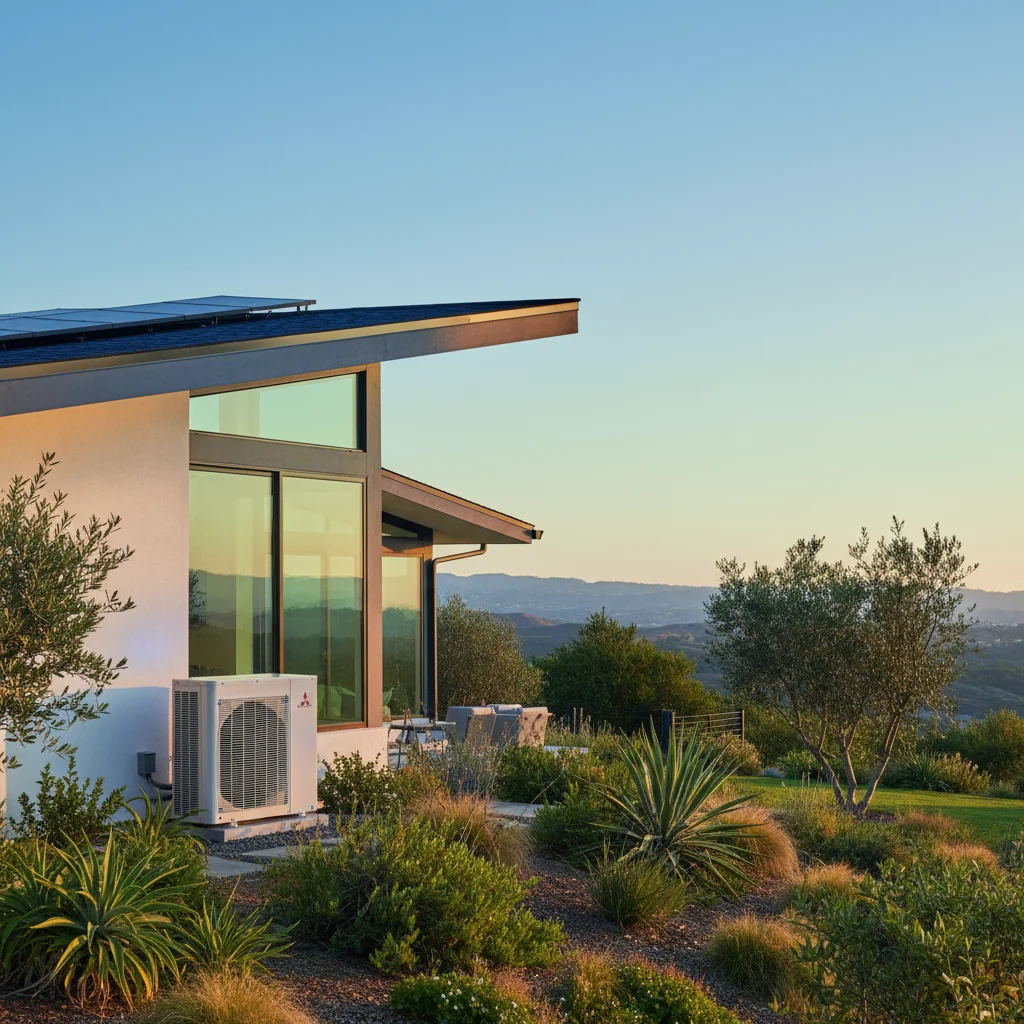
Mitsubishi heat pumps installed in California cost $8,400-$18,000 for single-zone systems and $15,000-$30,000 for multi-zone configurations—but after stacking federal IRA tax credits (30% of costs) with California utility rebates ($3,000-$6,500), homeowners pay $5,000-$15,000 out of pocket in 2026. And the payback period drops to 4-7 years through energy savings of $800-$1,500 annually.
How Much Does a Mitsubishi Heat Pump Cost in California?
Mitsubishi ductless heat pump systems cost $8,400-$18,000 for single-zone installations and $15,000-$30,000 for whole-home multi-zone systems in California. Equipment accounts for 40-50% of total costs, while labor, electrical upgrades, and permitting comprise the remainder. Installation complexity increases costs by $2,000-$5,000 in older homes requiring panel upgrades or extensive refrigerant line runs.
Single-zone systems using the Mitsubishi M-Series (MSZ-GL) start at $3,500 for equipment and $4,900-$6,000 for professional installation. Multi-zone systems with 3-5 indoor units cost $12,000-$18,000 installed. And premium models like the Mitsubishi Hyper-Heating H2i series add $1,500-$3,000 to equipment costs but deliver heating capacity at temperatures down to -13°F.
Labor rates in California metro areas range from $85-$150 per hour, with typical installations requiring 8-16 hours. Electrical work adds $500-$2,000 if upgrading from 100-amp to 200-amp service. But the heat pump rebates available through California utilities and federal programs reduce net costs by 40-60% in 2026.
"Ductless heat pumps provide efficient heating and cooling while eliminating energy losses associated with ductwork, which can account for more than 30% of energy consumption for space conditioning." — ENERGY STAR Heat Pumps Guide
What Mitsubishi Models Qualify for California Rebates and Tax Credits?
The federal Energy Efficient Home Improvement Credit (Section 25C) ended for property placed in service after December 31, 2025 (IRS FS-2025-05). Federal tax credits for this work have ended, but state, local and utility rebates may still apply; check what is available at your address with the DuloCore rebate calculator. California utility rebates require ENERGY STAR certification and variable-speed compressors, which all Mitsubishi M-Series, P-Series, and H2i models meet.
The Mitsubishi M-Series (MSZ-GL) qualifies for both federal credits and California utility rebates with SEER2 ratings of 19-22 and HSPF2 ratings of 9.0-10.5. Premium H2i models (MSZ-FH) achieve SEER2 ratings up to 23 and HSPF2 ratings of 11.0, qualifying for maximum rebate tiers. And the P-Series (MXZ) multi-zone systems qualify when paired with compatible indoor units meeting efficiency thresholds.
California utilities including PG&E, SCE, and SDG&E offer heat pump rebates ranging from $3,000-$6,500 in 2026. Income-qualified customers receive enhanced rebates of $5,500-$8,000 through TECH Clean California programs. So qualifying Mitsubishi installations receive combined incentives of $5,000-$10,000 when stacking federal and state programs.
Verify current rebate availability through the rebate calculator before purchasing, since utility program funding depletes throughout the year.
How Long Does It Take to Recover Your Investment in a Mitsubishi Heat Pump?
Mitsubishi heat pump installations in California achieve payback periods of 4-7 years through energy savings of $800-$1,500 annually compared to gas furnace and AC systems. Homes replacing electric resistance heating recover costs in 3-5 years with savings reaching $2,000 annually. The payback calculation factors equipment costs after rebates, installation expenses, energy savings, and avoided maintenance costs over the system's 20-25 year lifespan.
Energy savings depend on climate zone and replaced equipment. Coastal California homes (CZ 3-4) save $600-$900 annually replacing gas systems. Inland valley homes (CZ 12-15) with extreme summers save $1,200-$1,800 annually. And homes replacing propane or oil heating save $1,800-$2,400 annually with Mitsubishi heat pumps.
The total cost of ownership calculation includes avoided furnace maintenance ($150-$300 annually), longer equipment lifespan (heat pumps last 20-25 years versus 15-18 for furnaces), and increasing electricity rate stability compared to volatile natural gas prices. So the 20-year net savings reaches $18,000-$35,000 for typical California homes.
But payback periods extend to 8-12 years in homes with low existing energy costs or inefficient building envelopes where air sealing and insulation upgrades deliver better returns. Calculate your specific payback using the rebate calculator with your current utility bills.
How Do Mitsubishi Heat Pumps Compare in Cost to Other Brands in California?
Mitsubishi heat pumps cost 10-20% more than comparable Daikin, Fujitsu, or LG systems but deliver 5-8% higher efficiency ratings and 25-35% longer average equipment lifespan at 22-25 years versus 18-20 years. Initial equipment costs for Mitsubishi M-Series systems run $3,500-$5,500 compared to $3,000-$4,500 for Daikin Fit or Fujitsu Halcyon. The premium narrows to 5-10% after factoring rebates available for all qualifying models.
Daikin and Fujitsu systems offer comparable SEER2 ratings of 18-21 and HSPF2 ratings of 9.0-10.0, qualifying for identical rebate tiers. LG and Gree budget options cost 25-30% less at $2,500-$3,500 for equipment but sacrifice 10-15% efficiency and 30-40% lifespan. And Carrier and Trane ducted heat pumps cost $6,000-$12,000 installed for whole-home systems but require existing ductwork.
Labor costs remain consistent across brands at $85-$150 per hour for certified installers. But Mitsubishi Diamond Contractor networks maintain stricter training and warranty standards, reducing callback rates by 40-50% compared to generic HVAC contractors. So the 20-year total cost of ownership favors Mitsubishi by $2,000-$4,000 despite higher upfront costs.
Energy savings differences between premium brands amount to $50-$120 annually. Reliability differences create larger cost variations, with Mitsubishi systems requiring 30-40% fewer service calls over 15 years based on independent HVAC technician surveys.
How Long Will Your Mitsubishi Heat Pump Last and What's the Long-Term Cost?
Mitsubishi heat pumps operate for 20-25 years in California climates with proper maintenance, outlasting competitor systems by 3-5 years. The 20-year total cost of ownership including equipment, installation, maintenance, and energy costs ranges from $22,000-$38,000 compared to $28,000-$45,000 for gas furnace and AC combinations. Annual maintenance costs run $150-$250 for filter cleaning, refrigerant checks, and coil cleaning.
Equipment warranties cover compressors for 10-12 years and parts for 5-7 years when installed by certified Diamond Contractors. Extended warranties cost $400-$800 and cover parts and labor for 10 years. And Mitsubishi's variable-speed inverter compressors reduce wear by cycling less frequently than single-stage systems, extending lifespan by 25-30%.
Major repairs occur every 8-12 years with average costs of $800-$1,500 for compressor replacements or refrigerant line repairs. Annual filter replacements cost $40-$80 for washable filters or $120-$200 for HEPA upgrades. So the total maintenance and repair costs over 20 years reach $4,500-$7,500.
But avoided costs from eliminating furnace maintenance ($3,000-$6,000 over 20 years), AC repairs ($2,500-$5,000), and dual-system replacements ($8,000-$15,000) offset heat pump maintenance expenses. The net 20-year savings reaches $12,000-$25,000 compared to traditional HVAC systems.
What's the Complete Installation and Eligibility Process for Mitsubishi Rebates?
Mitsubishi heat pump rebate applications in California require pre-approval for utility programs and post-installation documentation for federal tax credits. The process takes 4-8 weeks from application to rebate payment. Start with a home energy assessment ($0-$150) to identify qualifying equipment, apply for utility rebates before installation, complete installation with a certified contractor, submit documentation within 90 days, and claim federal energy tax credits when filing taxes.
California utility rebates require applications submitted through contractor portals before installation begins. PG&E processes applications in 2-3 weeks, while SCE and SDG&E average 1-2 weeks. Income-qualified programs require verification of household income below 80% of area median income through tax returns or benefit enrollment documents. And TECH Clean California rebates require completed Home Upgrade forms documenting pre- and post-installation energy modeling.
Form 5695 only covers qualifying work completed by December 31, 2025 and claimed on a 2025 return; the federal 25C and 25D credits ended after that date (IRS FS-2025-05). The form needs manufacturer certification statements (available from Mitsubishi distributors), contractor invoices showing equipment costs and installation labor, and building permit numbers. Homeowners claim the credit in the tax year when installation was completed, with unused credits carrying forward to future years if tax liability is insufficient.
Installation timelines run 1-3 days for single-zone systems and 3-5 days for multi-zone installations. Permit approval adds 1-3 weeks in most California jurisdictions. So the total timeline from application to completed installation runs 6-10 weeks during peak season (March-June and September-November).
Official Sources
- ENERGY SAVER — Federal energy efficiency rebates and tax credit information (note: the federal 25C and 25D credits ended for projects completed after December 31, 2025)
- ENERGY STAR Heat Pumps — Qualified product lists and efficiency requirements
- DSIRE California — Database of state and utility rebate programs
Frequently Asked Questions
How much does a Mitsubishi heat pump cost in California?
Mitsubishi heat pumps cost $8,400-$18,000 for single-zone systems and $15,000-$30,000 for multi-zone installations in California before rebates. After applying the 30% federal IRA tax credit (up to $2,000) and California utility rebates ($3,000-$6,500), net costs drop to $5,000-$15,000. Equipment accounts for 40-50% of total costs, with labor, electrical work, and permits comprising the remainder.
What rebates are available for Mitsubishi heat pump installation in California?
California utilities offer heat pump rebates of $3,000-$6,500 through PG&E, SCE, and SDG&E in 2026. Income-qualified customers receive enhanced rebates of $5,500-$8,000 through TECH Clean California programs. The federal Energy Efficient Home Improvement Credit (Section 25C) ended for property placed in service after December 31, 2025 (IRS FS-2025-05). Combined incentives reach $5,000-$10,000 for qualifying installations, reducing net costs by 40-60%.
Are Mitsubishi heat pumps eligible for California tax credits in 2026?
The federal Energy Efficient Home Improvement Credit (Section 25C) ended for property placed in service after December 31, 2025 (IRS FS-2025-05). All Mitsubishi M-Series, P-Series, and H2i models exceed these thresholds. California does not offer separate state tax credits but provides utility rebates of $3,000-$6,500 that stack with federal credits.
How do I apply for Mitsubishi heat pump rebates in California?
Apply for California utility rebates before installation through certified contractor portals on PG&E, SCE, or SDG&E websites. Applications process in 1-3 weeks. Complete installation with a certified contractor, submit final documentation within 90 days, and receive rebate payments in 4-8 weeks. Form 5695 only covers qualifying work completed by December 31, 2025 and claimed on a 2025 return; the federal 25C and 25D credits ended after that date (IRS FS-2025-05).
What is the difference between federal and state rebates for heat pumps?
The federal Energy Efficient Home Improvement Credit (Section 25C) ended for property placed in service after December 31, 2025 (IRS FS-2025-05). California utility rebates provide $3,000-$6,500 paid directly by utilities within 4-8 weeks with varying income requirements by program. Federal credits reduce tax liability, while utility rebates provide upfront cost reduction. Both programs stack, delivering combined savings of $5,000-$10,000 for qualifying Mitsubishi heat pump installations in 2026.
Ready to find your exact savings? Use our free rebate calculator to calculate your personalized Mitsubishi heat pump costs after all available federal and California rebates. Get your custom quote in under 2 minutes with current 2026 program amounts.
Updated: April 14, 2026 — fact-checked by DuloCore Research. About our editorial process.
Check your California heat pump rebate eligibility — see the programs you qualify for and the dollar amounts on our California heat pump rebate finder.