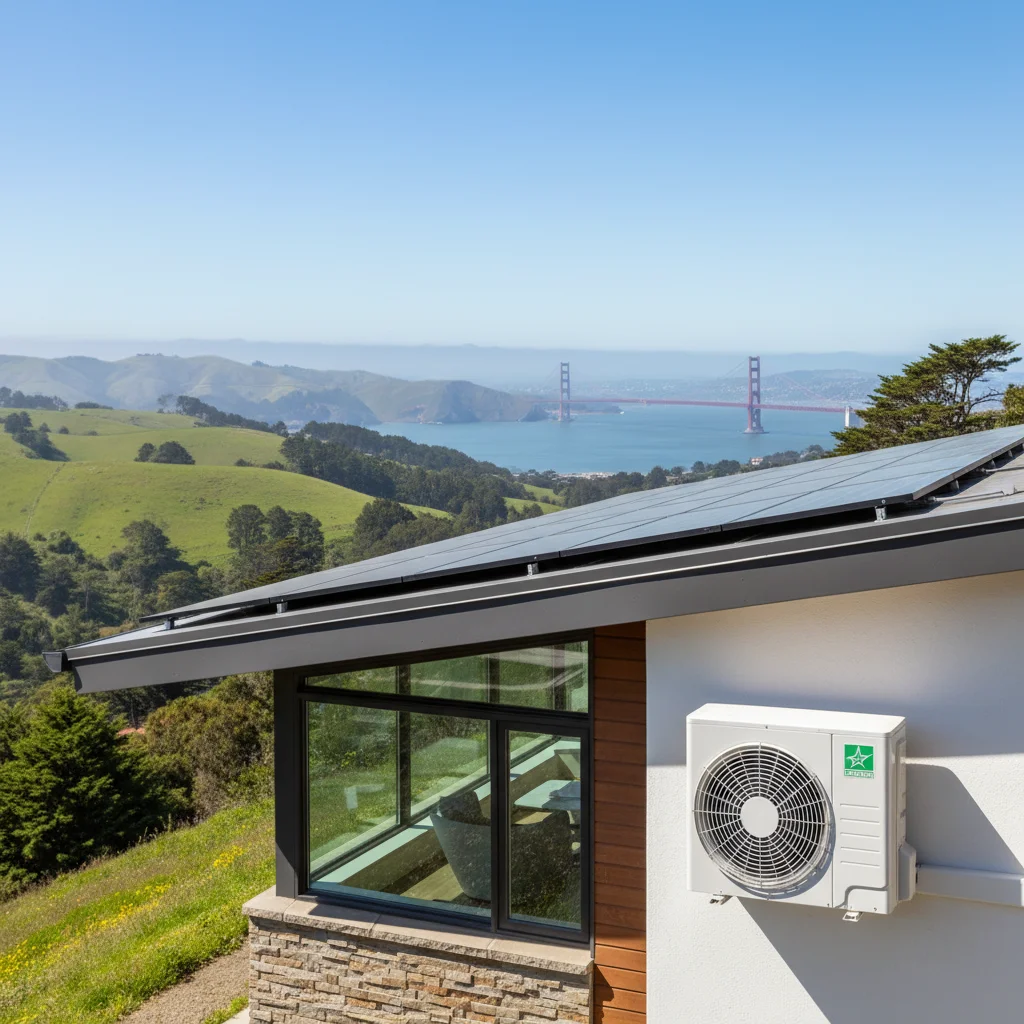
San Francisco homeowners spent an average of $14,200 on ductless heat pump installations in 2026, with Mitsubishi systems commanding premium pricing 18-25% above competitor brands. But federal tax credits now cover 30% of total project costs through 2032, and Bay Area utility rebates add another $3,000-$5,000, bringing net installation costs down to $6,000-$9,000 for most qualifying households.
What is the average cost of a Mitsubishi heat pump system in San Francisco?
Mitsubishi Electric heat pump systems cost $12,000-$18,000 installed in San Francisco in 2026, depending on home size, zone configuration, and model selection. Single-zone systems average $5,500-$8,000, while multi-zone installations serving 3-4 rooms range $12,000-$18,000 with professional installation and electrical work.
And the price variation reflects San Francisco's unique installation challenges. Victorian and Edwardian homes require custom mounting brackets, upgraded electrical panels, and specialized condensate management for fog-prone neighborhoods. Installers charge $120-$180 per hour in San Francisco versus $85-$110 in inland California cities.
Mitsubishi's premium tier—the Hyper-Heating H2i series designed for cold climate performance—adds $1,200-$2,400 to base system costs. But San Francisco's mild winters rarely justify this upgrade. The standard M-Series and P-Series models maintain 100% heating capacity down to 5°F, well below the city's coldest recorded temperature of 27°F.
So most San Francisco installations use 12,000-18,000 BTU outdoor units paired with 2-4 wall-mounted indoor heads. A typical 1,200-square-foot flat requires one 18,000 BTU outdoor unit ($3,800) plus three 9,000 BTU indoor heads ($1,400 each), totaling $8,000 in equipment before installation labor.
"Ductless heat pumps can reduce heating and cooling energy use by 25-50% compared to conventional electric resistance systems." — ENERGY STAR
How long does it take to break even on a Mitsubishi heat pump investment?
San Francisco homeowners break even on Mitsubishi heat pump installations in 6-9 years based on 2026 energy rates and available incentives. A $14,000 system drops to $6,800 net cost after the 30% federal tax credit ($4,200) and PG&E's Tech Clean California rebate ($3,000), requiring annual energy savings of $755-$1,133 to reach payback.
Households replacing electric baseboard heating see the fastest payback—often 4-6 years. Electric resistance heating costs $0.42 per kWh in San Francisco on PG&E's tiered residential rate, while heat pumps deliver the same heat for $0.14-$0.18 per kWh. A 1,500-square-foot home heating 6 months annually saves $1,400-$1,800 per year switching from baseboard to Mitsubishi heat pump.
But homes with natural gas furnaces face longer payback periods of 9-14 years. Natural gas averages $2.87 per therm in San Francisco, making gas heat cheaper per BTU than electric heat pumps in mild winters. The economic case strengthens when factoring cooling savings—Mitsubishi heat pumps eliminate window AC units that cost $180-$320 annually to run.
And the rebate calculator accounts for San Francisco's declining block rate structure. High-use households in Tier 3 ($0.54/kWh) see 40% faster payback than low-use households in Tier 1 ($0.32/kWh). Check our heat pump rebates guide for current program details.
What rebates and tax incentives can reduce your Mitsubishi heat pump costs?
The federal Energy Efficient Home Improvement Credit (Section 25C) ended for property placed in service after December 31, 2025 (IRS FS-2025-05). Federal tax credits for this work have ended, but state, local and utility rebates may still apply; check what is available at your address with the DuloCore rebate calculator. The maximum annual credit is $2,000 for heat pumps, applying to equipment, installation labor, electrical upgrades, and permit fees. Systems must meet ENERGY STAR Most Efficient criteria—all current Mitsubishi ductless models qualify.
California utilities offer point-of-sale rebates through the Tech Clean California program. PG&E provides $3,000 for ductless heat pump installations replacing electric resistance heating, and $1,500 for homes with existing gas heating. Bay Area Air Quality Management District adds $500-$2,000 for low-income households, verified through income documentation or enrollment in CARE/FERA utility discount programs.
So a qualifying San Francisco household installing a $14,000 Mitsubishi system receives $4,200 federal credit + $3,000 PG&E rebate + $1,500 BAAQMD low-income incentive = $8,700 total reduction. Net cost drops to $5,300 for equipment and installation covering whole-home heating and cooling.
Form 5695 only covers qualifying work completed by December 31, 2025 and claimed on a 2025 return; the federal 25C and 25D credits ended after that date (IRS FS-2025-05). Utility rebates process in 4-8 weeks as checks or account credits. And income-qualified incentives require pre-approval before installation begins.
How does the Mitsubishi heat pump cost compare to other HVAC systems in San Francisco?
Mitsubishi heat pump systems cost 15-30% more than comparable Daikin, Fujitsu, or LG installations in San Francisco. A 3-zone Mitsubishi system averages $14,200 installed versus $11,800 for Daikin and $10,600 for LG. But Mitsubishi's 12-year compressor warranty exceeds industry standard 5-7 year coverage, and the brand maintains a dedicated San Francisco service network with 2-hour emergency response.
Traditional ducted HVAC replacements cost $8,000-$16,000 in San Francisco, comparable to multi-zone ductless systems. But ducted installations require existing ductwork in good condition—a $6,000-$12,000 additional cost for homes without ducts. Victorian and Edwardian buildings rarely accommodate full duct runs without major structural modifications.
Window air conditioners cost $400-$1,200 per unit, but provide cooling only. A 1,200-square-foot flat needs 3-4 window units ($1,600 total) plus separate heating, while a single Mitsubishi heat pump handles both functions. And window units block natural light, create security vulnerabilities, and violate some San Francisco condo association rules.
So the comparison shifts when accounting for dual heating-cooling functionality. A gas furnace ($4,500) + central AC ($5,500) totals $10,000, matching multi-zone heat pump costs. But heat pumps eliminate gas service fees ($12/month), avoid combustion safety concerns, and qualify for higher incentive amounts than gas equipment.
What factors affect Mitsubishi heat pump pricing and installation costs?
San Francisco's housing stock drives significant price variation. Single-family homes with ground-level outdoor unit placement average $12,000-$14,000 for 3-zone systems. But multi-story buildings requiring rooftop condenser mounting add $2,000-$3,500 for crane rental, rigging, and reinforced mounting pads. Buildings over 4 stories need structural engineering approval, adding $1,200-$1,800 to project costs.
Electrical panel upgrades affect 40% of San Francisco heat pump installations. Homes built before 1980 often have 100-amp service insufficient for heat pump loads. Panel upgrades to 200-amp service cost $2,500-$4,500, but qualify for federal tax credit inclusion. And some neighborhoods require secondary electrical permits from SF Planning Department, adding 2-4 weeks to project timelines.
Zone configuration impacts equipment costs directly. Each indoor head adds $1,400-$2,200 depending on capacity. A 9,000 BTU wall unit costs $1,400, while a 15,000 BTU floor console runs $2,200. Ceiling cassette units for commercial spaces or high-ceiling homes add 30-40% to per-zone costs.
But installation labor represents 35-45% of total project cost. Licensed contractors charge $4,800-$8,000 for 3-zone installations including refrigerant line runs, electrical connections, wall penetrations, and system commissioning. Permit fees add $300-$600. And San Francisco's mandatory HERS rater verification for energy tax credits adds $150-$250 to documentation costs.
Is a Mitsubishi heat pump worth the investment for San Francisco homeowners?
San Francisco's climate profile makes heat pumps economically viable across 78% of the city's housing stock, according to 2026 California Energy Commission modeling. Mild winters (average low 46°F) and moderate summers (average high 67°F) keep heat pumps operating at peak efficiency year-round. Systems maintain COP (Coefficient of Performance) above 3.0 in San Francisco versus 1.8-2.2 in colder climates.
Homes without existing ductwork see the strongest economics. Installing new ducts costs $6,000-$12,000 before equipment, making ductless heat pumps the lowest-cost path to whole-home comfort. And Victorian homes with radiator heating gain modern cooling capability without architectural modifications.
But natural gas customers face marginal economics. PG&E gas rates ($2.87/therm) remain below the breakeven point versus electric heat pumps in mild winters. The case strengthens when factoring cooling demand—homes running window AC units 4+ months annually save $320-$480 yearly consolidating to heat pumps.
So the investment equation depends on existing systems and usage patterns. Electric heat households break even in 4-6 years. Gas heat households break even in 9-14 years. And renters or homeowners planning to sell within 5 years might not capture full payback, though heat pumps add $8,000-$12,000 to home resale value per Zillow 2026 market analysis.
Official Sources
- ENERGY STAR Heat Pumps — Federal efficiency standards and qualified product listings
- IRS Energy Credits — Tax credit eligibility and filing requirements (note: the federal 25C and 25D credits ended for projects completed after December 31, 2025)
- DOE Energy Saver — Heat pump technology guides and energy savings estimates
Frequently Asked Questions
How much does a Mitsubishi heat pump cost in San Francisco?
Mitsubishi heat pump installations cost $12,000-$18,000 in San Francisco for complete multi-zone systems in 2026. Single-zone systems range $5,500-$8,000. Costs include equipment, installation labor, electrical work, permits, and startup commissioning. Prices vary based on home size, zone count, and installation complexity.
What rebates are available for Mitsubishi heat pumps in San Francisco?
PG&E offers $3,000 rebates for ductless heat pumps replacing electric heating, and $1,500 for gas heating replacements through Tech Clean California. Bay Area Air Quality Management District provides $500-$2,000 additional incentives for income-qualified households. The federal Energy Efficient Home Improvement Credit (Section 25C) ended for property placed in service after December 31, 2025 (IRS FS-2025-05).
Are Mitsubishi heat pumps eligible for federal tax credits in 2026?
The federal Energy Efficient Home Improvement Credit (Section 25C) ended for property placed in service after December 31, 2025 (IRS FS-2025-05). The maximum annual credit is $2,000 for heat pump equipment and installation. Systems must meet ENERGY STAR Most Efficient criteria. Form 5695 only covers qualifying work completed by December 31, 2025 and claimed on a 2025 return; the federal 25C and 25D credits ended after that date (IRS FS-2025-05).
How long does it take to install a Mitsubishi heat pump in San Francisco?
Standard 3-zone Mitsubishi installations take 1-2 days for experienced contractors. Day 1 covers outdoor unit mounting, refrigerant line runs, and electrical connections. Day 2 handles indoor head installation, system charging, and commissioning. Complex installations requiring electrical panel upgrades or rooftop mounting extend timelines to 3-4 days.
What is the difference between a Mitsubishi heat pump and a traditional air conditioner?
Heat pumps provide both heating and cooling by reversing refrigerant flow, while air conditioners only cool. Mitsubishi heat pumps replace both furnaces and AC units with one system. Heat pumps transfer heat rather than generating it, achieving 300-400% efficiency versus 95% for gas furnaces. And heat pumps qualify for higher rebate amounts than cooling-only equipment.
Ready to calculate your savings? Use our free rebate calculator to estimate your net Mitsubishi heat pump cost after federal credits and California utility incentives. Get a personalized breakdown based on your current heating system and energy usage.
Updated on April 14, 2026. Fact-checked by DuloCore Editors. About our research team.
Check your California heat pump rebate eligibility — see the programs you qualify for and the dollar amounts on our California heat pump rebate finder.