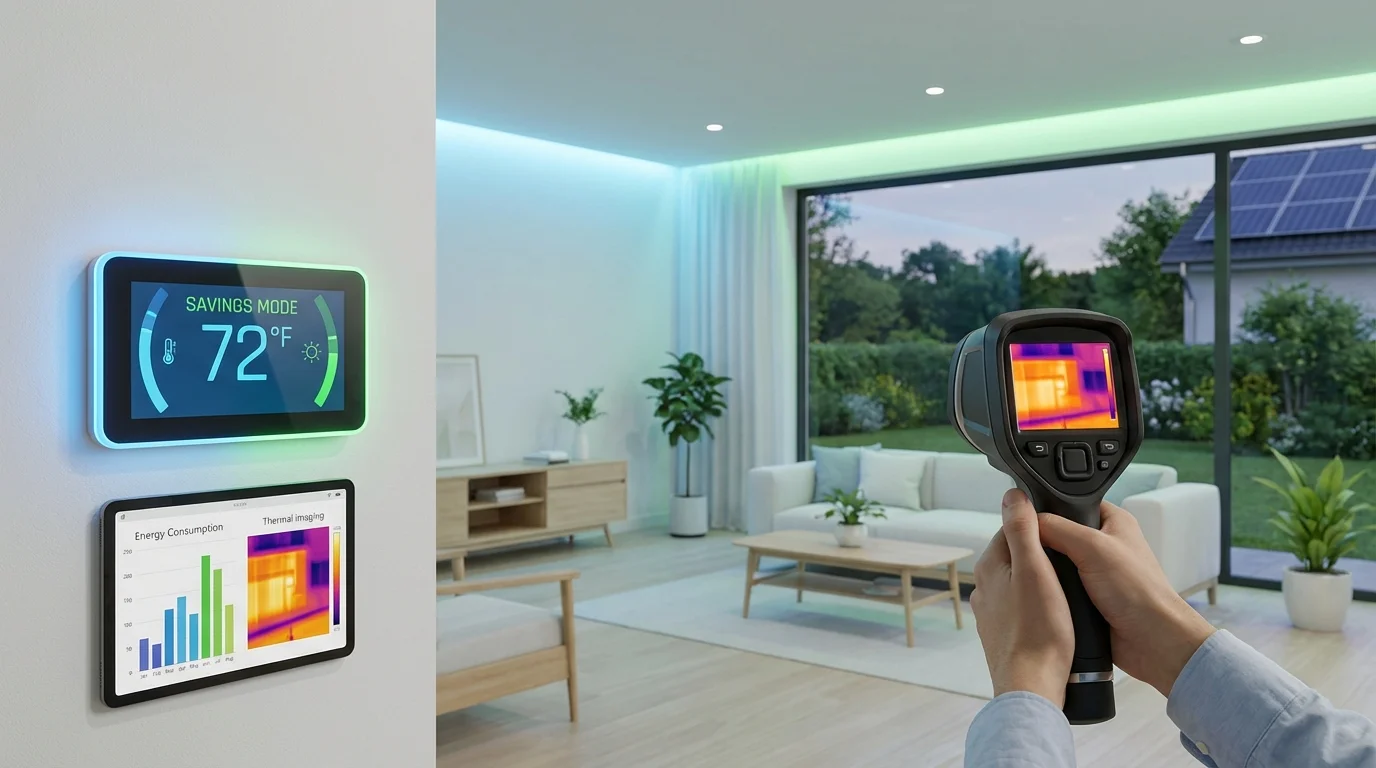
Heating and cooling account for nearly half of the average American household's energy bill, a cost that continues to climb each year. Yet many homeowners overlook one of the most accessible ways to control these expenses. So simply adjusting your home’s temperature by 7°–10°F for 8 hours a day from its normal setting saves up to 10% a year on heating and cooling. A programmable thermostat automates this process, ensuring consistent savings without daily manual adjustments.
How Much Can a Programmable Thermostat Save You Annually on Energy Bills?
A programmable thermostat saves homeowners up to $180 annually by optimizing heating and cooling schedules. These ENERGY STAR certified devices reduce energy consumption by 10-15% by automatically adjusting temperatures during sleep or away periods, preventing wasteful HVAC operation when climate control is not needed.
Properly using a programmable thermostat translates directly into lower utility bills. So the device prevents the HVAC system from running unnecessarily when the home is empty or occupants are asleep. But the exact savings depend on factors like local climate, home insulation, and the specific temperature setbacks programmed. For instance, a wider temperature setback—like 10°F instead of 5°F—delivers greater savings. And completing a home energy audit identifies other areas for efficiency improvements, further increasing the financial return from a thermostat upgrade. The Department of Energy confirms these savings are achievable for most households.
"You can save as much as 10% a year on heating and cooling by simply turning your thermostat back 7°-10°F for 8 hours a day from its normal setting." — U.S. Department of Energy
What Specific Rebates and Incentives Are Available for Smart Thermostats in My State and From My Utility?
Specific rebates for smart and programmable thermostats vary by state and utility provider, with 2026 programs offering between $25 and $100 per device. These incentives are designed to offset the upfront cost of ENERGY STAR certified models, encouraging adoption of energy-saving technology.
State and local utility companies administer most thermostat rebate programs. For example, Con Edison in New York offers a $50 rebate, while PG&E in California provides up to $75 for qualifying smart thermostats. So homeowners must check with their specific electricity or gas provider for current 2026 offers, as funding is often limited and operates on a first-come, first-served basis. And many of these local rebates can be combined with broader federal energy tax credits for a complete home efficiency upgrade. These programs often have specific lists of eligible equipment, so verifying your chosen model qualifies is a critical first step.
Am I Eligible for Programmable Thermostat Rebates, and Are There Income-Based Programs?
Eligibility for programmable thermostat rebates typically requires being a residential customer of the sponsoring utility and purchasing an ENERGY STAR certified model. Some 2026 programs include income-based incentives that offer higher rebate amounts or free thermostats for low-to-moderate income households, often defined by local median income levels.
Most standard rebate programs are open to all residential customers, regardless of income. But income-qualified programs provide enhanced support. For instance, a state's energy assistance program offers a free smart thermostat installation for households earning below 80% of the area median income (AMI). And homeowners must provide proof of income and residency to qualify for these specific programs. The application process is straightforward, but documentation requirements are strict. Use our free rebate calculator to find incentives you qualify for based on your location and income level.
What is the Application Process, Key Deadlines, and Current Funding Status for Thermostat Rebates?
The application process for a 2026 thermostat rebate typically involves submitting an online or mail-in form with a proof of purchase and the device's model number. Key deadlines are often December 31, 2026, or when program funding is exhausted, whichever comes first.
Homeowners should act quickly, as funding for these popular programs is limited and allocated annually. So the first step is to confirm the thermostat model is on the utility's pre-approved list before purchase. After installation, applicants submit the dated sales receipt and the UPC code from the packaging. And processing times range from 4 to 8 weeks, after which a check or bill credit is issued. Checking the utility's rebate portal for the current funding status is essential, as popular programs close early. This is especially true for incentives covering other upgrades like heat pump rebates.
"State, local, and utility incentives for energy efficiency can be found by searching DSIRE, the Database of State Incentives for Renewables & Efficiency." — DSIREUSA.org
Can I Combine Multiple Thermostat Rebates, and Are There Specific Contractor Requirements for Installation?
Combining a utility rebate with a manufacturer's discount on a programmable thermostat is often permitted, maximizing total savings. However, stacking two separate utility rebates for the same device is generally prohibited. Most 2026 programs don't require professional installation for these plug-and-play devices.
The ability to stack incentives, known as rebate stacking, depends on program rules. For example, a homeowner can apply for a $75 utility rebate and also claim a $25 instant discount from the manufacturer at the point of sale. But applying for a $75 rebate from both an electric and a gas utility for one thermostat is not allowed. And while professional installation isn't mandatory for most thermostat rebates, some "smart home" packages that bundle thermostats with other devices require installation by a certified contractor. Always review the program's terms and conditions to confirm stacking rules and any installation requirements.
2026 Thermostat Rebate Program Comparison
| Program / Utility | Rebate Amount | Eligibility Requirements | Application Deadline |
|---|---|---|---|
| State Energy Office (Example) | Up to $100 | Must be an ENERGY STAR certified smart thermostat; resident of the state. | December 31, 2026 |
| PG&E (California) | $75 | Must be a residential electric customer; qualifying model installed. | While funds last |
| Con Edison (New York) | $50 | Must be a residential electric customer; new qualifying device. | December 31, 2026 |
Official Sources
- ENERGY STAR — Federal resource for identifying certified energy-efficient products, including programmable and smart thermostats.
- Database of State Incentives for Renewables & Efficiency (DSIRE) — A comprehensive database of state, local, utility, and federal incentives that promote renewable energy and energy efficiency.
Frequently Asked Questions
How much money can a programmable thermostat save on energy bills?
A programmable thermostat saves a typical household up to $180 per year on energy bills. According to the U.S. Department of Energy, setting the temperature back 7°-10°F for 8 hours a day reduces annual heating and cooling costs by up to 10%. Savings vary based on climate and home insulation.
What types of programmable thermostats qualify for energy rebates?
Most 2026 energy rebate programs require the purchase of an ENERGY STAR certified programmable or smart thermostat. Utilities provide a specific list of qualifying models from brands like Google Nest, Ecobee, and Honeywell. So always verify your chosen model is on the approved list before purchasing to ensure eligibility.
How do programmable thermostats compare to smart thermostats for energy savings?
Both save energy, but smart thermostats offer greater savings potential, often 15-20% on heating and cooling costs compared to 10% for basic programmable models. Smart thermostats learn your behavior and use geofencing to adjust temperatures automatically, while programmable models rely on a fixed schedule you create.
What is the process to apply for programmable thermostat energy savings incentives?
The process involves purchasing a qualifying model, then submitting an online or mail-in application to your utility provider. You'll need to provide a copy of the dated sales receipt and the product's UPC code. Most applications are processed within 4-8 weeks, resulting in a bill credit or check.
Are there deadlines to claim rebates for programmable thermostat installations?
Yes, most 2026 rebate programs have a firm deadline, typically December 31, 2026, or whenever the program's allocated funds are depleted. Because funding is limited and distributed on a first-come, first-served basis, it's best to apply as soon as possible after your purchase and installation.
Unlock Your Home's Full Rebate Potential
Don't guess what you can save. Get a precise, instant estimate of all the thermostat, heat pump, and insulation rebates you qualify for.
Calculate Your Savings NowLast updated: April 14, 2026. Reviewed by the DuloCore Editorial Team. About our authors.
Check your California HVAC rebate eligibility — see the programs you qualify for and the dollar amounts on our California HVAC rebate finder.