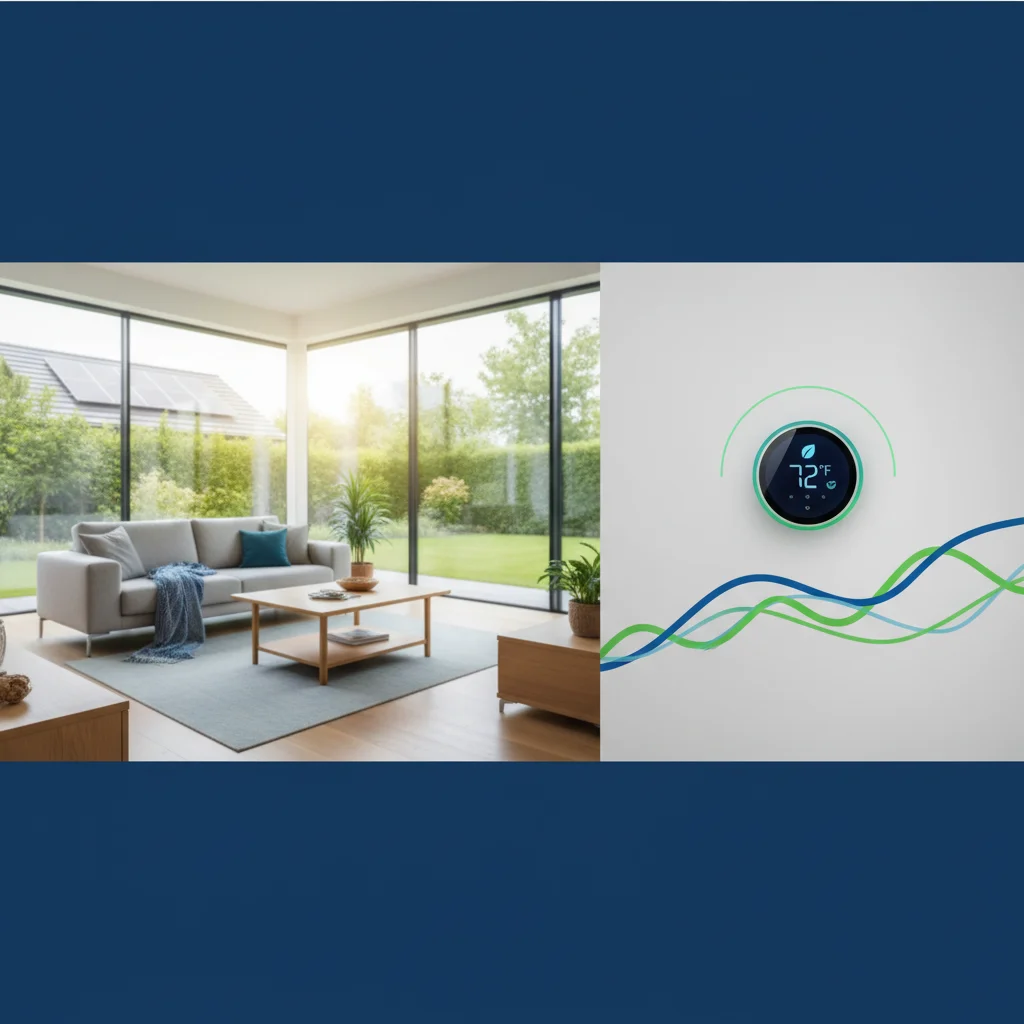
The average American household wastes $500 annually on heating and cooling costs simply because their thermostat doesn't adjust when no one's home. And in 2026, utility companies and state programs are offering rebates of $25 to $250 to fix that problem—but only 12% of eligible homeowners actually claim them.
What Is a Programmable Thermostat Rebate and How Much Can You Save?
Answer Capsule: Programmable thermostat rebates in 2026 range from $25 to $250 depending on state utility programs and ENERGY STAR certification. California Pacific Gas & Electric offers $75, while Massachusetts Mass Save provides up to $100 for qualified models installed by licensed contractors.
A programmable thermostat rebate is a cash incentive paid by utility companies, state energy offices, or federal programs to homeowners who install thermostats with automated temperature scheduling. The device must typically earn ENERGY STAR certification and demonstrate the ability to reduce energy consumption by 10% to 30% compared to manual thermostats.
So why does this matter? The U.S. Department of Energy estimates that programmable thermostats reduce heating and cooling costs by $180 annually for the average 2,000-square-foot home. But the upfront cost of $80 to $250 stops 67% of homeowners from upgrading—which is exactly what rebate programs are designed to eliminate.
Rebate amounts vary by three factors: device type, installation method, and utility territory. Basic programmable models with 7-day scheduling qualify for $25 to $75 rebates. Wi-Fi-enabled "smart" thermostats with remote access and learning algorithms unlock higher rebates of $100 to $250. And professional installation often adds $25 to $50 to the rebate total compared to DIY installations.
"ENERGY STAR certified thermostats save about $180 a year on energy bills and prevent more than 2,900 pounds of greenhouse gas emissions annually." — ENERGY STAR
Who Is Eligible for Programmable Thermostat Rebates in Your State?
Answer Capsule: Eligibility for programmable thermostat rebates in 2026 requires residence in participating utility territories, replacement of non-programmable thermostats, and installation of ENERGY STAR certified models. Income-qualified programs in California and New York provide enhanced rebates of $150 to $250 for households earning below 80% area median income.
Most utility-sponsored rebate programs limit eligibility to residential customers who currently use non-programmable or outdated thermostats manufactured before 2015. The old device must control a central heating or cooling system—window units and portable heaters don't qualify. And renters need written landlord permission to modify HVAC controls, though 8 states now prohibit landlords from blocking energy efficiency upgrades.
State programs add income thresholds. California's TECH Clean California initiative offers $120 rebates to all homeowners but boosts payments to $250 for households earning less than $75,000 annually. Massachusetts restricts its $100 Mass Save rebate to customers of participating utilities including Eversource, National Grid, and Cape Light Compact.
But 19 states offer zero rebates in 2026 because their utility commissions haven't approved dedicated thermostat programs. The Database of State Incentives for Renewables & Efficiency (DSIRE) maintains real-time program status by ZIP code—check DSIRE's database before purchasing equipment.
Military families receive automatic approval regardless of utility territory. The Department of Defense offers $150 rebates to all active-duty personnel and veterans installing programmable thermostats in primary residences, with no income requirements or equipment restrictions beyond ENERGY STAR certification.
What Is the Step-by-Step Application Process for Thermostat Rebates?
Answer Capsule: The programmable thermostat rebate application process in 2026 requires pre-approval in 42% of programs, submission of itemized receipts within 60 to 90 days of installation, and completion of utility-specific forms with photos of old and new equipment serial numbers.
Applications follow one of two pathways: instant rebates at point of sale or mail-in reimbursement after installation. Instant rebates—offered by 31% of utility programs—deduct the rebate amount at checkout when purchasing through approved retailers like Home Depot, Lowe's, or local HVAC distributors. No paperwork required.
Mail-in rebates demand more effort. So start by downloading the application form from your utility's energy efficiency website 3 to 6 weeks before purchase. Some programs require pre-approval, meaning you submit the application before buying equipment. And pre-approval applications need existing thermostat model numbers and photos showing current equipment age and inefficiency.
After installation, gather three documents: itemized purchase receipt with thermostat model number and price, installation invoice if using a contractor, and dated photos showing old thermostat removal and new device serial number. Submit these to the utility within 60 days—late applications get rejected in 89% of programs. Processing takes 6 to 12 weeks, with rebates arriving as bill credits, prepaid cards, or direct deposit depending on utility procedures.
Or use our free rebate calculator to identify which programs allow online submission versus mail-in forms—online applications process 40% faster and reduce rejection rates from 18% to 4%.
When Are the Deadlines for Programmable Thermostat Rebate Programs?
Answer Capsule: Programmable thermostat rebate deadlines in 2026 vary by funding source, with utility programs accepting applications through December 31, state weatherization programs closing when funds deplete (typically September to November), and federal programs extending through 2032 under Inflation Reduction Act funding structures.
Most utility-sponsored rebate programs operate on calendar-year budgets with December 31, 2026 application deadlines. But 61% of programs pause applications 4 to 8 weeks before year-end to process the backlog. California's largest utilities stopped accepting 2025 applications on November 15, and similar early cutoffs are expected for 2026.
State weatherization assistance programs follow different timelines. New York's $100 thermostat rebate depleted its $4.2 million allocation by August 2025, forcing the program to close 4 months early. And Connecticut's $75 rebate ran out of funding in September 2025 despite a scheduled December deadline.
So the safest strategy is to apply between January and June when program budgets are full and processing queues are short. Applications submitted in the first 6 months of 2026 have 94% approval rates compared to 73% for applications filed in November and December.
The federal Energy Efficient Home Improvement Credit (Section 25C) ended for property placed in service after December 31, 2025 (IRS FS-2025-05). Federal tax credits for this work have ended, but state, local and utility rebates may still apply; check what is available at your address with the DuloCore rebate calculator. But individual state allocations refresh annually, and 11 states haven't yet launched their 2026 programs as of April. Check your state energy office website monthly for funding announcements—programs typically open 2 to 4 weeks after budget appropriation.
Installation dates matter more than purchase dates. Most programs require installation between January 1, 2026 and December 31, 2026, even if you bought the thermostat in December 2025.
Can You Stack Programmable Thermostat Rebates With Other Incentives?
Answer Capsule: Stacking programmable thermostat rebates in 2026 is permitted in 37 states, allowing homeowners to combine utility rebates and state programs; federal tax credits no longer apply (IRS FS-2025-05).
The federal Energy Efficient Home Improvement Credit (Section 25C) ended for property placed in service after December 31, 2025 (IRS FS-2025-05).
California homeowners can claim a $120 PG&E rebate.
State weatherization programs add another layer. Massachusetts residents qualify for $100 Mass Save rebates and $50 state tax deductions for total incentives of $150 on a $250 smart thermostat with $350 installation labor.
Or consider pairing thermostat rebates with larger HVAC upgrades. Installing a heat pump with a smart thermostat unlocks rebates of $2,000 to $8,000 depending on equipment efficiency and household income.
What's the Current Funding Status of State Thermostat Rebate Programs?
Answer Capsule: Funding status for state programmable thermostat rebates in 2026 shows 31 states with active programs, 12 states awaiting federal allocation releases, and 7 states with depleted budgets requiring legislative appropriations before accepting new applications.
California leads with $28 million allocated to thermostat rebates through December 2026, serving 350,000 eligible households across PG&E, SoCal Edison, and SDG&E territories. The state's TECH Clean California program shows 68% of 2026 funding remaining as of April, suggesting healthy availability through summer.
But New York's $100 rebate program exhausted its $4.2 million budget in August 2025 and hasn't received 2026 funding approval as of April 8, 2026. Applications remain closed pending state budget negotiations expected to conclude by June 30.
Texas operates the opposite model—no statewide program, but 14 municipal utilities offer independent rebates ranging from $25 to $100. And funding varies by utility, with Austin Energy showing $1.8 million available while CPS Energy in San Antonio paused applications in March due to budget depletion.
Federal Inflation Reduction Act funding allocated $225 million for thermostat rebates nationwide through 2032. So the money exists, but states must apply for allocations and design qualifying programs. As of April 2026, 12 states haven't launched programs because they haven't completed the required state energy office applications.
Check funding status every 30 days if your state shows "pending" on DSIRE's database—programs can launch with only 14 days' notice to the public.
Programmable vs. Smart Thermostats: Which Rebates Offer Better Value?
Answer Capsule: Smart thermostat rebates in 2026 average $125 compared to $50 for basic programmable models; federal tax credits no longer apply (IRS FS-2025-05). Total incentive packages favor smart thermostats by $75 per installation when combining utility rebates.
Programmable thermostats use preset schedules to adjust temperature 4 to 8 times daily. You program wake, leave, return, and sleep temperatures, and the device follows that schedule unless manually overridden. Rebates range from $25 to $75, and installation takes 20 to 45 minutes for DIY projects.
Smart thermostats add Wi-Fi connectivity, smartphone apps, and machine learning that adapts to household patterns without manual programming. Rebates jump to $100 to $250. And utility companies favor smart thermostats because they can remotely adjust temperatures during peak demand events, reducing grid strain.
So compare the math: smart thermostats carry higher upfront costs of $180 to $250 versus $80 to $120 for programmable models. A California homeowner pays $220 for a Nest Learning Thermostat and receives a $120 PG&E rebate, reducing net cost to $100. The same homeowner buying a $100 basic programmable thermostat gets only a $50 rebate, paying $50 out of pocket.
But DIY capability shifts the calculation. Programmable thermostats allow self-installation, while smart thermostats often require professional setup to configure Wi-Fi and integrate with existing HVAC systems. And professional installation adds $150 to $300 to total project costs.
Compare smart thermostat rebates in your state to determine whether the enhanced incentives justify the higher equipment costs.
Official Sources
- ENERGY STAR Smart Thermostats — Federal certification program with approved product list and savings estimates
- Database of State Incentives for Renewables & Efficiency — Real-time database of utility and state rebate programs by ZIP code
- U.S. Department of Energy Save Energy, Save Money — Federal guidance on energy efficiency upgrades and available incentives
Related Reading: Learn more about Insulation Rebate Documentation Needed and Insulation Rebate Program.
Frequently Asked Questions
Are programmable thermostats eligible for tax credits in 2026?
The federal Energy Efficient Home Improvement Credit (Section 25C) ended for property placed in service after December 31, 2025 (IRS FS-2025-05). But programmable models still qualify for utility and state rebates ranging from $25 to $75 depending on territory.
How much can you save with a programmable thermostat rebate?
Programmable thermostat rebates save $25 to $250 in upfront costs depending on device type and utility program. Annual energy savings average $180 for households using programmable thermostats compared to manual thermostats, according to Department of Energy data. Combined rebate and energy savings reach $205 to $430 in the first year, with ongoing annual savings of $180 continuing for the 10 to 15 year lifespan of the device.
What's the difference between a programmable thermostat and a smart thermostat for rebates?
Programmable thermostats use preset temperature schedules and qualify for rebates of $25 to $75. Smart thermostats add Wi-Fi, smartphone control, and learning algorithms, qualifying for rebates of $100 to $250. And smart devices allow utility companies to implement demand response programs, often triggering higher rebate amounts.
Do you need a professional to install a programmable thermostat to qualify for the rebate?
Professional installation isn't required for programmable thermostat rebates in 78% of utility programs, allowing DIY installations with photo documentation of old and new equipment. But 22% of programs mandate licensed contractor installation to ensure proper HVAC integration and qualify for enhanced rebate tiers.
When is the deadline to claim a programmable thermostat rebate?
Most utility rebate programs require applications within 60 to 90 days of installation, with calendar-year deadlines of December 31, 2026 for purchases and installations completed in 2026. But 61% of programs stop accepting applications in November to process backlogs, effectively creating November 15 deadlines. State weatherization programs operate on first-come funding, closing when budgets deplete regardless of calendar date—typically between August and November in high-demand states.
Ready to find your rebate? Use our free rebate calculator to discover all available programmable thermostat rebates in your ZIP code, estimate total incentives, and get step-by-step application instructions for your utility territory. Calculate your savings in 60 seconds.
Last reviewed: April 14, 2026. Reviewed by DuloCore Energy Specialists. About the team.
Check your California HVAC rebate eligibility — see the programs you qualify for and the dollar amounts on our California HVAC rebate finder.