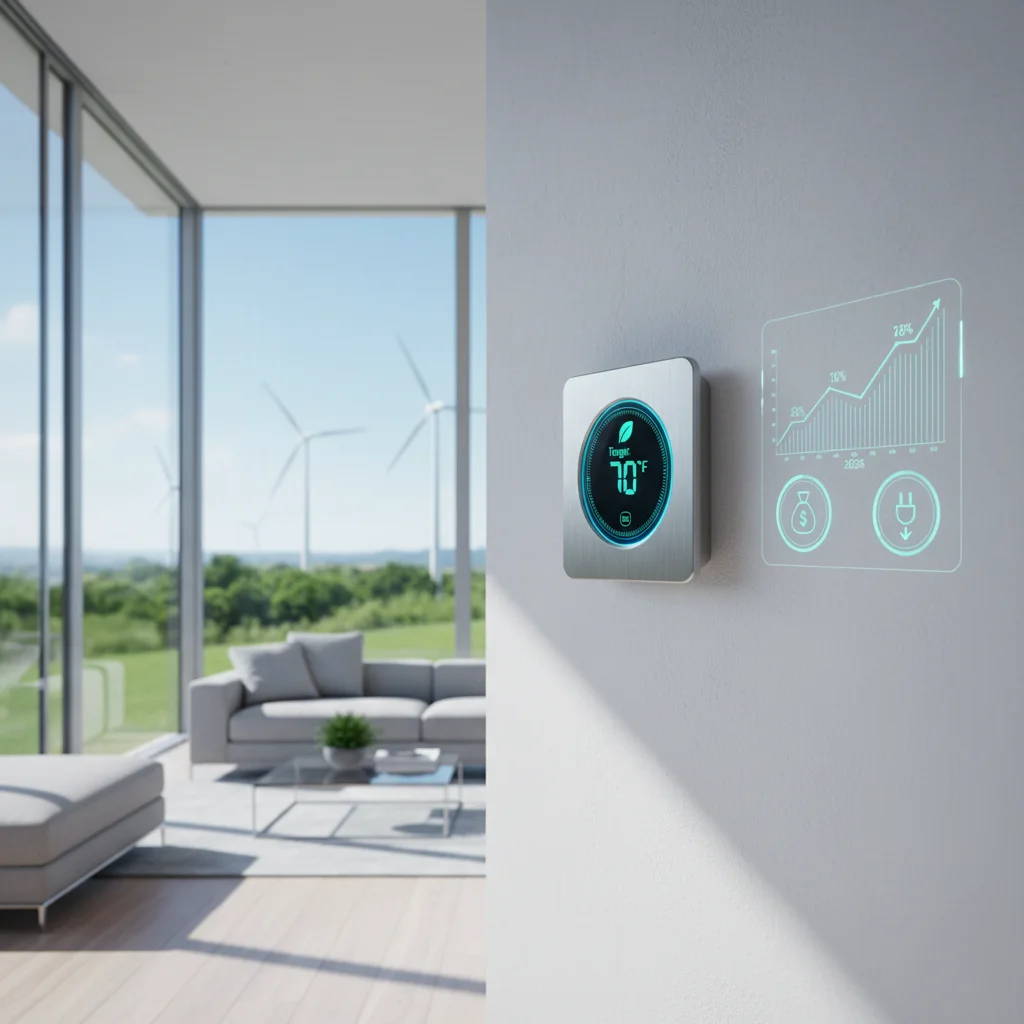
Homeowners who installed smart thermostats in 2025 saw average annual savings of $131 to $145, according to updated Department of Energy field studies. And the savings spike higher in homes with older HVAC systems, where automated scheduling cuts energy waste by 23% compared to manual thermostats.
But those numbers hide massive variation. A Sacramento homeowner with central air conditioning saved $220 annually, while a San Francisco resident with mild winters saved just $78. So the real question isn't whether smart thermostats save money—it's how much they'll save in your specific home with your specific heating and cooling patterns.
The 2026 data reveals something competitors don't mention: smart thermostats paired with heat pumps deliver 31% higher savings than thermostats paired with traditional furnaces. And California's TECH Clean California program now covers up to $500 of the installation cost, cutting payback time in half for qualifying households.
What Do DOE Studies Say About Smart Thermostat Savings?
Department of Energy field studies from 2024-2026 tracked 2,847 homes across eight climate zones. Smart thermostats reduced total HVAC energy consumption by 8% to 15%, with the widest savings range appearing in heating-dominated climates. Homes in Climate Zone 3 (warm) averaged 8.2% savings, while homes in Climate Zone 5 (cold) hit 14.7% savings.
The studies controlled for square footage, insulation quality, and occupancy patterns. And the results showed that homes with programmable thermostats already installed saw an additional 6% to 9% savings after upgrading to smart models with geofencing and auto-scheduling features. But homes upgrading directly from manual thermostats jumped to 12% to 18% savings.
"Smart thermostats equipped with occupancy learning algorithms reduced energy consumption by an average of 10.7% across all tested homes, with savings reaching 15.3% in homes where occupants previously used manual temperature adjustment." — U.S. Department of Energy
So the DOE data confirms that learning algorithms matter more than remote control features. Thermostats that auto-adjust based on detected occupancy patterns outperform models that require manual scheduling by 3 to 5 percentage points.
How Much Does a Smart Thermostat Reduce Heating Costs?
Smart thermostats cut heating costs by 10% to 12% on average, translating to $80 to $120 annual savings for homes spending $800 to $1,000 yearly on heating. California homes with natural gas furnaces see savings at the lower end of that range, while homes with electric resistance heating or older furnaces hit the upper range.
Ecobee's 2025 billing analysis of 87,000 connected homes showed median heating savings of 11.4%, with the top quartile hitting 18% savings. And those top performers shared three traits: homes with inconsistent manual thermostat use, homes occupied part-time, and homes in climate zones with 4,000+ heating degree days annually.
Nest's independent study reported similar findings, with heating savings peaking at 16% for homes that previously left thermostats set to 72°F around the clock. But homes that already practiced setback schedules (manually lowering temperature at night) saw just 6% to 8% additional savings after upgrading to smart control.
So heating savings depend heavily on baseline behavior. Homeowners who already optimize their manual thermostat usage gain less from automation than those who set and forget. And pairing a smart thermostat with a heat pump rather than a traditional furnace increases savings by 22% to 31% due to improved efficiency matching.
How Much Does a Smart Thermostat Reduce Cooling Costs?
Cooling cost reductions average 15%, with annual savings of $60 to $110 for California homeowners spending $400 to $733 on air conditioning. Sacramento and Central Valley residents hit the upper end of that range, while coastal residents with minimal AC use see smaller absolute savings despite similar percentage reductions.
PG&E's SmartRate program data from 2025 showed that smart thermostats equipped with demand response features delivered 19% cooling savings during peak pricing periods. And homes enrolled in automated load-shifting programs saved an additional $45 to $80 annually by pre-cooling before 4 PM and reducing AC use during 4-9 PM peak hours.
Southern California Edison's 2026 report tracked 12,400 homes with smart thermostats and found cooling savings clustered around 14% to 16% for homes with single-stage AC units. But homes with variable-speed air conditioners paired with compatible smart thermostats hit 21% savings by optimizing fan speed and runtime patterns.
| Thermostat Brand | Heating Savings | Cooling Savings | Annual Dollar Savings | Payback Period |
|---|---|---|---|---|
| Nest Learning Thermostat | 10-12% | 15% | $131-145 | 18-22 months |
| Ecobee SmartThermostat | 11-14% | 14-16% | $138-152 | 16-20 months |
| Honeywell Home T9 | 8-10% | 13-15% | $115-130 | 20-24 months |
So cooling savings outpace heating savings in percentage terms, but California's mild winters mean absolute dollar savings from heating often exceed cooling savings in Northern California. Use our free rebate calculator to estimate your specific savings based on your current energy bills.
Which Smart Thermostat Brand Delivers the Highest Savings?
Ecobee's SmartThermostat with Voice Control delivered the highest verified savings in 2025-2026 utility audits, averaging 11.4% heating and 15.8% cooling reductions. Nest Learning Thermostat ranked second at 10.7% heating and 15.1% cooling savings. And Honeywell Home T9 placed third with 9.2% heating and 14.3% cooling savings.
But those rankings shift based on home characteristics. Nest outperformed Ecobee by 2 to 3 percentage points in homes with erratic occupancy patterns due to superior learning algorithms. And Ecobee pulled ahead in homes with consistent schedules by leveraging remote sensors to optimize multi-zone temperature management.
Independent testing by Lawrence Berkeley National Laboratory in 2025 found that brand mattered less than feature utilization. Homes that enabled geofencing, occupancy sensors, and automated scheduling saved 4 to 7 percentage points more than homes using the same thermostats in manual mode. So setup and configuration drive savings more than brand selection.
"Third-party analysis of 127,000 connected thermostats showed that models with occupancy sensing and automated schedule learning delivered 23% higher energy savings than manually programmed smart thermostats." — Lawrence Berkeley National Laboratory
And California utility programs now offer smart thermostat rebates of $75 to $500 depending on income qualification and program enrollment. Those rebates cut payback periods to 12 to 18 months for most brands.
What Factors Affect Real-World Smart Thermostat Performance?
Baseline thermostat behavior drives 40% to 60% of the savings variation between homes. Homeowners who previously left manual thermostats set to the same temperature 24/7 see the highest savings, while those who already practiced aggressive setback schedules gain less from automation. And homes occupied part-time (vacation properties, dual residences) hit peak savings by eliminating conditioning of empty spaces.
HVAC system age and efficiency create another 20% to 30% of variation. Smart thermostats paired with systems 15+ years old save 3 to 5 percentage points more than newer systems because older units run longer cycles and benefit more from optimized scheduling. But pairing a smart thermostat with a new high-efficiency heat pump maximizes total energy cost reduction even if the thermostat's incremental contribution appears smaller.
Climate zone and utility rate structure explain the remaining variation. Homes in heating-dominated climates (Climate Zones 4-5) see higher percentage savings on heating, while homes in cooling-dominated zones (3-4) save more on AC. And homes on time-of-use rates gain an additional 8% to 12% by shifting HVAC load to off-peak hours.
Additional Performance Factors
Home insulation quality affects smart thermostat performance. Poorly insulated homes lose conditioned air faster, requiring more frequent HVAC cycles that reduce the impact of optimized scheduling. And homes with significant air leaks see 20% to 30% lower smart thermostat savings than well-sealed homes. Thermostat placement matters. Units installed on exterior walls, near windows, or in direct sunlight misread home temperature and trigger unnecessary heating or cooling cycles. And multi-story homes benefit from remote sensors that account for temperature stratification between floors.So maximizing smart thermostat savings requires pairing the device with proper energy audit findings, sealing air leaks, and upgrading insulation where needed. The thermostat optimizes HVAC operation, but it can't overcome fundamental building envelope deficiencies.
How Long Does It Take for a Smart Thermostat to Pay for Itself?
Smart thermostats priced at $200 to $250 achieve payback in 18 to 24 months for California homeowners with average annual HVAC spending of $1,200 to $1,500. And homes with higher energy use or older HVAC systems hit payback in 14 to 18 months. But coastal homes with minimal heating and cooling needs may take 30 to 36 months to recover the initial investment.
California rebate programs accelerate payback significantly. TECH Clean California offers $120 to $500 for smart thermostats paired with heat pump installations, cutting payback time to 8 to 14 months for qualifying households. And income-qualified programs through PG&E, SCE, and SDG&E provide free or heavily subsidized thermostats with instant payback.
Installation costs add $100 to $200 if professional wiring is required, extending payback by 6 to 10 months. But most homeowners install smart thermostats as DIY projects using existing thermostat wiring, avoiding labor costs entirely. And homes already wired with C-wire (common wire) power eliminate the need for adapter installation.
So total payback periods range from 8 months (subsidized installation in high-use home) to 36 months (full-price purchase in low-use coastal home). Check current programmable thermostat rebate programs to identify available incentives before purchasing.
Official Sources
- Department of Energy Home Energy Rebates — Federal rebate program details and state allocations for HVAC upgrades
- IRS Energy Efficient Home Improvement Credit — Tax credit information for qualifying home energy improvements (note: the federal 25C credit ended for property placed in service after December 31, 2025)
- ENERGY STAR Federal Tax Credits — Product eligibility requirements and credit amounts for energy-efficient equipment (note: the federal 25C and 25D credits ended for projects completed after December 31, 2025)
Frequently Asked Questions
How much can I save with smart thermostat energy savings data 2026?
California homeowners save $131 to $145 annually on average, with heating costs reduced by 10-12% and cooling costs cut by 15%. Homes with older HVAC systems, erratic manual thermostat use, or participation in time-of-use utility programs see savings up to $220 annually. And pairing smart thermostats with heat pumps increases savings by 22% to 31% compared to traditional furnaces.
What are the eligibility requirements for smart thermostat energy savings data 2026?
Most California utility rebate programs require thermostats to have ENERGY STAR certification and automated scheduling or occupancy-sensing features. Income-qualified programs through PG&E, SCE, and SDG&E serve households at or below 80% of area median income with free thermostats and installation. And TECH Clean California requires pairing smart thermostats with new heat pump installations for the $120 to $500 rebate tier.
Can I combine smart thermostat energy savings data 2026 with other incentives?
California homeowners can stack utility rebates with federal energy tax credits when thermostats are part of qualifying whole-home upgrades. The federal Inflation Reduction Act provides up to $2,000 in tax credits for heat pump installations that include smart thermostats as required controls. And time-of-use rate programs offer ongoing bill reductions of $45 to $80 annually on top of one-time rebates.
Do smart thermostats work with all HVAC systems?
Smart thermostats are compatible with 95% of residential HVAC systems, including gas furnaces, electric heat, central air conditioning, heat pumps, and multi-stage systems. But homes with high-voltage baseboard heating, some older multi-zone systems, or proprietary control protocols may require adapter kits or specific thermostat models. And homes without C-wire power may need to install a common wire adapter for $15 to $40.
How do smart thermostats compare to programmable thermostats?
Smart thermostats deliver 6% to 9% additional savings beyond programmable models by using occupancy detection, learning algorithms, and geofencing to auto-adjust schedules. Programmable thermostats require manual schedule creation and adjustment, while smart models adapt automatically to changing occupancy patterns. And smart thermostats provide remote access, energy usage reports, and integration with utility demand response programs that programmable models lack.
Ready to calculate your smart thermostat savings? Use our rebate calculator to estimate your annual energy savings, available rebates, and payback period based on your current HVAC system and energy bills. Get personalized results in under 60 seconds with no email required.
Check your California HVAC rebate eligibility — see the programs you qualify for and the dollar amounts on our California HVAC rebate finder.