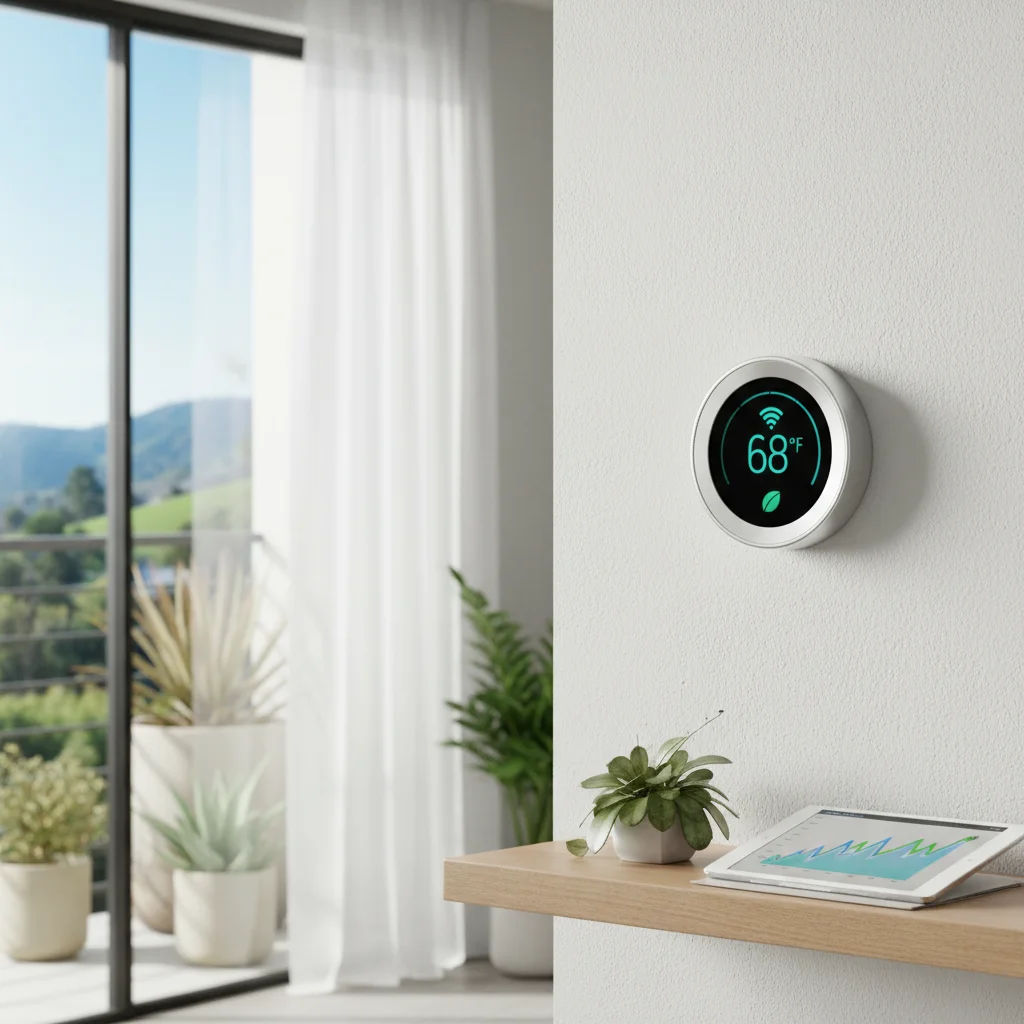
Renters in California left $47 million in smart thermostat rebates unclaimed in 2025, according to California Public Utilities Commission data. And most tenants don't realize they can claim these rebates without owning the property—landlord participation is optional for most 2026 programs. The state's utility districts and federal IRA incentives now cover 50% to 100% of smart thermostat costs for income-qualified renters, with rebates ranging from $50 to $250 per unit.
What Smart Thermostat Rebates Are Available for California Renters in 2026?
California renters in 2026 access smart thermostat rebates through utility providers like PG&E, SCE, SDG&E, and SoCalGas, plus federal IRA Home Efficiency Rebates. PG&E offers $50 standard rebates and $120 for income-qualified households. Southern California Edison provides $75 instant rebates at purchase. SDG&E pays $85 per thermostat. SoCalGas delivers $100 rebates for gas heating customers. Federal IRA programs offer $840 for households under 80% area median income.
Most California utility districts classify renters the same as homeowners for rebate eligibility. So tenants can claim rebates directly without property ownership. And utility programs don't require landlord signature for devices under $500 in installation costs. But some federal programs like the IRA Home Efficiency Rebates may require property owner consent for whole-home energy improvements.
The core tension: renters avoid energy upgrades because they won't own the equipment long-term, yet 68% of California renters pay their own utility bills and would see immediate monthly savings of $10 to $45 from smart thermostat installation.
PG&E's 2026 Marketplace platform offers instant rebates at checkout, reducing upfront costs from $129 to $9 for income-qualified renters purchasing eligible Google Nest or Ecobee models. And Southern California Edison partners with 47 retailers including Home Depot and Lowe's for point-of-sale discounts.
Renters in multifamily buildings with centralized HVAC systems don't qualify for individual thermostat rebates—property owners must apply for commercial building programs instead. So single-family rental homes and apartments with individual HVAC controls are the primary eligible property types.
Eligible smart thermostat models must carry ENERGY STAR certification and offer remote temperature control, learning capabilities, and utility demand response participation. And California utilities maintain approved product lists updated quarterly at their rebate portals.
How Much Can You Save With Smart Thermostat Rebates in California?
California renter savings from smart thermostat rebates in 2026 range from $125 to $1,090 in the first year, combining installation rebates with energy bill reductions. Standard utility rebates pay $50 to $100, while income-qualified programs deliver $120 to $840. Annual energy savings average $131 to $145 per household, according to ENERGY STAR estimates. So total first-year value reaches $175 to $985 for standard households and $251 to $1,090 for income-qualified renters.
PG&E's income-qualified program pays $120 upfront plus covers 100% of device costs through marketplace discounts, eliminating out-of-pocket expenses entirely. And Southern California Edison's $75 instant rebate reduces a $129 Nest Thermostat to $54 at purchase. Federal IRA rebates add $840 for households earning under 80% AMI, bringing total available incentives to $960 in some service territories.
Monthly utility bill reductions from smart thermostats average $11 to $18 in California climate zones, with higher savings in inland areas experiencing extreme summer heat. And winter heating savings reach $8 to $23 monthly for renters with gas furnaces. Demand response participation through utility programs like OhmConnect pays an additional $20 to $100 annually for allowing brief temperature adjustments during grid events.
Payback periods for renters who pay standard rebates equal 4 to 11 months. But income-qualified renters with zero out-of-pocket costs see immediate positive cash flow from month one. And renters who plan to stay in their unit 24 months or longer capture $262 to $290 in total savings even after device costs.
For renters paying full utility costs in California's Central Valley, where summer cooling bills exceed $200 monthly, smart thermostats reduce annual expenses by $180 to $230. So the equipment pays for itself in under 8 months with standard rebates or immediately with income-qualified incentives.
What Are the Eligibility Requirements for Renter Rebates?
California renter eligibility for 2026 smart thermostat rebates requires active utility service in your name, residence in a qualifying property type, and income verification for enhanced programs. Standard rebates require no income documentation—any customer paying their own utility bill qualifies. Income-qualified programs require household income at or below 80% of area median income, which equals $70,400 for a single person in Los Angeles County or $100,480 for a family of four in San Francisco.
Property eligibility includes single-family homes, apartments, condos, and townhomes with individual HVAC systems and separate utility meters. And renters must have an existing programmable or manual thermostat controlling forced-air heating or cooling equipment. Central HVAC systems in multifamily buildings don't qualify for individual renter rebates—building owners must apply through commercial programs instead.
Landlord permission requirements vary by program and installation scope. PG&E and SCE don't require landlord approval for smart thermostat replacement if installation is DIY or uses existing wiring with no wall modifications. But professional installations requiring new wiring or wall repairs typically need written landlord consent. Federal IRA programs require property owner participation for rebates exceeding $500.
Renters must maintain utility service for 6 to 12 months after rebate payment to avoid clawback provisions. And most programs prohibit claiming rebates for the same address within 24 months. Income-qualified applicants must provide recent pay stubs, tax returns, or enrollment in qualifying assistance programs like CalFresh or Medi-Cal.
ENERGY STAR certification is mandatory for all rebate-eligible devices. And thermostats must remain installed and functional for the utility program's minimum retention period, typically 12 months. Renters who move before the retention period ends may need to repay rebates unless they transfer the device to their new residence and update their utility account.
What Documentation Do You Need to Claim Your Smart Thermostat Rebate?
California renter rebate applications in 2026 require utility account numbers, purchase receipts, product serial numbers, installation verification, and income documentation for qualified programs. Standard rebates need proof of purchase showing device cost, purchase date, and retailer name. And utility account numbers must match the installation address and show active service status at the time of application.
Product documentation includes manufacturer serial numbers, model numbers from the approved device list, and ENERGY STAR certification labels. And installation photos showing the old thermostat before removal plus the new device after installation serve as proof of completion for most utility programs. Professional installations require contractor invoices with license numbers and installation dates.
Income-qualified programs demand recent income verification: pay stubs from the past 60 days, previous year's tax return, or enrollment confirmation in programs like CalWORKs, LIHEAP, or WIC. And household size documentation proves eligibility against area median income thresholds. PG&E accepts CalFresh cards as automatic income qualification without additional paperwork.
Landlord consent forms apply when installations require wall modifications, new wiring runs, or structural changes. But simple replacements using existing wiring don't trigger landlord approval requirements for most programs. And renters should photograph existing conditions before installation to document no damage occurred during device installation.
Application submissions use online portals for PG&E, SCE, and SDG&E, with mobile app options for instant rebates at partner retailers. And processing times range from 4 to 8 weeks for mail-in rebates versus instant discounts at point of sale. Federal IRA rebates require applications through state-approved contractors using the California Energy Upgrade California portal, with 60 to 90 day processing windows.
Renters moving before rebate processing completes must update their application with the new service address if transferring the device, or provide forwarding addresses for rebate check delivery. And utility programs allow one rebate per service agreement per 24 months, so new tenants at the same address can't claim duplicate rebates for equipment installed by prior occupants.
Can You Stack Multiple Rebates for Greater Savings?
California renters in 2026 can stack smart thermostat rebates from utility programs with federal IRA incentives, but can't combine multiple utility rebates for the same device. PG&E's $120 income-qualified rebate stacks with the IRA's $840 Home Efficiency Rebate, creating combined savings of $960. And Southern California Edison's $75 instant rebate combines with federal tax credits if the thermostat is part of a broader home energy upgrade package.
Stacking rules prohibit claiming both PG&E and SCE rebates for the same thermostat, even if your rental property sits in an overlapping service territory. But renters who install multiple qualifying devices—like a smart thermostat plus ENERGY STAR heat pump—can claim separate rebates for each distinct upgrade. And demand response programs like OhmConnect pay ongoing incentives that stack with one-time installation rebates.
Federal IRA Home Efficiency Rebates require whole-home energy assessments showing 35% energy savings for maximum payouts. So renters rarely access the full $840 thermostat allocation without coordinating with landlords on additional upgrades like insulation or heat pump installation. But point-of-use rebates for smart thermostats alone don't require whole-home assessments through most utility programs.
Tax credits from IRA energy efficiency provisions apply to property owners, not renters. So tenants can't claim federal tax deductions for smart thermostat purchases unless they own the property. But utility rebates and point-of-sale discounts deliver immediate cash value regardless of tax status.
Retailers offering manufacturer rebates allow stacking with utility incentives. And Google Nest and Ecobee periodically run $20 to $50 mail-in rebates that combine with California utility programs. So renters who time purchases during promotional periods can capture $145 to $220 in total rebates and discounts for devices normally priced at $129 to $179.
Use our free rebate calculator to find your total stackable savings based on your utility provider, income level, and installation timeline.
What's the Deadline to Apply for California Smart Thermostat Rebates?
California smart thermostat rebate deadlines in 2026 vary by program, with most utility rebates requiring applications within 60 to 180 days of purchase. PG&E accepts applications up to 180 days after installation. Southern California Edison requires submissions within 60 days of purchase for standard rebates and 90 days for income-qualified programs. SDG&E enforces a 120-day application window. Federal IRA Home Efficiency Rebates require applications within 12 months of project completion.
Budget exhaustion ends programs before published deadlines. And PG&E's income-qualified program reached capacity on August 12, 2025, suspending applications until the 2026 budget allocation launched January 1. Southern California Edison's 2025 rebate fund depleted on October 3, leaving applicants waitlisted until 2026. So early application in Q1 and Q2 maximizes approval chances before annual budgets run out.
Fiscal year cycles reset utility rebate budgets on January 1 for PG&E and SCE, July 1 for SDG&E, and October 1 for SoCalGas. And application volumes spike in January and July when new budgets activate, creating processing delays of 8 to 12 weeks versus 4 to 6 weeks during off-peak months.
Purchase date determines eligibility, not application date. So renters who buy devices in December 2025 but apply in January 2026 compete for 2026 budget allocations. And retroactive applications for installations completed in 2025 don't qualify for 2026 program funding if submitted after the 2025 deadline.
Federal IRA rebate deadlines extend through 2031 for program funding, but state-level administration may impose earlier cutoffs based on California's allocated budget. And income-qualified programs face higher demand than standard rebates, exhausting funds 3 to 5 months faster than non-income-restricted offerings.
Renters should submit applications within 30 days of installation to avoid documentation expiration issues—receipts and photos must show clear dates, and utility accounts must remain active from purchase through application approval.
Do You Need Pre-Approval Before Installing Your Smart Thermostat?
California smart thermostat rebates in 2026 don't require pre-approval for most utility programs, but federal IRA Home Efficiency Rebates demand pre-approval before purchase. PG&E, SCE, and SDG&E process rebates as post-purchase reimbursements—renters buy and install devices first, then submit applications with receipts and photos. So standard utility rebates use a buy-first, apply-later model with no pre-approval steps.
Federal IRA programs require renters to work with state-approved contractors who register projects before installation begins. And whole-home energy assessments must occur before purchasing equipment to establish baseline energy use and project savings. Applications submitted without pre-approval documentation are rejected, even if the equipment qualifies.
Income-qualified utility programs occasionally require pre-enrollment to verify household income before purchase, but most California utilities allow post-purchase income verification. And PG&E's Marketplace platform pre-verifies eligibility through utility account lookups, applying instant discounts at checkout without separate pre-approval applications.
Landlord pre-approval becomes necessary when installations require professional contractors, new electrical work, or wall modifications. But DIY replacements using existing wiring don't trigger landlord notification requirements under California Civil Code Section 1941.1, which permits tenants to make minor repairs and upgrades that don't alter property structure.
Renters planning to combine smart thermostat rebates with other upgrades like heat pump installation or attic insulation should pursue pre-approval through federal IRA programs to maximize stacking opportunities. And coordinating with landlords before purchasing equipment prevents rebate denials due to installation restrictions or lease violation claims.
Demand response program enrollment requires pre-registration with utility providers, but doesn't block rebate eligibility. And renters can enroll in programs like OhmConnect after installing smart thermostats to capture ongoing incentives without affecting initial rebate applications.
Official Sources
- ENERGY STAR Smart Thermostat Savings — Federal certification standards and energy savings estimates for qualifying devices
- DSIRE California Incentives Database — Comprehensive database of California utility rebates and federal IRA programs
- Database of State Incentives for Renewables & Efficiency — State-by-state rebate tracking and eligibility requirements
Frequently Asked Questions
Can renters get smart thermostat rebates in California?
Renters in California qualify for smart thermostat rebates from utility providers and federal IRA programs if they pay their own utility bills and live in properties with individual HVAC systems. PG&E, SCE, and SDG&E don't distinguish between renters and homeowners for rebate eligibility. And landlord approval is optional for installations using existing wiring without wall modifications. Income-qualified renters access enhanced rebates up to $120 from utilities and $840 from federal programs.
How much can you save with a smart thermostat rebate in California?
California renters save $125 to $1,090 in the first year by combining rebates with energy bill reductions. Standard utility rebates pay $50 to $100, while income-qualified programs deliver $120 to $840. And annual energy savings average $131 to $145 per household. Total first-year value reaches $175 to $985 for standard households and $251 to $1,090 for income-qualified renters.
What smart thermostats qualify for California rebates?
ENERGY STAR-certified smart thermostats qualify for California rebates, including Google Nest Learning Thermostat, Ecobee SmartThermostat, Honeywell Home T9, and Emerson Sensi Touch. And devices must offer remote temperature control, learning capabilities, and utility demand response participation. Utilities maintain approved product lists updated quarterly at rebate portals. Basic programmable thermostats without smart features don't qualify for 2026 rebate programs.
Do you need landlord permission for a smart thermostat rebate as a renter?
Landlord permission for smart thermostat installation depends on installation method and lease terms. DIY replacements using existing wiring don't require landlord approval under California law for most utility rebates. But professional installations involving new wiring or wall modifications typically need written landlord consent. And federal IRA programs require property owner participation for rebates exceeding $500. Renters should review lease agreements for appliance modification clauses before purchasing devices.
When do smart thermostat rebates expire in California?
California utility rebates require applications within 60 to 180 days of purchase—PG&E allows 180 days, SCE requires 60 days, and SDG&E enforces 120 days. Federal IRA programs demand applications within 12 months of installation. And program budgets exhaust mid-year during high-demand periods, suspending applications until next fiscal year. PG&E and SCE reset budgets January 1, while SDG&E resets July 1. Early Q1 applications maximize approval chances before annual funding depletes.
Ready to claim your rebates? Use our rebate calculator to find every smart thermostat incentive available at your address, calculate your total first-year savings, and get step-by-step application instructions for your utility provider and income level. Most California renters qualify for $125 to $960 in combined rebates—find your exact amount in under 60 seconds.
Updated: April 14, 2026 — fact-checked by DuloCore Research. About our editorial process.
Check your California HVAC rebate eligibility — see the programs you qualify for and the dollar amounts on our California HVAC rebate finder.