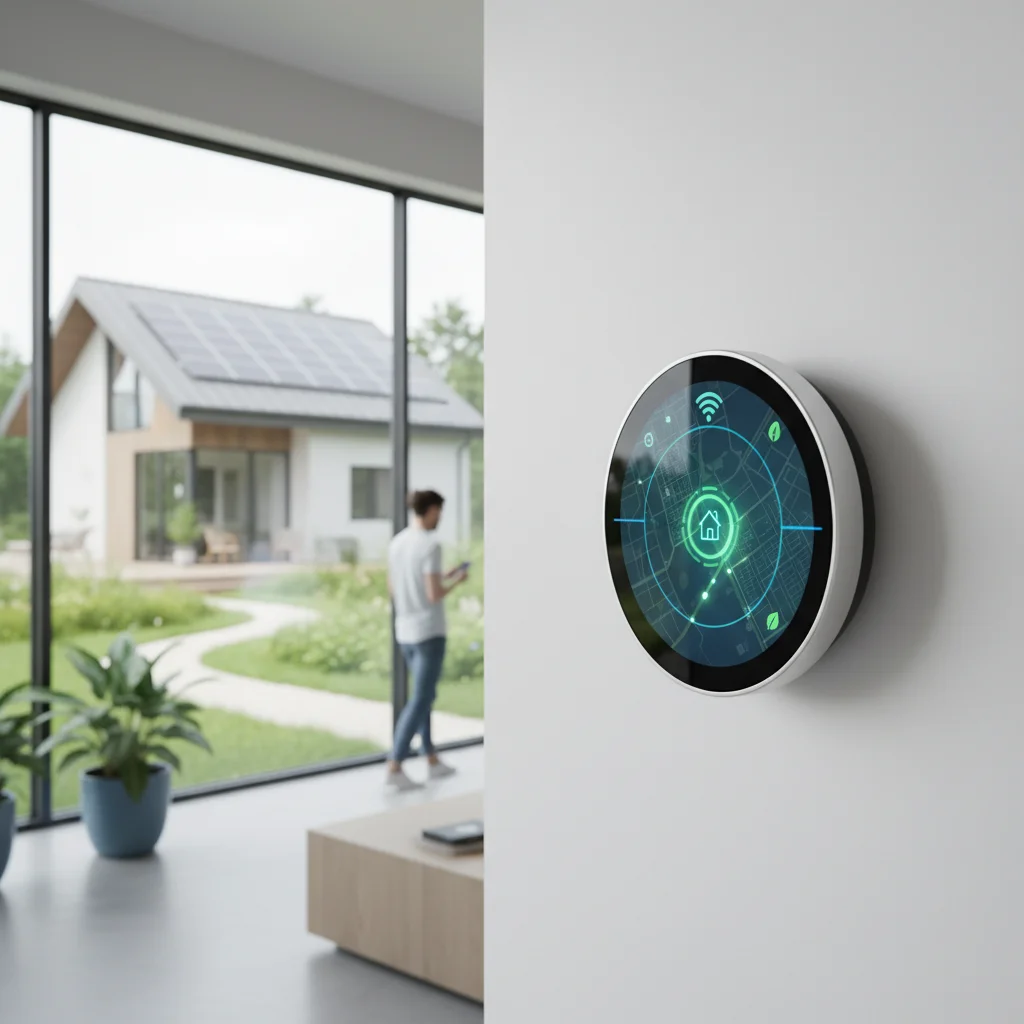
California homeowners waste $240 annually heating and cooling empty houses. And that waste multiplies when work schedules change, kids head to college, or weekend trips pop up. So programmable thermostats that rely on rigid schedules can't adapt. But geofencing-enabled smart thermostats detect when the last person leaves and automatically adjust temperature setpoints to save energy without manual intervention.
How Does Smart Thermostat Geofencing Save Money on Energy Bills?
Smart thermostat geofencing saves California households $180-$320 annually by automatically adjusting HVAC systems when occupants leave home. The feature uses smartphone GPS coordinates to create a virtual boundary around the residence. And when all connected devices exit the geofence radius—typically 500 feet to 7 miles depending on the model—the thermostat shifts into away mode and reduces heating or cooling output by 5-10°F.
Ecobee's 2026 usage data shows geofencing users reduce runtime 22% compared to schedule-only programming. And Google Nest reports geofencing prevents 312 hours of unnecessary heating per year in California's Central Valley, where daytime temperatures swing 30°F between seasons. But savings peak for multi-occupant households where departure and arrival times vary daily. So single-person households with consistent work schedules see smaller gains of $80-$120 annually.
The California Energy Commission's 2026 residential study found geofencing reduces HVAC energy consumption 18-23% in homes with variable occupancy patterns. But homes in coastal climate zones 3 and 4 with mild temperatures see smaller reductions of 12-15% because baseline HVAC usage is lower. And older HVAC systems without variable-speed compressors capture less savings because they can't modulate output efficiently.
What Income Limits Qualify You for Geofencing Thermostat Rebates?
California's TECH Clean California program provides $120-$180 instant rebates for smart thermostats with geofencing capability. Income limits vary by household size and utility territory. So a four-person household in PG&E territory qualifies for enhanced $180 rebates at or below $106,700 annual income—200% of the area median income. And the standard $120 rebate applies to all income levels through December 2026.
Southern California Edison's Energy Savings Assistance Program reserves $180 geofencing thermostat rebates for households at or below 250% of the federal poverty level. That's $78,125 for a family of four in 2026. But the program requires proof of income through tax returns, pay stubs, or participation in CalFresh, Medi-Cal, or other qualifying assistance programs.
Bay Area Community Choice Aggregators including Peninsula Clean Energy and East Bay Community Energy offer $150-$200 geofencing thermostat incentives with no income restrictions through June 2026. And stacking with the federal 30% Energy Efficient Home Improvement Credit reduces net costs to $50-$120 for qualifying ENERGY STAR certified models. Use our free rebate calculator to estimate combined federal and local savings.
| Program | Rebate Amount | Income Limit (4-person household) | Deadline |
|---|---|---|---|
| TECH Clean California | $120-$180 | $106,700 for enhanced tier | Dec 2026 |
| SCE Energy Savings Assistance | $180 | $78,125 (250% FPL) | Ongoing |
| Peninsula Clean Energy | $200 | No limit | Jun 2026 |
What's the Application Process for Smart Thermostat Geofencing Incentives?
Most California geofencing thermostat rebates use point-of-sale instant discounts that require no post-purchase paperwork. And TECH Clean California's network of 412 participating retailers including Home Depot, Lowe's, and local HVAC contractors apply the $120-$180 rebate at checkout. So homeowners provide proof of residence through a utility bill and select from pre-qualified models including Ecobee SmartThermostat Enhanced, Google Nest Learning Thermostat, and Honeywell Home T9.
Southern California Edison's mail-in rebate process requires submitting the application within 180 days of purchase. And applicants upload receipt photos, proof of income documents, and installation verification through SCE's online portal. Processing takes 6-8 weeks, with rebate checks mailed to the service address.
Form 5695 only covers qualifying work completed by December 31, 2025 and claimed on a 2025 return; the federal 25C and 25D credits ended after that date (IRS FS-2025-05). Federal tax credits for this work have ended, but state, local and utility rebates may still apply; check what is available at your address with the DuloCore rebate calculator. But the 30% credit applies only to thermostats meeting ENERGY STAR Most Efficient 2026 criteria and installed in the taxpayer's primary residence. And the Inflation Reduction Act caps the credit at $150 per thermostat. So a $250 qualifying model generates a $75 federal credit when stacked with a $180 California rebate, reducing net cost to $95.
When Are the Deadlines for Geofencing Thermostat Funding Programs?
TECH Clean California's $180 geofencing thermostat rebates remain funded through December 31, 2026, with $4.2 million allocated for the final quarter. But funding depletes when the statewide budget reaches zero. And PG&E territory saw temporary funding pauses in March 2026 when demand exceeded quarterly allocations by 140%. So applications submitted during funded periods receive instant point-of-sale discounts, while submissions during paused periods join a waitlist processed when new funding releases.
Peninsula Clean Energy's $200 incentive program ends June 30, 2026, with no confirmed extension. And the agency announced in February 2026 that the program will likely transition to a $100 rebate structure in fiscal year 2027. So installations completed before July 1, 2026, lock in the higher rebate tier.
The federal Energy Efficient Home Improvement Credit (Section 25C) ended for property placed in service after December 31, 2025 (IRS FS-2025-05). Check current state, local and utility incentives for your address with the DuloCore rebate calculator. And Congress can modify or extend the program through future legislation.
Can You Stack Geofencing Rebates with Other Energy Efficiency Programs?
And the combination reduces net costs 60-75% for qualifying models. So a $250 ENERGY STAR Most Efficient thermostat eligible for a $180 TECH Clean California rebate and a $75 federal tax credit costs $95 after incentives.
But stacking rules prohibit combining multiple utility rebates for the same equipment. So homeowners can't claim both a PG&E rebate and a Peninsula Clean Energy incentive for one thermostat installation. And utility programs generally prohibit stacking with manufacturer mail-in rebates, though point-of-sale manufacturer discounts don't affect utility rebate eligibility.
Low-income weatherization programs including the Energy Savings Assistance Program provide free geofencing thermostats with professional installation at no cost. But participants can't claim additional rebates or tax credits for equipment received through no-cost programs. And homeowners receiving free thermostats through utility programs must retain the equipment for 10 years or repay the equipment value upon early removal.
Read more about combining incentives in our guide to energy tax credits.
What Documentation Do You Need to Approve Geofencing Thermostat Claims?
Point-of-sale TECH Clean California rebates require proof of residence and selection from the pre-qualified product list. And acceptable residence verification includes a current utility bill, mortgage statement, or lease agreement showing the installation address. So renters qualify with landlord permission documented through a signed statement.
Mail-in rebate programs require dated purchase receipts showing the retailer name, product model number, and purchase price. And Southern California Edison's income-qualified tier requires one of these documents uploaded within 180 days of purchase: prior year tax return, two consecutive pay stubs, or proof of enrollment in CalFresh, Medi-Cal, Section 8, or SSI programs.
Federal tax credit claims require manufacturers' certification statements confirming ENERGY STAR Most Efficient 2026 compliance. Form 5695 only covers qualifying work completed by December 31, 2025 and claimed on a 2025 return; the federal 25C and 25D credits ended after that date (IRS FS-2025-05). So homeowners save the receipt, installation invoice, and product specification sheet showing geofencing capability and ENERGY STAR certification number.
Official Sources
- ENERGY STAR Most Efficient Thermostats — Federal certification database for qualifying smart thermostat models
- Database of State Incentives for Renewables & Efficiency — Comprehensive directory of California rebate programs and requirements
- Department of Energy: Smart Thermostats — Federal guidance on thermostat efficiency and geofencing technology
Frequently Asked Questions
Does geofencing on a smart thermostat save money on energy bills?
Geofencing saves California households $180-$320 annually by automatically adjusting temperature setpoints when occupants leave. And Ecobee's 2026 data shows 22% runtime reduction compared to schedule-only programming. But savings vary by climate zone, with coastal regions seeing 12-15% reductions and inland areas reaching 23% cuts. So homes with variable occupancy patterns capture the largest gains.
Can I get a tax credit or rebate for installing a smart thermostat with geofencing?
California offers $120-$180 instant rebates through TECH Clean California and utility programs. And the federal government provides a 30% tax credit (this federal credit ended for property placed in service after December 31, 2025) capped at $150 for ENERGY STAR Most Efficient 2026 models. So stacking a $180 state rebate with a $75 federal credit reduces a $250 thermostat's net cost to $95. But income limits apply to enhanced state rebate tiers.
How does geofencing work on a smart thermostat?
Geofencing creates a virtual boundary 500 feet to 7 miles around the home using smartphone GPS coordinates. And when all connected devices exit the boundary, the thermostat switches to away mode and adjusts temperature 5-10°F to reduce HVAC runtime. So the system detects the last person leaving and restores comfort settings when the first person returns. But accuracy requires all occupants to enable location sharing on their smartphones.
What's the difference between geofencing and scheduling on smart thermostats?
Scheduling uses fixed time-based temperature changes regardless of occupancy. And geofencing uses real-time GPS location to trigger adjustments only when occupants leave. So scheduled systems waste energy heating empty homes when residents leave early or arrive late. But geofencing adapts to variable routines, reducing unnecessary runtime 18-23% compared to schedules in homes with irregular occupancy patterns.
Do all smart thermostats have geofencing capabilities?
No. Geofencing requires Wi-Fi connectivity and smartphone app integration. And only 62% of smart thermostats sold in California during 2026 include the feature. So ENERGY STAR certification doesn't guarantee geofencing capability. But models qualifying for TECH Clean California's enhanced $180 rebate tier all include geofencing. And the program's pre-qualified product list at techcleanca.com shows which models support the feature.
Ready to calculate your geofencing thermostat savings? Use our free rebate calculator to estimate combined federal tax credits and California utility rebates. Enter your income, zip code, and utility provider to see instant point-of-sale discounts and stackable incentives that reduce net costs 60-75% on ENERGY STAR certified models.
Updated on April 14, 2026. Fact-checked by DuloCore Editors. About our research team.
Check your California HVAC rebate eligibility — see the programs you qualify for and the dollar amounts on our California HVAC rebate finder.