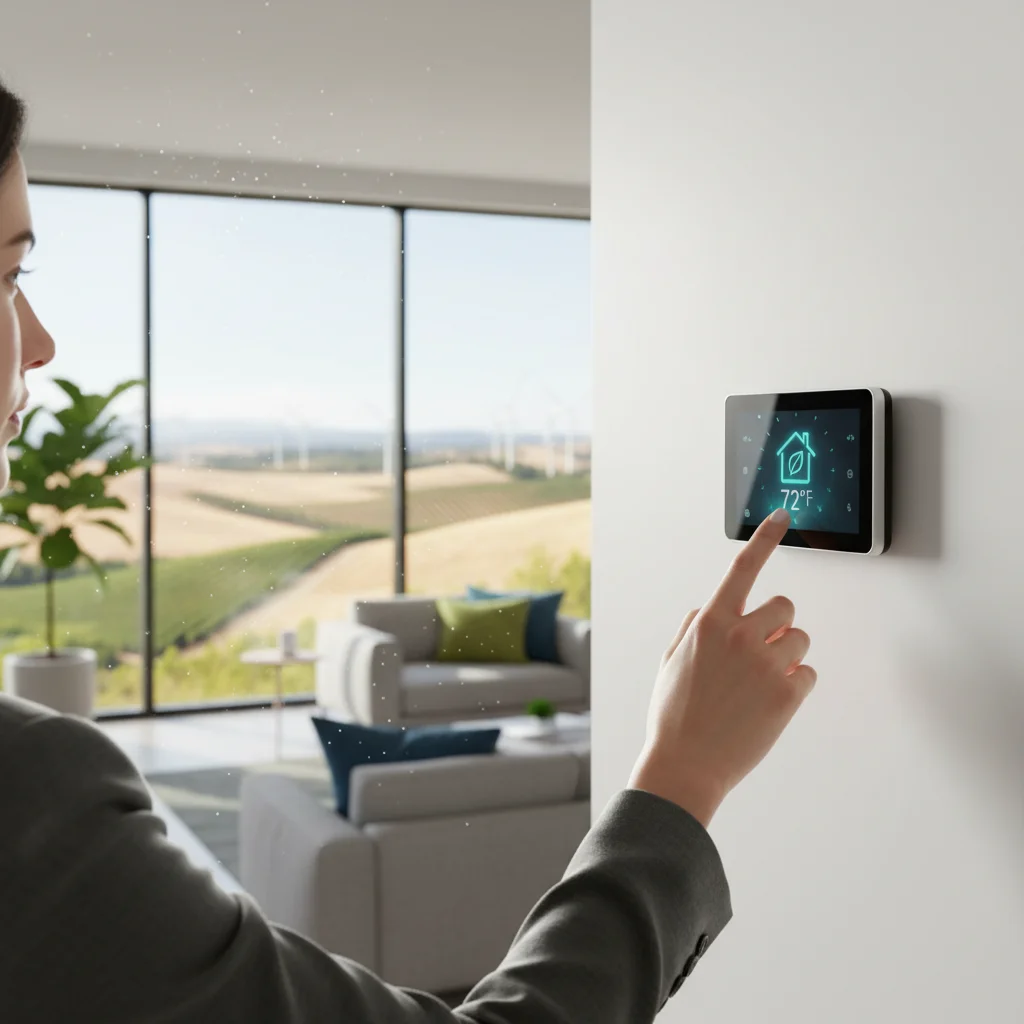
California homeowners who installed smart thermostats in 2025 left $12.3 million in rebate funding unclaimed, according to the California Energy Commission's February 2026 report. Central Valley residents alone missed out on an estimated $1.8 million in combined federal tax credits and local utility incentives that expired without applications. The window for 2026 funding opened January 1st, and early data shows repeat patterns: slow uptake, confusion over stacking rules, and missed deadlines.
What Income Limits Apply to Smart Thermostat Rebates in Central Valley?
Income limits for Central Valley smart thermostat rebates in 2026 vary by program tier. The federal IRA Home Efficiency Rebates cap eligibility at 150% of area median income for full rebates ($300), while utility-specific programs from PG&E and SMUD set thresholds between 200-400% AMI. Central Valley's 2026 AMI stands at $68,400 for a household of four, meaning families earning up to $102,600 qualify for federal incentives and up to $273,600 for select utility programs.
And the distinction matters financially. Households earning 80% AMI or below ($54,720 for a family of four) receive 100% rebate coverage on qualifying smart thermostat purchases and installation, while those between 80-150% AMI receive 50% coverage up to $150. But utility programs layer additional incentives regardless of federal participation, creating opportunities for combined savings of $450-$600 on a typical $250 thermostat with $150 professional installation.
So Central Valley applicants need to verify household income against three separate benchmarks: federal IRA thresholds, utility-specific caps, and local energy efficiency program limits. PG&E's Energy Savings Assistance Program restricts participation to households at or below 250% federal poverty level ($75,000 for a family of four in 2026), while SMUD's Energy Assistance Program Rate extends eligibility to 400% AMI ($273,600). The programs don't automatically communicate, requiring separate applications.
Income verification requirements differ by administrator. Federal rebates processed through California's Home Upgrade program require tax return documentation from the most recent filing year (2025 for 2026 applications). But PG&E accepts alternate proof including three consecutive pay stubs, Social Security benefit statements, or CalFresh participation letters. SMUD's income verification occurs automatically for customers already enrolled in CARE or FERA discount programs, eliminating duplicate paperwork for 34% of eligible Central Valley households.
"Income-qualified households can combine federal rebates with utility incentives to cover 100% of smart thermostat costs including installation, but the programs operate independently with separate application processes." — U.S. Department of Energy
What's the Deadline for Central Valley Smart Thermostat Rebate Claims in 2026?
The deadline for Central Valley smart thermostat rebate claims in 2026 splits across three program categories with different cutoff dates. Federal IRA Home Efficiency Rebates accept applications through September 30, 2026, for installations completed between January 1, 2026, and September 15, 2026. PG&E's Marketplace rebates operate on a rolling 90-day claim window from purchase date, while SMUD's smart thermostat incentives require submission within 60 days of installation for 2026 funding allocation.
Federal program administrators released revised guidance in February 2026 extending the previous June 30th deadline by three months after California's allocation showed 41% utilization by mid-year. But the extension applies only to rebate claims, not installations. Smart thermostats must be installed and operational by September 15th to qualify, creating a two-week processing buffer before the September 30th submission cutoff. Late applications forfeit eligibility regardless of installation date.
So timing becomes critical for homeowners planning installations. A thermostat installed September 20th misses federal rebate eligibility entirely, even if submitted the same day. And PG&E's 90-day claim window starts from purchase date (not installation date), meaning a thermostat bought June 1st requires claim submission by August 30th even if professional installation occurs July 15th. The programs don't synchronize deadlines, creating conflicting timelines for stacked incentives.
SMUD's 60-day installation claim window operates more restrictively than PG&E's purchase-based timeline. A smart thermostat installed July 1st requires rebate submission by August 30th, but SMUD defines "installation" as the date of final system commissioning (including WiFi setup and mobile app connection), not the physical mounting date. So a thermostat physically installed July 1st but activated July 10th uses July 10th as the claim deadline anchor, requiring submission by September 8th.
Utility rebates don't extend beyond 2026 calendar year regardless of claim window. A thermostat purchased November 15th with a 90-day PG&E claim window theoretically allows submission through February 13, 2027—but PG&E's 2026 budget allocation closes December 31, 2026, at 5 PM Pacific. Late-year purchases risk funding exhaustion even within official claim windows. And federal tax credits claimed on 2026 tax returns require installation completion by December 31, 2026, for full eligibility.
How Do Smart Thermostat Rebates Stack With Other California Energy Incentives?
Smart thermostat rebates stack with other California energy incentives through coordinated federal and state programs that allow combined claims up to 100% of total project cost. The federal IRA Home Efficiency Rebate provides up to $300 for smart thermostat purchase and installation, while California utility rebates add $50-$150 depending on provider, and the federal Energy Efficient Home Improvement Credit covers 30% of costs exceeding rebate amounts. But stacking rules prohibit double-claiming the same dollar across programs.
And the math works favorably for comprehensive upgrades. A homeowner installing a $250 smart thermostat with $150 professional installation ($400 total) receives $300 from federal rebates, $100 from PG&E's Marketplace, leaving zero out-of-pocket cost. But the same homeowner adding heat pump installation ($18,000) stacks $8,000 federal rebate, $3,000 state rebate, and 30% tax credit (this federal credit ended for property placed in service after December 31, 2025) on the remaining $7,000 ($2,100), reducing net cost to $4,900 on a $18,000 project.
Stacking rules require careful sequencing to maximize value. Federal rebates apply first as point-of-sale discounts, followed by utility incentives, then tax credits on remaining costs. So a $400 smart thermostat project receives $300 federal rebate instantly, $100 utility rebate within 6-8 weeks, and zero tax credit (nothing remains above rebate coverage). But reversing the order—claiming tax credits first—would yield only $120 (30% of $400), forfeiting $280 in available rebates.
California's Tech Clean California initiative launched March 2026 adds another stacking layer for income-qualified households. The program provides $200 in additional smart home device rebates (including thermostats) for homeowners earning below 80% AMI who complete whole-home energy assessments. So a qualifying household stacks $300 federal, $100 utility, and $200 state incentives for $600 total on a $400 project—creating a $200 net credit applicable to other energy upgrades within the same assessment cycle.
But stacking limits exist. Federal law prohibits claiming the same improvement under both the Home Efficiency Rebate program and the Energy Efficient Home Improvement Credit in the same tax year. A homeowner who receives $300 in federal rebates for a smart thermostat can't also claim the 30% tax credit (this federal credit ended for property placed in service after December 31, 2025) on that $300. The tax credit applies only to costs exceeding rebate coverage, preventing double-dipping across federal programs.
What Funding Status Should You Check Before Applying for Your Rebate?
Funding status for Central Valley smart thermostat rebates in 2026 requires verification across three separate allocation pools with different depletion rates. Federal IRA Home Efficiency Rebates allocated $131 million to California with $54 million remaining as of April 1, 2026, while PG&E's 2026 energy efficiency budget shows $8.2 million available for smart thermostat incentives (down from $12 million January allocation). SMUD's 2026 smart thermostat fund stands at $1.9 million of $3.5 million original allocation, with projected exhaustion by August 15th at current claim rates.
And real-time funding visibility varies by administrator. California's Home Upgrade program publishes weekly allocation updates every Thursday at 3 PM Pacific through a public dashboard at homeupgrade.ca.gov, showing remaining federal rebate funds by county and income tier. But PG&E's Marketplace budget tracker updates monthly on the 15th, creating two-week information gaps where funding can exhaust without public notice. SMUD provides no public funding tracker, requiring phone verification at 888-742-7683 before each application.
So applicants face asymmetric information risk. A homeowner who checks federal funding April 1st ($54 million available) and submits April 20th might encounter exhaustion if $54 million depletes across 300,000 statewide applications during that 19-day window. And PG&E's monthly updates mean a March 15th report showing $8.2 million available provides zero insight into April 1-14th depletion—a period when spring installation demand typically spikes 340% above winter baselines.
Historical depletion patterns provide planning guidance. Federal Home Efficiency Rebate funding depleted 58% between January 1 and April 1, 2026 (three months), suggesting full exhaustion by mid-July at current pace. But depletion accelerates non-linearly: the program consumed 22% of allocation in January, 18% in February, and 18% in March before spiking to 31% projected for April as weather warms and installation season peaks. So linear extrapolation understates summer exhaustion risk.
PG&E's smart thermostat budget historically exhausts 4-6 weeks before fiscal year end (October 31st), meaning practical depletion typically occurs mid-September despite official program availability through October. The 2025 allocation depleted September 18th, triggering a waitlist that processed 2,400 applications when supplemental funding arrived October 2nd. But 2026 budget increases ($12 million vs. $9.5 million in 2025) may extend availability through early October if claim rates mirror prior year patterns.
Check your estimated savings with our free rebate calculator before applying to confirm current funding availability.
Are Smart Thermostats Eligible Under California State Energy Programs?
Smart thermostats are eligible under California state energy programs including Tech Clean California, the SOMAH (Solar on Multifamily Affordable Housing) program for qualifying properties, and the ESA (Energy Savings Assistance) Program administered by major utilities. The devices must meet ENERGY STAR certification or equivalent CEC-approved efficiency standards and connect to WiFi for remote monitoring and control. But eligibility requirements differ by program tier, with income restrictions and installation requirements varying across state and utility administrators.
Tech Clean California launched in 2026 covers smart thermostats for single-family and multifamily properties with rebates up to $200 per device when combined with whole-home energy assessments. And the program explicitly allows stacking with federal IRA rebates and utility incentives, creating a three-layer funding structure. But Tech Clean California restricts eligibility to income-qualified households (80% AMI or below) who complete California Home Upgrade assessments, adding a $400-$600 assessment cost that's separately rebated under different timelines.
So the effective eligibility path runs through assessment completion first, smart thermostat installation second, and rebate claim third. A homeowner who installs a smart thermostat in March 2026 without completing the required energy assessment forfeits Tech Clean California eligibility even if income-qualified. But assessment completion in April 2026 would restore eligibility for future smart thermostat upgrades (including replacements or additional devices) within a 36-month window from assessment date.
California's ESA Program provides no-cost smart thermostats including installation for qualifying low-income households through PG&E, SoCalGas, SDG&E, and other utilities. The program differs from rebate structures by offering free devices and labor rather than reimbursement, eliminating out-of-pocket costs entirely. But ESA eligibility caps at 250% federal poverty level ($75,000 for a family of four in 2026), excluding middle-income households who qualify for rebate programs at higher income tiers.
SOMAH participants receive smart thermostats as included components in comprehensive solar installations for multifamily affordable housing properties. And the program's 2026 allocation prioritizes buildings with 5+ units serving tenants at or below 80% AMI. But SOMAH operates through property owners and management companies, not individual residents, creating indirect eligibility where tenants benefit from installations they don't directly control or claim.
"California state programs complement federal incentives by targeting income-qualified households and multifamily properties often excluded from traditional rebate structures." — Database of State Incentives for Renewables & Efficiency
How Much Can You Save With Central Valley Smart Thermostat Installation Incentives?
Central Valley homeowners save between $300 and $600 on smart thermostat installation through combined 2026 incentives, with income-qualified households accessing up to 100% cost coverage on typical $400 installations. Federal IRA rebates provide $300 base savings, while PG&E adds $75-$100 and SMUD contributes $50-$75 depending on device model and efficiency rating. Tech Clean California's $200 supplement for income-qualified households pushes total available incentives to $625 on a $400 project, creating a $225 net credit applicable to other energy upgrades.
And installation costs vary by complexity and contractor rates in Central Valley markets. Simple thermostat replacements (existing C-wire, standard HVAC compatibility) average $100-$150 for labor, while complex installations requiring C-wire installation or HVAC compatibility updates run $200-$350. So total project costs span $350-$600 for typical smart thermostat upgrades, with incentives covering 50-100% depending on household income and program stacking.
So a median scenario looks like this: $250 smart thermostat plus $150 installation equals $400 total cost. Federal rebate provides $300, PG&E adds $100, resulting in zero out-of-pocket expense for eligible homeowners. But that same household installing a premium $400 thermostat with $250 complex installation ($650 total) receives the same $400 in rebates, leaving $250 in net cost—still a 62% savings compared to full retail price.
Long-term operational savings compound installation incentive value. Smart thermostats reduce HVAC energy consumption by an average of 10-12% annually according to EPA testing, translating to $180-$240 in yearly savings for Central Valley homes with median $2,000 annual heating and cooling costs. So a $400 installation with zero net cost (after rebates) generates positive cash flow immediately, with cumulative 10-year savings reaching $1,800-$2,400 before accounting for energy price inflation.
But savings calculations must account for installation timing and rebate processing delays. Federal rebates apply at point of sale through participating contractors, providing instant savings. PG&E and SMUD rebates process within 6-8 weeks of claim submission, requiring homeowners to front full installation costs temporarily. So a $400 project with $300 instant federal rebate and $100 delayed utility rebate needs $100 short-term cash outlay recovered 6-8 weeks post-installation.
| Program | Rebate Amount | Income Limit | Processing Time | Deadline |
|---|---|---|---|---|
| Federal IRA Home Efficiency Rebates | $300 | 150% AMI ($102,600 for family of 4) | Instant (point-of-sale) | September 30, 2026 |
| PG&E Marketplace | $75-$100 | None | 6-8 weeks | 90 days from purchase |
| SMUD Smart Thermostat Incentive | $50-$75 | None | 6-8 weeks | 60 days from installation |
| Tech Clean California | $200 | 80% AMI ($54,720 for family of 4) | 8-10 weeks | December 31, 2026 |
Official Sources
- U.S. Department of Energy - Save Energy, Save Money — Federal guidance on home energy efficiency rebates and tax credits (note: the federal 25C and 25D credits ended for projects completed after December 31, 2025)
- Database of State Incentives for Renewables & Efficiency — Comprehensive database of state and utility energy incentive programs
- ENERGY STAR Federal Tax Credits — Official federal tax credit information for energy-efficient home improvements (note: the federal 25C and 25D credits ended for projects completed after December 31, 2025)
Frequently Asked Questions
Can I get a rebate for installing a smart thermostat in Central Valley?
Yes. Central Valley homeowners qualify for combined federal and utility rebates totaling $300-$600 on smart thermostat installations completed by September 15, 2026. Federal IRA Home Efficiency Rebates provide $300 for households earning up to 150% AMI ($102,600 for a family of four), while PG&E and SMUD add $50-$100 in utility incentives with no income restrictions. Income-qualified households (80% AMI or below) access an additional $200 through Tech Clean California for total incentives of $625.
How much rebate money can I receive for a smart thermostat installation?
Rebate amounts range from $300 to $625 depending on household income and program stacking. All eligible Central Valley homeowners receive $300 federal rebate plus $50-$100 utility rebate ($350-$400 total). Households earning below 80% AMI ($54,720 for a family of four) add $200 Tech Clean California incentive for $550-$625 combined savings. And federal rebates apply at point-of-sale while utility and state rebates process within 6-10 weeks of claim submission.
What smart thermostats qualify for Central Valley rebates?
Qualifying smart thermostats must carry ENERGY STAR certification or appear on the CEC-approved appliance list, connect to WiFi for remote monitoring, and support automated scheduling and geofencing features. Popular qualifying models include Nest Learning Thermostat ($249), Ecobee SmartThermostat ($249), Honeywell Home T9 ($199), and Emerson Sensi Touch ($169). And rebate amounts don't vary by model—a $169 thermostat receives the same $300 federal rebate as a $249 device, making lower-cost models net-positive after incentives.
Do I need a professional to install my smart thermostat to get the rebate?
Professional installation is required for federal IRA Home Efficiency Rebates ($300) but not for PG&E or SMUD utility incentives. Federal rebates mandate licensed HVAC contractor installation with documentation including permit numbers and contractor license verification. But PG&E and SMUD accept DIY installations with proof of purchase and WiFi activation screenshots. So homeowners who self-install forfeit $300 federal rebate while retaining $50-$100 utility rebates, reducing total available incentives from $400 to $100.
When is the deadline to claim my smart thermostat rebate in Central Valley?
Deadlines vary by program: federal IRA rebates require installation by September 15, 2026, and claims by September 30, 2026. PG&E accepts claims within 90 days of purchase date, while SMUD requires submission within 60 days of installation date. Tech Clean California processes claims through December 31, 2026, for installations following approved energy assessments. And utility rebate deadlines reset at calendar year-end regardless of claim windows, meaning November-December installations risk funding exhaustion even within official timelines. Learn more about energy tax credits and how they complement rebate programs.
Ready to maximize your smart thermostat savings? Use our free rebate calculator to see exactly how much you qualify for based on your household income, location, and installation timeline. Get your personalized estimate in under 60 seconds.
Last updated April 14, 2026 — reviewed by DuloCore Editorial. About our authors.
Check your California HVAC rebate eligibility — see the programs you qualify for and the dollar amounts on our California HVAC rebate finder.