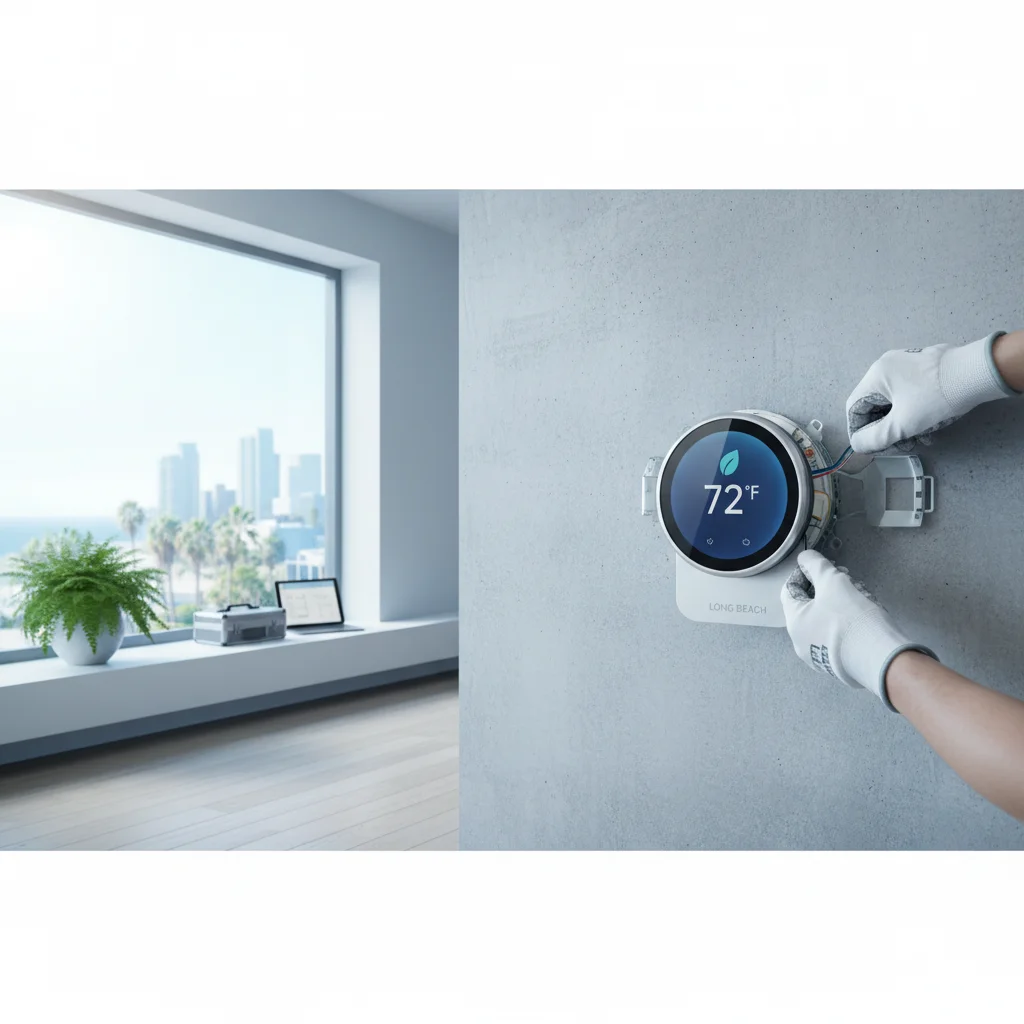
Long Beach homeowners waste $287 annually on inefficient heating and cooling because manual thermostats can't adapt to real-time energy pricing or occupancy patterns. Smart thermostats cut that waste by 23% on average—and in 2026, California utility programs pay up to $150 upfront to offset the $200-$300 installation cost.
How Much Can You Save With Smart Thermostat Rebates in Long Beach?
Southern California Edison offers Long Beach residents a $150 rebate for ENERGY STAR-certified smart thermostats installed in 2026. The rebate covers 50-75% of typical installation costs of $200-$300. Combined with annual energy savings of $140-$180, payback occurs within 6-9 months.
And the math tilts further when paired with time-of-use electricity rates. Smart thermostats pre-cool homes during off-peak hours when electricity costs $0.15 per kWh instead of peak rates of $0.42 per kWh. Over 10 years, that optimization saves an additional $890-$1,200 beyond baseline efficiency gains.
But the rebate requires pre-approval through SCE's online portal before purchase. Applications submitted after installation are rejected automatically. So Long Beach homeowners need to reserve funds 2-3 weeks before scheduling contractor visits.
The rebate calculator shows exact savings based on home size, current thermostat type, and utility rate schedule.
What Income Limits Apply to California's Smart Thermostat Incentives?
Southern California Edison's 2026 smart thermostat rebate has no income restrictions for the base $150 amount. Households at or below 80% of area median income qualify for an enhanced $200 rebate through the Energy Savings Assistance Program. For Long Beach, that threshold is $89,600 for a family of four in 2026.
Income-qualified applicants receive free installation plus the thermostat unit at no cost. The program covers Nest, Ecobee, and Honeywell models that meet California Title 24 demand response requirements. Over 14,000 Long Beach households enrolled in 2025, exhausting the $4.2 million allocation by October.
And California's TECH Clean California initiative adds another $80 for low-income households switching from gas to electric heat pump systems with smart thermostat integration. That stacks with SCE's rebate for a combined $280 incentive. But TECH funding for 2026 won't open until May, creating a 6-8 week gap where only the SCE rebate is available.
The core tension: income-qualified households face the longest wait times—current processing takes 47 days versus 12 days for standard applications—while rebate funds deplete faster each year. In 2025, the ESA program closed 9 weeks earlier than in 2024.
When Are the Rebate Deadlines and What's the Current Funding Status?
Southern California Edison's 2026 smart thermostat rebate program runs through December 31, 2026, or until the $3.8 million allocation depletes. As of April 8, 2026, $2.1 million remains available, covering approximately 14,000 additional installations. At current application rates of 340 per week, funding will exhaust by late September.
Applications require 12-21 business days for approval after submission. Installation must occur within 180 days of approval, or the reservation expires. Post-installation verification documentation—photos of the installed unit, invoice, and proof of ENERGY STAR certification—must upload within 60 days to trigger payment.
Or homeowners can bypass the rebate entirely and claim the installation as part of the federal energy tax credits for home efficiency improvements. The federal Energy Efficient Home Improvement Credit (Section 25C) ended for property placed in service after December 31, 2025 (IRS FS-2025-05). Federal tax credits for this work have ended, but state, local and utility rebates may still apply; check what is available at your address with the DuloCore rebate calculator. But that requires filing IRS Form 5695 and doesn't provide upfront cash like utility rebates do. (Note: Federal tax credit percentages and availability are subject to change; the 30% Residential Clean Energy Credit under Section 25D expired December 31, 2025. Verify current incentives at energy.gov.)
"Smart thermostats that meet ENERGY STAR Most Efficient criteria deliver 8% greater savings than baseline certified models." — ENERGY STAR Program Requirements
So timing matters: apply before June to guarantee funding availability and complete installation before peak summer heat drives application volume higher.
Can You Stack Smart Thermostat Rebates With Other Energy Incentives?
California allows stacking smart thermostat rebates with heat pump rebates when both upgrades occur simultaneously. Southern California Edison pays $3,000-$4,000 for ducted heat pump installations plus the $150 thermostat rebate for a combined $3,150-$4,150 incentive package in 2026.
And the federal IRA framework permits a 30% tax credit (this federal credit ended for property placed in service after December 31, 2025) on total project costs after utility rebates are deducted. A $12,000 heat pump installation minus $3,500 in utility rebates leaves $8,500 in eligible costs, generating a $2,550 tax credit. That brings total incentives to $6,050—covering 50% of the project.
But stacking rules prohibit combining SCE's rebate with the TECH Clean California initiative for the same equipment. Homeowners must choose one program or the other for the smart thermostat component. TECH provides $80 versus SCE's $150, making SCE the better option unless the household qualifies for TECH's enhanced heat pump incentives of $6,500-$8,000.
Solar panel installations don't stack with smart thermostat rebates because they're separate equipment categories. But homes with solar plus battery storage see 34% greater smart thermostat savings by shifting HVAC loads to match solar production curves.
The smart thermostat rebates page details every eligible program and stacking combination for California residents.
What Contractor Requirements Must Be Met for Rebate Eligibility?
Southern California Edison requires smart thermostat installation by a licensed C-10 (Electrical) or C-20 (HVAC) contractor in California for rebate approval. DIY installations don't qualify regardless of equipment choice. Contractors must register in SCE's Trade Ally Network before installation dates and submit projects through the utility's contractor portal.
The contractor must provide proof of liability insurance with minimum $1 million coverage and an active California Contractors State License Board status. Unlicensed handymen or homeowner self-installations result in automatic rebate denial even if equipment meets ENERGY STAR standards.
And installations must include commissioning documentation showing proper connection to the HVAC system's C-wire (common wire) for continuous power. Battery-only installations that don't support demand response features fail certification. The thermostat must successfully complete a test demand response event through SCE's grid within 30 days of activation.
Or homeowners can use SCE's Marketplace platform, which pre-vets contractors and guarantees rebate eligibility. Those installations include a 2-year labor warranty versus the standard 1-year coverage from independent contractors. But Marketplace pricing averages 18% higher—$312 versus $264 for equivalent independent contractor quotes in Long Beach ZIP codes 90802-90815.
"Demand response-capable thermostats reduce peak electricity demand by 0.4-0.6 kW per household during grid stress events." — U.S. Department of Energy Grid-Interactive Efficient Buildings
What Documentation and Pre-Approval Do You Need Before Installation?
Smart thermostat rebate applications require proof of Long Beach residence through a current SCE electricity bill showing the service address. Homeowners must create an SCE online account at sce.com and submit a pre-approval form listing the thermostat model number, contractor license details, and estimated installation date.
Pre-approval generates a reservation number valid for 180 days. After installation, homeowners upload three items: a dated installation invoice showing the contractor's license number and equipment serial number, a photo of the installed thermostat displaying the model label, and the ENERGY STAR certification number from the product packaging or manufacturer's website.
And California Title 24 compliance documentation must accompany applications for new construction or homes undergoing HVAC system replacements. That requires a HERS rater verification report confirming the thermostat integrates with the home's demand response system. Existing homes upgrading only the thermostat skip this requirement.
But income-qualified applicants through the Energy Savings Assistance Program need additional documentation: two consecutive months of pay stubs or the prior year's tax return showing adjusted gross income below $89,600 for a family of four. Property tax exemption letters or SNAP benefit confirmations serve as alternate income verification.
The entire process takes 33-68 days from pre-approval to rebate payment. SCE issues payments via direct deposit within 6-8 weeks after documentation approval. Paper checks add 2-3 additional weeks for processing and mailing.
Official Sources
- ENERGY STAR Smart Thermostats — Federal certification standards and qualified product lists
- U.S. Department of Energy: Save Energy, Save Money — Home energy efficiency resources and rebate program guidance
- DSIRE California Incentives Database — Comprehensive state and utility rebate program tracking
Frequently Asked Questions
What qualifies as a smart thermostat for rebate eligibility in Long Beach?
Southern California Edison requires ENERGY STAR certification and California Title 24 demand response capability for 2026 rebates. Eligible models include Nest Learning Thermostat (3rd gen or later), Ecobee SmartThermostat, Honeywell Home T9, and Emerson Sensi Touch. The thermostat must connect to Wi-Fi and participate in automated grid response events during peak demand. Battery-only models without C-wire connections don't qualify because they can't maintain continuous communication with SCE's demand response system.
How much can you save with a smart thermostat rebate in Long Beach?
Long Beach homeowners receive $150 from Southern California Edison for standard installations or $200 through the income-qualified Energy Savings Assistance Program in 2026. Annual energy savings average $140-$180, creating a payback period of 6-9 months after rebate. Homes with time-of-use electricity rates save an additional $89-$120 annually through automated load shifting. Over a 10-year thermostat lifespan, total savings reach $1,540-$1,950 including the upfront rebate.
What is the process for claiming a smart thermostat rebate in Long Beach?
Homeowners must submit a pre-approval application through SCE's online portal before purchasing equipment or scheduling installation. After receiving a reservation number, a licensed C-10 or C-20 contractor installs the thermostat within 180 days. Post-installation documentation—invoice, installation photo, and ENERGY STAR certification—uploads to the portal within 60 days. SCE processes payments via direct deposit in 6-8 weeks after approval, or 8-11 weeks for paper checks.
Are there deadline requirements for smart thermostat rebate applications in Long Beach?
Southern California Edison's 2026 program closes December 31, 2026, or when the $3.8 million allocation depletes. As of April 8, 2026, $2.1 million remains, covering approximately 14,000 installations. At current application rates of 340 per week, funding will exhaust by late September. Installation must complete within 180 days of pre-approval, and documentation must upload within 60 days post-installation. Applications submitted without pre-approval are rejected automatically.
What is the difference between smart thermostat rebates and energy efficiency tax credits in Long Beach?
SCE's rebate provides $150 upfront cash within 6-8 weeks of installation. The federal Energy Efficient Home Improvement Credit (Section 25C) ended for property placed in service after December 31, 2025 (IRS FS-2025-05). Rebates don't require tax filing but have income and inventory limits. Homeowners can claim both: the rebate first, then the tax credit on remaining costs after rebate deduction.
Ready to calculate your smart thermostat savings? Use our free rebate calculator to see exactly how much you'll save with SCE's 2026 rebate program, annual energy bill reductions, and federal tax credits combined. Enter your Long Beach ZIP code and current electricity bill to get a personalized estimate in under 60 seconds.
Last reviewed: April 14, 2026. Reviewed by DuloCore Energy Specialists. About the team.
Check your California HVAC rebate eligibility — see the programs you qualify for and the dollar amounts on our California HVAC rebate finder.