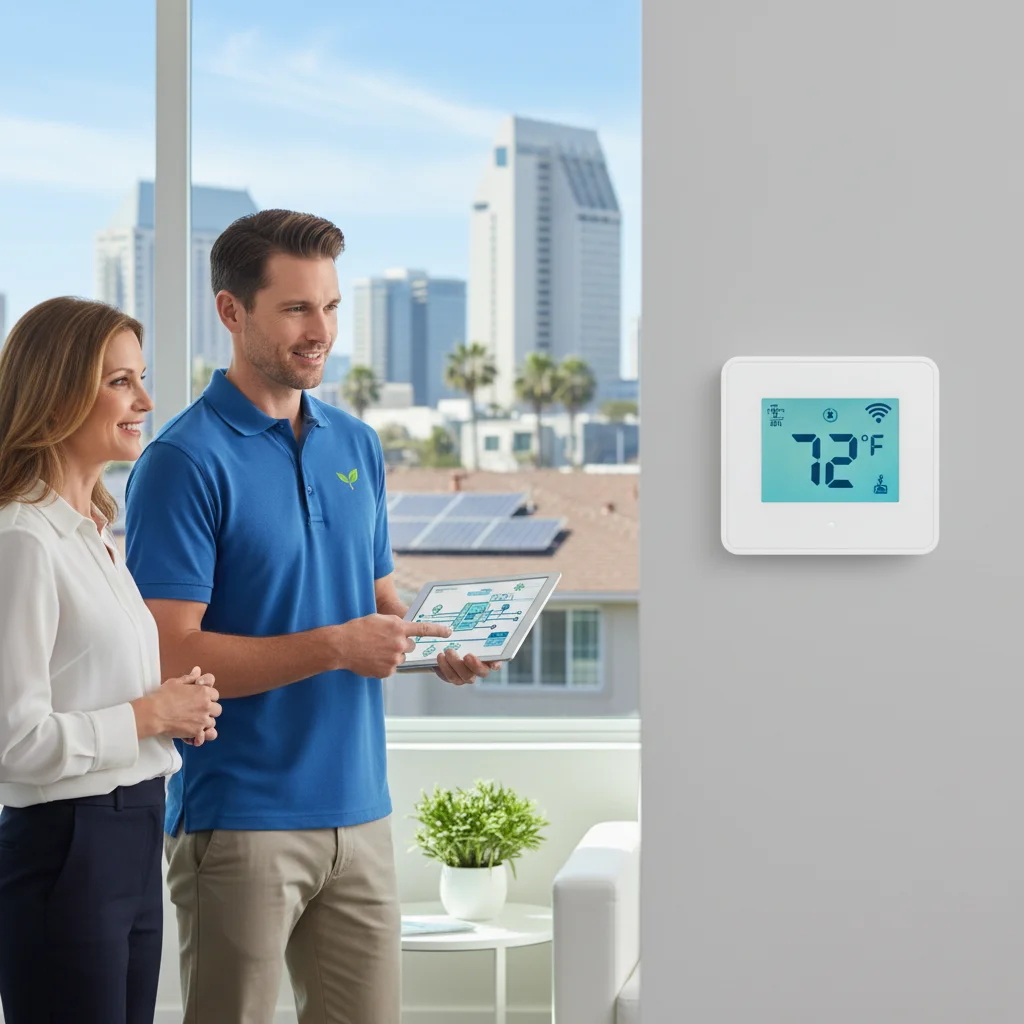
San Diego homeowners who upgraded to smart thermostats in 2025 saw average energy bill reductions of 12-18%, translating to $120-$240 in annual savings, according to San Diego Gas & Electric utility data. And that's before factoring in rebates and incentives that can cut upfront costs by $50-$200. California's energy efficiency programs for 2026 continue to prioritize HVAC control upgrades, with San Diego County residents accessing both statewide and utility-specific incentives.
What Smart Thermostat Models Qualify for San Diego Rebates and Incentives?
San Diego Gas & Electric (SDG&E) approves smart thermostats that meet ENERGY STAR certification standards for residential HVAC systems. Qualifying models include Nest Learning Thermostat, ecobee SmartThermostat, Honeywell Home T9, Emerson Sensi Touch, and Lux Kono Smart Thermostat. SDG&E's 2026 Residential Energy Efficiency Rebate Program offers $50-$75 rebates for single-zone installations and $100-$125 for multi-zone systems with remote sensors.
But not all ENERGY STAR thermostats qualify automatically. The device must connect to Wi-Fi, support demand response programs, and integrate with SDG&E's grid management system. Thermostats purchased through SDG&E's Marketplace qualify for instant rebates at checkout, eliminating the mail-in rebate process. Third-party retail purchases require manual application submission within 180 days of installation.
And smart thermostats installed as part of whole-home energy retrofits may qualify for additional California state incentives through the Building Initiative for Low-Emissions Development (BUILD) program, which provides up to $1,000 for comprehensive HVAC upgrades. So homeowners combining smart thermostat rebates with heat pump installations see the highest total incentive values.
What Are the Income Limits for Smart Thermostat Installation Programs in San Diego?
Standard SDG&E residential rebates carry no income restrictions—any San Diego County homeowner or renter with landlord permission qualifies for the $50-$125 smart thermostat rebate. But income-qualified programs offer substantially higher incentives. The Energy Savings Assistance Program (ESAP) provides free smart thermostat installation for households at or below 200% of the federal poverty level, which equals $62,400 for a family of four in 2026.
California Alternate Rates for Energy (CARE) participants automatically qualify for ESAP benefits, which include free professional installation valued at $150-$250 in addition to the free equipment. And SDG&E's Family Electric Rate Assistance (FERA) program, available to households between 200-250% of poverty level ($62,400-$78,000 for a family of four), provides discounted installation services at $75 compared to typical $150-$300 contractor rates.
"Income-qualified energy efficiency programs delivered $47 million in utility bill savings to San Diego County residents in 2025" — California Public Utilities Commission Annual Report
Federal IRA Home Energy Rebate programs launching in California during 2026 allocate $8,000 for comprehensive electric appliance conversions, with smart thermostats counting as eligible equipment when paired with heat pump installations. So low-to-moderate income households (below 80% area median income, or $89,600 for San Diego County families of four) access both immediate utility rebates and federal point-of-sale discounts.
How Do You Apply for Smart Thermostat Rebates—Step-by-Step Application Process
SDG&E Marketplace purchases generate automatic rebate application at checkout—no additional paperwork required. For retail purchases outside SDG&E's platform, homeowners complete the online rebate application at sdge.com/rebates within 180 days of installation. Required documentation includes proof of purchase showing model number and purchase date, installation receipt with contractor license number, and photos of the installed thermostat displaying Wi-Fi connectivity status.
The application processes in 6-8 weeks, with rebate payments issued as checks or bill credits. And SDG&E requires the thermostat to remain installed and operational for minimum 12 months—early removal triggers rebate recapture. Professional installation isn't mandatory for standard rebates, but ESAP and FERA programs require SDG&E-approved contractor installation to qualify.
For IRA federal rebates launching mid-2026, California's designated administrator (likely the California Energy Commission) will operate a separate application portal. Homeowners must obtain pre-approval before equipment purchase, submit contractor bids, and use participating contractors from the approved list. Unlike SDG&E's post-purchase rebate model, IRA rebates function as point-of-sale discounts—the contractor receives payment directly and reduces the homeowner's invoice.
"Point-of-sale rebates reduce upfront cost barriers by 73% compared to mail-in rebate programs, driving 2.4x higher participation rates" — U.S. Department of Energy Residential Retrofit Analysis
So homeowners planning comprehensive HVAC upgrades benefit from coordinating SDG&E utility rebates, California energy tax credits, and federal IRA incentives through a single participating contractor. Use our free rebate calculator to estimate your total available incentives.
When Are the Deadlines for San Diego Smart Thermostat Incentive Programs?
SDG&E residential rebate programs operate on annual budget cycles that typically exhaust funds by September-October. The 2026 program opened January 1 with $12 million allocated statewide for residential HVAC rebates, including smart thermostats. Applications submitted after fund depletion go on waitlists for the following budget year. And SDG&E doesn't announce fund exhaustion proactively—the rebate portal simply closes without notice when budgets deplete.
ESAP income-qualified programs receive separate, more stable funding with year-round availability, though wait times extend to 3-6 months during peak summer demand periods. California IRA Home Energy Rebate funding extends through 2031, but the state's $306 million allocation will serve on a first-come basis across 14 million California households. Early applicants in 2026-2027 face shortest wait times before backlogs develop.
The federal Energy Efficient Home Improvement Credit (Section 25C) ended for property placed in service after December 31, 2025 (IRS FS-2025-05). Federal tax credits for this work have ended, but state, local and utility rebates may still apply; check what is available at your address with the DuloCore rebate calculator.
Can You Stack Smart Thermostat Rebates with Other California Energy Efficiency Programs?
California explicitly allows stacking utility rebates and state incentives without penalties; federal tax credits no longer apply (IRS FS-2025-05). SDG&E smart thermostat rebates ($50-$125) combine with California state BUILD program incentives (up to $1,000 for whole-home upgrades) and federal IRA Home Energy Rebates ($8,000 maximum for comprehensive electric conversions). But total incentives can't exceed the project's total cost—a $300 smart thermostat with $150 installation can't receive $500 in combined rebates.
And heat pump rebates stack with smart thermostat incentives when installed together. SDG&E offers $3,000-$6,000 for heat pump installations, which can combine with the $50-$125 smart thermostat rebate in the same application. IRA federal rebates treat smart thermostats as eligible load management devices when paired with electric heating/cooling systems, adding $500-$1,000 to the combined incentive package.
Local San Diego municipal programs, like the City of San Diego Climate Equity Fund, provide additional $500-$2,000 grants for low-income households completing comprehensive electrification projects. These municipal incentives layer on top of utility and federal programs. So income-qualified San Diego homeowners installing heat pumps with smart thermostats access four incentive sources simultaneously: SDG&E utility rebates, California BUILD, federal IRA rebates, and municipal climate equity grants.
But CARE and FERA discount rate programs can't be combined with ESAP free installation programs—households must choose between ongoing monthly bill discounts (CARE/FERA) or one-time free equipment installation (ESAP). The CARE discount averages $40/month or $480 annually, typically exceeding the one-time $200-$300 value of free thermostat installation.
What Documentation Do You Need Before Installing a Smart Thermostat in San Diego?
SDG&E rebate applications require proof of purchase showing equipment make, model, serial number, and purchase date. Receipts must clearly identify the thermostat as ENERGY STAR certified—generic "thermostat" line items without certification documentation get rejected. Installation receipts must include contractor name, California contractor license number (C-20 HVAC or C-10 Electrical), installation date, and property address.
And applicants must photograph the installed thermostat displaying three elements: the unit's model label, Wi-Fi connectivity confirmation on the screen, and the physical wall installation. SDG&E's photo review process checks for proper installation height (52-60 inches above floor), location away from heat sources and direct sunlight, and functional display. Rebates get denied for thermostats installed in improper locations like above ovens, near exterior doors, or in direct sunlight paths.
ESAP and FERA income-qualified programs require additional documentation: prior year tax returns or recent pay stubs proving household income, utility account number and service address, and homeowner/renter status documentation. Renters must submit landlord authorization forms obtained through SDG&E's website. So the complete application package includes 6-8 documents compared to 2-3 for standard rebate programs.
| Program | Rebate Amount | Income Limit | Professional Installation Required | Application Deadline |
|---|---|---|---|---|
| SDG&E Standard Residential | $50-$125 | None | No | When funds exhausted (typically Sept-Oct) |
| SDG&E ESAP (Income-Qualified) | Free equipment + installation ($200-$300 value) | ≤200% federal poverty level ($62,400 family of four) | Yes | Year-round (waitlist during peak demand) |
| SDG&E FERA | Equipment rebate + $75 installation | 200-250% federal poverty level ($62,400-$78,000 family of four) | Yes | Year-round |
| California IRA Home Energy Rebates | Up to $8,000 (smart thermostat portion ~$500-$1,000) | ≤150% area median income ($133,350 family of four, San Diego) | Yes, from approved contractor list | Through 2031 (first-come allocation) |
Official Sources
- SDG&E Residential Rebates — Current 2026 smart thermostat rebate amounts, eligible models, and online application portal
- ENERGY STAR Certified Thermostats Database — Federal certification database for qualifying smart thermostat models
- DSIRE California Incentives Database — Comprehensive state and utility rebate program directory with eligibility criteria
Frequently Asked Questions
What are the eligibility requirements for smart thermostat rebates in San Diego?
San Diego homeowners and renters (with landlord permission) qualify for SDG&E's $50-$125 standard rebates with no income restrictions. The thermostat must be ENERGY STAR certified, Wi-Fi enabled, and compatible with SDG&E's demand response programs. Installation must occur at an SDG&E service address, and applications must be submitted within 180 days of purchase. Income-qualified programs (ESAP at ≤200% poverty level, FERA at 200-250% poverty level) require additional income documentation and use SDG&E-approved contractors.
How much can you save with a smart thermostat rebate in San Diego?
SDG&E offers $50-$75 rebates for single-zone smart thermostats and $100-$125 for multi-zone systems with remote sensors. Income-qualified ESAP participants receive free equipment and installation valued at $200-$300. When combined with California BUILD program incentives ($1,000 for whole-home upgrades) and federal IRA rebates ($500-$1,000 for load management devices), total upfront savings reach $1,650-$2,425. Annual energy savings average $120-$240 based on SDG&E 2025 participant data.
What is the process for applying for a smart thermostat rebate in San Diego?
Purchases through SDG&E's online Marketplace generate automatic rebate application at checkout. For retail purchases, homeowners submit online applications at sdge.com/rebates within 180 days, uploading proof of purchase, installation receipt with contractor license number, and photos showing model number and Wi-Fi connectivity. Applications process in 6-8 weeks with payment via check or bill credit. ESAP and FERA income-qualified programs require pre-enrollment before installation and use SDG&E-assigned contractors.
What are the deadlines for smart thermostat rebate applications in San Diego?
SDG&E's 2026 standard rebate program operates on a $12 million annual budget that typically depletes by September-October, after which applications waitlist for the next budget year. Applications must be submitted within 180 days of installation date. ESAP income-qualified programs accept applications year-round but face 3-6 month wait times during peak summer demand. Federal IRA rebates launching mid-2026 extend through 2031 on a first-come basis with California's $306 million allocation.
Which smart thermostats qualify for rebates in San Diego?
SDG&E approves ENERGY STAR certified models including Nest Learning Thermostat (all generations), ecobee SmartThermostat with Voice Control, Honeywell Home T9 and T10 Pro, Emerson Sensi Touch Wi-Fi, and Lux Kono Smart Thermostat. The device must connect to Wi-Fi, support remote temperature adjustment, and integrate with SDG&E's grid demand response signals. Thermostats without ENERGY STAR certification or those lacking Wi-Fi connectivity don't qualify regardless of "smart" features like programmable schedules.
Ready to maximize your smart thermostat savings? Use our rebate calculator to see exactly how much you qualify for based on your household income, location, and planned upgrades. Get your personalized rebate estimate in under 2 minutes—completely free.
Updated on April 14, 2026. Fact-checked by DuloCore Editors. About our research team.
Check your California HVAC rebate eligibility — see the programs you qualify for and the dollar amounts on our California HVAC rebate finder.