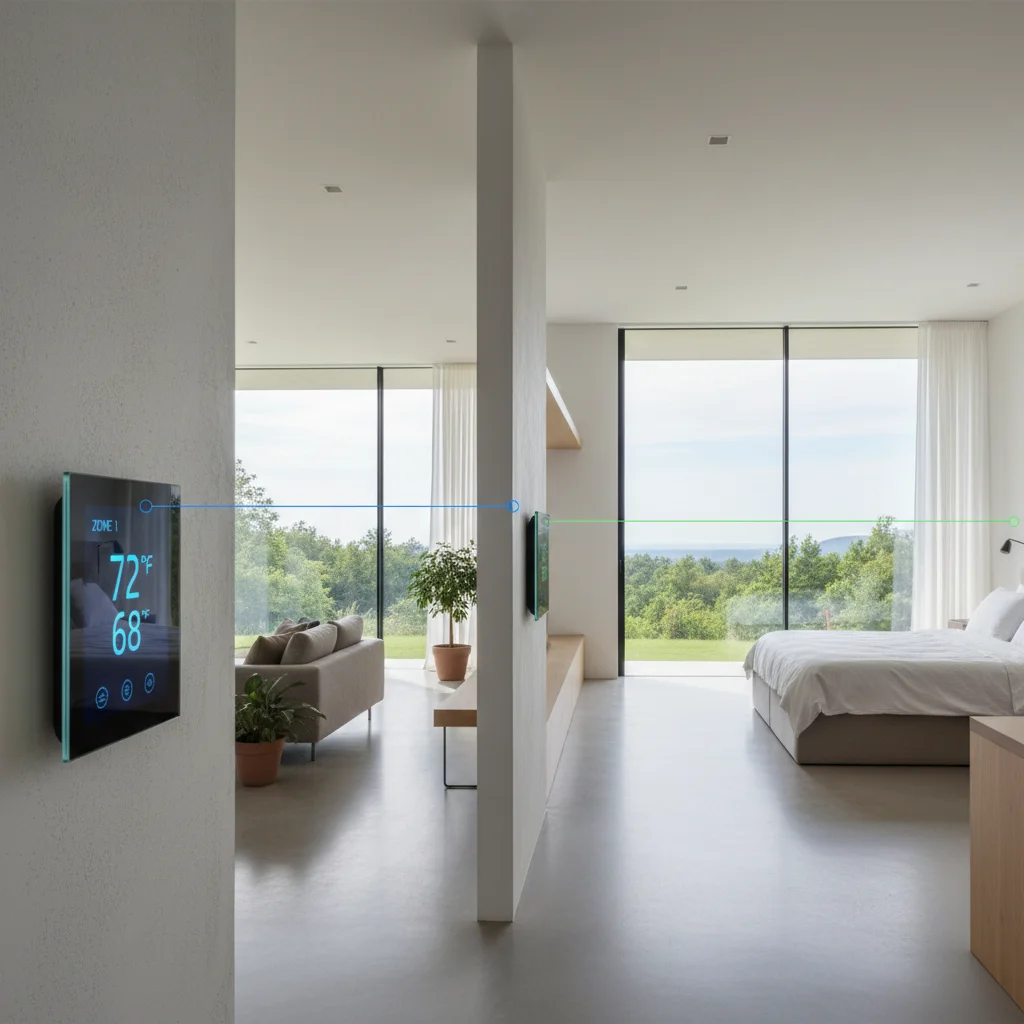
Homeowners with older forced-air HVAC systems waste $600 to $1,200 annually heating and cooling empty rooms. Multi-zone smart thermostats eliminate that waste by controlling temperature independently across different areas of a home—and in 2026, federal and California state programs offer up to $2,000 in combined rebates and tax credits for eligible installations.
What Are the Income Limits for Smart Thermostat Multi-Zone Rebates and Tax Credits?
California's TECH Clean California program offers $500 rebates for smart thermostats with no income limits for single-zone systems, but multi-zone installations qualify for enhanced rebates of $1,000 when paired with heat pump zoning systems. The federal Energy Efficient Home Improvement Credit (Section 25C) ended for property placed in service after December 31, 2025 (IRS FS-2025-05). Federal tax credits for this work have ended, but state, local and utility rebates may still apply; check what is available at your address with the DuloCore rebate calculator.
Income-qualified programs offer larger amounts. California's Energy Savings Assistance Program provides free multi-zone smart thermostat installation for households earning below 200% of federal poverty guidelines—$60,000 for a family of four in 2026. So low- to moderate-income homeowners access the technology at zero upfront cost while saving $40 to $80 monthly on utility bills.
But the IRA Home Efficiency Rebate program sets stricter income caps. Households earning below 80% of area median income ($95,000 in Los Angeles County for a family of four) receive $8,000 rebates for whole-home electrification projects that include multi-zone controls. And moderate-income households at 80-150% of area median income qualify for $4,000 rebates when multi-zone thermostats are installed alongside heat pumps or ductless mini-splits. Use our free rebate calculator to determine your eligibility tier.
"Smart thermostats that earn the ENERGY STAR certification can save homeowners about $180 a year on energy bills when properly installed and configured." — ENERGY STAR
How Do You Apply for Smart Thermostat Multi-Zone Incentives and What's the Application Process?
Form 5695 only covers qualifying work completed by December 31, 2025 and claimed on a 2025 return; the federal 25C and 25D credits ended after that date (IRS FS-2025-05). The process takes 15-30 minutes and delivers credits directly as tax liability reduction, not as cash refunds. But taxpayers with insufficient tax liability can't carry forward unused credits beyond the current tax year.
California's TECH Clean California instant rebate program requires contractor pre-approval and online application submission before installation begins. Contractors complete the rebate paperwork at point of sale, reducing upfront costs by $500 to $1,000 immediately. And the entire approval process takes 48 to 72 hours for standard installations, with funds disbursed to contractors within 14 business days.
Income-qualified programs operate differently. Energy Savings Assistance Program participants receive direct installation from utility-approved contractors after income verification through a single online application at sce.com/residential/assistance/esa or pge.com/fera. So eligible households complete the process in one step with no upfront payment required.
Bay Area Regional Energy Network offers a hybrid model. Homeowners submit pre-approval applications with income documentation, receive conditional approval within 5 business days, then select from approved contractor networks for installation. Post-installation inspection occurs within 10 days, and rebate checks arrive 30 to 45 days after final approval. For comprehensive guidance on federal programs, explore energy tax credits available in 2026.
When Are the Deadlines for Smart Thermostat Multi-Zone Rebate Programs in 2026?
The federal Energy Efficient Home Improvement Credit (Section 25C) ended for property placed in service after December 31, 2025 (IRS FS-2025-05). So taxpayers have a 6-year window to plan installations strategically.
California state programs operate on fiscal year cycles ending June 30, 2026. TECH Clean California allocated $120 million for 2026 but reached 78% of budget capacity by March 2026. And program administrators expect full subscription by May 15, 2026, creating an effective deadline 45 days before the official program year ends.
Utility-specific programs follow different timelines. Southern California Edison's multi-zone thermostat rebates close September 30, 2026, while Pacific Gas & Electric extends through November 30, 2026. But both utilities reserve the right to pause enrollment when budgets reach 90% allocation, typically occurring 30 to 60 days before posted deadlines.
Income-qualified programs remain open year-round with rolling enrollment, but wait times increase seasonally. Energy Savings Assistance Program applications submitted between June and September face 8 to 12-week scheduling delays due to peak cooling season demand. So homeowners seeking free installation complete applications between October and March for fastest service within 3 to 4 weeks.
Can You Stack Multiple Rebates and Tax Credits for Smart Thermostat Multi-Zone Systems?
A $2,500 multi-zone smart thermostat system qualifies for a $750 federal tax credit (30% of cost) plus a $500 to $1,000 TECH Clean California rebate, reducing net cost to $750 to $1,250. And income-qualified households add Energy Savings Assistance Program benefits for zero net cost.
Utility rebates generally prohibit stacking with other utility programs from the same provider but allow combination with state and federal incentives. Southern California Edison customers can't combine SCE's $500 multi-zone thermostat rebate with SCE's $300 HVAC tune-up rebate for the same project. But the same customer stacks SCE's utility rebate with TECH Clean California's state rebate and federal IRA tax credits for total savings of $1,750 to $2,250.
Local municipality programs add a fourth stacking layer. Los Angeles Department of Water & Power offers $750 rebates for multi-zone smart thermostats when installed with qualifying heat pump systems, stackable with all state and federal programs. So LADWP customers access up to $2,500 in combined incentives, reducing a $3,000 installation to $500 net cost.
"Rebates and tax credits can be stacked in most cases, but homeowners should verify program rules before installation to ensure compliance with stacking policies." — Database of State Incentives for Renewables & Efficiency
What Contractor Requirements and Pre-Approval Steps Do You Need for Multi-Zone Thermostat Installation?
California Title 24 mandates licensed C-20 (Warm-Air Heating, Ventilation and Air-Conditioning) contractors for all multi-zone thermostat installations integrated with HVAC systems. DIY installation disqualifies projects from TECH Clean California rebates and voids manufacturer warranties on zoned systems. And unlicensed installation violates state building codes, creating liability for homeowners during property sales.
TECH Clean California requires contractors to complete online training certification and register with program administrators before submitting rebate applications. The training takes 2 hours and costs $0, covering proper load calculations, zone configuration, and documentation requirements. So contractors complete pre-approval once and process unlimited rebate applications afterward.
Form 5695 only covers qualifying work completed by December 31, 2025 and claimed on a 2025 return; the federal 25C and 25D credits ended after that date (IRS FS-2025-05). Only 37% of smart thermostats sold in 2026 meet Most Efficient standards. And homeowners who install non-certified models forfeit the entire $600 tax credit.
Income-qualified programs maintain approved contractor networks with background checks and performance bonding. Energy Savings Assistance Program contractors undergo annual recertification including license verification, insurance confirmation, and customer satisfaction audits. But homeowners can't select contractors—utilities assign installations based on geographic service areas and contractor availability within 6 to 8 weeks of application approval. For HVAC system upgrades paired with multi-zone controls, review heat pump rebates available in California.
Smart Thermostat Multi-Zone Funding Status: Which Programs Are Currently Active?
The federal Energy Efficient Home Improvement Credit (Section 25C) ended for property placed in service after December 31, 2025 (IRS FS-2025-05). The program operates as a tax expenditure rather than a grant program, so every eligible taxpayer who files Form 5695 receives the full 30% credit up to $600.
California's TECH Clean California entered its third program year in January 2026 with $120 million allocated for all HVAC electrification measures including multi-zone thermostats. As of April 2026, $93.6 million (78%) has been reserved through approved applications, leaving $26.4 million for the final 11 weeks of the fiscal year. So applications submitted after April 15, 2026, face high probability of waitlist placement for the 2027 program year starting July 1, 2026.
Southern California Edison's multi-zone thermostat rebate program shows "Active" status as of April 8, 2026, with $8.2 million remaining from a $15 million annual budget. But Pacific Gas & Electric suspended new applications on March 22, 2026, after reaching 100% budget allocation in the first quarter. And PG&E customers now join a waitlist for the next budget cycle starting October 1, 2026.
Income-qualified Energy Savings Assistance Program maintains continuous funding through utility ratepayer surcharges, with $285 million allocated for 2026 across all California investor-owned utilities. The program serves 200,000 households annually with no enrollment caps, but wait times extend to 12 weeks during peak summer months.
Official Sources
- ENERGY STAR Smart Thermostats — Federal efficiency standards and certified product directory
- Database of State Incentives for Renewables & Efficiency — Comprehensive state and utility rebate program database
- U.S. Department of Energy Save Energy, Save Money — Federal tax credit guidance and home efficiency resources (note: the federal 25C and 25D credits ended for projects completed after December 31, 2025)
Frequently Asked Questions
Can smart thermostats with multiple zones qualify for energy tax credits?
Multi-zone smart thermostats qualify for federal IRA tax credits when they meet Energy Star Most Efficient certification and are installed as part of a whole-home HVAC upgrade. The federal Energy Efficient Home Improvement Credit (Section 25C) ended for property placed in service after December 31, 2025 (IRS FS-2025-05). And standalone thermostat replacement without HVAC system modification doesn't qualify for federal credits but remains eligible for California state rebates of $500 to $1,000.
How much can you save with a multi-zone smart thermostat system?
Energy Star-certified multi-zone smart thermostats save homeowners $240 to $480 annually by reducing heating and cooling in unused zones by 25% to 40%. Homes with 3 or more distinct zones (upstairs/downstairs, bedrooms/living areas) see the highest savings of $480 to $720 yearly. And payback periods range from 2 to 4 years when accounting for $1,750 to $2,500 in combined federal and California rebates.
What's the difference between a smart thermostat and a multi-zone system?
Single-zone smart thermostats control one HVAC system for an entire home, while multi-zone systems use dampers and multiple thermostats to create independent temperature control in 2 to 8 different areas. Multi-zone systems cost $2,500 to $5,000 installed compared to $200 to $400 for single-zone smart thermostats. But homes over 2,500 square feet with uneven heating or cooling patterns save $300 to $600 more annually with multi-zone configurations.
Do I need a professional to install a multi-zone smart thermostat?
California building codes require licensed C-20 HVAC contractors for all multi-zone installations because the systems modify ductwork with motorized dampers and zone control panels. DIY installation voids manufacturer warranties, disqualifies projects from $500 to $1,000 state rebates, and violates Title 24 energy code. And professional installation costs $800 to $1,500 but ensures proper load calculations, damper placement, and system balancing for optimal performance.
Are multi-zone smart thermostats worth the extra cost compared to single-zone systems?
Homes over 2,000 square feet with temperature variations exceeding 5°F between floors or zones recover the $2,000 to $3,500 premium for multi-zone systems within 3 to 5 years through energy savings. Single-story homes under 1,800 square feet with open floor plans see minimal benefit and achieve faster payback with single-zone smart thermostats. And homes with existing zone dampers reduce multi-zone upgrade costs to $800 to $1,500 by retrofitting smart controls onto legacy systems. Check available smart thermostat rebates to reduce net installation costs.
Ready to find out how much you can save? Use our free rebate calculator to discover your eligibility for federal tax credits, California state rebates, and utility incentives for multi-zone smart thermostat installation. Get your personalized savings estimate in under 2 minutes.
Updated: April 14, 2026 — fact-checked by DuloCore Research. About our editorial process.
Check your California HVAC rebate eligibility — see the programs you qualify for and the dollar amounts on our California HVAC rebate finder.