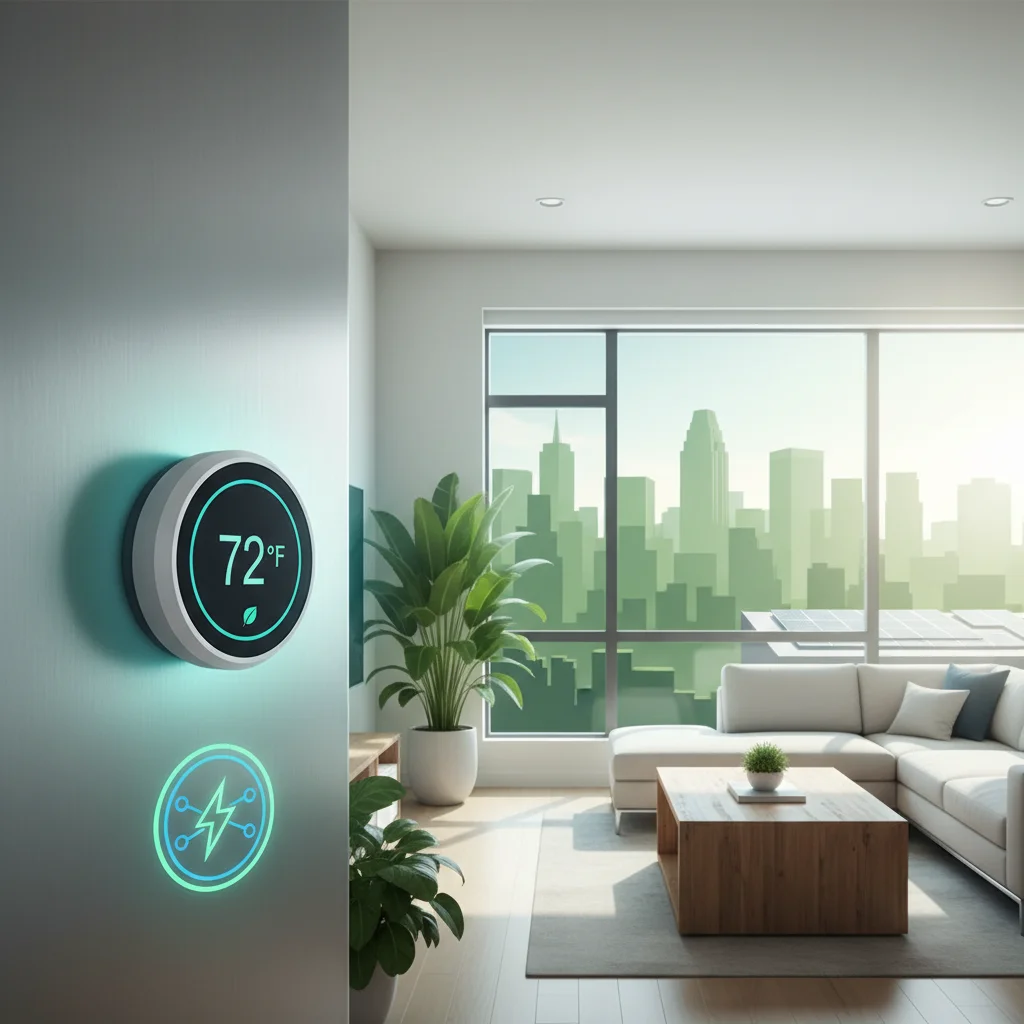
Oakland homeowners replaced over 3,400 thermostats with smart models in 2025, and nearly half left money on the table by not claiming available rebates. Pacific Gas & Electric Company (PG&E) customers in Oakland can access instant rebates up to $120 for qualifying smart thermostats. The federal Energy Efficient Home Improvement Credit (Section 25C) ended for property placed in service after December 31, 2025 (IRS FS-2025-05). And the Bay Area Air Quality Management District occasionally offers additional incentives during peak demand reduction periods.
What Smart Thermostat Rebates Are Available in Oakland Right Now?
Oakland residents in 2026 qualify for PG&E's Smart Thermostat Program offering $50-$120 instant rebates depending on device model and income qualification. The federal Energy Efficient Home Improvement Credit (Section 25C) ended for property placed in service after December 31, 2025 (IRS FS-2025-05). Federal tax credits for this work have ended, but state, local and utility rebates may still apply; check what is available at your address with the DuloCore rebate calculator. The Bay Area Air Quality Management District runs seasonal demand response programs with bonus payments.
PG&E divides its smart thermostat rebates into two tiers: standard devices earn $50 instant rebates at purchase, while advanced learning models with automated demand response capabilities receive $120. Income-qualified customers receive an additional $50 bonus on top of base rebate amounts. And the utility processes rebates instantly at participating retailers including Home Depot, Lowe's, and Best Buy locations across Oakland.
The federal investment differs from utility rebates because it comes as a tax credit claimed on IRS Form 5695 when filing annual returns. Homeowners can claim 30% of total smart thermostat costs up to a maximum of $600 annually for all home energy improvements combined. So a $250 Nest Learning Thermostat with $150 professional installation costs $400 total, generating a $120 federal credit.
The federal Energy Efficient Home Improvement Credit (Section 25C) ended for property placed in service after December 31, 2025 (IRS FS-2025-05).
But Oakland's location in PG&E territory creates additional opportunities through demand response events. When grid strain occurs during heat waves or high renewable energy production periods, enrolled smart thermostats automatically adjust temperatures by 2-4 degrees and homeowners earn $25-$50 per summer season in bill credits.
How Much Can You Save With Oakland Smart Thermostat Rebates?
Total savings from combined rebate programs range from $170 to $390 depending on device selection, installation method, and income status. A standard installation scenario for non-income-qualified Oakland homeowners generates $170: $50 PG&E instant rebate plus $120 federal tax credit on a $400 total project cost. Income-qualified residents receive $220 total through the enhanced $100 PG&E rebate plus the same federal credit.
Premium installations with learning thermostats and professional setup cost approximately $600 ($350 device plus $250 installation) and generate higher returns. And these projects earn $120 PG&E rebate plus $180 federal credit (30% of $600) for $300 total savings, reducing net cost to $300. Income-qualified households receive $170 from PG&E plus $180 federal for $350 total savings.
The math shifts when Oakland homeowners combine smart thermostats with other energy upgrades in the same tax year. Federal rules cap the combined home energy improvement credit at $600 annually across all projects including insulation, windows, doors, and HVAC equipment. So homeowners planning multiple upgrades need to calculate which improvements deliver the highest return on the $600 federal limit.
Use our free rebate calculator to model your specific scenario with current Oakland program rates and federal tax credit percentages.
Annual operating savings add to the upfront rebate value. Environmental Protection Agency ENERGY STAR data shows smart thermostats reduce heating and cooling costs by an average of $180 per year in California climate zones. Oakland's Mediterranean climate with mild winters and warm summers falls in the moderate savings category at approximately $150-$200 annually depending on home size and HVAC system efficiency.
But payback periods vary significantly. A $300 net-cost installation (after $300 in rebates) pays for itself in roughly 18 months with $200 annual savings. And homeowners who skip professional installation and choose DIY-friendly models reduce the payback to under 12 months.
What Are the Eligibility Requirements and Documentation You'll Need?
PG&E requires applicants to be current residential electric customers with an active account in good standing. Smart thermostats must appear on the utility's qualified products list, which includes models from Nest, Ecobee, Honeywell, Emerson, and Lux meeting specific connectivity and demand response standards. And devices must connect to home WiFi networks and link to PG&E's online portal for demand response participation.
Income qualification for enhanced rebates follows California Alternate Rates for Energy (CARE) or Family Electric Rate Assistance (FERA) program guidelines. CARE eligible households earn income at or below 200% of federal poverty guidelines, while FERA covers those between 200-250%. Oakland families of four qualify for CARE with annual income under $62,450 in 2026, automatically receiving the $100 PG&E rebate instead of the standard $50.
Federal tax credit eligibility requires different documentation. Homeowners must owe federal income tax in the year of installation to benefit from the non-refundable credit. And the IRS requires manufacturers' certification statements confirming ENERGY STAR compliance, available as downloadable PDFs from product websites or printed on device packaging.
Documentation requirements differ by program. PG&E's instant rebate system requires no paperwork when purchasing from participating retailers because the discount applies automatically at checkout after scanning loyalty cards linked to PG&E accounts. But mail-in rebates for online purchases need proof of purchase receipts, device serial numbers, and completed application forms submitted within 60 days of installation.
Federal credits demand more extensive records. The IRS recommends retaining itemized receipts showing equipment costs separated from installation labor, manufacturers' certification statements, and installation invoices with contractor license numbers. And homeowners should photograph product labels showing model numbers and ENERGY STAR logos before installation as backup documentation.
Do You Need Pre-Approval Before Installing Your Smart Thermostat?
PG&E's smart thermostat program requires no pre-approval for standard rebates. Homeowners select qualifying devices, purchase from retailers or online vendors, complete installation, and claim instant or mail-in rebates within program deadlines. And the utility's automated rebate processing system approves most claims within 6-8 weeks for mail submissions or instantly at point of sale for retail purchases.
But income-qualified enhanced rebates do require advance verification. Oakland residents must enroll in CARE or FERA programs before purchasing smart thermostats to receive the $100 rebate tier instead of the standard $50. PG&E processes CARE/FERA applications in approximately 2-3 weeks after receiving proof of income documentation including tax returns, pay stubs, or government assistance award letters.
Federal tax credits operate on a post-installation claim basis with zero pre-approval requirements. Form 5695 only covers qualifying work completed by December 31, 2025 and claimed on a 2025 return; the federal 25C and 25D credits ended after that date (IRS FS-2025-05). And the IRS processes energy tax credits as part of standard return processing without separate approval steps.
Special circumstances create exceptions. Rental properties need landlord consent for thermostat installations, though rebate claims belong to whoever pays utility bills. And homeowners' associations sometimes restrict exterior equipment changes, though smart thermostats rarely trigger these covenants because they replace existing indoor wall units.
So the standard Oakland smart thermostat rebate process follows a simple timeline: verify PG&E account status, confirm device appears on qualified products list, purchase and install, then claim rebates through appropriate channels. Income-qualified applicants should complete CARE/FERA enrollment 3-4 weeks before planned purchases to ensure enhanced rebate availability.
What Are the Deadlines for Oakland Thermostat Rebate Programs?
PG&E's smart thermostat rebate program operates on a calendar year cycle running January 1 through December 31, 2026, with funding allocated on a first-come, first-served basis until annual budgets exhaust. The utility historically maintains smart thermostat rebate availability throughout full calendar years because demand spreads evenly across seasons unlike heating and cooling equipment rebates that concentrate during summer and winter. And PG&E announces program renewals and budget allocations each December for the following year.
Purchase and installation deadlines differ from claim deadlines. Oakland homeowners must purchase qualifying smart thermostats by December 31, 2026 to claim 2026 program year rebates, but PG&E accepts mail-in rebate applications up to 180 days after purchase date. So a device bought on December 15, 2026 remains eligible for rebate submission through June 13, 2027 using 2026 program rules and rebate amounts.
The federal Energy Efficient Home Improvement Credit (Section 25C) ended for property placed in service after December 31, 2025 (IRS FS-2025-05). Homeowners claim credits when filing returns for the tax year in which they placed equipment in service, with a standard April 15 filing deadline plus extensions.
But the federal program includes a critical installation date requirement: homeowners must install smart thermostats in their primary residence, not investment properties or second homes. And devices must enter service (become operational and connected to HVAC systems) within the tax year claimed, not merely purchased or delivered.
Seasonal demand response programs operate on separate enrollment cycles. PG&E's SmartRate and Peak Day Pricing programs accepting smart thermostat participants open enrollment in February-March for upcoming summer seasons. And participants must maintain active enrollment through full program periods (typically June through September) to receive bill credit incentives.
Missing deadlines eliminates rebate eligibility without exceptions. PG&E's automated rebate processing system rejects applications submitted beyond 180-day purchase windows, and the IRS disallows tax credits claimed for installations completed outside the tax year filed.
Can You Stack Multiple Rebates to Maximize Your Savings?
Oakland homeowners can combine PG&E utility rebates with federal tax credits on the same smart thermostat installation without restrictions. The IRS treats utility company rebates as purchase price reductions rather than taxable income, so the federal 30% credit calculation uses the net cost after subtracting utility rebates. And this stacking approach maximizes total savings while maintaining compliance with both programs.
The calculation follows a specific order: subtract PG&E rebates from gross equipment and installation costs first, then apply the 30% federal credit (this federal credit ended for property placed in service after December 31, 2025) to the reduced subtotal. A $600 installation ($350 device plus $250 labor) minus a $120 PG&E rebate equals $480 net cost, generating a $144 federal credit (30% of $480) for $264 total savings. Income-qualified Oakland residents subtract $170 PG&E rebate first, leaving $430 net cost and $129 federal credit for $299 total savings.
The $600 annual maximum for all home energy improvements combined under IRS rules applies to the aggregate of insulation, windows, doors, HVAC equipment, and smart thermostats installed in the same tax year. So homeowners completing multiple projects must allocate the $600 cap strategically across improvements delivering the highest percentage returns.
Demand response bill credits stack on top of equipment rebates without affecting federal tax calculations. PG&E's SmartRate program pays $25-$50 annually in summer bill credits for smart thermostat participation in automated demand response events, and these operational incentives don't reduce equipment purchase prices or federal credit eligibility.
Local municipal and county programs occasionally offer additional smart thermostat incentives that stack with PG&E and federal programs. Oakland's Energy and Climate Action Plan periodically funds direct-install programs for income-qualified residents, though these initiatives target rental properties and multifamily buildings rather than single-family homeowners. And the Bay Area Air Quality Management District's incentive programs focus primarily on heat pump rebates rather than thermostats.
Stacking restrictions appear when combining programs serving identical purposes. Homeowners cannot claim both PG&E's standard $50 rebate and income-qualified $100 rebate on the same device because these represent different tiers of the same program. And manufacturers' instant rebates or retailer promotions don't stack with utility rebates if programs explicitly prohibit combining offers.
So the optimal stacking strategy for Oakland homeowners in 2026 combines PG&E's highest available rebate tier ($50 standard or $100 income-qualified) with the 30% federal tax credit applied to net costs, plus optional demand response bill credits for ongoing savings. Calculate your combined savings with our rebate calculator using current program rules.
Official Sources
- ENERGY STAR Smart Thermostats — Federal efficiency standards and qualified product listings
- IRS Energy Incentives for Individuals — Tax credit guidance and Form 5695 instructions (note: the federal 25C and 25D credits ended for projects completed after December 31, 2025)
- Database of State Incentives for Renewables & Efficiency — Comprehensive California and utility program database
Frequently Asked Questions
What smart thermostats qualify for Oakland rebates?
PG&E's qualified products list includes models from Nest (Learning Thermostat and Thermostat E), Ecobee (SmartThermostat and 3 Lite), Honeywell Home T9 and T10 Pro, Emerson Sensi Touch, and Lux Kono. Devices must feature WiFi connectivity, programmable scheduling, remote control via smartphone apps, and compatibility with PG&E's demand response platform. And all qualifying models carry ENERGY STAR certification meeting EPA efficiency standards. The complete qualified products list updates quarterly on PG&E's website with approximately 35-40 approved models available as of April 2026.
How much money can you get back with a smart thermostat rebate in Oakland?
Standard PG&E customers receive $50-$120 instant rebates depending on device model, while income-qualified CARE/FERA participants receive $100-$170. The federal Energy Efficient Home Improvement Credit (Section 25C) ended for property placed in service after December 31, 2025 (IRS FS-2025-05). A typical installation generates $170-$300 in combined rebates and credits, with income-qualified households reaching $220-$390 total. And demand response program participants earn an additional $25-$50 in annual bill credits for automated temperature adjustments during grid events.
Are smart thermostat rebates still available in Oakland in 2026?
PG&E confirmed smart thermostat rebate program continuation through December 31, 2026 with unchanged rebate amounts from 2025 levels. The federal Energy Efficient Home Improvement Credit (Section 25C) ended for property placed in service after December 31, 2025 (IRS FS-2025-05). But homeowners should verify current program status before purchasing because utility rebates operate on first-come, first-served basis with annual budget allocations that can exhaust mid-year during high-demand periods. And PG&E's website maintains real-time program availability status updated weekly during peak installation seasons.
Do you need a professional to install a smart thermostat to get the Oakland rebate?
PG&E rebates apply to both professional and DIY installations without restrictions. Homeowners comfortable with basic electrical work can install most smart thermostats in 30-45 minutes following manufacturers' instructions and claim full rebate amounts. The federal Energy Efficient Home Improvement Credit (Section 25C) ended for property placed in service after December 31, 2025 (IRS FS-2025-05).
What's the difference between PG&E and city of Oakland smart thermostat rebates?
PG&E operates the primary smart thermostat rebate program for Oakland residents, funded through California Public Utilities Commission-approved energy efficiency portfolios. The city of Oakland does not maintain a separate municipal smart thermostat rebate program as of 2026, though the city's Energy and Climate Action Plan occasionally funds targeted direct-install initiatives for income-qualified residents in multifamily buildings. And Oakland property owners should claim PG&E utility rebates as the primary incentive source, supplemented by federal tax credits and optional demand response bill credits for maximum savings.
Ready to claim your smart thermostat rebates? Use our free rebate calculator to estimate your total savings from PG&E utility rebates, federal tax credits, and demand response incentives. Calculate your personalized rebate amount in under 60 seconds based on your Oakland zip code, income status, and planned installation approach.
Last reviewed: April 14, 2026. Reviewed by DuloCore Energy Specialists. About the team.
Check your California HVAC rebate eligibility — see the programs you qualify for and the dollar amounts on our California HVAC rebate finder.