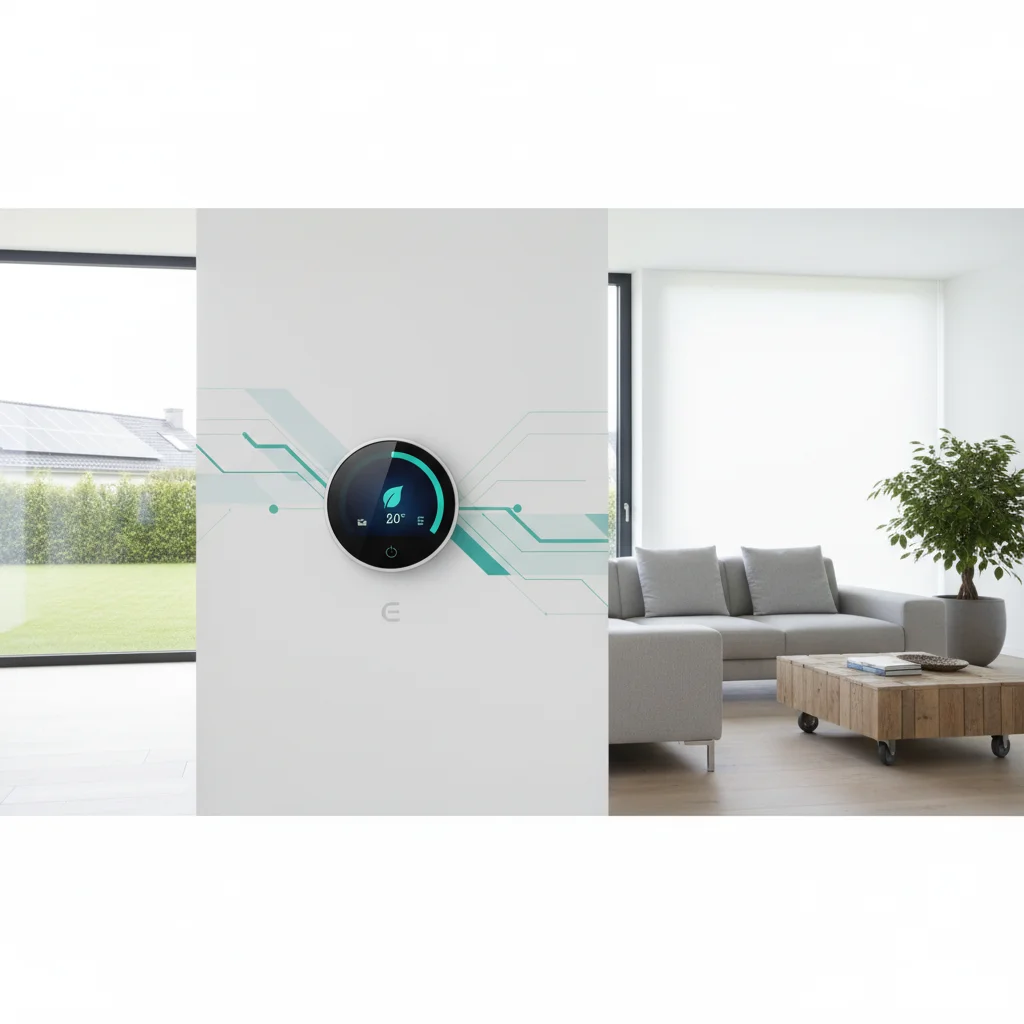
Nearly 40% of American homeowners overpay on heating and cooling costs because their thermostats can't adapt to real-time energy pricing or occupancy patterns. And that 40% translates to $900 million in wasted energy spending annually across residential buildings. But programmable smart thermostats solve this problem by learning household schedules and automatically adjusting temperatures to minimize runtime during peak-rate hours.
What is the smart thermostat tax credit and how much money can you claim?
The federal Energy Efficient Home Improvement Credit (Section 25C) ended for property placed in service after December 31, 2025 (IRS FS-2025-05). Federal tax credits for this work have ended, but state, local and utility rebates may still apply; check what is available at your address with the DuloCore rebate calculator. So a $250 smart thermostat installation generates a $75 tax credit. But this $600 combined cap also covers programmable thermostats, home energy monitors, and professional energy audits performed in the same tax year.
Smart thermostats must meet ENERGY STAR certification requirements and include occupancy sensing, programmable schedules, and remote control capabilities to qualify. And the IRS defines qualifying equipment as devices that can adjust HVAC system runtime based on occupancy patterns or time-of-use utility rates. The 30% credit rate remains constant through 2032, after which it decreases to 26% in 2033 and 22% in 2034 before expiring entirely in 2035.
"Qualifying energy property includes any advanced main air circulating fan, any natural gas, propane, or oil furnace or hot water boiler, and any energy-efficient building property." — IRS Energy Efficient Home Improvement Credit
The annual $600 cap creates strategic timing considerations for homeowners planning multiple efficiency upgrades. So installing a smart thermostat in 2026 and scheduling a comprehensive home energy audit in 2027 maximizes total credit value across both tax years instead of splitting the $600 cap.
Are you eligible for the smart thermostat tax credit in 2026?
Homeowners who install ENERGY STAR-certified smart thermostats in their primary residence between January 1, 2026, and December 31, 2026, qualify for the federal tax credit, provided they have sufficient tax liability to claim the non-refundable credit and the installation occurs in an existing home rather than new construction. And landlords cannot claim the credit for rental properties, but homeowners can claim it for second homes where they pay utility bills directly.
The credit applies only to existing homes placed in service before the thermostat installation date. So new construction projects completed after January 1, 2026, don't qualify even if the builder installs an ENERGY STAR thermostat during construction. But major renovations on existing homes that add new HVAC zones do qualify if the thermostat controls heating or cooling equipment in previously occupied spaces.
Three technical requirements determine eligibility beyond basic ENERGY STAR certification. The thermostat must connect to a central HVAC system (not window units or portable heaters), include adaptive learning or geofencing capabilities, and provide detailed energy usage reporting through a mobile app or web interface. The federal Energy Efficient Home Improvement Credit (Section 25C) ended for property placed in service after December 31, 2025 (IRS FS-2025-05).
State residency doesn't affect federal credit eligibility, but California residents can stack the federal credit with the California Energy Commission's TECH Clean California program, which offers point-of-sale rebates up to $120 for smart thermostats when purchased through participating retailers like Home Depot or Best Buy.
How do you apply for and document the smart thermostat tax credit?
Form 5695 only covers qualifying work completed by December 31, 2025 and claimed on a 2025 return; the federal 25C and 25D credits ended after that date (IRS FS-2025-05). And the credit reduces tax liability dollar-for-dollar but cannot generate a refund if the credit exceeds taxes owed.
Form 5695 only covers qualifying work completed by December 31, 2025 and claimed on a 2025 return; the federal 25C and 25D credits ended after that date (IRS FS-2025-05). So a $180 Nest Learning Thermostat plus $70 professional installation generates a combined $250 basis for calculating the 30% credit. But DIY installations still qualify for the credit on equipment costs even when homeowners perform installation without hiring licensed contractors.
The IRS doesn't require submitting receipts or manufacturer certifications with the initial tax return. But homeowners must retain these documents for at least seven years in case of audit. And the documentation package should include the dated sales receipt showing thermostat model number and purchase price, installation invoice if applicable, and ENERGY STAR certificate from the manufacturer's website confirming the model meets certification requirements.
Form 5695 only covers qualifying work completed by December 31, 2025 and claimed on a 2025 return; the federal 25C and 25D credits ended after that date (IRS FS-2025-05). So the smart thermostat credit reduces overall tax liability but stops at zero—any excess credit amount disappears rather than carrying forward to future tax years.
Can you stack the smart thermostat tax credit with other federal or state incentives?
Homeowners can combine the federal smart thermostat tax credit with state rebates, utility incentive programs, and separate federal credits for other efficiency upgrades like heat pumps or insulation, but they cannot claim the same thermostat installation under multiple federal tax credit categories or receive federal credits for equipment costs already reimbursed through state or utility rebates. And the federal credit calculates based on net out-of-pocket costs after subtracting any rebates or manufacturer discounts.
California's TECH Clean California program offers instant point-of-sale rebates up to $120 for qualifying smart thermostats, which reduce the purchase price before calculating the 30% federal credit (this federal credit ended for property placed in service after December 31, 2025). So a $250 thermostat with a $120 TECH rebate costs $130 out of pocket, generating a federal credit of $39 (30% of $130) instead of $75. But utility rebates from Pacific Gas & Electric or Southern California Edison don't affect federal credit calculations because utilities classify these payments as rebates rather than purchase price reductions.
The $600 annual federal cap applies across all energy efficiency improvements in the same tax year, including smart thermostats, home energy audits, insulation, air sealing, and non-heat-pump HVAC equipment. So installing a $250 smart thermostat ($75 credit) and $3,000 in attic insulation ($900 credit) in the same year caps the combined federal credit at $600 rather than $975.
State and federal programs use different eligibility criteria and qualification timelines. California's TECH program requires purchasing through participating retailers and may restrict eligible models to specific brands. And federal credits accept any ENERGY STAR-certified model purchased from any retailer, including online marketplaces, as long as the homeowner retains purchase documentation.
Homeowners planning multiple efficiency upgrades should review our rebate calculator to model different installation timing scenarios and maximize total incentive value across federal credits, state rebates, and utility programs.
What documentation do you need to claim the smart thermostat tax credit?
The IRS requires homeowners to retain purchase receipts showing thermostat model number and purchase date, manufacturer certification statements confirming ENERGY STAR qualification, and installation invoices itemizing labor and materials costs separately, though these documents stay with the homeowner's tax records rather than submitting to the IRS unless the return undergoes audit review. And documentation must prove the equipment meets technical specifications outlined in IRS Notice 2023-59, which defines qualifying smart thermostats as devices with programmable scheduling, occupancy sensing, and energy reporting capabilities.
Three specific documents satisfy IRS documentation requirements for smart thermostat installations. The dated sales receipt must include retailer name, purchase date, thermostat manufacturer and model number, and itemized purchase price before tax. And the ENERGY STAR certificate comes from the manufacturer's website product page showing the specific model number appears on the ENERGY STAR qualified products list as of the installation date.
Installation documentation requirements differ for professional installation versus DIY projects. Professional installations need invoices showing contractor license number, installation date, labor costs, and materials costs as separate line items. But DIY installations only require the equipment purchase receipt since homeowners cannot claim personal labor as a qualifying cost under federal tax credit rules.
The Manufacturer Certification Statement provides technical specifications confirming the thermostat meets federal requirements for adaptive controls and energy monitoring. And most manufacturers post these PDF certificates on product support pages under sections labeled "Tax Credit Documentation" or "Energy Efficiency Certifications." Download and save the PDF within 90 days of purchase because manufacturers sometimes remove obsolete model documentation from their websites after discontinuation.
Store all documentation together in a dedicated folder labeled by tax year. And retain these records for seven years from the tax return filing date, which matches the IRS statute of limitations for auditing energy credit claims and allows homeowners to prove qualification if the IRS requests supporting documentation during compliance reviews.
Smart thermostat tax credit vs. other HVAC tax credits: which one saves you more?
The smart thermostat tax credit delivers smaller absolute savings than heat pump or furnace credits but requires significantly lower upfront investment, making it the most accessible entry point for homeowners starting energy efficiency upgrades, while heat pump rebates offer larger total credits up to $2,000 through separate federal programs but demand installation costs between $8,000 and $15,000 that create cash flow barriers for most households.
| Program | Equipment Type | Maximum Credit | Installation Cost | Credit Rate | Annual Cap |
|---|---|---|---|---|---|
| Smart Thermostat Credit | Programmable thermostat | $180 | $250-600 | 30% | $600 combined |
| Heat Pump Credit | Air-source heat pump | $2,000 | $8,000-15,000 | 30% | $2,000 per unit |
| Furnace/Boiler Credit | Gas furnace ≥97% AFUE | $600 | $3,500-6,000 | 30% | $600 combined |
| Insulation Credit | Air sealing + insulation | $1,200 | $2,000-8,000 | 30% | $1,200 separate |
The smart thermostat shares its $600 annual cap with furnaces, boilers, and home energy audits under the "energy efficiency improvements" category. But heat pumps receive a separate $2,000 annual cap under the "residential energy property" category, allowing homeowners to claim both a smart thermostat credit and heat pump credit in the same tax year without the credits competing for the same cap space.
Strategic timing maximizes total credit value across multiple upgrade projects. Installing a smart thermostat in 2026 captures the full $600 energy efficiency improvements cap for that tax year. And scheduling a heat pump installation in 2027 preserves that year's $2,000 heat pump cap while allowing another smart thermostat or furnace upgrade to claim the 2027 energy efficiency improvements cap.
So homeowners planning comprehensive HVAC upgrades should prioritize heat pumps first to capture the larger $2,000 credit, then add smart thermostats in subsequent years to maximize the annual $600 efficiency improvements cap. But households with limited budgets gain more immediate payback from smart thermostats because the $250-600 upfront cost generates 15-20% annual energy savings that recover the net investment within 18-24 months even after subtracting the federal credit.
Official Sources
- ENERGY STAR Certified Thermostats — Official product finder and certification requirements for qualifying models
- IRS Energy Efficient Home Improvement Credit — Complete federal tax credit guidelines and Form 5695 instructions (note: the federal 25C and 25D credits ended for projects completed after December 31, 2025)
- DOE Home Efficiency Rebates — Federal rebate programs and state-level energy efficiency incentives
Frequently Asked Questions
What is the smart thermostat tax credit?
The federal Energy Efficient Home Improvement Credit (Section 25C) ended for property placed in service after December 31, 2025 (IRS FS-2025-05). Form 5695 only covers qualifying work completed by December 31, 2025 and claimed on a 2025 return; the federal 25C and 25D credits ended after that date (IRS FS-2025-05).
Are smart thermostats eligible for the 2026 tax credit?
Smart thermostats with ENERGY STAR certification installed in existing homes during 2026 qualify for the federal tax credit, but the equipment must include programmable scheduling, occupancy sensing, and energy monitoring capabilities to meet IRS technical requirements outlined in Notice 2023-59. And new construction projects don't qualify even if builders install certified thermostats during initial home construction.
How much can you claim for a smart thermostat?
Homeowners claim 30% of the total equipment and installation cost up to a combined $600 annual cap that includes thermostats, home energy audits, and other efficiency controls installed in the same tax year. So a $250 thermostat generates a $75 credit, while a $600 thermostat with professional installation reaches the maximum combined cap in a single purchase.
What is the deadline to claim the smart thermostat tax credit?
The federal Energy Efficient Home Improvement Credit (Section 25C) ended for property placed in service after December 31, 2025 (IRS FS-2025-05). And the credit rate decreases to 26% for 2033 installations and 22% for 2034 installations before expiring entirely after December 31, 2034.
Do smart thermostats qualify for both federal and state rebates?
Smart thermostats qualify for federal tax credits and separate state or utility rebates simultaneously, but state rebate amounts reduce the net equipment cost before calculating the 30% federal credit (this federal credit ended for property placed in service after December 31, 2025). And California's TECH Clean California program offers point-of-sale rebates up to $120 that stack with federal credits, though the federal credit calculates on the reduced purchase price after applying the state rebate.
Ready to find all your eligible rebates? Use our free rebate calculator to discover federal tax credits, state programs, and utility incentives for smart thermostats and other home efficiency upgrades. Get your personalized savings estimate in under 60 seconds.
Last updated April 14, 2026 — reviewed by DuloCore Editorial. About our authors.
Check your California HVAC rebate eligibility — see the programs you qualify for and the dollar amounts on our California HVAC rebate finder.