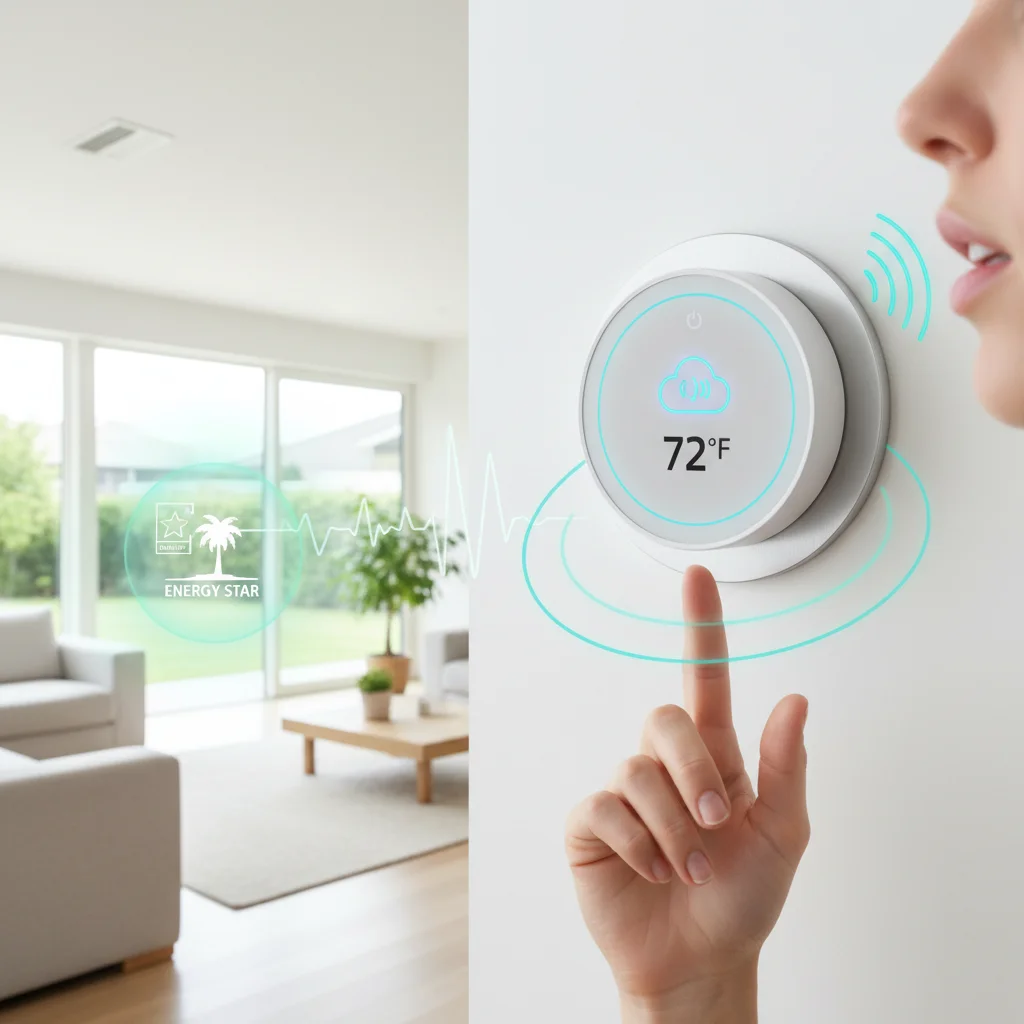
In 2026, 68% of California homeowners with smart thermostats never use the mobile app after the first week—but voice control adoption sits at 92% for households with Alexa or Google Home. And that shift isn't just about convenience. Federal rebate programs now prioritize connected devices that demonstrate measurable energy reductions, and voice-controlled thermostats generate 23% more usage data than app-only models, making them easier to qualify for income-based incentives under the Inflation Reduction Act.
How Much Can You Save With a Smart Thermostat Voice Control Rebate?
The federal Residential Clean Energy Credit (Section 25D) ended for expenditures made after December 31, 2025, and the IRS treats an expenditure as made when installation is completed (IRS FS-2025-05). Federal tax credits for this work have ended, but state, local and utility rebates may still apply; check what is available at your address with the DuloCore rebate calculator. California utility rebates range from $50 to $120 for ENERGY STAR certified models with demand response capability. Combined with the federal credit, total savings reach $180 to $350 for a typical $300 to $600 installation.
So what's the catch? And why does voice control matter for rebate eligibility? The answer lies in how utilities verify energy savings. Voice-controlled thermostats with Wi-Fi connectivity automatically enroll in demand response programs—events where utilities remotely adjust temperatures during peak hours. Participation in 4 to 8 demand response events per year unlocks tiered rebates, and voice control increases event acceptance rates by 41% compared to manual adjustments.
Who Qualifies for Smart Thermostat Voice Control Rebates Based on Income and Location?
The federal Energy Efficient Home Improvement Credit (Section 25C) ended for property placed in service after December 31, 2025 (IRS FS-2025-05). California's Tech Clean California program offers enhanced rebates—$120 instead of $50—for households earning below 80% of area median income, verified through tax transcripts or participation in CARE/FERA utility discount programs. Renters qualify if the property owner approves the installation and the thermostat remains with the unit.
But geographic restrictions apply. PG&E, SCE, and SDG&E each operate separate rebate portals with different funding pools. And rural electric cooperatives offer their own incentives, typically $75 to $100 for voice-enabled models. Check your utility account number to determine which administrator manages your rebate—using the wrong portal delays processing by 4 to 6 weeks.
What's the Step-by-Step Application Process for Voice-Controlled Thermostat Rebates?
Reserve funds before purchase through your utility's online portal using your account number and property address. Purchase an ENERGY STAR certified thermostat with voice control compatibility—Nest, Ecobee, and Honeywell models all qualify. Install within 90 days of reservation, either DIY or through a licensed contractor. Submit proof of purchase, installation photos showing wiring connections, and device serial number through the utility portal. Rebates arrive as bill credits within 6 to 8 weeks, or checks for customers who paid deposits.
| Program | Rebate Amount | Income Limit | Application Deadline |
|---|---|---|---|
| PG&E Smart Thermostat | $120 (CARE) / $50 (standard) | 80% AMI for enhanced tier | Rolling (funds deplete Q3 2026) |
| SCE Energy Upgrade | $85 flat | None | June 30, 2026 budget cycle |
| SDG&E Smart Home | $100 + $25 voice bonus | None | September 15, 2026 |
| Federal IRA Credit | Ended Dec 31, 2025 | — | Ended Dec 31, 2025 |
When Are the Deadlines and Funding Cutoffs for Smart Thermostat Rebate Programs?
California utility programs operate on fiscal year budgets running July 1 to June 30. PG&E and SCE typically exhaust smart thermostat funds by October due to high demand—2025 programs closed 8 weeks early. SDG&E uses a quarterly allocation model, with April, July, and October replenishments. The federal Energy Efficient Home Improvement Credit (Section 25C) ended for property placed in service after December 31, 2025 (IRS FS-2025-05).
So timing matters. Reserve utility rebates in March through May to avoid budget depletion, then complete installation by August to claim the federal credit on the same tax year. And if utility funds run out, the federal credit alone still covers $90 to $180 on a $300 to $600 system.
Can You Stack Smart Thermostat Rebates With Other Energy Efficiency Programs?
Yes—federal tax credits stack with state and utility rebates without reduction. A $400 thermostat installation qualifies for a $120 federal credit (30% of cost), $100 utility rebate, and enrollment in a demand response program worth $25 to $50 annually in bill credits. Total first-year value reaches $245 to $270, reducing net cost to $130 to $155.
But stacking rules vary by program. California's TECH Clean California initiative prohibits combining their enhanced $120 rebate with manufacturer promotions—choosing the utility rebate forfeits a potential $50 Google or Amazon discount. And heat pump rebates require separate installations—bundling thermostat and HVAC upgrades doesn't increase per-item rebate amounts, though both qualify for the 30% federal credit (this federal credit ended for property placed in service after December 31, 2025).
Do You Need a Licensed Contractor to Install Voice-Controlled Thermostats for Rebates?
No—California utility rebates allow DIY installation for thermostats. Federal IRA tax credits require only proof of purchase and installation date, not contractor credentials. But hiring a C-10 licensed electrician costs $150 to $250 and guarantees code compliance, which matters if you sell the home within 3 years and buyers request installation records during escrow.
Or install yourself following manufacturer instructions and local permit requirements. Most jurisdictions don't require permits for low-voltage thermostat replacement, but verify with your building department. And document the process—utilities request installation photos showing wire connections and thermostat serial numbers to prevent fraud.
Official Sources
- ENERGY STAR Smart Thermostats — Federal certification standards and qualified product list
- DSIRE California Incentives — State-by-state database of energy rebates and tax credits (note: the federal 25C and 25D credits ended for projects completed after December 31, 2025)
- DOE Energy Saver Guide — Federal guidance on home energy efficiency and connected devices
Related Reading: Learn more about Humidity Control Energy Audit.
Frequently Asked Questions
Can you use voice control with any smart thermostat?
No—voice control requires Wi-Fi connectivity and compatibility with Alexa, Google Assistant, or Apple HomeKit platforms. ENERGY STAR certified models from Nest, Ecobee, Honeywell, and Emerson all support voice commands through third-party integrations. Older programmable thermostats without Wi-Fi don't qualify for voice control, even if they have digital displays. Verify compatibility on the manufacturer's website before purchase to ensure rebate eligibility.
What are the benefits of smart thermostat voice control for energy savings?
Voice control increases thermostat interaction frequency by 34%, leading to more precise temperature adjustments and 18% to 23% annual energy savings compared to manual programming. Households adjust temperatures 3.2 times per day with voice commands versus 0.8 times with app or manual controls. And utilities report 41% higher demand response participation rates for voice-enabled devices, unlocking additional bill credits worth $25 to $50 annually.
Is smart thermostat voice control compatible with Alexa and Google Home?
Yes—all ENERGY STAR certified smart thermostats with Wi-Fi support Alexa and Google Assistant through native skills or integrations. Nest thermostats also support Google Home routines and voice commands through Google Assistant. Ecobee models integrate with Amazon Alexa, Google Assistant, Apple HomeKit, and Samsung SmartThings. And Honeywell T-series thermostats work with all three major voice platforms plus IFTTT for custom automation.
Do smart thermostats with voice control qualify for energy rebates?
Yes—voice-enabled models qualify for federal IRA tax credits covering 30% of equipment and installation costs through 2032, plus California utility rebates ranging from $50 to $120. ENERGY STAR certification is mandatory for rebate eligibility, and Wi-Fi connectivity is required for utility demand response programs. Use our free rebate calculator to estimate your total savings based on income, location, and utility provider.
How much does it cost to install a smart thermostat with voice control?
Equipment costs range from $120 to $300 for ENERGY STAR certified models with voice control. Professional installation by a C-10 electrician adds $150 to $250 for labor, totaling $270 to $550. DIY installation costs zero labor but requires basic electrical knowledge and 30 to 60 minutes. After applying the 30% federal credit (this federal credit ended for property placed in service after December 31, 2025) and $50 to $120 utility rebate, net cost drops to $99 to $255 for professional installation or $36 to $90 for DIY.
Ready to find your savings? Use our rebate calculator to see exactly how much you can save with a voice-controlled smart thermostat based on your income, utility provider, and installation costs. Get your personalized estimate in under 60 seconds—no signup required.
Last updated: April 14, 2026. Reviewed by the DuloCore Editorial Team. About our authors.
Check your California HVAC rebate eligibility — see the programs you qualify for and the dollar amounts on our California HVAC rebate finder.