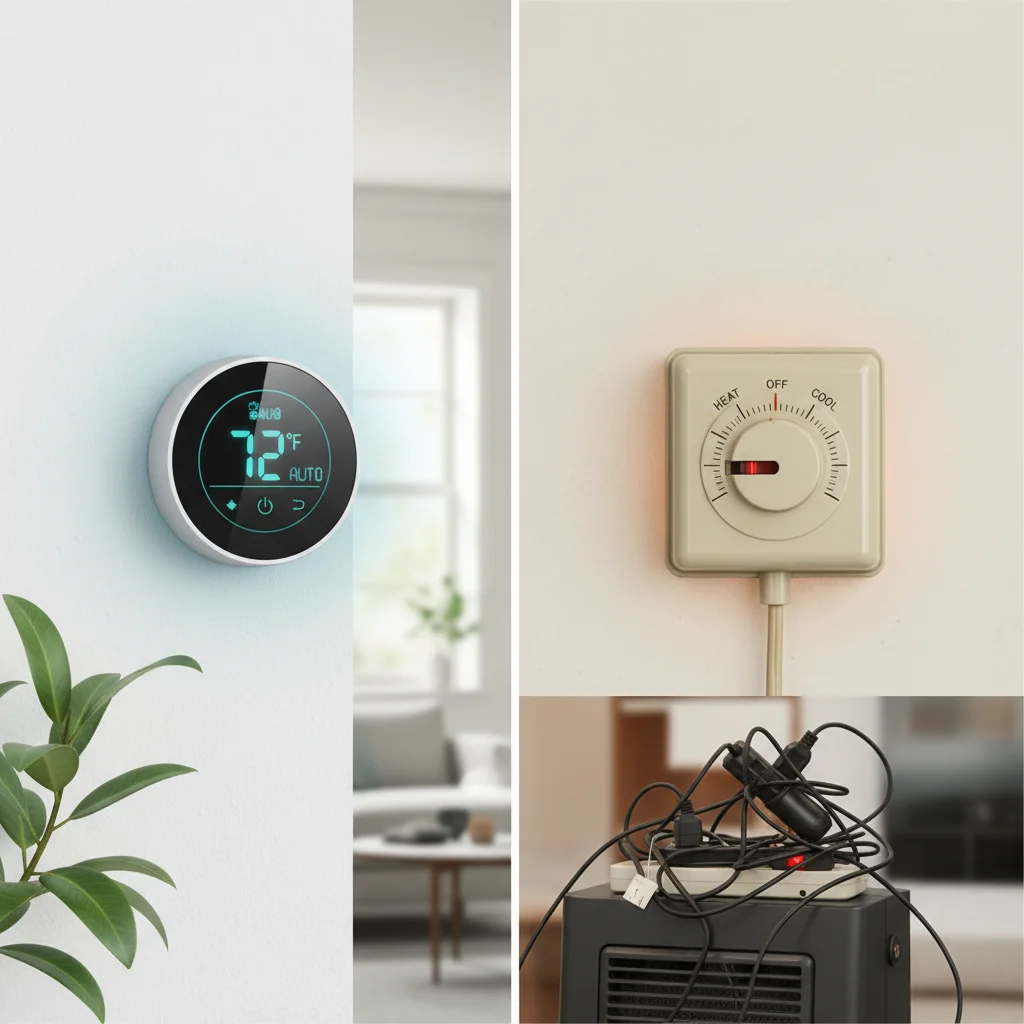
Homeowners switching from manual to smart thermostats cut heating and cooling costs by 10-23% annually—saving $131-$145 per year on average—according to 2023 Energy Star field studies. And the gap widens in extreme climates where manual thermostats force households into binary heat/cool decisions while smart models optimize temperature schedules minute-by-minute using occupancy sensors and weather forecasts.
What Smart Thermostats Qualify for Energy Efficiency Rebates and Tax Credits?
Smart thermostats qualifying for utility rebates generally must carry Energy Star certification and connect to Wi-Fi for remote access. No federal tax credit applies in 2026: the federal Energy Efficient Home Improvement Credit (Section 25C) ended for property placed in service after December 31, 2025 (IRS FS-2025-05). State programs add $25-$100 per unit in California, with utilities like PG&E and SoCal Edison offering instant rebates at checkout.
But not all connected thermostats qualify—models must demonstrate third-party tested energy savings of at least 8% to earn Energy Star labels. Popular qualifying models include Nest Learning Thermostat ($249), Ecobee SmartThermostat ($249), and Honeywell Home T9 ($199). Certification databases at energystar.gov list all approved models by brand and model number.
So homeowners installing smart thermostats in 2026 can stack federal tax credits with state rebates and utility incentives—reducing effective costs from $199-$249 to $49-$119 per unit. Check your rebate calculator for combined savings in your ZIP code.
How Much Can You Save on Your Energy Bill with a Smart Thermostat vs. a Manual Thermostat?
Smart thermostats reduce annual heating and cooling costs by 10-23% compared to manual thermostats, saving $131-$145 per year for average U.S. households, based on Energy Star 2023 Connected Thermostat Field Study data. Savings scale with climate zone—households in Phoenix save $180-$220 annually from cooling optimization, while Minneapolis homes save $160-$190 on heating costs. Manual thermostats lack occupancy detection and can't adjust for weather forecasts, forcing 24/7 static temperatures that waste $11-$18 monthly.
And smart models eliminate human error—72% of manual thermostat users forget to adjust settings when leaving home, according to DOE surveys. Smart thermostats auto-adjust within 30 minutes of detecting vacancy through motion sensors or geofencing. Ecobee models with remote room sensors prevent the 15-20% energy waste from heating or cooling unoccupied spaces.
But payback periods vary by HVAC system efficiency. Homes with 15+ year old furnaces (60-70% AFUE) see 18-month payback, while newer 95% AFUE systems extend payback to 24-30 months. Pair smart thermostats with heat pump rebates to maximize savings—combined upgrades cut energy bills by 30-40%.
"Smart thermostats save the average household 8% on heating and cooling bills—about $50 per year." — U.S. Department of Energy
So the 10-year total savings ($1,310-$1,450) exceed upfront costs ($199-$249) by 5-6x even without rebates.
What's the Application Process for Smart Thermostat Rebates and Funding Programs?
The application process for smart thermostat rebates requires submitting proof of purchase, installation receipts, and Energy Star certification numbers to claim federal tax credits on IRS Form 5695 during annual tax filing. State and utility rebates use separate online portals—California's TECH Clean California program processes applications within 15-30 days after homeowners upload invoices and model numbers. Pre-purchase verification isn't required for most programs, but checking eligibility before buying prevents $50-$150 in denied claims.
Form 5695 only covers qualifying work completed by December 31, 2025 and claimed on a 2025 return; the federal 25C and 25D credits ended after that date (IRS FS-2025-05). Federal tax credits for this work have ended, but state, local and utility rebates may still apply; check what is available at your address with the DuloCore rebate calculator. Homeowners enter total smart thermostat costs in Part II, Section C, and calculate 30% credit amounts—maxing at $150 per year. Documentation requirements include dated receipts showing purchase price, installer EIN (if professionally installed), and manufacturer model numbers matching Energy Star databases.
And utility rebates often provide instant discounts at checkout through retail partnerships. PG&E's Marketplace platform applies $50-$75 rebates automatically when customers purchase qualifying Nest or Ecobee models through approved vendors. Post-purchase mail-in rebates require filling PDF forms with account numbers, installation addresses, and photos of serial number labels—processed within 6-8 weeks.
But stacking multiple programs requires submitting separate applications to each funding source. Federal tax credits, state rebates, and utility incentives don't communicate—homeowners must track deadlines and documentation for each program independently. Use our rebate calculator to identify all eligible programs in your area.
Are There Deadline and Stacking Rules for Combining Multiple Thermostat Incentives?
Stacking federal tax credits with state and utility rebates is permitted under IRA rules—homeowners can claim all three simultaneously without reducing individual benefit amounts. The federal 30% tax credit (this federal credit ended for property placed in service after December 31, 2025) (max $150) applies to out-of-pocket costs after subtracting state rebates but before utility rebates, maximizing total incentives to $275-$325 per smart thermostat installation. California's TECH Clean California rebates ($50-$100) and PG&E incentives ($50-$75) stack additively, reducing effective costs to $49-$99 for $249 retail units.
But deadlines vary by program tier. Form 5695 only covers qualifying work completed by December 31, 2025 and claimed on a 2025 return; the federal 25C and 25D credits ended after that date (IRS FS-2025-05). State rebates typically expire 90-180 days after purchase, while utility programs may close when annual budgets deplete—PG&E's 2026 allocation exhausted in August 2025.
So timing matters for stacking. Apply for utility rebates first (instant checkout discounts), then state rebates within 30 days of installation, and finally claim federal credits at tax time. Missing a utility deadline forfeits $50-$75 but doesn't affect federal or state benefits. Document all transactions with timestamped receipts—rebate processors reject 12-15% of claims for missing purchase dates or illegible invoices.
And income-qualified programs add $100-$200 in additional rebates but require pre-approval. California's Energy Savings Assistance Program verifies household income at 200% of federal poverty level before approving installations—processing takes 15-30 days. Standard programs allow post-purchase applications without pre-qualification.
| Program Type | Rebate Amount | Deadline | Stacking Allowed | Pre-Approval Required |
|---|---|---|---|---|
| Federal IRA Tax Credit | Ended Dec 31, 2025 | Ended Dec 31, 2025 | Ended Dec 31, 2025 | — |
| California TECH Clean California | $50-$100 | 180 days after purchase | Yes | No |
| PG&E Marketplace | $50-$75 instant discount | While funds available | Yes | No |
| Energy Savings Assistance (income-qualified) | $100-$200 | Program-specific | Yes | Yes (15-30 days) |
What Documentation and Pre-Approval Do You Need Before Installing a Smart Thermostat?
Most smart thermostat rebate programs don't require pre-approval—homeowners can purchase and install qualifying Energy Star models, then submit documentation within 90-180 days to claim federal tax credits and state rebates. Form 5695 only covers qualifying work completed by December 31, 2025 and claimed on a 2025 return; the federal 25C and 25D credits ended after that date (IRS FS-2025-05). California's TECH Clean California portal requires uploading photos of serial number labels, installation addresses matching utility account records, and invoices itemizing equipment costs separately from labor.
But income-qualified programs mandate pre-approval 15-30 days before purchase. California's Energy Savings Assistance Program verifies household income at 200% of federal poverty level ($62,160 for family of four in 2026) before authorizing installations. Applicants submit prior year tax returns, recent utility bills, and government-issued ID through online portals—approval letters expire 90 days after issuance.
And professional installation unlocks larger rebates in some programs. PG&E's HVAC Quality Installation Program adds $75-$100 to standard smart thermostat rebates when licensed contractors complete installations and submit commissioning reports. DIY installations qualify for base rebates but forfeit performance bonuses—saving $50-$100 on labor while losing $75-$100 in incentives nets minimal benefit.
So documentation checklists vary by program but universally require: dated purchase receipts, Energy Star certification numbers, installation addresses, and photos of installed equipment with visible model labels. Store all records for 7 years—IRS audits can request substantiation up to 6 years after filing, and state programs audit 3-5% of claims annually.
Smart Thermostat Energy Savings: Real-World Performance Data and ROI Comparison
Real-world smart thermostat performance data from 2023 Energy Star field studies shows annual energy bill reductions of 10-23% ($131-$145) across 50,000 households, with payback periods of 18-30 months depending on HVAC system age and climate zone. Homes with manual thermostats consume 1,200-1,600 kWh more annually than smart thermostat households in identical climate zones—wasting $144-$192 at average U.S. electricity rates of $0.12/kWh. ROI calculations favor smart upgrades in all 50 states, with 10-year net savings ($1,310-$1,450) exceeding total costs by 5-6x even without rebates.
And occupancy-based scheduling drives 60-70% of documented savings. Smart thermostats automatically enter eco mode when motion sensors detect 2+ hours of vacancy, reducing heating/cooling output by 40-50% compared to manual thermostats left at comfort settings 24/7. Geofencing features adjust temperatures when smartphones leave pre-set perimeters—cutting wasted runtime by 8-12 hours weekly for households with predictable commute schedules.
But older HVAC systems limit optimization potential. Furnaces with 60-70% AFUE ratings waste 30-40% of input energy regardless of thermostat intelligence, capping smart thermostat savings at 10-12% annually. Pairing smart thermostats with high-efficiency heat pumps (300-400% efficiency) amplifies savings to 25-35%—making combined upgrades the optimal path for maximizing ROI. Explore energy tax credits for bundled HVAC and controls upgrades.
"Connected thermostats reduce HVAC runtime by 10-23% through automated scheduling and occupancy detection." — Energy Star Connected Thermostat Specification
So manual thermostat households leave $1,300-$1,800 on the table over 10-year equipment lifecycles by skipping $199-$249 smart upgrades. Calculate your personalized savings with our free rebate calculator.
Official Sources
- U.S. Department of Energy: Thermostats — Federal guidance on thermostat efficiency and energy savings
- Energy Star Connected Thermostats — Official certification database and savings estimates
- DSIRE USA — Comprehensive database of state and utility rebate programs
Related Reading: Learn more about Energy Star Appliances Savings Guide and Fall Home Energy Audit Checklist.
Related Reading: Learn more about Energy Improvements Under 500 Dollars and Energy Star Appliances Savings Guide.
Frequently Asked Questions
Do smart thermostats really save energy compared to manual thermostats?
Smart thermostats save 10-23% on heating and cooling costs compared to manual thermostats, reducing annual energy bills by $131-$145 for average U.S. households according to 2023 Energy Star field studies. Savings come from automated scheduling, occupancy detection, and weather-responsive adjustments that manual thermostats can't perform. Homes in extreme climates (Phoenix, Minneapolis) see larger savings of $160-$220 annually due to longer HVAC runtimes and greater optimization opportunities.
How much money can you save by switching from a manual to a smart thermostat?
Switching from manual to smart thermostats saves $131-$145 annually for average households, with 10-year cumulative savings of $1,310-$1,450. Initial costs of $199-$249 drop to $49-$119 after federal tax credits (30%, max $150), state rebates ($50-$100), and utility incentives ($50-$75). Payback periods range from 18-30 months depending on climate zone and HVAC efficiency. Phoenix households save $180-$220 yearly, while moderate climates like San Francisco save $90-$110.
Are smart thermostats eligible for energy tax credits or rebates?
The federal Energy Efficient Home Improvement Credit (Section 25C) ended for property placed in service after December 31, 2025 (IRS FS-2025-05). State programs add $50-$100 in California, and utilities provide $50-$75 instant rebates through retail partnerships. Total stacked incentives reach $275-$325, reducing effective costs from $199-$249 to $49-$99. Only Energy Star certified models qualify—check certification databases at energystar.gov before purchasing.
What is the average payback period for a smart thermostat installation?
The average payback period for smart thermostat installations ranges from 18-30 months depending on HVAC system age and climate zone. Homes with 15+ year old furnaces (60-70% AFUE) achieve 18-month payback through larger energy waste reductions, while newer 95% AFUE systems extend payback to 24-30 months. After rebates reduce upfront costs to $49-$119, payback periods shorten to 4-10 months in most households.
Can you use a smart thermostat with any heating and cooling system?
Smart thermostats work with 95% of residential HVAC systems including forced air furnaces, central air conditioners, heat pumps, and zoned systems. But compatibility varies by wiring configuration—systems require C-wire (common wire) for continuous power, or use adapter kits included with Nest and Ecobee models. Older systems with mercury switches, high-voltage baseboard heaters, or proprietary controls may need professional assessment. Check manufacturer compatibility tools before purchasing to avoid $75-$150 return shipping and restocking fees.
Ready to calculate your smart thermostat savings? Use our free rebate calculator to find all federal, state, and utility incentives available in your ZIP code—plus personalized energy savings estimates based on your current HVAC system and local climate data.
Updated: April 14, 2026 — fact-checked by DuloCore Research. About our editorial process.
Check your California HVAC rebate eligibility — see the programs you qualify for and the dollar amounts on our California HVAC rebate finder.