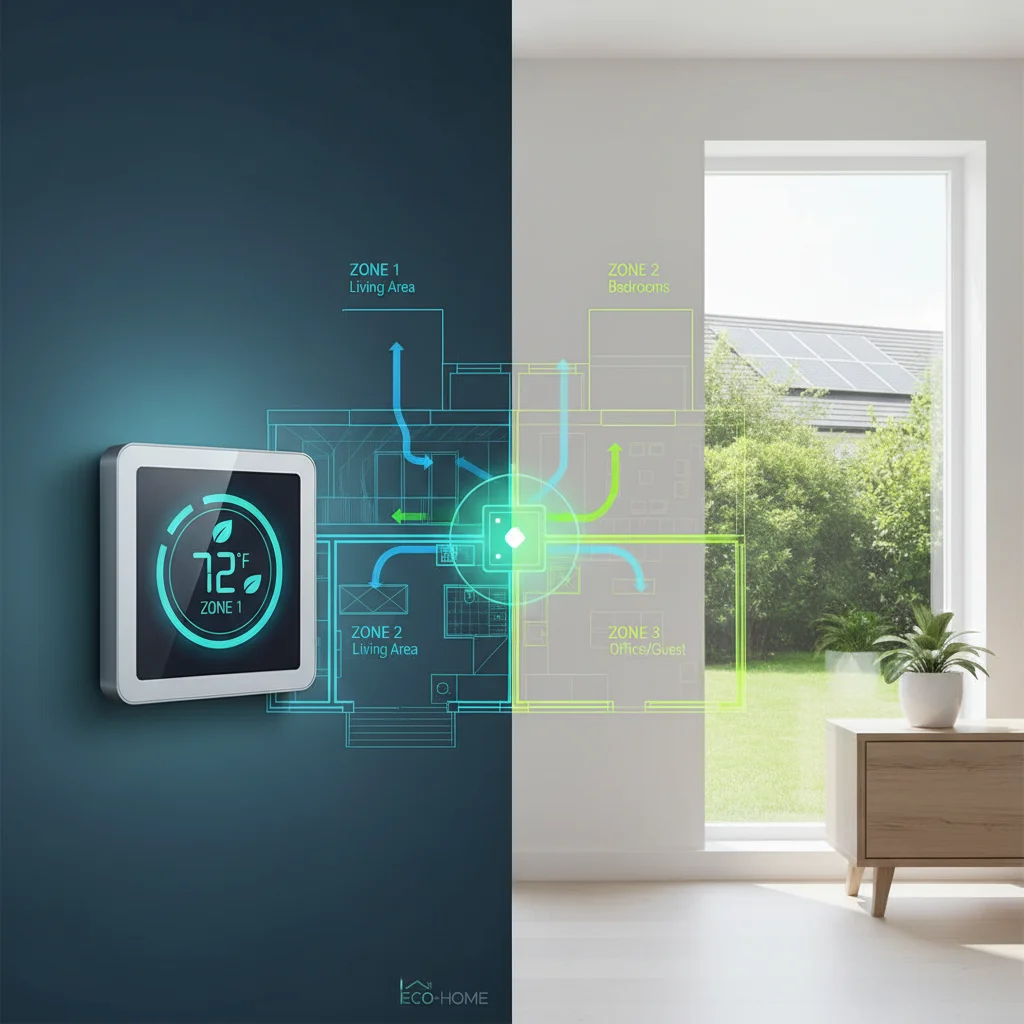
California homeowners waste $437 per year heating empty bedrooms and cooling unoccupied living rooms. A smart thermostat zoning system divides a home into independently controlled temperature zones, cutting energy bills by 20-30% while qualifying for federal tax credits worth up to $2,000 and state rebates reaching $6,500 in 2026.
How Much Does a Smart Thermostat Zoning System Cost in California?
Smart thermostat zoning systems cost between $1,800 and $4,500 installed in California, with prices varying by home size and number of zones. A 2,000 square-foot home with three zones averages $2,800, while a 3,500 square-foot home with five zones runs $4,200. The system includes a smart thermostat ($200-$400), motorized dampers ($150-$300 each), zone control panel ($400-$800), and installation labor ($800-$1,500). And federal IRA tax credits cover 30% of equipment costs up to $2,000, reducing net costs by $540-$1,350. California utility companies offer additional rebates of $500-$6,500 based on system efficiency ratings and household income, with CARE/FERA participants receiving the highest incentives through the Tech Clean California program.
What's the Deadline to Claim Tax Credits and Rebates for Smart Zoning Installation?
The federal Energy Efficient Home Improvement Credit (Section 25C) ended for property placed in service after December 31, 2025 (IRS FS-2025-05). Federal tax credits for this work have ended, but state, local and utility rebates may still apply; check what is available at your address with the DuloCore rebate calculator. California utility rebates operate on annual program cycles with funding allocated quarterly, and programs typically open January 1 and close when funds exhaust—often by September or October in high-demand territories. So homeowners must complete installation and submit applications within 90-180 days of project completion, depending on utility provider requirements. PG&E's 2026 Tech Clean California program closes applications November 15, 2026, while SoCalGas extends its deadline to December 31, 2026, for HVAC upgrades. But late applications face rejection even if installation occurred during the program year, making prompt submission critical for securing the full $500-$6,500 in available state incentives. Use our free rebate calculator to see which programs remain open in your zip code.
Do You Need Pre-Approval Before Installing a Smart Thermostat Zoning System?
Pre-approval requirements vary by utility provider and rebate amount, with most California programs requiring application submission before installation for rebates exceeding $1,000. PG&E's Energy Efficiency Program mandates pre-approval for zoning systems qualifying for $2,500+ rebates, while SCE allows post-installation applications for standard $500-$1,000 rebates but requires pre-approval for CARE/FERA enhanced incentives reaching $6,500. And SMUD's Home Performance Program requires a pre-installation energy audit ($150-$300, often rebated) before approving zoning system rebates. Form 5695 only covers qualifying work completed by December 31, 2025 and claimed on a 2025 return; the federal 25C and 25D credits ended after that date (IRS FS-2025-05). So checking your utility's specific requirements at California DSIRE before purchasing equipment prevents application rejection and lost rebates worth $1,000-$6,500.
Can You Stack Multiple Rebates and Incentives for Smart Zoning Systems?
California homeowners can stack federal IRA tax credits with state utility rebates and local incentives, creating combined savings of $2,540-$8,500 on smart thermostat zoning installations. The federal 30% IRA credit (up to $2,000) combines with utility rebates ($500-$6,500) without penalty, and municipal programs in cities like San Francisco and San Jose offer additional $40-$200 incentives for ENERGY STAR-certified thermostats. But homeowners cannot claim both the federal credit and California state tax credits on the same equipment—only federal IRA credits apply to HVAC controls in 2026. And combining rebates requires meeting eligibility thresholds for each program individually. For instance, a $3,200 installation qualifies for a $960 federal credit, $2,500 PG&E rebate for moderate-income households, and $100 local smart thermostat incentive, reducing net costs to just $640—an 80% effective discount on total installation expenses.
Which Utility Companies Offer Rebates for Smart Thermostat Zoning?
California's three largest utilities—PG&E, SCE, and SoCalGas—offer smart thermostat zoning rebates ranging from $500 to $6,500 in 2026, with amounts scaled by household income and system efficiency. PG&E provides $500 base rebates for standard installations, $2,500 for moderate-income households (earning 80-200% of area median income), and $6,500 for CARE/FERA-qualified participants through Tech Clean California. SCE's Home Energy Efficiency Rebate covers $800 for ducted zoning systems and $1,200 when paired with heat pump upgrades. And SoCalGas allocates $600 for gas furnace zoning conversions that reduce winter heating loads by 25%+ based on energy modeling. Municipal utilities including LADWP ($750), SMUD ($1,000), and Silicon Valley Power ($500) maintain separate programs with varying eligibility rules. So verifying your specific utility provider at your service address determines which of the 45+ California programs apply to your home.
"Smart thermostats paired with zoning controls reduce HVAC energy consumption by 10-30% compared to single-zone systems." — U.S. Department of Energy
What's Your Funding Status? How to Check Rebate Program Availability in Your Area
California rebate programs allocate annual budgets that exhaust at different rates by territory, with high-demand areas depleting funds 3-6 months before fiscal year end. PG&E's 2026 Tech Clean California received $180 million in funding, with $87 million already committed by April 2026, leaving approximately 51% of funds available through November 15, 2026. SCE reports 68% of allocated HVAC rebate funds remaining as of April 2026, while SMUD shows just 34% availability after strong Q1 demand. And checking funding status requires calling utility rebate hotlines or consulting real-time program dashboards—online information lags actual availability by 2-4 weeks. DSIRE USA provides program links but doesn't track live funding levels. So homeowners in high-demand territories like San Francisco, Los Angeles, and San Diego should verify funding before scheduling installation, as waiting lists form when programs reach 90% capacity, delaying rebate payment by 4-6 months even for approved applications.
| Utility Provider | Base Rebate | Income-Qualified Rebate | Application Deadline |
|---|---|---|---|
| PG&E | $500 | $2,500-$6,500 (CARE/FERA) | November 15, 2026 |
| SCE | $800 | $1,500-$4,000 | December 31, 2026 |
| SoCalGas | $600 | $2,000 | December 31, 2026 |
| SMUD | $1,000 | $3,500 | Funds depleting—apply early |
| LADWP | $750 | $2,200 | Rolling (funds limited) |
Official Sources
- U.S. Department of Energy - Smart Thermostats — Federal guidance on smart thermostat efficiency and zoning benefits
- DSIRE USA — Comprehensive database of state, local, and utility energy incentive programs
- IRS Form 5695 — Residential Energy Credits form for claiming federal IRA tax credits (note: the federal 25C and 25D credits ended for projects completed after December 31, 2025)
Related Reading: Learn more about Smart Home Energy Management System.
Frequently Asked Questions
What is a smart thermostat zoning system and how does it work?
A smart thermostat zoning system divides a home into 2-8 independently controlled temperature zones using motorized dampers installed in ductwork, with each zone regulated by its own thermostat or wireless temperature sensor. The central control panel communicates with dampers via wired or wireless connections, opening or closing airflow to specific rooms based on programmed temperature preferences and occupancy patterns. Smart systems integrate with WiFi for remote control via smartphone apps and can learn household schedules to automatically adjust temperatures, reducing energy use by 20-30% compared to single-zone systems.
Are smart thermostat zoning systems eligible for tax credits or rebates?
Smart thermostat zoning systems qualify for the federal IRA 30% tax credit (this federal credit ended for property placed in service after December 31, 2025) up to $2,000 when installed with qualifying HVAC equipment like heat pumps or high-efficiency furnaces. California utility rebates of $500-$6,500 apply specifically to zoning installations that meet efficiency thresholds and household income requirements. And standalone smart thermostats receive separate $50-$200 rebates from utilities, but cannot be combined with zoning system rebates for the same equipment. So total available incentives range from $2,540 to $8,500 when stacking federal credits with state programs.
How much can you save with a smart thermostat zoning system?
California homeowners save $300-$650 annually on energy bills with smart thermostat zoning systems, based on home size and usage patterns. A 2,500 square-foot home reducing second-floor cooling during daytime hours saves $420 per year at current California electricity rates of $0.32/kWh. And homes with 3+ unoccupied rooms during work hours see the highest returns, with payback periods of 3-5 years after applying federal credits and utility rebates. Winter heating savings reach 25-35% for homes with cathedral ceilings or bonus rooms that overheat when single-zone systems target living areas.
What's the difference between a smart thermostat and a zoning system?
A smart thermostat controls one HVAC system for an entire home using WiFi connectivity and programmable schedules, while a zoning system divides the home into multiple temperature zones with independent control using motorized dampers and multiple thermostats or sensors. Smart thermostats cost $200-$400 installed and save 8-12% on energy bills. But zoning systems cost $1,800-$4,500 and save 20-30% by preventing energy waste in unoccupied rooms. And combining a smart thermostat with a zoning system delivers maximum savings—the smart thermostat optimizes schedules while dampers direct airflow only where needed.
Do I need a professional to install a smart thermostat zoning system?
Smart thermostat zoning systems require professional HVAC installation due to electrical wiring, ductwork modifications, and system balancing needs, with labor costs ranging from $800 to $1,500 depending on home size and zone count. And California utility rebates mandate installation by licensed HVAC contractors to qualify for $500-$6,500 incentives—DIY installations are ineligible for state programs. But simple smart thermostat replacements without zoning dampers cost just $150-$300 for professional installation and can be DIY projects for homeowners comfortable with basic electrical work, though DIY installations may void manufacturer warranties and rebate eligibility.
Ready to calculate your smart thermostat zoning system savings? Use our free rebate calculator to find federal credits, utility rebates, and total incentives available at your California address. Enter your zip code and see exactly which programs apply to your home—results in under 60 seconds.
Last updated: April 14, 2026. Reviewed by the DuloCore Editorial Team. About our authors.
Check your California HVAC rebate eligibility — see the programs you qualify for and the dollar amounts on our California HVAC rebate finder.