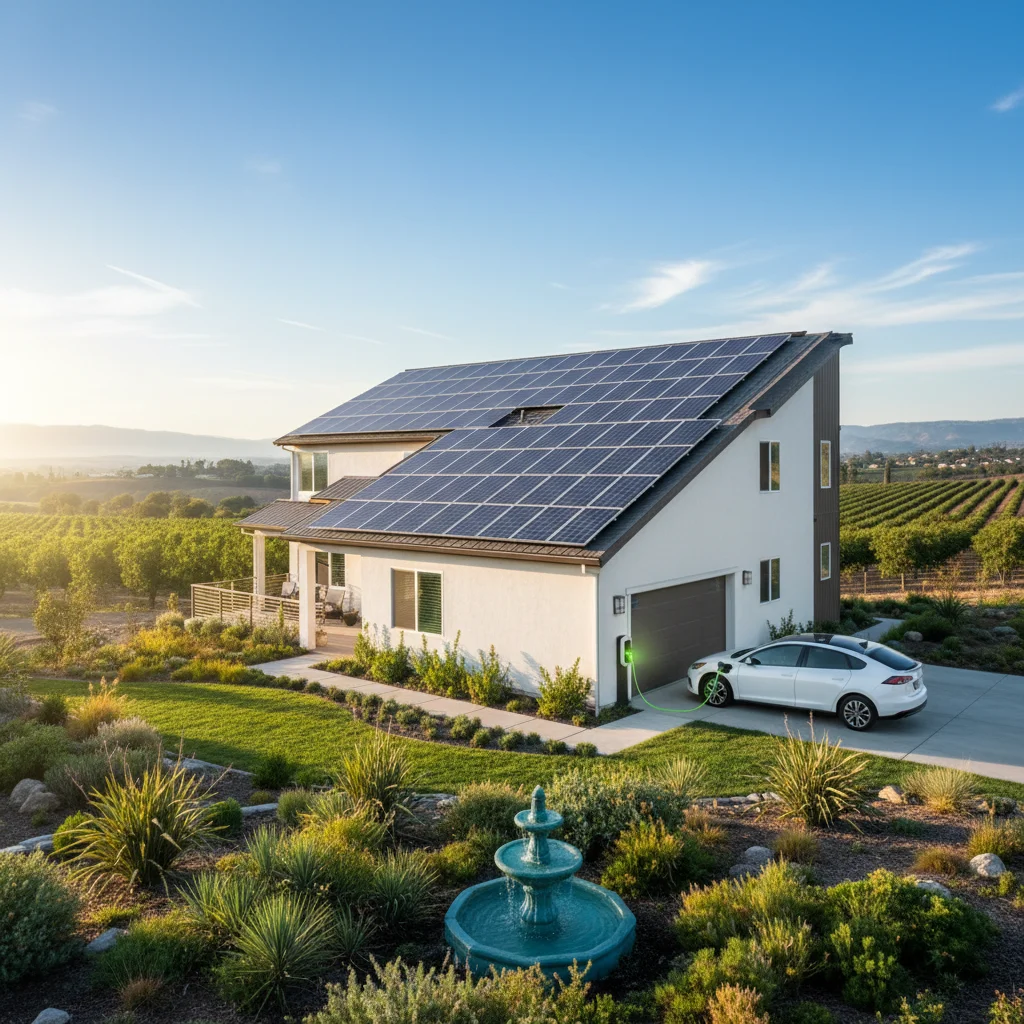
California's Central Valley receives 270 sunny days per year, yet less than 7% of homeowners have installed solar panels despite rebates covering up to $14,000 in combined federal and state incentives. The region's extreme summer heat drives electricity costs to $250-$400 monthly for many households, making solar installations financially compelling in 2026.
How Much Can You Save With Solar Rebates in the Central Valley?
Central Valley homeowners access $7,500-$14,000 in combined solar incentives through 2026 federal tax credits and state programs. The federal Residential Clean Energy Credit (Section 25D) ended for expenditures made after December 31, 2025, and the IRS treats an expenditure as made when installation is completed (IRS FS-2025-05). Federal tax credits for this work have ended, but state, local and utility rebates may still apply; check what is available at your address with the DuloCore rebate calculator. And state programs add $3,000-$4,500 for income-qualified households.
A typical 6-kilowatt residential solar system in Fresno or Modesto costs $18,000-$24,000 before incentives. After the 30% federal credit, net cost drops to $12,600-$16,800. And low-to-moderate income households qualify for additional California Solar Initiative rebates of $3,000-$4,500, reducing final costs to $9,100-$13,800.
So the core tension: rebate funds deplete quarterly, and utility rates increase 5-8% annually in the Central Valley. Homeowners who delay installation face higher baseline electricity costs and diminished rebate availability.
Monthly electricity savings in the Central Valley average $150-$280 depending on system size and household consumption. A $20,000 system with $6,000 in federal credits and $3,500 in state rebates pays back in 5-7 years based on current PG&E rates of $0.32-$0.45 per kilowatt-hour.
| Program | Rebate Amount | Income Limit | Deadline |
|---|---|---|---|
| Federal IRA Tax Credit | Ended Dec 31, 2025 | — | Ended Dec 31, 2025 |
| California SGIP | $3,000-$4,500 | 80% AMI | Funds-dependent |
| PG&E Net Metering 3.0 | Bill credits | None | Ongoing |
What Equipment Qualifies for Central Valley Solar Rebates?
Solar photovoltaic panels, inverters, racking systems, and battery storage units qualify for federal and state rebates in 2026. Equipment must meet ENERGY STAR certification or California Energy Commission approval standards. And battery systems rated at 3 kilowatt-hours or higher qualify for separate storage incentives.
Federal IRA credits cover monocrystalline and polycrystalline solar panels rated at 350-550 watts per panel. Inverters must maintain 95%+ efficiency ratings, and racking systems require structural engineering approval for Central Valley wind loads. But thin-film solar panels don't qualify for state rebates despite federal eligibility.
Battery storage systems from manufacturers like Tesla Powerwall (13.5 kWh), LG Chem RESU (9.8 kWh), and Enphase IQ Battery (10 kWh) qualify for combined solar-plus-storage incentives. The California Self-Generation Incentive Program provides $200-$350 per kilowatt-hour for battery installations paired with solar panel systems.
Ground-mounted solar arrays qualify for rebates if installed on residential property, but carport and pergola-mounted systems face additional permitting in Stanislaus and San Joaquin counties. Rooftop installations process faster with fewer restrictions.
Are You Income-Eligible for Solar Rebates in the Central Valley?
Income-qualified rebates require household income at or below 80% of Area Median Income for Central Valley counties. Fresno County's 80% AMI threshold equals $62,400 for a family of four in 2026, while Stanislaus County's limit reaches $64,800 for the same household size.
Verification requires tax returns from the two most recent years or documentation of public assistance enrollment. Accepted proof includes CalFresh benefits, Medi-Cal coverage, or Federal Public Housing assistance. And self-employed applicants provide Schedule C forms and quarterly estimated tax payments.
Low-income households at or below 60% AMI access $4,000-$4,500 rebates through California's Disadvantaged Communities Single-Family Solar Homes program. Moderate-income households between 60-80% AMI receive $3,000-$3,500 through standard SGIP allocations.
But federal IRA tax credits remain available to all income levels without verification requirements. Homeowners with insufficient tax liability can carry forward unused credits for up to five years, or elect direct payment through 2026 IRS provisions.
Calculate your specific rebate amounts using our rebate calculator with 2026 income thresholds and equipment costs.
"California's SGIP program reserves 25% of incentive funding for households in disadvantaged communities with additional $1,000 adders." — California Public Utilities Commission
What's the Step-by-Step Application Process for Central Valley Solar Rebates?
Form 5695 only covers qualifying work completed by December 31, 2025 and claimed on a 2025 return; the federal 25C and 25D credits ended after that date (IRS FS-2025-05). Homeowners complete Part I for solar energy property credits, reporting total installation costs and calculating the 30% credit amount.
State rebate applications submit through the California SGIP portal within 30 days of installation completion. Required documents include contractor invoices, equipment specifications, building permits, and interconnection agreements with PG&E. Processing takes 60-90 days, with payment issued via check or ACH transfer.
But pre-approval applications accelerate funding by reserving incentive amounts before installation begins. Contractors submit pre-approval forms with equipment quotes and site assessments, securing rebate commitments that remain valid for 180 days. This protects homeowners from budget depletion during installation timelines.
PG&E interconnection applications file separately through the utility's Net Energy Metering portal. Electrical inspections and permission-to-operate approvals take 15-45 days depending on system size. And Central Valley counties require separate building permits with fees ranging from $250-$800.
Track your application status through the SGIP online portal using your project ID number. Approved rebates disburse within 30 days of final inspection approval and utility interconnection completion.
When Are Central Valley Solar Rebate Deadlines and Is Funding Still Available?
The federal Residential Clean Energy Credit (Section 25D) ended for expenditures made after December 31, 2025, and the IRS treats an expenditure as made when installation is completed (IRS FS-2025-05). The 30% credit rate remains fixed through 2032, then decreases to 26% in 2033 and 22% in 2034 before expiring. And installations must achieve substantial completion by December 31 to qualify for that year's credit.
California SGIP funding depletes on a first-come, first-served basis with no guaranteed end date. As of April 2026, $47 million remains in the residential solar-plus-storage budget for PG&E territory. But moderate-income and equity budget allocations fill 40% faster than general market funds.
PG&E's Net Energy Metering 3.0 program accepts new applications through 2030 under current regulations, though export credit rates adjust quarterly based on avoided cost calculations. Spring 2026 rates pay $0.08-$0.12 per kilowatt-hour for exported solar generation.
So homeowners face a strategic decision point: current rebate availability versus future rate increases. PG&E residential rates increased 28% between 2023-2026, and the California Public Utilities Commission projects another 15% increase by 2028.
Local building permit requirements don't expire, but processing times extend during peak installation seasons from March through September. Fresno County's building department reports 4-6 week permit timelines during summer months versus 10-15 days in winter.
Can You Stack Multiple Rebates and Incentives Together in the Central Valley?
Homeowners claim the full 30% federal credit while simultaneously receiving SGIP battery incentives and PG&E net metering credits. And local property tax exemptions for solar installations add another layer of savings. (Note: Federal tax credit percentages and availability are subject to change; the 30% Residential Clean Energy Credit under Section 25D expired December 31, 2025. Verify current incentives at energy.gov.)
California's Active Solar Energy System Property Tax Exclusion exempts solar equipment value from property tax assessments through 2027. A $20,000 solar system adds zero dollars to annual property tax bills, saving $200-$280 annually based on Central Valley tax rates of 1.0-1.4%.
But stacking doesn't apply to overlapping federal programs. Homeowners can't combine IRA solar credits with separate federal renewable energy grants or USDA rural energy programs for the same equipment. The federal Residential Clean Energy Credit (Section 25D) ended for expenditures made after December 31, 2025, and the IRS treats an expenditure as made when installation is completed (IRS FS-2025-05).
Low-income households stack federal credits, state SGIP rebates, and additional equity adders worth $1,000-$1,500 for installations in disadvantaged communities. Total combined incentives reach $12,000-$16,000 on a $22,000 system, reducing net costs to $6,000-$10,000.
Financing impacts stacking strategy because energy tax credits apply only to system costs paid by the homeowner. Leased systems or power purchase agreements transfer tax credit eligibility to the third-party owner. But loan-financed installations preserve full rebate eligibility.
What Contractor Requirements Must You Meet to Qualify for Rebates?
Licensed C-46 Solar contractors with active California Contractors State License Board registration must perform all installations eligible for state rebates. Federal tax credits don't require specific licensing, but installations must meet National Electrical Code standards and pass local building inspections.
NABCEP (North American Board of Certified Energy Practitioners) certification isn't mandatory but demonstrates advanced technical expertise. And SGIP applications require contractor proof of workers' compensation insurance and $1 million general liability coverage.
Contractors must submit equipment cut sheets, electrical schematics, and structural calculations with permit applications. Central Valley jurisdictions require wet-stamp approval from California-licensed Professional Engineers for roof loads exceeding 4 pounds per square foot.
But homeowner-performed installations don't qualify for state rebates and face stricter inspection requirements. DIY solar projects can claim federal tax credits if they pass electrical and structural inspections, though permitting authorities in Fresno and Stanislaus counties rarely approve owner-builder solar permits.
Review your contractor's CSLB license status at cslb.ca.gov before signing contracts. And verify SGIP installer registration through the California Public Utilities Commission's approved contractor database.
Compare rebate-qualified contractors and equipment options through resources like heat pump rebates, which follow similar qualification frameworks.
Official Sources
- DOE Federal Solar Tax Credit Guide — Complete federal IRA credit requirements and application instructions
- DSIRE California Solar Incentives — Comprehensive database of state and utility solar rebate programs
- California SGIP Portal — Official state rebate applications and funding status
Related Reading: Learn more about Solar Net Metering Rebates and Solar Panel Home Energy Audit.
Frequently Asked Questions
What solar panel rebates are available in the Central Valley?
Central Valley homeowners access three primary rebate programs in 2026: the 30% federal IRA tax credit covering all installation costs, California SGIP rebates of $3,000-$4,500 for income-qualified households, and PG&E Net Energy Metering 3.0 bill credits. Combined incentives total $7,500-$14,000 on average residential installations. And property tax exemptions save $200-$280 annually.
How much money can you get from solar panel rebates in Central Valley?
Federal tax credits provide 30% of total costs with no dollar cap, averaging $5,400-$7,200 on typical $18,000-$24,000 systems. State SGIP adds $3,000-$4,500 for income-eligible households. Battery storage systems receive separate incentives of $200-$350 per kilowatt-hour. Total combined rebates reach $12,000-$16,000 for low-income homeowners with solar-plus-storage installations.
Are you eligible for solar rebates in the Central Valley?
All homeowners with tax liability qualify for federal IRA credits regardless of income. State SGIP rebates require household income at or below 80% Area Median Income: $62,400 for Fresno County families of four in 2026. Verification requires two years of tax returns or public assistance enrollment documentation. And systems must use ENERGY STAR certified equipment installed by C-46 licensed contractors.
What is the process for applying for solar panel rebates in Central Valley?
Form 5695 only covers qualifying work completed by December 31, 2025 and claimed on a 2025 return; the federal 25C and 25D credits ended after that date (IRS FS-2025-05). Submit SGIP applications through the California Public Utilities Commission portal within 30 days of installation with contractor invoices, equipment specs, and permits. File PG&E interconnection applications separately through the Net Energy Metering portal. And obtain local building permits from county authorities before starting installation.
When do solar panel rebates expire in the Central Valley?
Federal IRA tax credits continue through December 31, 2032 at 30%, then decrease to 26% in 2033. California SGIP funding depletes on first-come basis with $47 million remaining as of April 2026 for PG&E territory. PG&E Net Metering 3.0 accepts applications through 2030. And property tax exemptions expire January 1, 2027 unless renewed by state legislature.
Ready to calculate your Central Valley solar savings? Use our free rebate calculator to find your exact federal tax credit amount, state rebate eligibility, and monthly electricity savings based on your home's energy use and local PG&E rates. Get your personalized rebate estimate in under 2 minutes.
Updated: April 14, 2026 — fact-checked by DuloCore Research. About our editorial process.
Check your California solar rebate eligibility — see the programs you qualify for and the dollar amounts on our California solar rebate finder.