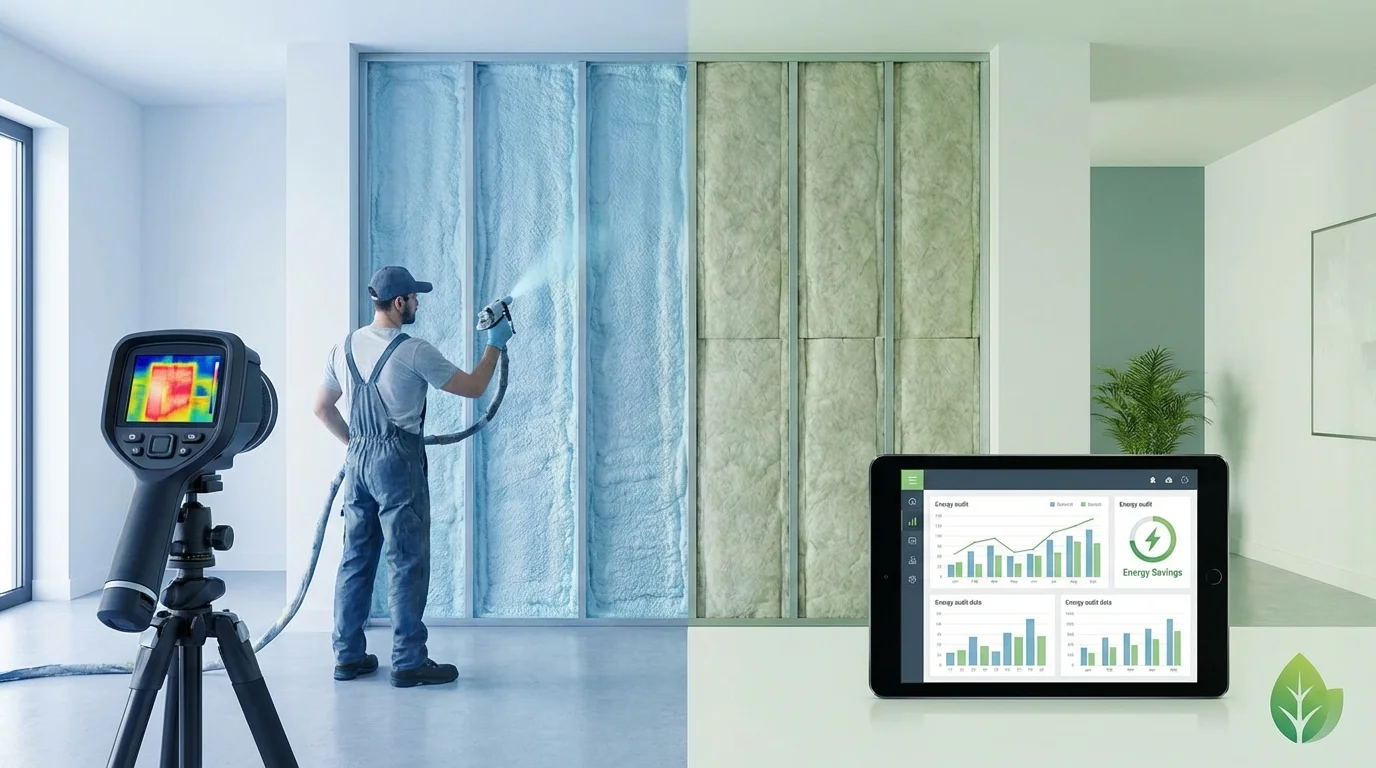
Up to 40% of a home's energy loss occurs through its attic, walls, and floors, directly impacting heating and cooling bills every month. But choosing the right insulation to stop that loss involves a critical financial trade-off. Homeowners face a decision between higher upfront costs for superior performance and lower initial spending for standard protection. So the choice isn't just about comfort; it's a calculated investment in your home's long-term financial efficiency.
How Much Does Spray Foam Insulation Cost Compared to Fiberglass, Including Installation?
Spray foam insulation's installed cost ranges from $1.50 to $4.90 per board foot in 2026, a price reflecting its superior R-value and air-sealing properties. In contrast, fiberglass insulation is priced between $0.64 and $1.19 per square foot for batts, making it a more budget-friendly initial option.
The final project cost depends heavily on the type of spray foam—open-cell is less expensive than closed-cell—and the complexity of the installation. So, a typical 1,500-square-foot attic costs between $2,250 and $7,350 for spray foam. And the same space costs $960 to $1,785 for fiberglass batts. Labor accounts for approximately 50-60% of the total price for both materials, but spray foam requires specialized equipment and certified installers, increasing labor expenses. The material's ability to fill every crack and crevice, however, often reduces the need for separate air-sealing measures, offsetting some of the initial material price difference. But the upfront investment for spray foam remains 2 to 4 times higher than for fiberglass.
What Rebates and Tax Credits Are Available for Spray Foam and Fiberglass Insulation, and How Do They Impact ROI?
The federal Energy Efficient Home Improvement Credit (Section 25C) ended for property placed in service after December 31, 2025 (IRS FS-2025-05). Federal tax credits for this work have ended, but state, local and utility rebates may still apply; check what is available at your address with the DuloCore rebate calculator. Both spray foam and fiberglass insulation are eligible, provided they meet specific energy efficiency standards. These incentives directly reduce the net cost and shorten the payback period.
The Inflation Reduction Act provides these energy tax credits for weatherization improvements, which include insulation and air sealing. So, a $4,000 spray foam installation receives a $1,200 federal tax credit, lowering the net cost to $2,800. But state and utility rebates, which often stack with federal incentives, provide further savings. For example, programs listed on DSIRE offer rebates from $0.15 to $1.50 per square foot for qualifying insulation projects. You can use our free rebate calculator to find your exact savings.
"Adding insulation and sealing air leaks are two of the most cost-effective ways to make your home more comfortable and energy efficient." — U.S. Department of Energy
These combined incentives make higher-performance options like spray foam more accessible. And the reduced upfront cost accelerates the return on investment through immediate and sustained monthly energy savings.
Which Insulation Offers Superior Energy Efficiency and Is Best Suited for Your Climate Zone?
Spray foam insulation delivers a higher R-value, ranging from R-3.5 to R-7.0 per inch, compared to fiberglass's R-2.9 to R-3.8 per inch. This thermal resistance, combined with its air-sealing capability, makes spray foam a more effective barrier against heat transfer for most climates in 2026.
Spray foam's key advantage is its monolithic application, which eliminates the gaps and seams common with fiberglass batts. So it functions as both an insulator and an air barrier, preventing drafts and moisture infiltration that degrade energy performance. This dual function is particularly valuable in colder climate zones (5-8), where air leakage accounts for 25-40% of heating costs. But in milder climates (zones 1-4), the lower upfront cost of professionally installed, high-density fiberglass batts often provides a sufficient thermal barrier. A professional home energy audit will identify the specific R-value needed for your home's walls, attic, and crawl spaces based on local building codes and climate demands.
What Are the Long-Term Lifespan and Maintenance Requirements for Spray Foam vs. Fiberglass?
Spray foam insulation has a functional lifespan of over 80 years, requiring virtually no maintenance after installation. Because it's a rigid, inert polymer, it doesn't sag, settle, or degrade over time. Conversely, fiberglass insulation's effective lifespan is 15 to 30 years before it begins to compress.
The primary difference lies in material stability. Spray foam adheres directly to surfaces, creating a rigid structure that adds to the building's integrity and resists moisture, mold, and pests. And it won't lose its R-value unless it's physically damaged. Fiberglass, however, is susceptible to moisture, which causes it to clump and lose its insulating properties. It also sags over time in wall cavities and attic floors, creating thermal bridges that reduce efficiency. So, while fiberglass requires periodic inspection and potential topping-up or replacement after two decades, spray foam is a one-time installation designed to last the life of the home.
How Do Other Insulation Alternatives Compare in Cost and Performance to Spray Foam and Fiberglass?
Cellulose insulation, with an installed cost of $0.60 to $2.30 per square foot, offers an R-value of R-3.1 to R-3.8 per inch, making its performance comparable to fiberglass. Rigid foam boards, costing $0.25 to $2.00 per square foot, provide a higher R-value of R-4.0 to R-6.5 per inch.
Cellulose, made from recycled paper treated with a fire retardant, is a popular choice for retrofitting existing walls and attics due to its dense-pack application that fills cavities well. But it's more susceptible to moisture absorption than fiberglass or spray foam. Rigid foam boards (XPS, EPS, Polyiso) are ideal for foundation walls and under concrete slabs where moisture resistance and compressive strength are critical. So, while spray foam offers the highest all-in-one performance as an insulator and air barrier, cellulose presents a low-cost, eco-friendly alternative, and rigid foam excels in specific, high-moisture applications. The selection often depends on the project's specific needs, like the efficiency goals of new heat pump rebates.
| Feature | Spray Foam Insulation | Fiberglass Insulation | Cellulose Insulation |
|---|---|---|---|
| Installed Cost (per sq. ft.) | $1.50 - $4.90 | $0.64 - $1.19 | $0.60 - $2.30 |
| Typical R-Value (per inch) | R-3.5 - R-7.0 | R-2.9 - R-3.8 | R-3.1 - R-3.8 |
| Lifespan | 80+ years | 15-30 years | 20-30 years |
| Federal Rebate Eligibility (2026) | Yes, up to $1,200 | Yes, up to $1,200 | Yes, up to $1,200 |
Official Sources
- ENERGY STAR — Federal guidelines and recommendations for insulation R-values by climate zone.
- DSIRE — A comprehensive database of state, local, and utility incentives for renewable energy and energy efficiency.
Related Reading: Learn more about Vinyl Vs Fiberglass Window Comparison.
Frequently Asked Questions
What is the typical upfront cost comparison between spray foam and fiberglass insulation?
The upfront installed cost for spray foam insulation in 2026 is between $1.50 and $4.90 per board foot. For fiberglass batt insulation, the cost is much lower, ranging from $0.64 to $1.19 per square foot. This means a typical spray foam project costs 2 to 4 times more than an equivalent fiberglass project before any incentives are applied.
How do available rebates impact the net cost of spray foam versus fiberglass insulation?
In 2026, federal tax credits cover 30% of the cost up to $1,200, and state rebates add savings from $200 to over $1,000. For a $5,000 spray foam project, this reduces the net cost to $3,800. For a $1,500 fiberglass project, the net cost drops to $1,050 after a 30% credit. So, rebates reduce the absolute cost of both but don't close the initial price gap.
Does spray foam insulation qualify for higher rebate amounts than fiberglass insulation?
Rebate amounts are typically tied to achieving a specific R-value or performance target, not the material itself. Because spray foam has a higher R-value per inch (up to R-7.0), it more easily qualifies for top-tier rebate programs that demand a higher level of energy efficiency. Fiberglass can also qualify but may require a thicker application to meet the same performance threshold.
Which insulation type, spray foam or fiberglass, offers greater long-term savings after considering rebates?
Spray foam offers greater long-term savings. Its higher R-value and air-sealing properties reduce annual energy bills by up to 30%, compared to 15-20% for fiberglass. Despite its higher net cost after rebates, the superior energy savings result in a payback period of 5-10 years, after which it generates more savings over its 80+ year lifespan.
Is the process for claiming rebates different when installing spray foam versus fiberglass insulation?
The process is identical for both. Form 5695 only covers qualifying work completed by December 31, 2025 and claimed on a 2025 return; the federal 25C and 25D credits ended after that date (IRS FS-2025-05). For state or utility rebates, an application with proof of purchase and installation is submitted directly to the program administrator, regardless of the insulation material used.
Find Your Insulation Rebates Now
Don't guess your savings. Use the DuloCore Rebate Calculator to see exactly how much you can get back on your insulation project in 2026. Find federal, state, and utility incentives in seconds.
Calculate Your SavingsUpdated on April 14, 2026. Fact-checked by DuloCore Editors. About our research team.
Check your California insulation rebate eligibility — see the programs you qualify for and the dollar amounts on our California insulation rebate finder.