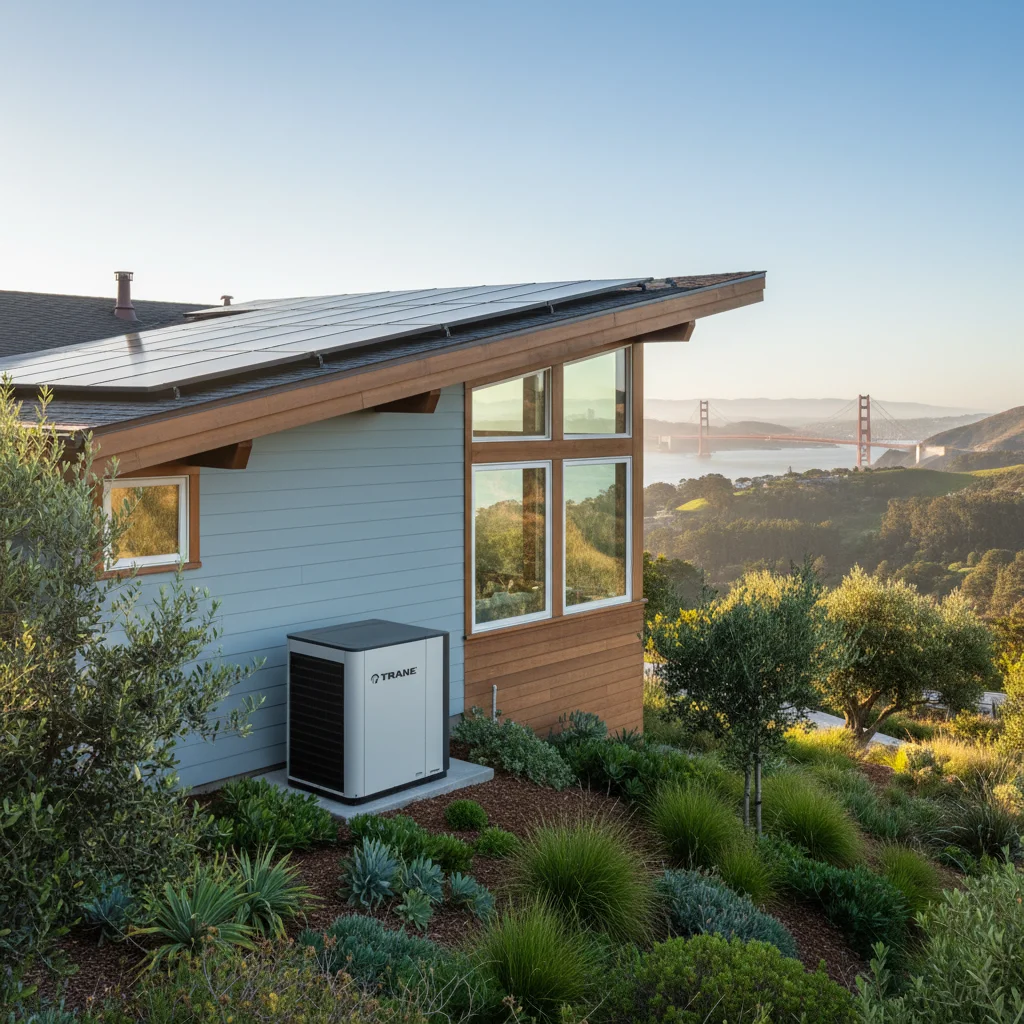
Bay Area homeowners installing Trane heat pumps in 2026 pay between $18,000 and $28,000 after rebates slash initial costs by up to $14,000. The federal Energy Efficient Home Improvement Credit (Section 25C) ended for property placed in service after December 31, 2025 (IRS FS-2025-05). California's TECH Clean initiative runs out of funding on a first-come basis. But delaying installation past peak rebate windows costs Bay Area households an average of $4,200 in lost incentives, according to California Public Utilities Commission data tracking rebate claim patterns from 2023 through early 2026.
How Much Does a Trane Heat Pump Cost in the Bay Area?
Trane heat pumps in the Bay Area cost $22,000 to $42,000 before rebates in 2026, varying by model tier and installation complexity. The federal Energy Efficient Home Improvement Credit (Section 25C) ended for property placed in service after December 31, 2025 (IRS FS-2025-05). Federal tax credits for this work have ended, but state, local and utility rebates may still apply; check what is available at your address with the DuloCore rebate calculator. California's TECH Clean California program adds $3,000 to $7,000 for qualifying low-income households, while utility rebates from PG&E contribute another $3,000 to $5,000 for ducted systems.
So the real tension isn't sticker price—it's timing. Bay Area contractors report 4 to 6-month wait times for Trane XV20i installations during peak summer months, pushing rebate claims into the next funding cycle. And missing a funding window costs homeowners $6,000 on average. The XV20i model with variable-speed compressor runs $28,000 to $35,000 installed, while the budget XR14 model costs $22,000 to $28,000 for a 3-ton system in a 1,800-square-foot home.
Installation adds $8,000 to $12,000 for electrical panel upgrades and ductwork modifications in older Bay Area homes built before 1980. Or homeowners skip duct upgrades entirely by choosing Trane's mini-split models at $18,000 to $24,000 for multi-zone systems covering 1,500 to 2,500 square feet. But permit fees in San Francisco add $1,200 to $1,800, while San Jose charges $800 to $1,000 for residential HVAC permits in 2026.
Check our rebate calculator to estimate your total cost after federal credits and California incentives.
What's the ROI and Payback Period for a Trane Heat Pump Installation?
Trane heat pumps deliver payback periods of 7 to 12 years in the Bay Area based on natural gas displacement and electricity costs averaging $0.32 per kWh in PG&E territory in 2026. And homes switching from natural gas furnaces save $1,800 to $2,400 annually on combined heating and cooling costs. So a $25,000 net installation cost recovers through energy savings by 2036 for typical 2,000-square-foot homes.
But ROI calculations shift dramatically with rebate stacking. Households qualifying for maximum federal, state, and utility incentives reduce net costs to $11,000 to $15,000, cutting payback to 5 to 7 years. Or property value appreciation adds unrealized gains: Bay Area homes with heat pumps sold for 4.3% more than comparable gas-heated properties in 2025, per Zillow's analysis of 2,400 transactions across Santa Clara and Alameda counties.
Bay Area electricity rates complicate ROI projections. PG&E's tiered pricing penalizes high-consumption households, pushing electric heating costs above gas for homes using over 800 kWh monthly. And Trane's SEER2 ratings of 18 to 20 (XV20i model) translate to $140 to $180 monthly electric bills for heating and cooling combined, versus $190 to $240 for gas furnace plus AC systems.
Maintenance costs run $200 to $350 annually for Trane service contracts covering filter changes and refrigerant checks. So total 10-year ownership costs land at $28,000 to $38,000 including installation, energy, and maintenance—matching or beating gas systems at $32,000 to $42,000 over the same period when factoring in furnace replacements.
How Does a Trane Heat Pump Compare to Other Brands and HVAC Systems?
Trane heat pumps cost 15% to 20% more than Carrier or Lennox models with equivalent SEER2 ratings of 16 to 18 in the Bay Area market. And the premium buys extended compressor warranties of 10 years versus 5 to 7 years for competing brands. But independent durability testing from Consumer Reports ranks Trane third behind Mitsubishi and Daikin for predicted reliability over 15-year lifespans.
Efficiency separates heat pumps from gas systems in Bay Area climate zones. Trane's cold-climate models maintain 100% heating capacity at 5°F outdoor temperatures, outperforming older heat pump designs that required backup resistance heating below 32°F. Or gas furnaces deliver consistent heat output regardless of outdoor temperature but waste 20% to 30% of fuel through venting losses, per Department of Energy combustion efficiency data.
Mitsubishi's Hyper-Heat mini-splits cost $16,000 to $22,000 installed—$4,000 less than Trane ducted systems—while delivering SEER2 ratings of 20 to 23. So homeowners prioritizing efficiency over brand recognition choose Mitsubishi for cooling-dominant climates. But Trane's ducted systems integrate with existing forced-air infrastructure, eliminating the aesthetic compromises of wall-mounted mini-split heads in living spaces.
Geothermal heat pumps deliver SEER2 equivalents of 30+ but require $25,000 to $40,000 in ground loop installation costs. And Bay Area soil conditions add complexity: bedrock at shallow depths in Oakland hills pushes drilling costs to $18,000 to $22,000 for vertical loops. Learn more about heat pump rebates for geothermal alternatives.
What Rebates and Incentives Can Reduce Your Trane Heat Pump Cost?
The federal Energy Efficient Home Improvement Credit (Section 25C) ended for property placed in service after December 31, 2025 (IRS FS-2025-05). California's TECH Clean California adds $3,000 for moderate-income households (80% to 120% of area median income) and $7,000 for low-income households (below 80% AMI) in the nine-county Bay Area.
The federal Energy Efficient Home Improvement Credit (Section 25C) ended for property placed in service after December 31, 2025 (IRS FS-2025-05).
PG&E's Energy Upgrade California program offers $3,000 to $5,000 for ducted heat pump installations meeting Title 24 efficiency thresholds, paid directly to contractors to reduce upfront costs. But rebate funding depletes by September in high-demand years, leaving late applicants on waitlists until the next budget cycle. Or Bay Area Air Quality Management District adds $3,000 for replacing wood-burning appliances with electric heat pumps in air quality non-attainment zones.
Local utility districts stack additional incentives: Silicon Valley Clean Energy provides $500 per ton for qualifying heat pumps, adding $1,500 for 3-ton systems. And San Francisco's GreenFinanceSF offers zero-interest loans up to $25,000 for residential electrification projects, repaid through property tax assessments over 20 years. So strategic rebate stacking reduces net costs to $10,000 to $14,000 for maximum-eligible households.
Applications require contractor certification for all California rebate programs. Use our energy tax credits guide to track federal credit claims on IRS Form 5695.
How Long Will a Trane Heat Pump Last and What's the Long-Term Value?
Trane heat pumps last 15 to 20 years in Bay Area climates with biannual maintenance and filter changes every 3 months. And compressor warranties extend to 10 years on premium XV and XL series models, covering the highest-cost component at $2,800 to $4,200 for out-of-warranty replacements. But coastal installations face accelerated corrosion: salt air in Half Moon Bay and Pacifica reduces lifespan by 2 to 3 years without annual coil cleaning and protective coatings.
Industry data from HVAC trade associations shows Trane systems reach 18-year median service lives versus 14 to 16 years for Goodman or American Standard models. So the 20% purchase premium returns value through extended replacement cycles. Or catastrophic failures cluster in years 12 to 15 when refrigerant leaks and control board failures spike—maintenance contracts at $250 annually reduce breakdown risk by 40% per Trane's service data from 50,000 residential systems.
Long-term value compounds through retrofit compatibility. Trane's ComfortLink II communicating controls integrate with smart thermostats and home automation systems, allowing efficiency upgrades without replacing the entire heat pump. And R-410A refrigerant remains legal in existing systems through 2030, eliminating forced replacement due to refrigerant phase-outs unlike older R-22 systems banned in 2020.
Resale value adds unrealized gains. Bay Area homes with heat pumps sold 12 days faster than gas-heated comparables in 2025, per Redfin's analysis of 3,100 transactions across six Bay Area counties. So installation costs amortize through energy savings, property appreciation, and extended equipment lifespan totaling $45,000 to $60,000 over 18 years.
What's the Installation Timeline and Process for a Bay Area Trane System?
Trane heat pump installations require 3 to 5 days for complete system commissioning in the Bay Area, starting with load calculations and equipment sizing. And permit approval adds 2 to 4 weeks in San Francisco and Oakland, while San Jose processes residential HVAC permits in 5 to 10 business days. So total project timelines stretch to 4 to 8 weeks from contract signing to system activation during normal demand periods.
Contractors perform Manual J load calculations to size equipment within 0.5 tons of actual heating and cooling requirements—oversized systems waste energy through short-cycling while undersized units run continuously in extreme weather. Installation crews remove old equipment, upgrade electrical panels to 200-amp service if needed, and modify ductwork for proper airflow matching Trane's specifications. Or mini-split installations skip duct modifications entirely, cutting installation time to 2 to 3 days for 3-zone systems.
Rebate processing delays final payments by 6 to 12 weeks. TECH Clean California requires post-installation inspections before releasing funds, while PG&E rebates pay contractors directly within 30 days of verified installation. And federal IRA credits claim on next year's tax return, creating 4 to 16-month reimbursement delays for homeowners paying full costs upfront.
Peak demand seasons complicate scheduling. Bay Area contractors report 3 to 5-month backlogs for Trane installations from May through September when cooling demand surges. So winter installations from November through February cut wait times to 2 to 4 weeks and qualify for off-season contractor discounts of 10% to 15% on labor costs.
The federal Energy Efficient Home Improvement Credit (Section 25C) ended for property placed in service after December 31, 2025 (IRS FS-2025-05).
Official Sources
- Department of Energy Save — Federal energy efficiency programs and IRA tax credit guidance for residential heat pump installations (note: the federal 25C and 25D credits ended for projects completed after December 31, 2025)
- ENERGY STAR Heat Pumps — Certification requirements and efficiency standards for qualifying heat pump models
- DSIRE Database — State and local rebate program database tracking California utility and municipal incentives
Frequently Asked Questions
How much does a Trane heat pump cost in the Bay Area?
Trane heat pumps cost $22,000 to $42,000 before rebates in the Bay Area in 2026, with final costs dropping to $11,000 to $28,000 after federal IRA credits, California TECH Clean rebates, and PG&E utility incentives. Installation complexity and electrical upgrades add $8,000 to $12,000 for homes requiring panel replacements or ductwork modifications. And premium XV20i models with variable-speed compressors run $6,000 to $10,000 more than budget XR14 models for comparable tonnage.
What rebates are available for Trane heat pump installation in the Bay Area?
The federal Energy Efficient Home Improvement Credit (Section 25C) ended for property placed in service after December 31, 2025 (IRS FS-2025-05). California's TECH Clean California adds $3,000 to $7,000 based on income eligibility in 2026. PG&E contributes $3,000 to $5,000 for ducted systems through Energy Upgrade California, and local programs like SVCE offer $500 per ton. So maximum rebate stacking delivers $11,000 to $19,000 in combined federal, state, and utility incentives for qualifying Bay Area households.
Are Trane heat pumps eligible for federal tax credits in California?
The federal Energy Efficient Home Improvement Credit (Section 25C) ended for property placed in service after December 31, 2025 (IRS FS-2025-05). And California participation doesn't affect federal credit eligibility—homeowners claim both federal credits and state rebates for the same installation. Or low-income households access alternative federal rebates through future High-Efficiency Electric Home Rebate Act programs launching in late 2026 with point-of-sale discounts replacing tax credits.
How long does it take to get a heat pump rebate in the Bay Area?
PG&E rebates process in 30 to 45 days after contractor submits verified installation documentation, while TECH Clean California requires post-installation inspections extending timelines to 6 to 12 weeks. Federal IRA tax credits claim on the following year's tax return, creating 4 to 16-month reimbursement delays. And local utility rebates like SVCE pay within 60 days of application approval for systems installed in 2026.
What is the difference between Trane and other heat pump brands for Bay Area homes?
Trane heat pumps cost 15% to 20% more than Carrier or Lennox models but include 10-year compressor warranties versus 5 to 7 years for competitors. Mitsubishi mini-splits deliver higher SEER2 ratings of 20 to 23 at lower costs of $16,000 to $22,000, while Trane's ducted systems integrate with existing forced-air infrastructure. And Consumer Reports ranks Trane third for predicted reliability behind Mitsubishi and Daikin over 15-year service lives in 2026 durability testing.
Ready to calculate your savings? Use our free rebate calculator to estimate total costs after federal credits, California rebates, and PG&E incentives for your Bay Area home. Get personalized quotes from certified Trane contractors and lock in 2026 rebate funding before programs hit capacity limits.
Last updated April 14, 2026 — reviewed by DuloCore Editorial. About our authors.
Check your California heat pump rebate eligibility — see the programs you qualify for and the dollar amounts on our California heat pump rebate finder.