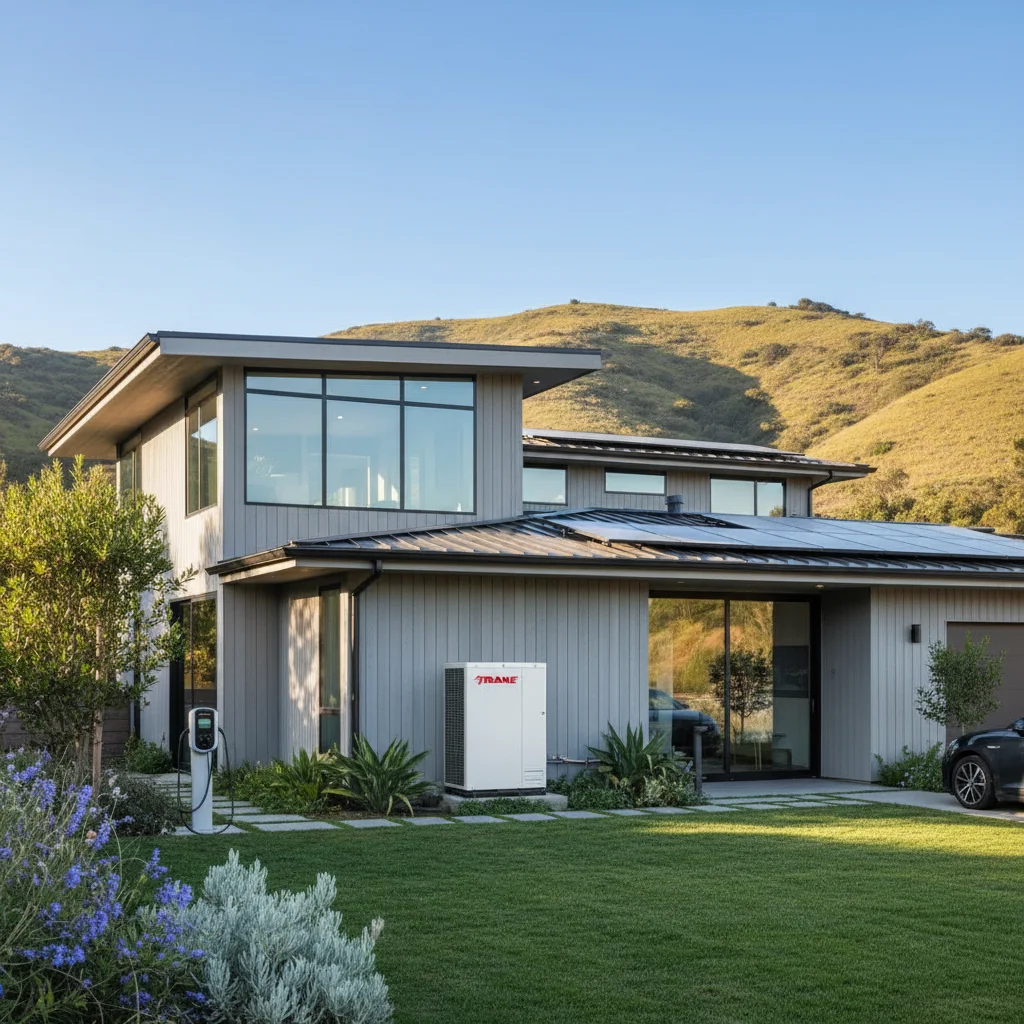
California homeowners paid between $12,000 and $28,000 for Trane heat pump installations in 2025, but utility rebates cut that cost by $4,000 to $12,000 in 2026. And the gap between sticker price and net cost just widened with new California TECH Clean rebates launching this spring.
How Much Does a Trane Heat Pump Cost in California?
Trane heat pump installations in California range from $12,000 to $28,000 in 2026, with equipment accounting for $8,000 to $18,000 and labor adding $4,000 to $10,000. Installation costs vary by model efficiency (14 SEER2 to 20+ SEER2), home size (1,200 to 3,500 square feet), and ductwork modifications.
Equipment costs break down into three tiers. Trane's XV series (20+ SEER2) costs $14,000 to $18,000 for the outdoor and indoor units. The XR series (16-18 SEER2) runs $10,000 to $14,000. And the entry-level XL series (14-16 SEER2) starts at $8,000 to $11,000. But these prices don't include installation labor, which varies by climate zone and existing HVAC infrastructure.
Labor costs spike when homes lack existing ductwork. Duct installation adds $5,000 to $12,000 to the total project cost in California markets. So a complete Trane heat pump system with new ducts can reach $35,000 before rebates. Homes with functional ductwork avoid this expense entirely.
"Heat pump installations in existing homes with forced-air systems typically cost 40% less than installations requiring new duct systems." — U.S. Department of Energy
Coastal California regions (San Francisco, Los Angeles, San Diego) see installation costs 15% to 25% higher than inland markets due to permitting fees and labor rates. Permit costs range from $400 to $1,200 depending on municipality. And contractor availability affects pricing—coastal markets with limited HVAC contractors charge premium rates during peak installation seasons (April through September).
What's the ROI and Payback Period for a Trane Heat Pump Installation?
Trane heat pump installations in California deliver payback periods of 6 to 12 years with total ROI ranging from 180% to 320% over the system's lifespan. Annual energy savings average $800 to $1,600 compared to gas furnace and air conditioner combinations, with Climate Zone 3 (coastal) homeowners seeing faster payback than Zone 16 (high desert) installations.
The payback calculation starts with net installation cost after rebates. A $20,000 Trane XV installation with $6,000 in state incentives costs $14,000 net. At $1,200 annual energy savings, the system pays for itself in about 11.7 years. But this assumes natural gas prices stay at $2.50 per therm—California's 2026 average.
Energy savings vary by replaced system type. Homes replacing electric resistance heat see immediate 50% to 65% heating cost reductions. But homes replacing high-efficiency gas furnaces (95% AFUE) may see only 20% to 35% savings in heating costs. The cooling efficiency upgrade (from 13 SEER to 20 SEER2) adds $300 to $600 in annual summer savings for Central Valley homeowners.
California's rising electricity rates affect ROI projections. PG&E, SCE, and SDG&E all increased rates 8% to 13% between 2024 and 2026. So heat pump operating costs rise even as efficiency improves. Homeowners with solar panels see better ROI—excess solar generation offsets heat pump electricity consumption during shoulder seasons (March-May, September-November).
Use our free rebate calculator to calculate your exact payback period based on your climate zone, current heating system, and electricity rates.
The total ROI over a 15-year lifespan reaches 250% for average installations. A $14,000 net cost system saves $18,000 in energy costs over 15 years ($1,200 annually). And avoided maintenance costs add another $2,000 to $4,000—heat pumps eliminate annual furnace inspections and air conditioner coil cleaning.
How Does a Trane Heat Pump Compare to Alternative Heating Systems in California?
Trane heat pumps cost 40% to 80% more upfront than gas furnace installations ($7,000 to $12,000) but deliver 35% to 55% lower annual operating costs. Ground-source geothermal systems outperform Trane air-source models by 20% to 30% in efficiency but require $25,000 to $45,000 installations that extend payback periods to 15 to 25 years.
Gas furnaces remain California's baseline heating comparison. A 95% AFUE furnace installation costs $7,000 to $12,000 including labor. Annual heating costs for a 2,000-square-foot home run $800 to $1,400 at current natural gas rates. But furnaces require separate air conditioner systems ($4,000 to $8,000), bringing total HVAC costs to $11,000 to $20,000—comparable to mid-tier Trane heat pump installations.
Ductless mini-split heat pumps from Mitsubishi and Daikin cost $8,000 to $18,000 for whole-home installations. These systems match Trane's efficiency (18-22 SEER2) but require multiple indoor units (3 to 5) instead of central ductwork. So mini-splits work better for homes without existing ducts or for room-by-room climate control. And mini-split maintenance costs run 20% lower than ducted systems.
Geothermal heat pumps deliver COPs (Coefficient of Performance) of 3.5 to 5.0 compared to Trane air-source COPs of 2.5 to 3.5. This translates to 400% to 500% efficiency versus Trane's 250% to 350%. But drilling costs ($15,000 to $30,000) make geothermal economical only for new construction or homes with large lots allowing horizontal loop installations.
"Air-source heat pumps provide the lowest installed cost path to electrification in California's moderate climates, while geothermal systems excel in extreme temperature regions with higher energy loads." — California Energy Commission
Electric resistance baseboard heating costs 60% to 75% less to install ($2,000 to $4,000) but runs 200% to 300% more expensive annually. A 2,000-square-foot home heated with baseboard costs $2,400 to $3,600 per year versus $800 to $1,200 for a Trane heat pump. So baseboard heating makes sense only for rarely-used spaces or mild climates with minimal heating demand.
What's the Lifespan of a Trane Heat Pump and When Will You Need Replacement?
Trane heat pumps last 15 to 20 years in California climates with proper maintenance, reaching end-of-life at 12 to 15 years in high-use installations (Climate Zones 13-16) and 18 to 22 years in mild coastal regions (Zones 1-6). Compressor failure triggers replacement in 65% of cases, while refrigerant leaks and control board failures account for the remaining 35%.
Maintenance frequency directly impacts lifespan. Annual professional inspections ($150 to $300) catch refrigerant leaks, electrical issues, and airflow restrictions before they cause component failures. And biannual filter changes (every 60 to 90 days) prevent coil fouling that reduces efficiency by 15% to 25% and shortens compressor life.
The compressor—the heat pump's most expensive component—typically fails between year 12 and year 18. Replacement costs $2,500 to $4,500 including labor. But if the compressor fails after year 12, replacing the entire system makes more financial sense than repair. Modern heat pumps offer 30% to 50% better efficiency than 2012-2014 models, so energy savings often justify full replacement over major component repair.
California's coastal salt air accelerates outdoor unit corrosion. Homes within 10 miles of the Pacific Ocean see 20% to 30% shorter heat pump lifespans without corrosion-resistant coatings. Trane's WeatherGuard coating adds $400 to $800 to installation costs but extends coastal lifespans by 3 to 5 years. So coastal homeowners should factor coating costs into initial purchase decisions.
Heat pump efficiency degrades 2% to 3% annually even with perfect maintenance. A 20 SEER2 system drops to 17-18 SEER2 after 8 to 10 years of operation. And efficiency below 14 SEER2 makes replacement economically justified—the energy savings from a new 20 SEER2 system pay for installation within 8 to 12 years.
What California Rebates and Tax Credits Can Reduce Your Trane Heat Pump Cost?
The federal Energy Efficient Home Improvement Credit (Section 25C) ended for property placed in service after December 31, 2025 (IRS FS-2025-05). Federal tax credits for this work have ended, but state, local and utility rebates may still apply; check what is available at your address with the DuloCore rebate calculator. California's TECH Clean California program adds $3,000 to $5,000 utility rebates for income-qualified households, while standard rebates range from $1,500 to $3,000 depending on equipment efficiency and utility territory.
TECH Clean California rebates launched in 2024 and expanded statewide in 2026. Income-qualified households (≤80% area median income) receive $5,000 for heat pump installations in PG&E, SCE, and SDG&E territories. Moderate-income households (80% to 150% AMI) get $3,000. And all California households qualify for base rebates of $1,500 to $2,500 depending on installed SEER2 rating (minimum 15 SEER2 required).
Stacking multiple incentives delivers the maximum cost reduction. A $20,000 Trane installation qualifies for: - Federal tax credit: ended for property placed in service after December 31, 2025 (IRS FS-2025-05) - TECH Clean rebate (income-qualified): $5,000 - Utility rebate (SCE): $2,000 - Total incentives: $7,000 - Net cost: $13,000
Learn more about available heat pump rebates and how they combine with other energy tax credits.
Bay Area Air Quality Management District offers additional $3,000 rebates for replacing natural gas furnaces with heat pumps. So San Francisco Bay Area homeowners can stack BAAQMD and TECH Clean rebates for total incentives reaching $8,000 to $10,000 on $20,000 installations.
"California's statewide heat pump rebate programs aim to install 6 million heat pumps by 2030, with higher incentives targeted at disadvantaged and low-income communities." — California Public Utilities Commission
Application deadlines vary by program. Form 5695 only covers qualifying work completed by December 31, 2025 and claimed on a 2025 return; the federal 25C and 25D credits ended after that date (IRS FS-2025-05). But TECH Clean rebates require pre-approval before installation. Contractors submit applications showing equipment specifications and homeowner income verification. And rebate funds deplete annually, so early application (January-March) ensures funding availability.
What's the Installation Timeline and Process for a Trane Heat Pump in California?
Trane heat pump installations take 1 to 3 days for standard replacements in homes with existing ductwork, extending to 5 to 10 days when ductwork installation or electrical panel upgrades are required. The full process from contractor selection to final inspection spans 3 to 8 weeks in 2026 California markets due to equipment lead times (2 to 4 weeks) and municipal permitting delays (1 to 3 weeks).
The process starts with in-home energy assessments. HVAC contractors perform Manual J load calculations to determine correct heat pump sizing (18,000 to 60,000 BTU for California homes). Undersized systems run continuously without reaching temperature setpoints. And oversized systems short-cycle, reducing efficiency by 20% to 30% and shortening equipment life. So proper sizing requires room-by-room calculations accounting for insulation, window area, and climate zone.
Permit acquisition follows contractor selection. California requires building permits for all heat pump installations that modify electrical service or refrigerant lines. Permit fees range from $400 to $1,200 depending on municipality. And permit approval takes 3 to 14 business days in most jurisdictions. Some cities (San Francisco, Los Angeles) offer expedited review ($200 to $400 additional) reducing wait times to 24 to 48 hours.
Equipment ordering adds 2 to 4 weeks to the timeline. Trane's XV and XR series face longer lead times (3 to 5 weeks) than XL models (1 to 2 weeks) due to higher demand for premium efficiency units. So contractors recommend ordering immediately after permit approval rather than waiting for installation scheduling.
Physical installation breaks into phases: - Day 1: Remove old HVAC system, install outdoor unit, run refrigerant lines (6 to 8 hours) - Day 2: Install indoor air handler, connect ductwork, electrical hookup (6 to 10 hours) - Day 3: System startup, refrigerant charging, testing, thermostat programming (3 to 5 hours)
Homes requiring ductwork installation add 3 to 7 days depending on home size and accessibility. And electrical panel upgrades (required when existing panels lack 240V/60A circuits) add 1 to 2 days plus separate electrical permits.
Final inspections occur 1 to 3 days after installation completion. Building inspectors verify refrigerant line installation, electrical connections, and permit compliance. And inspection passage triggers rebate processing—TECH Clean rebates arrive 4 to 8 weeks after inspection approval.
Official Sources
- U.S. Department of Energy: Heat Pump Systems — Federal guidance on heat pump technology, efficiency ratings, and installation best practices
- ENERGY STAR Heat Pumps — Product certification database and efficiency requirements for tax credit eligibility (note: the federal 25C and 25D credits ended for projects completed after December 31, 2025)
- California Public Utilities Commission: TECH Clean California — Statewide heat pump rebate program details, income qualification, and application process
Related Reading: Learn more about Trane Heat Pump Cost Riverside.
Frequently Asked Questions
How much does a Trane heat pump cost in California?
Trane heat pump installations cost $12,000 to $28,000 in California before rebates, with equipment ranging from $8,000 (XL series, 14 SEER2) to $18,000 (XV series, 20+ SEER2). Labor adds $4,000 to $10,000 depending on home size and ductwork requirements. But California TECH Clean rebates ($1,500 to $5,000) reduce net costs to $10,000 to $20,000 for most installations.
What rebates are available for Trane heat pumps in California?
California homeowners qualify for TECH Clean California rebates of $1,500 to $5,000 depending on income and utility-specific rebates of $500 to $2,000; federal tax credits no longer apply (IRS FS-2025-05). Bay Area residents get additional BAAQMD rebates of $3,000 for gas furnace replacements. Total incentives reach $4,000 to $10,000 when stacking all available programs in 2026.
Do I qualify for Trane heat pump rebates in California?
All California homeowners qualify for base TECH Clean rebates regardless of income. Income-qualified households earning ≤80% area median income receive enhanced TECH Clean rebates of $5,000 versus $1,500 to $3,000 for higher earners. And heat pumps must meet minimum 15 SEER2 efficiency to qualify for California rebates.
When is the deadline for Trane heat pump rebate applications in California?
The federal Energy Efficient Home Improvement Credit (Section 25C) ended for property placed in service after December 31, 2025 (IRS FS-2025-05). TECH Clean California rebates require pre-approval before installation and operate on annual funding cycles (January 1 to December 31). But rebate funds often deplete by June in high-demand utility territories, so applications submitted January through March have higher approval rates.
How does a Trane heat pump compare to other brands for California rebates?
Trane, Carrier, Lennox, and Rheem heat pumps all qualify for identical California rebate amounts—programs base incentives on SEER2 ratings and equipment type rather than manufacturer. But Trane's 12-year compressor warranty exceeds Carrier's 10-year and Rheem's 5-year coverage, potentially reducing long-term ownership costs by $1,500 to $3,000.
Ready to calculate your exact rebate amount and net installation cost? Use our rebate calculator to get a personalized quote based on your income, climate zone, and existing heating system. Enter your ZIP code and system details to see all available state and utility incentives for your Trane heat pump installation.
Last reviewed: April 14, 2026. Reviewed by DuloCore Energy Specialists. About the team.
Check your California heat pump rebate eligibility — see the programs you qualify for and the dollar amounts on our California heat pump rebate finder.