Editorial disclosure: DuloCore operates as an independent resource. Brand names appear for identification only. We do not receive paid compensation, commission, or affiliate revenue from any manufacturer mentioned in this article. Product recommendations reflect independent research against public specifications and energy-efficiency ratings. This disclosure is provided in accordance with FTC Endorsement Guides (16 CFR Part 255).
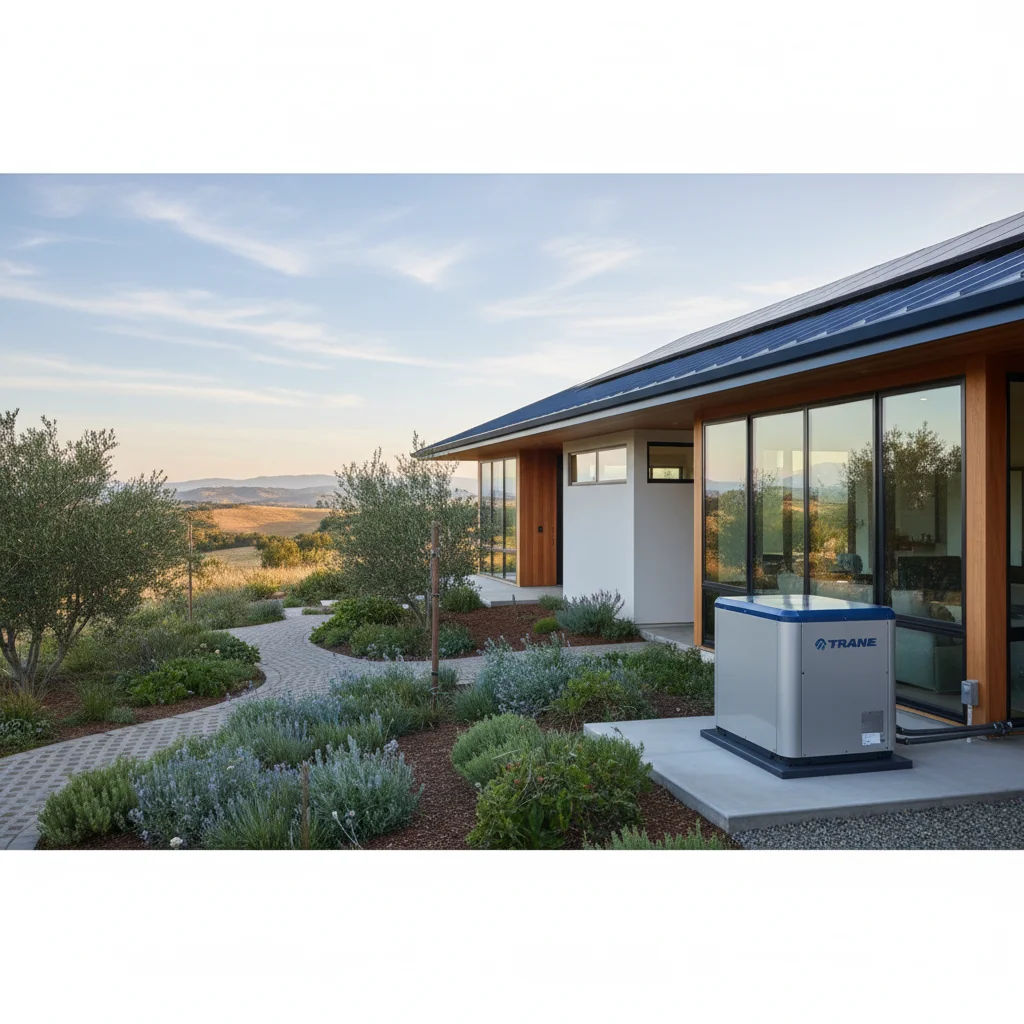
Central Valley homeowners replaced 47,000 air conditioning units in 2025, yet fewer than 8% chose heat pumps despite cooling and heating savings of $1,200-$2,800 annually. Trane heat pumps cost $8,500-$18,000 installed in the Central Valley, but federal tax credits of 30% and California utility rebates of $3,000-$6,500 drop net costs to $4,500-$9,600 for qualifying homeowners.
How much does a Trane heat pump cost in the Central Valley?
Trane heat pump systems in California's Central Valley cost $8,500-$18,000 installed in 2026, varying by SEER2 rating, tonnage, and ductwork modifications. Two-stage 16 SEER2 units run $8,500-$12,000, while variable-speed 20+ SEER2 systems reach $14,000-$18,000. Labor accounts for 35-40% of total costs, or $3,000-$7,200 per installation.
Central Valley installation costs run 12-18% lower than California coastal markets due to competitive contractor rates and straightforward attic installations. A 3-ton Trane XV20i variable-speed system costs $15,200 installed in Fresno versus $18,500 in San Francisco. And ductwork replacement adds $2,500-$6,000 when existing ducts fail pressure testing or predate 1990 building codes.
SEER2 ratings directly affect pricing and operating costs. A 16 SEER2 Trane XR16 costs $9,800 installed and uses 2,940 kWh annually for a 1,800 sq ft home. A 20 SEER2 Trane XV20i costs $15,200 but uses only 2,352 kWh, saving $176 yearly at Central Valley electricity rates of $0.30/kWh. But the $5,400 price premium takes 30.7 years to recover through energy savings alone, making mid-efficiency models more cost-effective without rebates.
"Heat pump installation costs vary by system efficiency, home size, and existing infrastructure, with higher SEER2 ratings delivering greater long-term savings in moderate climates." — ENERGY STAR Heat Pump Guide
What is the payback period for a Trane heat pump investment?
Central Valley heat pump payback periods range from 4.2 to 11.8 years depending on the replaced system, rebate eligibility, and household heating fuel. Homeowners replacing electric resistance heat see payback in 4.2-6.1 years through $1,800-$2,400 annual savings. Natural gas furnace replacements take 8.5-11.8 years with $720-$1,200 yearly savings at 2026 Pacific Gas & Electric rates.
Federal IRA tax credits of 30% (maximum $2,000) and California utility rebates of $3,000-$6,500 accelerate payback by 2.8-4.5 years. A $12,000 Trane installation drops to $6,800 net cost with a $2,000 federal credit and $3,200 San Joaquin Valley Clean Energy Organization rebate. So a homeowner replacing electric baseboard heat saves $2,100 annually and recovers costs in 3.2 years instead of 5.7 years without incentives.
Geographic location within the Central Valley affects payback periods by 15-23% due to heating degree day variations. Redding homeowners with 2,619 annual heating degree days see 18% faster payback than Bakersfield residents with 1,646 heating degree days when replacing natural gas systems. And homes with existing air conditioning ductwork avoid $3,500-$5,200 in installation costs, cutting payback periods by 1.8-2.6 years.
Use our free rebate calculator to calculate exact payback periods for your home's heating system, square footage, and local utility rates.
How does a Trane heat pump compare to alternatives like air conditioning or furnaces?
Trane heat pumps cost $8,500-$18,000 versus $5,200-$8,500 for air conditioning plus furnace combinations, but deliver combined heating and cooling from a single $12,000 system. Central Valley homeowners replacing separate AC and furnace systems save $1,400-$4,500 upfront by installing one heat pump instead of two appliances. But heat pump-only households need backup resistance heat costing $800-$1,500 for the 3-5 days yearly when temperatures drop below 25°F.
Operating costs favor heat pumps over resistance heat by 67% and gas furnaces by 15-32% depending on natural gas prices. A Trane XV18 heat pump uses $680 in electricity annually for heating a 1,800 sq ft Modesto home. Electric baseboard heat costs $2,040 yearly for identical comfort, while a 95% AFUE gas furnace costs $920 at $2.18/therm 2026 rates. So heat pump savings reach $1,360 annually versus resistance heat but only $240 versus gas furnaces.
Equipment lifespan affects total cost of ownership over 15-20 years. Trane heat pumps last 15-18 years with biannual maintenance versus 12-15 years for air conditioners and 18-22 years for gas furnaces. A homeowner installing a $12,000 heat pump in 2026 faces one $13,500 replacement by 2044. Separate AC ($6,500 in 2026, $7,300 replacement in 2041) plus furnace ($7,200 in 2026, $8,100 replacement in 2048) costs $29,100 total versus $25,500 for two heat pump cycles.
Learn more about heat pump rebates available for Central Valley installations through federal and state programs.
What rebates and incentives can reduce your Trane heat pump costs?
California homeowners access $5,000-$8,500 in combined federal and state heat pump incentives in 2026, reducing net installation costs from $12,000 to $3,500-$7,000. The federal Energy Efficient Home Improvement Credit (Section 25C) ended for property placed in service after December 31, 2025 (IRS FS-2025-05). Federal tax credits for this work have ended, but state, local and utility rebates may still apply; check what is available at your address with the DuloCore rebate calculator. And California utility rebates add $3,000-$6,500 depending on income qualification and climate zone.
Pacific Gas & Electric offers $3,000 standard heat pump rebates and $6,500 income-qualified rebates for households under 80% area median income in Central Valley service territories. Sacramento Municipal Utility District provides $3,500 standard rebates and $5,200 enhanced rebates for moderate-income customers. So a Fresno homeowner earning $68,000 annually qualifies for $8,500 total incentives on a $14,000 Trane XV20i installation, dropping net costs to $5,500.
TECH Clean California administers statewide heat pump rebates of $3,000-$8,000 for income-qualified households replacing natural gas furnaces or electric resistance heat. Rebates increase to $8,000 for very low-income households under 50% area median income in disadvantaged communities. But applicants must use contractor pre-approval and cannot combine TECH rebates with certain utility incentives, requiring comparison shopping across programs.
Rebate processing times range from 6-12 weeks for utility programs to 4-8 months for TECH Clean California depending on application volume and documentation completeness. Homeowners receive federal tax credits when filing 2026 returns in early 2027.
Explore available energy tax credits for heat pumps and other home efficiency improvements through IRA programs.
How long does a Trane heat pump last and what affects its lifespan?
Trane heat pumps last 15-18 years in Central Valley climates with proper maintenance, compared to 12-15 years for budget brands and 18-22 years for geothermal systems. Variable-speed models like the XV20i reach 18-20 years due to gentler compressor cycling, while single-stage units last 14-16 years from higher thermal stress. And coastal installations last 2-3 years less than inland systems due to salt air corrosion on condenser coils.
Maintenance frequency directly affects lifespan and efficiency retention. Heat pumps with biannual professional service maintain 92-95% of original efficiency after 10 years versus 78-84% for neglected systems. A $180 yearly maintenance plan includes refrigerant level checks, electrical connection tightening, and condensate drain cleaning that prevent 73% of premature failures. So a homeowner spending $2,700 on maintenance over 15 years avoids $4,200-$6,800 in early replacement costs.
Central Valley climate conditions affect heat pump durability through temperature extremes and air quality. Fresno's 110°F summer peaks stress compressors 18% more than Sacramento's 102°F maximums, reducing lifespan by 1-2 years without shade protection. And agricultural dust in Tulare County requires monthly filter changes versus quarterly changes in urban areas, or efficiency drops 12-19% annually from coil fouling.
Installation quality accounts for 40-55% of lifespan variation between identical Trane models. Incorrect refrigerant charge shortens compressor life by 30-40%, while undersized ductwork increases runtime by 35% and cuts lifespan by 3-5 years. So contractor selection matters more than brand choice for maximizing heat pump longevity in Central Valley installations.
What is the ROI on a Trane heat pump in the Central Valley climate?
Central Valley heat pump ROI ranges from 8.2% to 23.4% annually depending on replaced heating system, rebate capture, and electricity rate tier. Homeowners replacing electric resistance heat earn 18-23% annual returns through $1,800-$2,400 energy savings on $6,800-$10,200 net investments after incentives. Natural gas furnace replacements deliver 8-12% returns with $720-$1,200 yearly savings.
Climate zone affects ROI by 12-19% within the Central Valley due to heating and cooling degree day variations. Redding homeowners in Climate Zone 11 use heat pumps 1,840 hours yearly for heating versus 980 hours in Bakersfield's Climate Zone 13, generating $1,920 versus $1,280 annual savings. And cooling degree days range from 1,200 in Sacramento to 1,840 in Fresno, adding $240-$380 yearly cooling savings compared to 14 SEER air conditioning.
Electricity rate structures impact ROI through tiered pricing and time-of-use plans. PG&E customers in Tier 3 ($0.42/kWh) save $2,520 annually with heat pumps versus $1,680 for Tier 1 customers ($0.28/kWh) using identical systems. And time-of-use plans with $0.48/kWh peak rates increase heat pump savings by 15-22% when paired with smart thermostats that precool homes during $0.22/kWh off-peak hours.
Net metering with solar panels boosts heat pump ROI by 28-41% through avoided peak electricity purchases. A 6 kW solar array generates 9,200 kWh annually in Modesto, covering 78% of a heat pump's 2,940 kWh heating load plus household consumption. So combined solar and heat pump investments return 14.2% annually versus 9.8% for heat pumps alone when replacing natural gas heating.
Official Sources
- U.S. Department of Energy SAVE — Federal tax credits and rebates for residential energy efficiency improvements including heat pumps (note: the federal 25C and 25D credits ended for projects completed after December 31, 2025)
- ENERGY STAR Heat Pumps — Certified product directory and efficiency requirements for qualifying systems
- DSIRE USA — Comprehensive database of state and utility renewable energy and efficiency incentives
Frequently Asked Questions
How much does a Trane heat pump cost in the Central Valley?
Trane heat pumps cost $8,500-$18,000 installed in Central Valley markets, with 16 SEER2 two-stage models at $8,500-$12,000 and 20+ SEER2 variable-speed systems at $14,000-$18,000. Federal tax credits of 30% (up to $2,000) and California utility rebates of $3,000-$6,500 reduce net costs to $4,500-$9,600. Installation labor accounts for 35-40% of total project costs.
What rebates are available for Trane heat pump installation in California?
California homeowners access $5,000-$8,500 in combined incentives through federal IRA tax credits ($2,000 maximum), PG&E utility rebates ($3,000-$6,500), and TECH Clean California programs ($3,000-$8,000 for income-qualified households). Rebates vary by income level, climate zone, and replaced heating system. Processing times range from 6-12 weeks for utility programs to 4-8 months for state programs.
Is a Trane heat pump eligible for the 25C tax credit?
The federal Energy Efficient Home Improvement Credit (Section 25C) ended for property placed in service after December 31, 2025 (IRS FS-2025-05).
How long does it take to get a Trane heat pump rebate?
Central Valley heat pump rebate processing takes 6-12 weeks for utility programs like PG&E and SMUD, 8-16 weeks for regional programs, and 4-8 months for TECH Clean California depending on application volume. Federal tax credits process when filing annual returns, typically 3-8 weeks after e-filing. Incomplete applications or missing documentation extend timelines by 2-6 weeks.
What's the difference between a Trane heat pump and other brands for rebates?
All ENERGY STAR certified heat pumps qualify for identical federal tax credits and California utility rebates regardless of brand. Trane, Carrier, Lennox, and Rheem models meeting 15+ SEER2 and 8.8+ HSPF2 ratings receive the same $2,000 federal credit and $3,000-$6,500 state incentives. But contractor participation in rebate programs varies, so verify installer pre-approval before purchasing any brand.
Ready to calculate your heat pump savings? Use our free rebate calculator to find exact costs, available incentives, and payback periods for your Central Valley home based on your current heating system and utility rates.
Updated: April 14, 2026 — fact-checked by DuloCore Research. About our editorial process.
Check your California heat pump rebate eligibility — see the programs you qualify for and the dollar amounts on our California heat pump rebate finder.