Editorial disclosure: DuloCore operates as an independent resource. Brand names appear for identification only. We do not receive paid compensation, commission, or affiliate revenue from any manufacturer mentioned in this article. Product recommendations reflect independent research against public specifications and energy-efficiency ratings. This disclosure is provided in accordance with FTC Endorsement Guides (16 CFR Part 255).
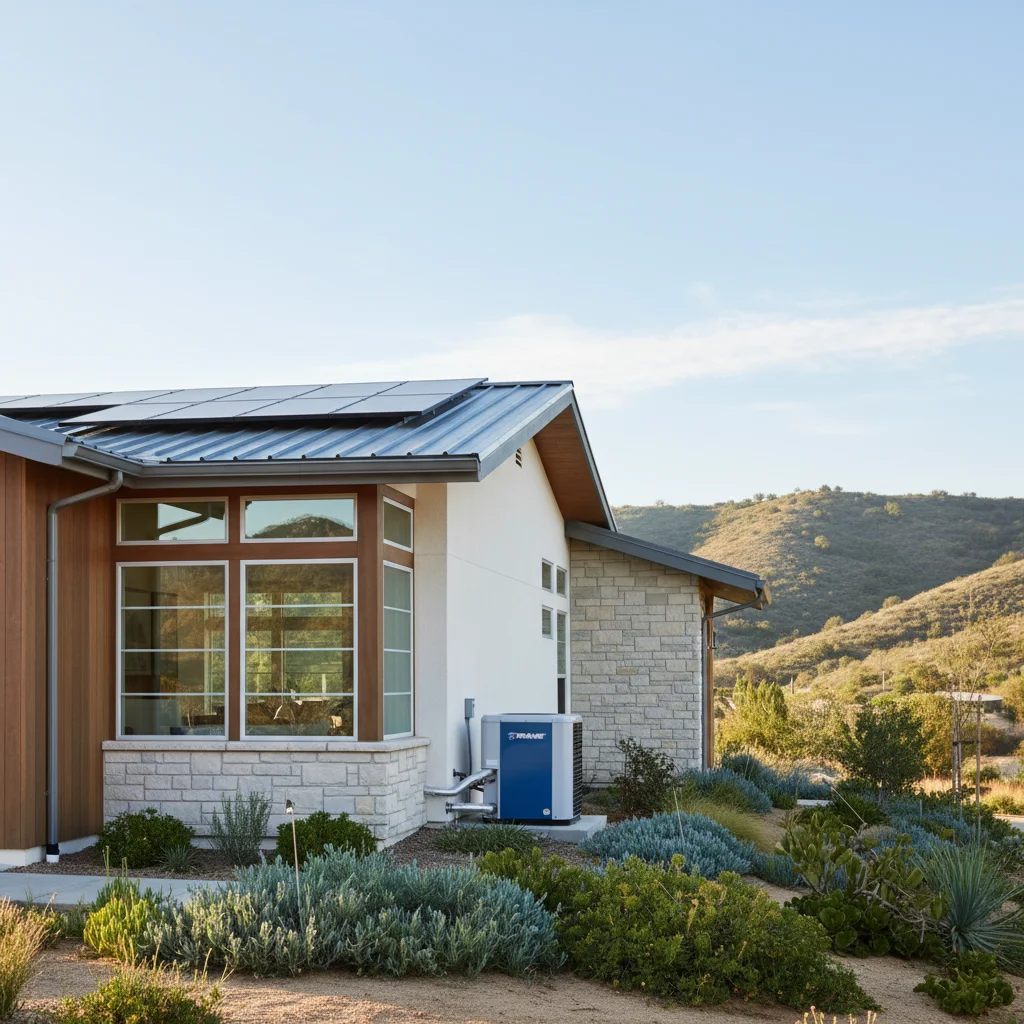
Inland Empire homeowners pay $8,500 to $18,000 for Trane heat pump installation in 2026, but federal tax credits and California utility rebates cut that cost by 30% to 50%. And with summer temperatures regularly exceeding 105°F and winter lows dropping to 30°F, heat pumps deliver year-round efficiency that single-function HVAC systems can't match.
How Much Does a Trane Heat Pump Cost in the Inland Empire?
Trane heat pump systems in the Inland Empire cost $8,500 to $18,000 installed in 2026, with mid-tier models averaging $12,000 to $14,500. Single-zone systems start at $8,500, while whole-home installations with zoning controls reach $18,000. Labor accounts for 30% to 40% of total cost, or $2,500 to $7,000 depending on system complexity.
So why do Trane systems command premium pricing? The brand's variable-speed compressors and WeatherGuard fasteners deliver 20% longer equipment life than builder-grade units, according to ENERGY STAR efficiency data. And Inland Empire homeowners replacing 15-year-old air conditioners see average energy savings of $1,200 to $1,800 annually.
But installation complexity drives final costs. Homes without existing ductwork add $3,500 to $7,000 for new distribution systems. Electrical panel upgrades for 200-amp service cost $1,200 to $2,500. So total project costs range from $8,500 for straightforward replacements to $25,000 for comprehensive HVAC overhauls with ductwork and electrical upgrades.
Trane's XV20i variable-speed model costs $15,000 to $18,000 installed and delivers 20 SEER2 cooling efficiency. The mid-tier XL16i runs $11,000 to $14,000 with 17 SEER2 ratings. Entry-level XR14 systems start at $8,500 with 14.5 SEER2 performance. Use our free rebate calculator to estimate your specific system cost after available incentives.
What's the ROI and Payback Period for a Trane Heat Pump Investment?
Trane heat pump installations in the Inland Empire deliver payback periods of 5 to 9 years, with annual energy savings of $1,200 to $2,400 offsetting upfront costs of $8,500 to $18,000. Homes upgrading from electric resistance heating see 3 to 5 year payback, while gas furnace replacements extend to 7 to 9 years based on natural gas pricing.
The math changes dramatically with rebates. A $14,000 Trane XV18i installation drops to $7,000 after the 30% federal tax credit ($4,200) plus Southern California Edison's $2,800 heat pump (this federal credit ended for property placed in service after December 31, 2025) rebate. That reduces payback to 3 to 4 years for electric heat replacements, or 5 to 6 years for gas conversions. (Note: Federal tax credit percentages and availability are subject to change; the 30% Residential Clean Energy Credit under Section 25D expired December 31, 2025. Verify current incentives at energy.gov.)
"Air-source heat pumps can reduce electricity use for heating by approximately 50% compared to electric resistance heating such as furnaces and baseboard heaters." — U.S. Department of Energy
And variable-speed models amplify savings. Trane's XV20i achieves 10 HSPF2 heating efficiency, delivering 300% more heat per kilowatt-hour than electric baseboards. So homeowners using 2,000 kWh monthly for heating in January cut consumption to 650 kWh, saving $200 to $270 per month at Inland Empire electricity rates of $0.28 to $0.34 per kWh.
But payback calculations must factor maintenance costs. Trane systems require annual service visits at $150 to $250, plus refrigerant top-offs every 3 to 5 years at $200 to $400. Or homeowners can purchase extended warranties for $800 to $1,500 that cover all repairs beyond the standard 10-year parts warranty.
Equipment lifespan extends ROI. Trane heat pumps last 15 to 20 years with proper maintenance, compared to 12 to 15 years for budget brands. So the premium upfront cost spreads across 5 to 8 additional years of service, reducing annualized ownership costs by 20% to 30%.
What Rebates and Tax Credits Can Lower Your Trane Heat Pump Cost?
Federal tax credits cover 30% of Trane heat pump (this federal credit ended for property placed in service after December 31, 2025) installation costs in 2026 under the Inflation Reduction Act, capping at $2,000 for equipment meeting ENERGY STAR efficiency requirements. Systems rated 16 SEER2 or higher for cooling and 9 HSPF2 for heating qualify, including all Trane XV and XL series models.
Southern California Edison pays $2,800 for ENERGY STAR heat pump installations in 2026. Riverside Public Utilities offers $1,500 for qualifying systems. But income-qualified homeowners earning below 80% of area median income access enhanced rebates of $4,000 to $8,000 through California's TECH Clean California program.
The federal Residential Clean Energy Credit (Section 25D) ended for expenditures made after December 31, 2025, and the IRS treats an expenditure as made when installation is completed (IRS FS-2025-05).
And rebate timing affects cash flow. Federal tax credits apply when filing returns in April 2027 for 2026 installations, delaying reimbursement by 4 to 16 months. Or utility rebates process within 6 to 10 weeks of installation, providing faster cost recovery. Some contractors offer instant rebates at point of sale, eliminating upfront payment entirely.
But rebate eligibility includes strict requirements. Homes must replace existing HVAC systems, not add supplemental capacity. Installations require permits and inspections. Or contractors must be licensed and bonded. Check complete requirements through the ENERGY STAR rebate finder before purchasing equipment.
How Does Trane's Cost Compare to Other Heat Pump Brands in the Inland Empire?
Trane heat pumps cost 15% to 25% more than Goodman, Rheem, or American Standard systems with comparable SEER2 ratings, with Trane's $14,000 average installation exceeding Goodman's $10,500 for similar 16 SEER2 performance. But Trane's compressor warranty extends to 10 years versus 5 years for budget brands.
Carrier and Lennox compete at Trane's premium tier. Carrier Infinity systems run $13,500 to $17,000 installed, within $500 to $1,000 of equivalent Trane models. Lennox Signature series installations cost $14,000 to $18,500, slightly exceeding Trane for top-tier variable-speed units. So brand choice at the premium level depends on contractor relationships and parts availability rather than significant price differences.
But mid-tier alternatives deliver value. Rheem Prestige series heat pumps cost $9,500 to $12,000 installed with 17 SEER2 ratings, undercutting Trane's XL16i by $2,000 to $3,000. American Standard Silver series systems run $8,500 to $11,000, matching Trane's entry-level pricing with similar efficiency specifications.
And warranty coverage varies. Trane includes 10-year compressor and 10-year parts warranties standard, with optional extended coverage to 12 years. Carrier matches at 10 years. Or Goodman offers lifetime compressor warranties with registered installations, potentially exceeding Trane's long-term value for homeowners planning 20-year ownership.
Service network density matters in the Inland Empire. Trane maintains 47 authorized dealers across Riverside and San Bernardino counties, ensuring parts availability within 24 hours. Carrier operates 52 local dealers. But specialty brands like BoSch or Mitsubishi limit service providers to 12 to 18 contractors, extending repair timelines to 3 to 5 days for uncommon parts.
What Factors Affect Your Final Trane Heat Pump Installation Cost?
System capacity drives base pricing, with 2-ton units serving homes under 1,200 square feet costing $8,500 to $11,000, while 5-ton systems for 2,500 to 3,500 square foot homes run $14,000 to $18,000 installed. Oversized systems waste energy through short-cycling, while undersized units can't maintain temperatures during Inland Empire's 110°F summer peaks.
Ductwork condition affects installation scope. Homes with leaky or undersized ducts add $2,500 to $6,000 for sealing and upgrades. Or ductless mini-split installations eliminate ductwork entirely, costing $4,500 to $8,000 per zone for Trane multi-split systems. So older homes built before 1990 frequently require duct modifications that double total project costs.
Electrical infrastructure creates hidden expenses. Heat pumps draw 30 to 60 amps depending on capacity, requiring dedicated 240-volt circuits. Homes with 100-amp panels need $1,800 to $3,500 upgrades to 200-amp service. And installations farther than 50 feet from electrical panels add $400 to $900 in wiring costs.
But refrigerant regulations increase prices. California banned R-410A refrigerant in new equipment starting January 2025, requiring R-32 or R-454B alternatives. Trane's R-410A inventory cleared by mid-2025, so all 2026 installations use next-generation refrigerants costing 20% more for initial charges and future service calls.
Permit fees vary by jurisdiction. Riverside charges $180 for HVAC permits plus $0.34 per square foot for residential alterations. San Bernardino County collects $215 base fees plus $45 per $1,000 of project value. So a $14,000 installation incurs $400 to $800 in permit and inspection costs depending on location.
Seasonal pricing fluctuates by 10% to 20%. Installations from November through February see lower labor rates as contractors offer off-season discounts of $500 to $1,500. Or summer peak demand from June through August adds $800 to $2,000 in premium pricing when wait times extend to 4 to 6 weeks.
How Long Does It Take to Install a Trane Heat Pump?
Trane heat pump installations in existing homes with compatible ductwork take 6 to 10 hours for single-day completion, with two-technician crews removing old equipment, mounting outdoor condensers, connecting refrigerant lines, and commissioning systems. Complex installations requiring ductwork modifications or electrical upgrades extend to 2 to 3 days.
But project timelines include pre-installation steps. Manual J load calculations require 2 to 4 hours of on-site assessment. Permit applications process in 3 to 7 business days depending on municipal workload. So homeowners should plan 2 to 3 weeks from initial consultation to completed installation during normal demand periods.
Or emergency replacements accelerate timelines. Contractors stock Trane XR series units for same-day or next-day installation when existing HVAC systems fail. But premium XV or XL models require 5 to 10 day factory ordering, extending total project time to 2 to 3 weeks including permitting and scheduling.
And seasonal demand affects availability. Summer installations from June through August see 3 to 6 week backlogs as contractors prioritize air conditioning emergencies. Winter scheduling from November through February typically completes within 1 to 2 weeks. Learn more about timing strategies in our guide to energy tax credits.
Official Sources
- U.S. Department of Energy - Heat Pump Systems — Federal guidance on heat pump efficiency, types, and savings potential
- ENERGY STAR Heat Pumps — Efficiency requirements, rebate finder, and qualified product lists
- IRS Residential Clean Energy Credit — Tax credit amounts, eligibility, and filing requirements for 2026 (note: the federal 25C and 25D credits ended for projects completed after December 31, 2025)
Frequently Asked Questions
How much does a Trane heat pump cost in the Inland Empire?
Trane heat pump systems cost $8,500 to $18,000 installed in the Inland Empire in 2026, with pricing varying by capacity, efficiency rating, and installation complexity. Entry-level XR14 models start at $8,500 for straightforward replacements. Mid-tier XL16i systems average $11,000 to $14,000. Premium XV20i variable-speed units run $15,000 to $18,000. Federal tax credits reduce costs by 30%, or $2,550 to $5,400.
What rebates are available for Trane heat pump installation in the Inland Empire?
The federal Energy Efficient Home Improvement Credit (Section 25C) ended for property placed in service after December 31, 2025 (IRS FS-2025-05). Southern California Edison pays $2,800 for qualifying heat pump installations. Riverside Public Utilities offers $1,500 rebates. Income-qualified homeowners access $4,000 to $8,000 through California's TECH Clean California program. Combined incentives reduce a $14,000 installation to $7,000 after all rebates and credits.
Am I eligible for Trane heat pump rebates in the Inland Empire?
Homeowners replacing existing HVAC systems with ENERGY STAR certified heat pumps rated 16 SEER2 or higher qualify for federal tax credits and California utility rebates in 2026. Systems must be installed by licensed contractors with proper permits. Income-qualified rebates require household income below 80% of area median income, or $79,200 for families of four in Riverside County. New construction projects don't qualify for most utility rebates.
How long does it take to get a Trane heat pump rebate in the Inland Empire?
Federal tax credits apply when filing returns in April 2027 for 2026 installations, creating 4 to 16 month reimbursement delays. Southern California Edison processes rebates within 6 to 10 weeks of receiving completed applications and proof of installation. Riverside Public Utilities pays rebates in 4 to 8 weeks. Some contractors offer instant rebates at point of sale, eliminating wait times entirely.
What's the difference between Trane and other heat pump brands for Inland Empire rebates?
All heat pump brands qualify for identical federal tax credits and California utility rebates when meeting ENERGY STAR efficiency requirements of 16 SEER2 cooling and 9 HSPF2 heating. Trane's XV and XL series exceed these thresholds, as do premium models from Carrier, Lennox, Rheem, and American Standard. Rebate amounts depend on efficiency ratings and installation specifications, not brand names. Budget brands like Goodman offer lower upfront costs but match rebate eligibility.
Ready to calculate your exact Trane heat pump cost after rebates? Use our free rebate calculator to get personalized estimates based on your home size, existing HVAC system, and available 2026 incentives. Get instant quotes from licensed Inland Empire contractors and start saving on energy costs today.
Last updated April 14, 2026 — reviewed by DuloCore Editorial. About our authors.
Check your California heat pump rebate eligibility — see the programs you qualify for and the dollar amounts on our California heat pump rebate finder.