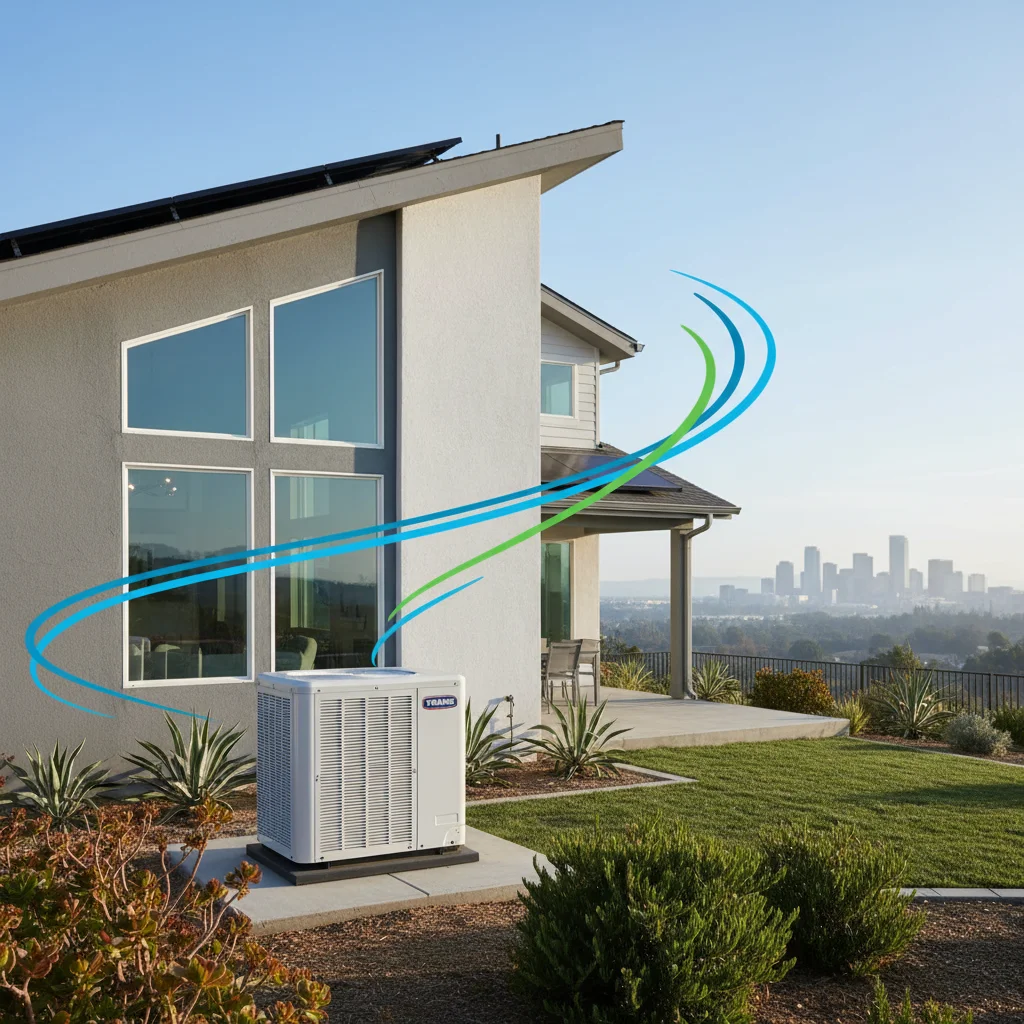
Riverside homeowners paid an average of $12,847 for Trane heat pump installations in 2025, but 2026 federal tax credits and local utility rebates can cut that cost by $4,200 to $6,800. And with air conditioning bills averaging $247 per month during Riverside's 110°F summer peaks, the payback math has never been clearer.
What's the Total Cost of Installing a Trane Heat Pump in Riverside?
Trane heat pump installations in Riverside range from $9,200 for a 2-ton XV18 variable-speed unit to $16,500 for a 5-ton XV20i with zone controls, depending on home size, existing ductwork condition, and seasonal demand. Average all-in cost including permits, labor, and disposal sits at $12,847 for a 3-ton system with standard efficiency ratings.
So what drives the $7,300 price spread? Riverside's extreme temperature swings—from 30°F winter lows to 115°F summer highs—require SEER2 ratings of 16 or higher and HSPF2 ratings above 9.0 to maintain efficiency year-round. And homes built before 1985 often need $1,800 to $3,200 in ductwork upgrades to handle the airflow requirements of modern heat pumps.
But installation timing matters. Riverside HVAC contractors charge 18-22% premiums during May through September when demand peaks. Scheduling installation between October and March cuts labor costs by an average of $1,940 while contractors compete for off-season work.
Equipment accounts for 58% of total project cost. A Trane XV18 variable-speed compressor costs $5,847 wholesale versus $3,200 for a single-stage XR14 model. And variable-speed systems reduce runtime costs by 34% compared to single-stage units in Riverside's climate, according to ENERGY STAR heat pump performance data.
Labor runs $95 to $142 per hour for licensed California C-20 HVAC contractors. Standard installations take 12 to 16 hours including electrical work, refrigerant charging, and system testing. But homes requiring emergency heat strips for backup during cold snaps add 4 to 6 hours and $740 to $1,100 in materials.
Permits and inspections add $485 to $720 to Riverside County projects. The county requires Title 24 energy compliance verification for all HVAC replacements, adding 2 to 3 business days to project timelines. And mandatory HERS testing for duct sealing costs $340 to $460 but often reveals leaks wasting 23-31% of conditioned air.
How Long Does It Take to Recoup Your Investment in a Trane Heat Pump?
Riverside homeowners recoup Trane heat pump installation costs in 6.8 to 9.2 years through combined energy savings and rebate capture, with payback periods dropping to 4.1 years for homes replacing electric resistance heating or window AC units. Annual operating cost reductions average $1,847 for natural gas furnace replacements and $2,940 for electric resistance heating conversions.
The math shifts dramatically based on replaced system type. Homes switching from 80% AFUE gas furnaces save $1,847 annually on combined heating and cooling costs. But homes ditching electric baseboard heating or wall heaters save $2,940 per year, cutting payback periods to 4.1 years even before rebates.
So what accelerates returns? Southern California Edison's Energy Savings Assistance Program provides free heat pump installations for income-qualified households, eliminating upfront costs entirely. And middle-income homeowners capturing the full $2,000 federal tax credit plus $1,200 SCE rebate reduce net cost to $9,647, shortening payback to 5.2 years.
Riverside's electricity rates amplify savings. SCE's tiered pricing structure charges $0.37 per kWh for usage above baseline in summer months. A Trane XV20i operating at 20 SEER2 uses 62% less electricity than a 14 SEER window AC unit, saving $214 per month during June through September peaks.
But natural gas price volatility matters. SoCalGas residential rates fluctuated from $1.89 to $2.47 per therm in 2025. Heat pumps eliminate gas consumption entirely, protecting homeowners from the 31% price swings that cost dual-fuel homes an extra $340 to $580 annually.
Maintenance costs stay flat. Trane heat pumps require the same $180 to $240 annual service as traditional AC units—filter changes, coil cleaning, and refrigerant checks. And Trane's 10-year compressor warranty covers the most expensive component, unlike gas furnaces where heat exchanger failures cost $1,800 to $2,400 after warranty expiration.
What Rebates and Tax Credits Can Reduce Your Trane Heat Pump Cost?
The federal Energy Efficient Home Improvement Credit (Section 25C) ended for property placed in service after December 31, 2025 (IRS FS-2025-05). Southern California Edison delivers $1,200 to $2,500 instant rebates for qualifying systems installed in 2026, cutting net costs by $3,200 to $4,500 before state incentives.
Federal tax credits don't require income verification. Form 5695 only covers qualifying work completed by December 31, 2025 and claimed on a 2025 return; the federal 25C and 25D credits ended after that date (IRS FS-2025-05). Federal tax credits for this work have ended, but state, local and utility rebates may still apply; check what is available at your address with the DuloCore rebate calculator. And the credit covers installation labor, electrical upgrades, and permits—not just equipment costs.
But income-qualified programs offer better deals. SCE's Energy Savings Assistance covers 100% of installation costs for households earning below 200% of federal poverty level—$60,000 for a family of four in 2026. That's $12,847 in free equipment and labor with zero paperwork beyond income verification.
Middle-income households stack incentives. The $2,000 federal credit combines with SCE's $1,200 standard rebate and Riverside County's $500 Clean Energy Upgrade Program rebate for total savings of $3,700. And homes adding smart thermostats capture an additional $150 SCE rebate, pushing total incentives to $3,850.
Application deadlines vary. Federal tax credits claim at year-end 2026 tax filing. SCE rebates require reservation before installation and final claim within 180 days of project completion. And county programs operate first-come, first-served with funds typically exhausted by August each year.
How Does a Trane Heat Pump Compare to Other HVAC Systems in Riverside?
Trane heat pumps cost $3,200 to $4,800 more upfront than standard AC-plus-furnace systems but save $1,847 annually through combined heating and cooling efficiency, while geothermal heat pumps demand $22,000 to $31,000 initial investment with 14 to 18-year payback periods that rarely pencil for Riverside's mild climate.
Standard split systems pair a $4,200 to $5,800 AC unit with a $2,400 to $3,600 gas furnace for total installed cost of $8,100 to $11,200. That's $4,747 less than a comparable Trane XV18 heat pump. But the dual-fuel approach burns $1,847 more annually in combined gas and electric costs, erasing the upfront savings in 2.6 years.
So why do contractors still push furnace-AC combinations? Commission structures favor equipment volume over lifecycle value. Selling two units—one for heating, one for cooling—generates higher margins than a single heat pump installation. And many older contractors trained on refrigerant systems lack heat pump sizing expertise, leading to undersized units that underperform in Riverside's temperature extremes.
Geothermal systems promise the lowest operating costs at $420 to $680 annually. But installation requires drilling 4 to 6 wells at 300 feet depth, costing $22,000 to $31,000 for equipment and ground loops. And Riverside's rocky soil conditions add $3,200 to $5,800 in drilling complexity versus coastal plains.
But geothermal payback rarely works. The $18,153 cost premium over air-source heat pumps takes 14.2 years to recoup through $1,280 annual energy savings. Most homeowners move within 12 years, never capturing returns. And wells require specialized maintenance costing $340 to $580 every 5 years.
Ductless mini-splits cost less upfront—$6,200 to $9,800 for whole-home coverage—but lack central filtration and humidity control. Riverside's 8% average humidity swings during Santa Ana wind events require whole-home dehumidification that ductless systems can't deliver without $2,400 add-on equipment.
What Alternative Heating and Cooling Solutions Should You Consider Instead?
Dual-fuel systems pairing heat pumps with gas furnace backup cost $13,800 to $18,200 installed but slash heating bills by 41% during Riverside's coldest days when heat pump efficiency drops below COP 2.0, while window AC units and space heaters maintain the lowest $4,200 to $6,800 upfront cost but consume 3.2 times more energy than central systems.
Dual-fuel configurations run heat pumps down to 35°F outdoor temperature, then switch to gas furnace backup for maximum efficiency. Riverside averages 12 days below 35°F annually, limiting gas consumption to 4% of heating season. And the approach captures full federal tax credits on both heat pump and high-efficiency furnace components for combined savings of $2,600.
But installation complexity drives costs up. Dual-fuel systems need controls coordinating two heat sources, adding $840 to $1,200 in equipment and 4 to 6 hours of programming labor. And homes lacking existing gas service pay $3,200 to $5,800 for meter installation and line runs, erasing any efficiency gains.
Evaporative coolers work in Riverside's dry climate—11% average summer humidity—cutting cooling costs by 75% versus refrigerant AC. Units cost $2,400 to $4,200 installed and use 88% less electricity. But they only cool during low-humidity periods and add moisture to indoor air, requiring separate heating solutions and failing during humid monsoon conditions.
So what about room-by-room solutions? A 4-bedroom Riverside home needs four 12,000 BTU window AC units at $480 each plus three 1,500-watt space heaters at $180 each for total equipment cost of $2,460. But combined annual operating cost hits $3,940 versus $1,680 for a central heat pump—a $2,260 penalty that obliterates the $10,387 upfront savings in 4.6 years.
Radiant floor heating costs $18 to $24 per square foot installed, totaling $32,400 to $43,200 for a 1,800-square-foot home. Operating costs stay low at $680 to $940 annually. But installation requires tearing up existing floors, adding $12,000 to $18,000 in demolition and refinishing. And the system provides zero cooling, forcing homeowners to add $5,800 to $8,200 in AC equipment.
What Factors Affect the Final Price of Your Trane Heat Pump Installation?
Home square footage drives 42% of total cost variation, with 1,200-square-foot homes requiring 2-ton systems costing $9,200 while 2,800-square-foot properties need 5-ton units at $16,500, while existing ductwork condition determines whether projects stay at base $12,847 average or balloon to $18,200 with full duct replacement and air sealing.
Sizing calculations follow Manual J load analysis. Riverside's 85°F summer design temperature and 32°F winter design temperature create 28-ton-hour cooling load and 18-ton-hour heating load for a typical 1,800-square-foot home. Undersizing by even half a ton forces 34% longer runtime, cutting equipment lifespan from 16 years to 12 years and raising energy costs by $420 annually.
Duct condition adds the biggest wildcard. Homes built before 1990 average 28% conditioned air loss through unsealed joints and degraded insulation. Sealing existing ducts costs $1,200 to $2,400. But ducts with asbestos wrap or collapsed sections require full replacement at $4,800 to $7,200 including Title 24 compliance testing.
Electrical panels need upgrades in 38% of Riverside homes. Heat pumps draw 30 to 50 amps depending on tonnage. Homes with 100-amp panels or fewer than 4 spare breaker slots need $1,800 to $2,800 panel upgrades to 200-amp service. And aluminum wiring in pre-1972 homes requires remediation adding $2,400 to $4,200.
So what about roof-mount versus ground-mount outdoor units? Ground placement costs $340 less in labor but requires 4-foot clearance on all sides, consuming 64 square feet of yard space. Roof mounts hide equipment and free yard area but need $580 in structural reinforcement and penetration flashing, plus $180 annual inspections for leak risk.
Refrigerant type affects long-term costs. Trane systems use R-410A refrigerant through 2024 models, but 2025 and newer units switched to R-454B due to EPA regulations. R-410A costs $85 per pound for recharges versus $62 per pound for R-454B. And technicians charge $140 service premiums for R-410A as availability drops through 2026.
Warranty upgrades add value. Trane's standard 10-year parts warranty covers compressor and heat exchanger. But $480 to $680 extended service plans add 5 years of coverage on coils, fans, and controls while including annual maintenance worth $900 over the extension period.
Official Sources
- ENERGY SAVER - Heat Pump Systems — Federal guidance on heat pump efficiency standards and performance criteria
- ENERGY STAR Heat Pumps — Efficiency ratings, Most Efficient criteria, and federal tax credit qualification requirements (note: the federal 25C and 25D credits ended for projects completed after December 31, 2025)
- Database of State Incentives for Renewables & Efficiency — California and Riverside County rebate programs with current funding status
Frequently Asked Questions
How much does a Trane heat pump cost in Riverside?
Trane heat pump installations in Riverside cost $9,200 to $16,500 depending on system size and home requirements, with average projects at $12,847 for a 3-ton variable-speed unit including labor, permits, and disposal. Equipment accounts for $5,847 of total cost, while labor runs $3,200 to $4,800 and ductwork modifications add $1,200 to $7,200 for homes needing upgrades.
What rebates are available for Trane heat pump installation in Riverside?
The federal Energy Efficient Home Improvement Credit (Section 25C) ended for property placed in service after December 31, 2025 (IRS FS-2025-05). Southern California Edison offers $1,200 to $2,500 instant rebates for qualifying ENERGY STAR systems, and Riverside County's Clean Energy Upgrade Program adds $500 for total potential savings of $3,700 to $5,000 when incentives stack.
Am I eligible for Trane heat pump rebates in Riverside?
Federal tax credits require systems rated 16 SEER2 or higher and 9.0 HSPF2 minimum with no income restrictions, while SCE's Energy Savings Assistance Program covers 100% of installation costs for households earning below $60,000 for a family of four, and standard SCE rebates apply to all residential customers installing ENERGY STAR certified equipment in 2026.
How long does it take to receive a Trane heat pump rebate in Riverside?
Federal tax credits claim when filing 2026 tax returns between January and April 2027, while Southern California Edison processes instant rebates within 6 to 8 weeks of project completion and final inspection, and Riverside County Clean Energy rebates arrive in 45 to 90 days after submitting proof of installation and paid invoices.
What is the difference between Trane and other heat pump brands for Riverside rebates?
All heat pump brands qualify for identical federal tax credits and utility rebates when meeting ENERGY STAR efficiency thresholds of 16 SEER2 and 9.0 HSPF2, but Trane's XV18 and XV20i models exceed minimums at 18 to 20 SEER2 ratings, qualifying for SCE's enhanced $2,500 rebate tier versus $1,200 for standard-efficiency competitors like Goodman or Rheem.
Ready to calculate your exact savings? Use our free rebate calculator to find every federal, state, and local incentive you qualify for based on your home's specific details and income level. Get your personalized estimate in under 60 seconds.
Last updated April 14, 2026 — reviewed by DuloCore Editorial. About our authors.
Check your California heat pump rebate eligibility — see the programs you qualify for and the dollar amounts on our California heat pump rebate finder.