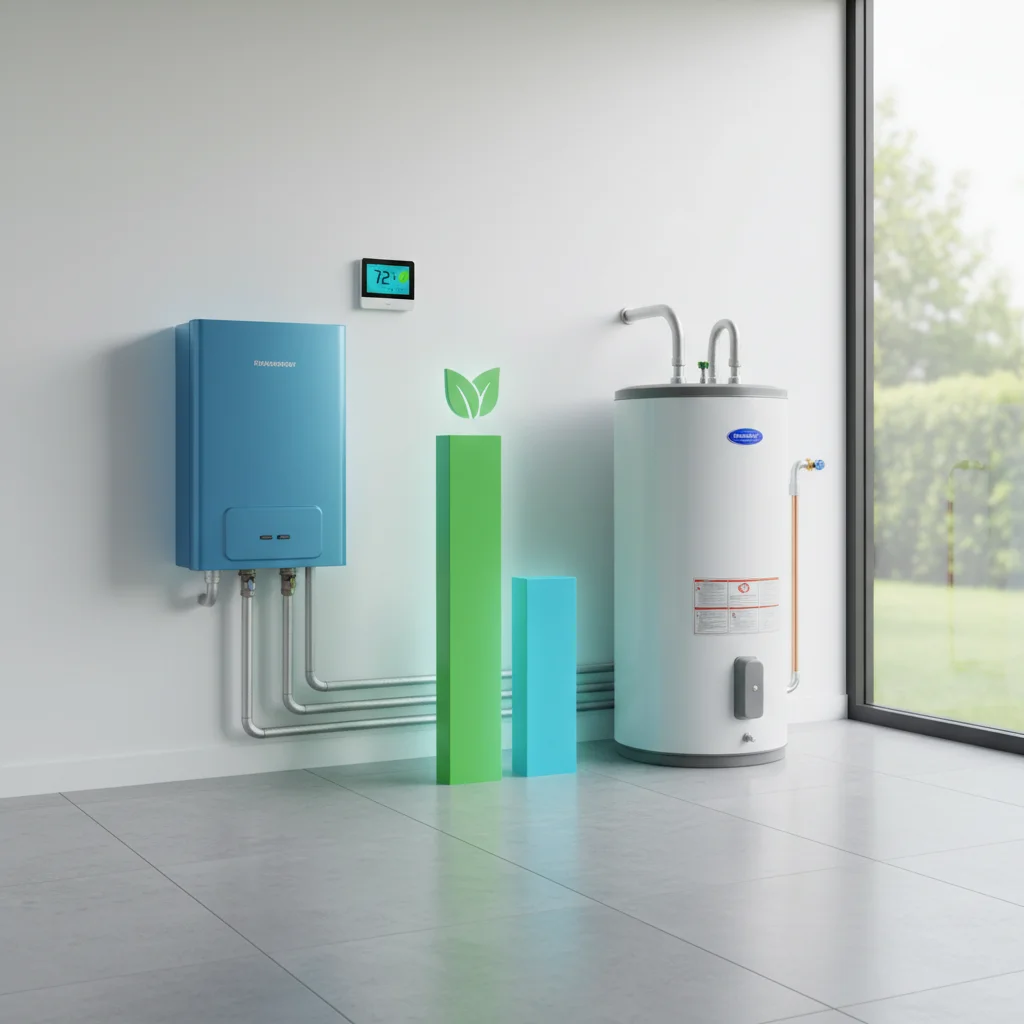
Water heating accounts for 18-20% of a typical California home's energy bill—around $400-$600 annually—making it the second-largest energy expense after heating and cooling. And with federal tax credits covering up to 30% of installation costs for high-efficiency models through 2032, the price gap between standard and premium units has narrowed to just 3-5 years of payback for most homeowners.
How Much Can You Save With a High-Efficiency Water Heater?
Heat pump water heaters deliver annual savings of $330-$550 compared to electric resistance models in California climate zones, while tankless gas units save $70-$150 over conventional storage tanks. Energy factor ratings range from 0.90 for standard tanks to 3.5+ for heat pump models, translating to 60-70% lower operating costs. And homeowners in PG&E territory see the highest returns due to electricity rates averaging $0.32-$0.38 per kWh in 2026.
High-efficiency models cost $1,200-$3,500 installed versus $800-$1,500 for standard tanks. But the IRA federal tax credit covers 30% of equipment and installation costs up to $2,000 for heat pump water heaters, plus California utility rebates add $200-$500. So the true net cost difference drops to $500-$1,200 for most upgrades.
The stakes matter because water heaters last 10-15 years, locking in energy costs for over a decade. Homeowners choosing a $900 standard electric tank over a $2,400 heat pump model forfeit $4,000-$6,500 in lifetime savings after accounting for the federal energy tax credits and lower operating costs. And with California's 2030 carbon neutrality goals driving electricity rate increases of 4-6% annually, efficiency gaps widen each year.
What's the ROI and Payback Period for Different Water Heater Types?
| Water Heater Type | Installed Cost | Annual Savings vs. Standard | Simple Payback | 12-Year Net Savings |
|---|---|---|---|---|
| Heat Pump (Electric) | $2,400-$3,500 | $330-$550 | 3-5 years | $2,000-$4,400 |
| Tankless Gas | $2,500-$4,500 | $70-$150 | 8-12 years | $-600-$600 |
| High-Efficiency Tank Gas | $1,200-$2,000 | $40-$80 | 5-8 years | $-120-$360 |
| Solar Water Heater | $4,500-$8,000 | $400-$600 | 6-10 years | $800-$3,200 |
| Standard Electric Tank | $800-$1,500 | Baseline | N/A | Baseline |
Heat pump water heaters deliver the fastest payback at 3-5 years in California due to high electricity rates and robust rebate programs. So a $2,800 installed heat pump receiving a $600 federal credit and $300 utility rebate costs $1,900 net, paying back in 3.8 years against $500 annual savings.
Tankless gas models struggle with ROI in California's mild climate—annual savings of $70-$150 don't offset the $2,500-$4,500 installation premium over 8-12 years. But households with 5+ occupants see better returns due to unlimited hot water capacity eliminating recovery time losses. And natural gas rates in SoCalGas territory ($1.80-$2.20 per therm in 2026) favor gas efficiency over electric resistance, though not over heat pump technology.
"ENERGY STAR certified heat pump water heaters use up to 70% less energy than standard electric resistance models, saving a family of four approximately $3,500 over the unit's lifetime." — ENERGY STAR Water Heaters
How Long Do Energy-Efficient Water Heaters Last Compared to Standard Models?
Heat pump water heaters last 12-15 years with proper maintenance, matching or exceeding standard electric tanks at 10-13 years. Tankless gas models deliver 15-20 years due to no storage tank corrosion, while solar systems last 15-20 years for collectors and 10-15 years for storage tanks. And condensing tank gas heaters last 10-13 years, identical to non-condensing models.
Lifespan differences stem from component complexity and operating conditions. Heat pump units add compressor and fan components but eliminate high-temperature heating elements that fail in standard tanks. So failure modes shift from element burnout to refrigerant leaks or compressor wear, typically occurring after 10-12 years. But annual anode rod inspection and replacement extends tank life by 3-5 years across all storage models.
California's soft water in coastal regions (under 60 mg/L hardness) reduces scale buildup extending life 2-3 years versus Central Valley areas (180-240 mg/L hardness). And homes with whole-house water softeners see 15-20% longer water heater lifespans regardless of type. So location and water treatment affect durability more than efficiency tier.
Which Water Heater Has the Best Lifespan-to-Cost Ratio?
Tankless gas water heaters deliver the lowest cost per year of service at $125-$225 annually over 18-year average lifespans, beating heat pump models at $160-$233 per year. But heat pump units win on total cost of ownership when including energy costs—$5,200-$7,400 total versus $8,800-$11,200 for tankless gas over 12 years.
Standard electric tanks cost $62-$115 per year of lifespan but rack up $6,000-$7,200 in electricity over 12 years, totaling $7,500-$9,000 versus $5,800-$8,100 for heat pump alternatives. So the cheapest upfront option becomes the most expensive within 6-8 years.
Or consider solar water heaters at $225-$400 per year of lifespan but near-zero operating costs—total 15-year ownership runs $4,500-$6,000 in sunny inland California climates. And the federal tax credit covering 30% of the $5,000-$8,000 installation drops effective annual cost to $157-$280, competitive with heat pumps in high-sun areas.
"Solar water heaters in California can provide 60-80% of annual hot water needs, with higher percentages in southern regions and lower in coastal fog zones." — California Energy Commission Solar Water Heating
What's the Total Cost of Ownership Over a Water Heater's Lifetime?
Total cost of ownership combines purchase price, installation, energy costs, maintenance, and repairs over the unit's lifespan. Heat pump water heaters cost $5,800-$8,100 total over 12 years in California—$2,400-$3,500 installed minus $900-$1,100 in incentives, plus $4,000-$5,200 in electricity, plus $300-$500 maintenance. And that beats standard electric tanks at $7,500-$9,000 total and tankless gas at $8,800-$11,200.
Standard electric resistance tanks appear cheapest at $800-$1,500 upfront but consume $500-$600 annually in electricity at California's $0.32-$0.38 per kWh rates. So 12-year energy costs hit $6,000-$7,200, overwhelming the initial savings. But heat pump models use just $140-$180 annually, totaling $1,680-$2,160 over 12 years—a $4,300-$5,000 difference.
Maintenance costs favor simple tanks at $20-$40 annually for anode rod replacement and flushing versus $40-$80 for heat pump air filter changes and coil cleaning. Tankless gas units require $80-$150 annual descaling in hard water areas but just $40-$60 in coastal zones. And solar systems need $50-$100 annually for pump, controller, and glycol checks, plus potential $400-$800 collector replacements after 15 years.
Calculate your specific savings and available incentives with our free rebate calculator based on your zip code, utility, and household size.
How Do Federal Tax Credits and Rebates Affect Your Water Heater Investment?
The federal Energy Efficient Home Improvement Credit (Section 25C) ended for property placed in service after December 31, 2025 (IRS FS-2025-05). Federal tax credits for this work have ended, but state, local and utility rebates may still apply; check what is available at your address with the DuloCore rebate calculator. So a $3,000 heat pump installation qualifies for $900 federal credit, while a $1,800 condensing gas tank receives $540. And there's no income limit for the credit—all taxpayers qualify.
PG&E offers $200-$400 for heat pump water heaters in 2026, SCE provides $300-$500, and SoCalGas delivers $75-$200 for high-efficiency gas models. And Bay Area Clean Energy (MCEA) and Silicon Valley Clean Energy add $500-$750 for qualifying heat pump installations. So total incentives reach $1,100-$1,900 for heat pump upgrades in some service territories.
Or look at the economics for a typical upgrade: $2,800 heat pump installation minus $900 federal credit minus $400 utility rebate equals $1,500 net cost. That compares to $1,200 for a standard electric tank—just $300 difference. And the heat pump saves $450 annually, paying back the premium in 8 months while delivering $5,000+ in lifetime savings.
Check current water heater rebate availability in your area, as utility programs change annually and some operate on first-come, first-served budgets that exhaust by mid-year. And federal credits require tax liability—the credit is non-refundable, so homeowners need at least $900 in federal tax owed to capture the full heat pump credit.
Official Sources
- ENERGY STAR Water Heaters — Federal efficiency standards and certified product listings
- DOE Energy Saver Water Heating — Comprehensive water heater efficiency guidance and savings calculations
- Database of State Incentives for Renewables & Efficiency — Searchable database of federal, state, and utility rebate programs
Related Reading: Learn more about Furnace Efficiency Audit Guide and Home Energy Monitoring App Comparison.
Related Reading: Learn more about Air Conditioner Efficiency Testing and Furnace Efficiency Audit Guide.
Frequently Asked Questions
What is the most energy efficient water heater type?
Heat pump water heaters rank as the most efficient with energy factor (EF) ratings of 3.0-3.5, meaning they generate 3-3.5 units of heat for every unit of electricity consumed. That beats tankless gas models at 0.92-0.98 EF, condensing tank gas at 0.80-0.90 EF, solar at 1.5-2.5 EF, and standard electric tanks at 0.90-0.95 EF. And heat pump models earn ENERGY STAR certification when exceeding 3.0 EF.
How much money can you save by upgrading to an efficient water heater?
California homeowners save $330-$550 annually switching from standard electric to heat pump water heaters, or $70-$150 upgrading to tankless gas from conventional storage tanks. Total 12-year savings reach $4,000-$6,600 for heat pump upgrades after subtracting the higher purchase price and adding federal and utility incentives. And solar water heaters save $400-$600 annually in sunny inland areas versus electric resistance models.
Are tankless water heaters more efficient than traditional tank water heaters?
Tankless gas models achieve 0.92-0.98 energy factor versus 0.62-0.72 for standard gas storage tanks—a 30-40% efficiency improvement. But tankless units cost $2,500-$4,500 installed versus $1,200-$1,800 for conventional tanks, requiring 8-12 years to recoup the premium through $70-$150 annual savings in California. And heat pump tank models at 3.0+ EF beat both options while costing less than tankless installations.
What size water heater do I need for my home?
Households with 1-2 people need 30-40 gallon tanks or 5-7 GPM tankless capacity, 3-4 people require 40-50 gallons or 7-9 GPM, and 5+ people need 50-80 gallons or 9-11 GPM. Heat pump water heaters need 50-80 gallon tanks due to slower recovery rates of 12-25 gallons per hour versus 40-60 GPH for electric resistance. And tankless models size by simultaneous fixtures—2 showers plus dishwasher demands 9-11 GPM capacity.
Do efficient water heaters qualify for tax credits or rebates?
The federal Energy Efficient Home Improvement Credit (Section 25C) ended for property placed in service after December 31, 2025 (IRS FS-2025-05). California utilities offer $200-$500 rebates for heat pump installations and $75-$200 for condensing gas tanks in 2026. The federal home energy tax credits (Sections 25C and 25D) ended for projects completed after December 31, 2025 (IRS FS-2025-05). Stack federal and utility incentives for total savings of $1,100-$2,400 on qualifying installations.
Ready to find your water heater savings? Use our rebate calculator to see federal credits, utility rebates, and projected energy savings for your home. Get personalized recommendations based on your zip code, household size, and current utility rates—free in under 2 minutes.
Last updated: April 14, 2026. Reviewed by the DuloCore Editorial Team. About our authors.
Check your California water heater rebate eligibility — see the programs you qualify for and the dollar amounts on our California water heater rebate finder.