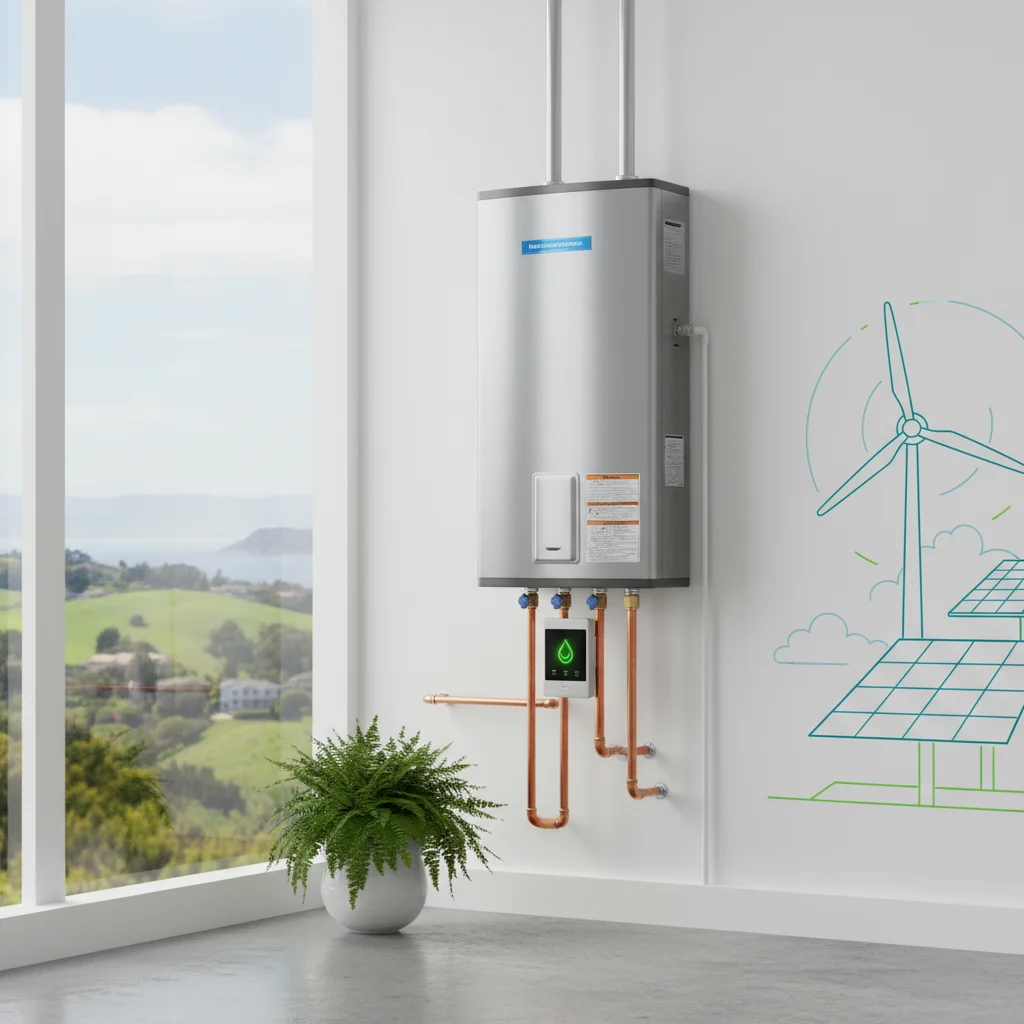
A Bay Area homeowner replacing a failed water heater in 2026 faces installation costs ranging from $1,800 to $6,500 depending on system type. But federal tax credits and utility rebates can slash that price by 30% to 50%, turning an emergency expense into a forced upgrade opportunity. The catch? Most homeowners miss these incentives because they don't know which rebates stack, which contractors qualify, or whether their home's electrical panel can even handle a heat pump water heater.
What's the Average Water Heater Installation Cost in the Bay Area for 2026?
Bay Area water heater installation costs in 2026 range from $1,800 for basic tank replacements to $6,500 for high-efficiency heat pump systems. Standard 40-50 gallon gas tank installations average $2,200-$3,500, while tankless gas units run $3,000-$5,000 installed. Heat pump water heaters cost $3,500-$6,500 but qualify for $2,000 federal tax credits plus $400-$2,000 utility rebates through PG&E and other providers.
And these prices include labor, permits, and basic modifications. But upgrading from gas to electric heat pump systems often requires electrical panel upgrades costing $1,500-$3,000 additional. So total project costs can reach $9,500 for a complete heat pump conversion with panel work.
The tension? Tank water heaters fail without warning, forcing rushed decisions. And contractors charge 15-30% premiums for emergency same-day installations when families need hot water immediately. So homeowners who wait until failure pay more than those who plan replacements proactively during the 8-12 year expected lifespan window.
Bay Area labor costs run 20-35% higher than California averages. A San Francisco installation costs $800-$1,200 more than the same work in Sacramento. But utility rebates are also more generous in PG&E territory, offsetting some of the Bay Area premium.
"Heat pump water heaters can save a household of four approximately $330 per year on electric bills compared to standard electric resistance water heaters" — U.S. Department of Energy
Permit costs add $150-$400 depending on municipality. San Francisco requires mechanical permits for all water heater work. Oakland and San Jose have similar requirements. And all installations must meet 2022 California Title 24 energy code standards.
How Long Until Your Water Heater Installation Pays for Itself in Energy Savings?
Heat pump water heaters in the Bay Area pay for themselves in 4-7 years through energy savings. A household using 50 gallons of hot water daily saves $330-$450 annually compared to conventional electric resistance tanks. With total installed costs of $3,500-$4,500 after rebates, payback periods average 5.2 years based on PG&E's 2026 electricity rates of $0.38-$0.42 per kWh.
Gas tankless water heaters save $100-$180 annually compared to tank gas heaters. But higher installation costs ($3,000-$5,000) extend payback to 12-16 years. So tankless systems make financial sense primarily for large families using 80+ gallons daily or homes needing space savings more than cost optimization.
Standard efficiency gas tank replacements ($1,800-$2,500 installed) offer minimal savings over existing tanks. Payback calculations don't apply because homeowners replace failed units rather than upgrade for efficiency. But choosing Energy Star models adds $200-$350 to costs while saving $35-$60 annually.
PG&E's tiered rate structure accelerates heat pump payback for high-usage households. Families in Tier 3-4 rates ($0.45-$0.52 per kWh) see 3-4 year payback periods. And future rate increases shorten payback further as California transitions to time-of-use pricing.
Climate Zone 3 (coastal Bay Area) offers ideal conditions for heat pump efficiency. Units maintain 300-350% efficiency year-round compared to 200-250% in hotter inland zones. So Daly City and Pacifica installations deliver faster payback than Concord or Livermore despite identical equipment costs.
Which Water Heater Type Works Best for Bay Area's Climate Zone?
Heat pump water heaters perform optimally in Bay Area Climate Zone 3, maintaining 300-350% energy efficiency in ambient temperatures of 50-75°F typical of coastal microclimates. These systems extract heat from surrounding air, so garage or basement installations in mild Bay Area weather avoid the cold-climate efficiency penalties seen in Chicago or Minneapolis. And coastal fog actually benefits performance by providing cool, moisture-rich air for heat exchange.
But Climate Zone 12 (inland valleys like Livermore and Concord) presents challenges. Summer temperatures exceeding 95°F reduce heat pump efficiency by 15-25% when ambient air approaches water target temperatures. So inland homeowners see smaller savings than coastal residents despite identical equipment.
Gas tankless systems work well across all Bay Area climate zones. Performance doesn't vary with outdoor temperature since combustion heat remains constant. But California's gas rates ($1.85-$2.20 per therm in 2026) and pending gas appliance phase-out policies make new gas installations risky 10-year investments.
"California will require all new residential construction to be all-electric starting in 2026, with existing home retrofit incentives accelerating the transition" — California Energy Commission
Traditional tank water heaters suit homes with incompatible electrical panels or insufficient space for heat pump installations. A 40-gallon tank needs 18 inches clearance while heat pump units require 1,000 cubic feet of air volume. So compact San Francisco utility closets often can't accommodate heat pump systems without major remodeling.
Seismic considerations matter for Bay Area installations. All water heaters require earthquake strapping per California code. But top-heavy heat pump units need reinforced strapping rated for 150-200 pounds versus 100-120 pounds for standard tanks.
How Do Tank, Tankless, and Heat Pump Water Heaters Compare in Cost and Performance?
Tank water heaters cost $1,800-$3,500 installed, store 40-75 gallons, and deliver 60-70 gallons of hot water per hour before depleting. Tankless systems cost $3,000-$5,000, provide endless hot water at 5-10 gallons per minute, but require upgraded gas lines or 150-200 amp electrical service. Heat pump models cost $3,500-$6,500 before rebates, use 60-70% less energy than tank heaters, but need 1,000+ cubic feet installation space.
And recovery time differs dramatically. Tank heaters take 45-60 minutes to reheat after depletion. Tankless units deliver instant continuous hot water. Heat pump systems recover in 2-3 hours, slower than tanks but rarely deplete because of larger 50-80 gallon capacities.
Operating costs separate the technologies. Heat pump water heaters cost $200-$300 annually to operate on Bay Area electricity rates. Gas tanks run $400-$550 yearly. Electric resistance tanks cost $650-$800 annually. So heat pump systems save $100-$500 per year depending on replacement type.
Installation complexity varies. Tank-for-tank replacements take 2-4 hours. Tankless installations require 4-6 hours plus gas line or electrical upgrades. Heat pump conversions need 5-8 hours including electrical work, condensate drains, and air flow modifications.
Maintenance requirements also differ. Tank heaters need annual flushing to prevent sediment buildup. Tankless systems require descaling every 1-2 years in Bay Area's moderate hardness water. Heat pump units need air filter cleaning quarterly and anode rod replacement every 3-5 years.
Use our free rebate calculator to compare total costs including available incentives for your specific installation type.
How Long Will Your New Water Heater Last, and What Affects Its Lifespan?
Heat pump water heaters last 10-15 years in Bay Area conditions, matching standard electric tank lifespans but exceeding gas tank durability of 8-12 years. Tankless systems last 15-20 years, justifying higher upfront costs for homeowners planning long-term ownership. But actual lifespan depends on water quality, maintenance frequency, and usage patterns rather than rated life alone.
Bay Area water hardness averages 5-12 grains per gallon, moderate compared to Central Valley's 15-25 grains. So sediment buildup occurs more slowly, extending tank life by 2-3 years versus harder water regions. But San Francisco's chloramine water treatment accelerates anode rod corrosion, requiring replacement every 3-4 years instead of 5-6 years for homes on different water systems.
Temperature settings affect longevity. Units maintained at 120°F last 25-40% longer than those set to 140°F. Higher temperatures accelerate mineral precipitation and component wear. And California's 2022 energy code limits residential water heater temperatures to 120°F maximum, aligning code compliance with extended equipment life.
Usage intensity matters more than household size. A family of four using 40-50 gallons daily sees longer equipment life than two people using 80+ gallons through multiple showers and appliance loads. Heat pump compressors rated for 15-20,000 operating hours fail sooner under continuous high-demand cycling.
Professional installation adds 3-5 years compared to DIY work. Proper anode rod installation, expansion tank sizing, and pressure relief valve placement prevent early failures. And permitted work ensures code-compliant installations that avoid corrosion from improper venting or condensate drainage.
Are You Eligible for Bay Area Rebates and Tax Credits on Water Heater Installation?
Bay Area homeowners qualify for $2,000-$4,400 in combined federal tax credits and utility rebates on heat pump water heater installations in 2026. The federal Inflation Reduction Act provides 30% tax credit (this federal credit ended for property placed in service after December 31, 2025)s up to $2,000 for qualifying Energy Star heat pump units. PG&E offers $400-$1,000 instant rebates, while BayREN provides additional $750-$1,500 rebates for moderate-income households earning 80-120% of area median income.
And income-qualified programs deliver even larger incentives. Households at or below 80% AMI ($106,000 for a family of four in San Francisco) qualify for up to $8,000 federal tax credits covering 100% of installation costs. Combined with utility rebates, low-income homeowners can install heat pump water heaters at zero net cost.
Eligibility requires professional installation by licensed contractors. DIY installations don't qualify for federal credits. And rebates require Energy Star certification—not all heat pump models meet the 3.75+ Uniform Energy Factor threshold. Rheem, AO Smith, and Bradford White manufacture qualifying models widely available in Bay Area markets.
Federal tax credits apply to tax year 2026 returns filed in 2027. Form 5695 only covers qualifying work completed by December 31, 2025 and claimed on a 2025 return; the federal 25C and 25D credits ended after that date (IRS FS-2025-05). Federal tax credits for this work have ended, but state, local and utility rebates may still apply; check what is available at your address with the DuloCore rebate calculator. And credits are nonrefundable, reducing tax liability but not generating refunds beyond taxes owed. So homeowners with minimal tax liability benefit more from upfront utility rebates than year-delayed tax credits.
PG&E rebates apply at purchase through participating contractors. Bay Area homeowners don't submit applications—contractors process rebates directly, reducing invoice amounts immediately. But inventory availability affects timing since rebate-eligible models often have 2-4 week lead times.
Learn more about available water heater rebates and how to maximize your savings across federal and local programs.
Official Sources
- U.S. Department of Energy - Energy Saver — Federal guidance on water heater efficiency, savings calculations, and rebate programs
- DSIRE USA — Comprehensive database of state and utility energy efficiency incentives including California rebate programs
- California Energy Commission — State energy policies, building codes, and appliance standards affecting water heater installations
Related Reading: Learn more about Water Heater Rebates Bay Area.
Frequently Asked Questions
How much does water heater installation cost in the Bay Area?
Bay Area water heater installation costs range from $1,800 for standard 40-gallon gas tank replacements to $6,500 for heat pump systems before rebates. Labor costs run $800-$1,500, permits add $150-$400, and materials account for the remainder. Heat pump installations requiring electrical panel upgrades can reach $9,500 total. But federal tax credits of up to $2,000 and utility rebates of $400-$2,500 reduce net costs significantly for qualifying homeowners.
What rebates are available for water heater installation in California?
California homeowners qualify for PG&E rebates of $400-$1,000 on Energy Star heat pump water heaters, BayREN rebates of $750-$1,500 for moderate-income households, and federal tax credits of 30% up to $2,000 through the Inflation Reduction Act in 2026. Income-qualified homeowners earning below 80% area median income qualify for up to $8,000 federal tax credits covering full installation costs. And some municipal utilities offer additional local incentives stacking with state and federal programs.
Do I qualify for a water heater rebate in the Bay Area?
Bay Area homeowners qualify for PG&E rebates by installing Energy Star certified heat pump water heaters through licensed contractors. No income limits apply for standard $400-$1,000 utility rebates. BayREN rebates require household income between 80-120% area median income ($106,000-$159,000 for a family of four in 2026). And all programs require professional installation of qualifying equipment models.
How long does it take to get a water heater installation rebate?
PG&E rebates process instantly at purchase through participating contractors. Homeowners see reduced invoice amounts the day of installation. BayREN rebates take 4-6 weeks from application submission to payment. Federal tax credits apply when filing tax returns, so 2026 installations generate credits claimed on 2027 tax returns filed by April 15, 2027. And some municipal utility rebates require 6-8 week processing after submitting proof of purchase and installation permits.
What's the difference between tankless and traditional water heater installation costs?
Traditional tank water heater installations cost $1,800-$3,500 for straightforward replacements requiring 2-4 hours labor. Tankless installations cost $3,000-$5,000 because they require gas line upgrades to 3/4-inch diameter, electrical service for ignition systems, and venting modifications adding 4-6 hours labor. Tankless units also need annual descaling maintenance costing $150-$200 while tanks only require anode rod replacement every 3-5 years. But tankless systems last 15-20 years versus 8-12 years for tanks, offsetting higher upfront costs.
Ready to find out how much you can save? Calculate your personalized rebate amount and compare water heater costs with our free rebate calculator. Get instant estimates for your specific situation including federal tax credits, utility rebates, and total installed costs.
Updated: April 14, 2026 — fact-checked by DuloCore Research. About our editorial process.
Check your California water heater rebate eligibility — see the programs you qualify for and the dollar amounts on our California water heater rebate finder.