Water Heater Rebates

Water Heater Sizing Guide

person Ivo Dachev
calendar_today
Updated Apr 20, 2026

Water Heater Sizing Guide: everything you need to know about eligibility, amounts, and the application process.

Quick Answer: Climate zone determines water heater sizing requirements because incoming groundwater temperatures vary by 30-50°F between regions. A 50-gallon tank in Miami heats 78°F groundwater to 120°F (42°F rise), while the same unit in Minneapolis heats 37°F water (83°F rise), reducing effective capacity by 35%. Homeowners in cold climates need 10-15 additional gallons of rated capacity to match warm-climate performance.
Water Heater Sizing Guide

A water heater 10 gallons too small forces families to schedule showers, while a unit 20 gallons too large wastes $150-$300 per year in standby heat loss. The difference between a 40-gallon and 50-gallon tank—$45 in annual operating costs—compounds to $900 over the unit's 20-year life. And most homeowners choose size based solely on what the previous owner installed, not what their household actually needs.

What Size Water Heater Do I Need for My Climate Zone?

Climate zone determines water heater sizing requirements because incoming groundwater temperatures vary by 30-50°F between regions. A 50-gallon tank in Miami heats 78°F groundwater to 120°F (42°F rise), while the same unit in Minneapolis heats 37°F water (83°F rise), reducing effective capacity by 35%. Homeowners in cold climates need 10-15 additional gallons of rated capacity to match warm-climate performance.

Climate zones 1-2 (Southern California, Florida, Hawaii) operate with groundwater temperatures of 70-78°F year-round. A family of four in these zones uses a 40-gallon tank efficiently, with recovery rates of 40-45 gallons per hour for gas models. But climate zones 6-7 (Northern Plains, Rocky Mountains, Alaska) face winter groundwater temperatures as low as 37°F, requiring 50-55 gallon tanks for the same family size. The Department of Energy maps show groundwater temperature variations from 42°F in Maine to 77°F in southern Florida, creating a 35°F spread that directly impacts sizing calculations.

"Incoming water temperature affects recovery time and energy consumption more than any other single factor in water heater performance." — U.S. Department of Energy

California homeowners see groundwater temperatures between 52°F (Northern California) and 72°F (Southern California), a 20°F range that changes sizing recommendations by 8-12 gallons. And the state's Title 24 energy code now requires water heaters to meet Uniform Energy Factor (UEF) ratings of 0.64 or higher for gas units and 2.0 or higher for heat pump models, pushing many homeowners toward tankless or heat pump alternatives that eliminate the sizing guesswork.

Heat pump water heaters sized for climate zones 3-4 deliver 50-60 gallons of hot water with a 50-gallon tank, matching the output of a 65-gallon conventional electric tank. So homeowners in moderate climates gain 25% more capacity per gallon of storage when switching to heat pump technology, which now qualifies for federal tax credits up to $2,000 under the energy tax credits framework continuing through 2032.

How Does My Home's Square Footage and Occupancy Affect Water Heater Sizing?

Square footage correlates weakly with water heater sizing compared to occupancy and fixture count, which drive 80-90% of hot water demand. A 1,200-square-foot home with 4 occupants uses 60-80 gallons daily, while a 3,000-square-foot home with 2 occupants uses 40-50 gallons. The first-hour rating (FHR)—gallons delivered in the first hour of peak demand—matters more than tank size, with FHR requirements calculated as number of bedrooms plus 1, multiplied by 12 gallons.

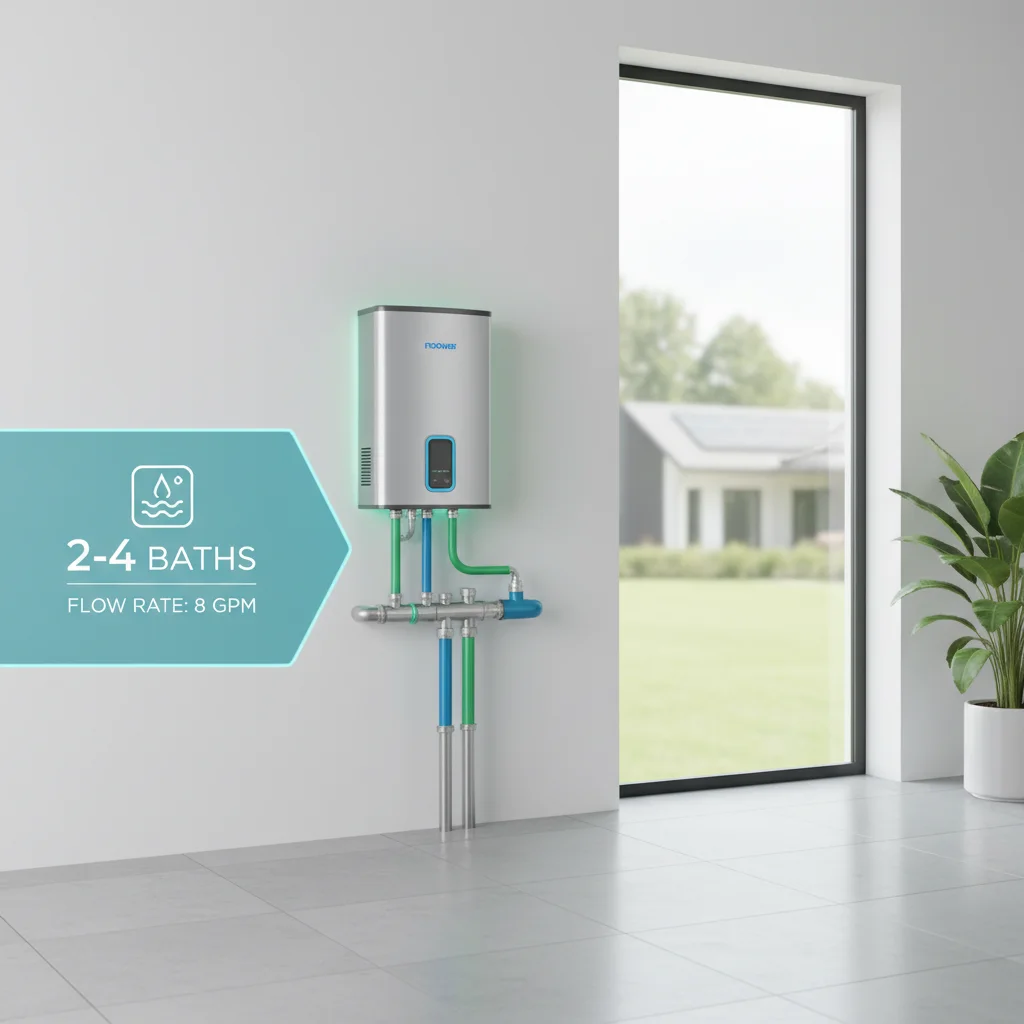
A 3-bedroom home calculates FHR as (3+1) × 12 = 48 gallons, meaning the water heater must deliver 48 gallons in the first hour of peak morning use. A 40-gallon gas tank with a 38-gallon FHR fails this test, while a 50-gallon tank with 67-gallon FHR exceeds it by 40%. But a tankless unit sized at 8-10 gallons per minute (GPM) delivers unlimited hot water at 3-4 simultaneous fixtures, eliminating FHR calculations entirely.

Occupancy drives sizing more directly: 1-2 people use 30-40 gallons daily, 3-4 people use 50-60 gallons, and 5-6 people use 70-80 gallons. And homes with 3+ bathrooms add 15-20 gallons to baseline requirements because simultaneous shower use creates demand spikes that exceed average daily consumption by 200-300%. A family of 4 with 2.5 bathrooms needs 60-70 gallon capacity during peak morning hours, even if daily average is 55 gallons.

Square footage impacts sizing indirectly through plumbing run lengths, which increase heat loss in larger homes. A water heater 60 feet from the master bathroom loses 2-3°F per 10 feet of uninsulated pipe, requiring 5-10°F higher tank temperature to maintain 120°F delivery. So larger homes benefit from point-of-use tankless heaters at distant fixtures, reducing trunk line losses by 40-60% and eliminating the 1-2 minute wait for hot water that wastes 2-3 gallons per shower.

Water Heater Types Compared: Which Alternative Fits Your Home Best?

Tankless water heaters deliver 6-12 GPM continuously but require 0.5-0.75-inch gas lines and 150,000-199,000 BTU burners, forcing 30-40% of homes to upgrade gas service at $1,200-$2,500. Heat pump water heaters store 50-80 gallons and operate at 300% efficiency (3.0 COP) but need 700-1,000 cubic feet of ambient air and 7-foot ceilings, eliminating closet installations. Conventional storage tanks cost $400-$1,200 installed but waste 10-20% of energy to standby losses, adding $80-$150 annually to operating costs.

Gas tankless units sized for whole-home use cost $1,800-$3,500 installed and save 20-30% on water heating bills, paying back in 8-12 years for families using 60+ gallons daily. But homes with 0.5-inch gas lines and 100,000 BTU furnaces hit supply limits, capping tankless units at 6-7 GPM—enough for 2 simultaneous showers but insufficient for 3+ fixtures. And cold-climate performance drops 30-40% when incoming water reaches 37-42°F, reducing effective capacity from 8 GPM to 5-6 GPM.

"Heat pump water heaters use up to 63% less energy than conventional electric models and qualify for a $2,000 federal tax credit through 2032." — ENERGY STAR

Heat pump water heaters cost $1,200-$2,500 installed and cut electric water heating costs by 50-60%, saving $250-$400 annually for families replacing standard electric tanks. The technology extracts heat from basement or garage air, delivering 2.0-3.5 kWh of heat per 1.0 kWh of electricity consumed. But cold ambient air below 45°F reduces efficiency by 20-30%, and the units generate noise at 49-55 decibels—comparable to a refrigerator—making bedroom-adjacent installations impractical. Use the rebate calculator to find available incentives for heat pump water heater upgrades in your area.

Conventional storage tanks remain the lowest upfront cost at $800-$1,600 installed for 40-50 gallon gas models, but 12-year lifecycle costs exceed tankless and heat pump alternatives by $1,200-$2,400 due to standby losses and lower efficiency. Gas tanks operate at 0.60-0.64 UEF, while condensing gas tanks reach 0.80-0.96 UEF by capturing flue heat, adding $400-$800 to purchase price but saving $60-$120 annually.

How Long Will My Water Heater Last, and When Should I Replace It?

Gas storage water heaters last 8-12 years on average, while electric models reach 10-15 years before tank corrosion causes leaks. Tankless units operate 20-25 years with biennial descaling in hard water areas, and heat pump water heaters last 12-15 years with compressor replacement at year 10-12 adding $600-$1,000. And anode rod replacement every 3-5 years extends tank life by 40-60%, costing $20-$40 in parts but requiring drain-and-refill labor adding $150-$200 for professional service.

The serial number reveals manufacturing date: a code like "0823" indicates August 2023, making a 2015-era tank 11 years old and due for replacement within 1-2 years. Signs of imminent failure include rust-colored water (corroded anode rod or tank lining), rumbling noises (sediment buildup), and puddles at the base (tank micro-leaks). But catastrophic failures—50-gallon floods damaging flooring and drywall at $3,000-$8,000—occur in 14-18% of tanks older than 11 years, making proactive replacement at year 10-11 the cost-effective choice.

Water hardness accelerates tank corrosion, reducing lifespan by 2-4 years in areas exceeding 10 grains per gallon (GPG). California's Central Valley sees 12-18 GPG, while coastal areas measure 3-7 GPG, creating a 5-year lifespan difference between regions 50 miles apart. And tankless units require annual descaling with vinegar or citric acid when hardness exceeds 7 GPG, costing $150-$200 for professional service or $30-$40 for DIY treatment.

Replacement timing intersects with rebate availability: the federal tax credit delivers $2,000 for heat pump water heater installations through 2032, while California's TECH Clean California program offers $1,000-$3,800 rebates through 2026. So homeowners replacing a 9-10 year old tank capture $3,000-$5,800 in incentives, reducing heat pump water heater net cost to $400-$1,200—competitive with conventional tank replacements at $800-$1,600.

What's the Total Cost to Install a Properly Sized Water Heater?

Conventional 40-50 gallon gas water heaters cost $800-$1,600 installed, including removal of the old unit, permit fees, and code-compliant venting. Tankless gas units run $1,800-$3,500 installed, adding $600-$1,200 for gas line upgrades when existing service is undersized. Heat pump water heaters cost $1,200-$2,500 installed but drop to $400-$1,200 net after federal tax credits and state rebates, making them the lowest total cost for electric water heater replacements.

Labor accounts for 40-50% of installation costs, with base fees of $400-$800 for tank replacements and $800-$1,400 for tankless installations requiring electrical or gas upgrades. Permit fees add $50-$150 in most California jurisdictions, and code compliance—earthquake straps in seismic zones, expansion tanks for closed-loop systems, pan-and-drain installations for indoor units—adds $100-$300. And disposal fees for old tanks run $25-$75, though some contractors include removal in the base quote.

Gas line upgrades represent the largest variable cost, running $800-$2,500 to upsize from 0.5-inch to 0.75-inch diameter over 30-60 foot runs. Homes built before 1990 often have undersized gas service capped at 120,000-150,000 BTU total load, forcing a choice between tankless installation and furnace-plus-water-heater demand that exceeds capacity during simultaneous use. But electric heat pump water heaters bypass this constraint, requiring only a dedicated 30-amp 240V circuit at $300-$600 installation cost.

Federal tax credits deliver $2,000 for heat pump water heater installations and $600 for gas tankless units meeting 0.95+ UEF efficiency standards, both available through 2032 under the Inflation Reduction Act framework. California utilities add $500-$1,000 rebates for heat pump models through TECH Clean California, and some water districts offer $200-$400 rebates for tankless units that reduce water waste. Stacking incentives cuts net heat pump water heater cost to $200-$1,000 after $3,000-$4,000 in combined rebates and credits for homeowners replacing electric storage tanks.

How Do I Choose Between Tank, Tankless, and Heat Pump Water Heaters?

Tank water heaters fit homes with standard 30-40 amp electrical service or existing gas lines, costing $800-$1,600 installed with 8-12 year lifespans and conventional performance. Tankless units suit homes using 60+ gallons daily with upgraded gas service or 150+ amp electrical panels, delivering unlimited hot water at $1,800-$3,500 installed and 20-25 year lifespans. Heat pump water heaters match homes with 700+ cubic feet of conditioned space and electric water heating, cutting energy costs by 50-60% at $1,200-$2,500 installed with $2,000-$4,000 in rebates reducing net cost below conventional tanks.

Gas availability determines the first decision point: homes with natural gas service choose between conventional storage tanks (0.60-0.64 UEF, $800-$1,200 installed), condensing storage tanks (0.80-0.96 UEF, $1,400-$2,200 installed), and tankless units (0.95+ UEF, $2,200-$3,500 installed). Electric-only homes compare conventional electric tanks (0.92-0.95 UEF, $600-$1,000 installed) against heat pump models (3.0-3.5 COP, $1,200-$2,500 installed before rebates). And propane users face $3.00-$4.50/gallon fuel costs that favor heat pump electric over propane tank or tankless options.

Hot water usage patterns separate marginal cases: households using 40-50 gallons daily see minimal savings from tankless or heat pump upgrades, with payback periods exceeding 15-20 years. But families consuming 70+ gallons daily—3+ occupants with daily showers, dishwasher, and washing machine use—save $200-$400 annually with heat pump water heaters and $150-$250 annually with tankless gas units, achieving payback in 4-8 years. Calculate your savings with the rebate calculator to compare lifecycle costs across technologies.

Installation constraints eliminate options: heat pump water heaters require 700-1,000 cubic feet of space at 45-90°F ambient temperature, ruling out small closets and unconditioned garages in cold climates. Tankless gas units need 0.75-inch gas lines and clearances for direct-vent or power-vent flues, adding $1,200-$2,500 to retrofit costs in 30-40% of homes. And both technologies require dedicated electrical circuits—30 amp for heat pumps, 15 amp for tankless gas electronics—adding $200-$600 when existing panels lack capacity.

Official Sources

Related Reading: Learn more about Wall Insulation R Value Guide and Water Heating Energy Consumption Guide.

Frequently Asked Questions

What size water heater do I need for my home?

Water heater sizing depends on first-hour rating (FHR) calculated as (bedrooms + 1) × 12 gallons. A 3-bedroom home needs 48-gallon FHR, met by a 50-gallon gas tank or 40-gallon heat pump unit. And households with 5+ occupants add 10-15 gallons to baseline requirements. Climate zone affects sizing by 10-15 gallons due to groundwater temperature variations from 37°F to 77°F across regions.

How do I calculate the right water heater capacity for my household?

Count peak-hour hot water demand: showers use 20 gallons each, dishwashers use 6-10 gallons, and washing machines use 7-12 gallons. A family of 4 with 2 morning showers, dishwasher, and laundry uses 53-64 gallons in the first hour, requiring 60-gallon FHR. But tankless units sized at 2 GPM per simultaneous fixture eliminate capacity calculations, delivering unlimited hot water at 6-10 GPM for whole-home use.

What is the difference between tank and tankless water heaters?

Tank water heaters store 30-80 gallons at 120-140°F, delivering hot water instantly but wasting 10-20% of energy to standby heat loss. Tankless units heat water on demand at 6-12 GPM, eliminating standby losses but requiring 150,000-199,000 BTU burners and 0.75-inch gas lines. And tank units cost $800-$1,600 installed with 8-12 year lifespans, while tankless models cost $1,800-$3,500 installed with 20-25 year lifespans.

How long does a water heater typically last before needing replacement?

Gas storage tanks last 8-12 years, electric tanks last 10-15 years, and tankless units last 20-25 years with biennial descaling. Heat pump water heaters operate 12-15 years with compressor replacement at year 10-12 adding $600-$1,000. Anode rod replacement every 3-5 years extends tank life by 40-60%, costing $20-$40 for DIY service or $150-$200 for professional replacement.

What factors affect water heater sizing and efficiency ratings?

Groundwater temperature varies by 30-50°F between climate zones, changing effective capacity by 25-35%. Hard water exceeding 10 grains per gallon reduces tank lifespan by 2-4 years and requires annual tankless descaling at $150-$200. And gas line size limits tankless BTU input to 100,000-120,000 on 0.5-inch lines, capping flow rate at 6-7 GPM versus 8-10 GPM on 0.75-inch service.


Ready to upgrade to an efficient water heater? Use our free rebate calculator to find federal tax credits up to $2,000 and state rebates up to $3,800 for heat pump water heater installations. Calculate your savings in 60 seconds and discover how much you can save on your next water heater upgrade.


Updated: April 14, 2026 — fact-checked by DuloCore Research. About our editorial process.

rebates 2026 water-heater

Find Your Rebates

Use our calculator to see how much you can save on your home improvement project.

Calculate My Savings