Update (2026): The federal Energy Efficient Home Improvement Credit (Section 25C) expired December 31, 2025, following the passage of the OBBBA. Check state and local programs for current incentives.
Heating water is the second highest utility expense in the average American home, accounting for nearly 20% of the total energy bill. With electricity and natural gas prices continuing to climb in 2026, the cost of a hot shower or a load of laundry is putting an unprecedented strain on household budgets. So this silent energy drain is no longer a minor expense but a critical area for financial savings.
What Are My Water Heater's Energy Consumption Costs and How Can I Reduce Them?
An average household's water heating energy consumption costs $400-$600 annually, representing 20% of total utility bills. Homeowners reduce these costs by 50% or more by installing ENERGY STAR certified heat pump water heaters, which qualify for 2026 federal and state rebates designed to lower upfront expenses.
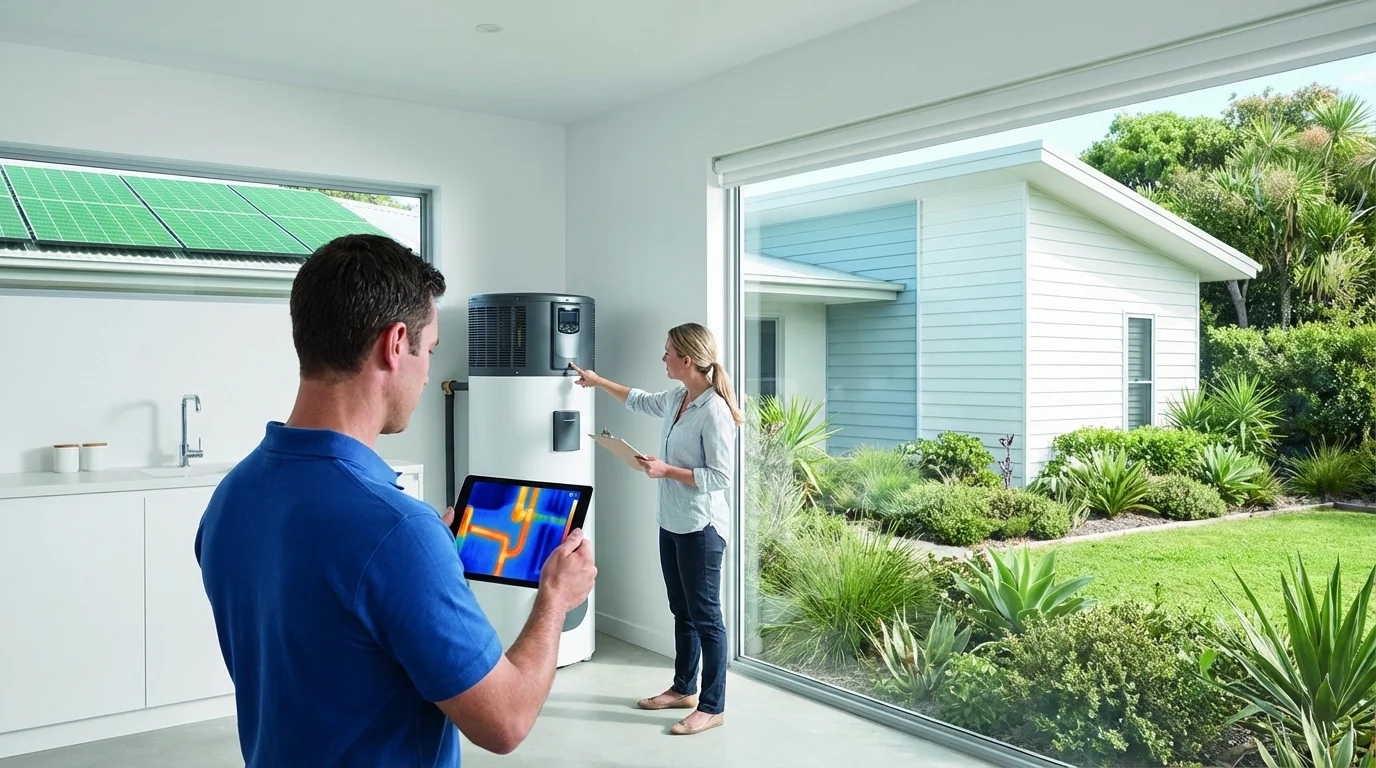
Understanding your water heater's energy consumption starts with its Energy Factor (EF) rating—the higher the number, the more efficient the unit. But traditional electric resistance and gas tank models have EF ratings below 1.0, meaning some energy is always lost. So upgrading to a heat pump water heater, which has an EF rating of 2.0 or higher, cuts this consumption by over 50%. And according to the U.S. Department of Energy, these models save a typical family of four around $550 per year. Conducting a full home energy audit identifies additional opportunities to reduce waste, such as insulating hot water pipes or lowering the thermostat setting to 120°F. And these small adjustments compound the savings from an equipment upgrade.
What State and Utility Rebates Are Available for Energy-Efficient Water Heaters?
State and utility rebates for 2026 offer point-of-sale discounts or mail-in checks from $300 to over $1,750 for qualifying heat pump water heaters. These incentives, managed by entities like NYSERDA or Mass Save, have specific equipment and efficiency requirements for eligibility and are designed to accelerate adoption.
These programs vary widely by location. And some utilities provide instant, point-of-sale rebates that directly reduce the purchase price, while state energy offices often manage mail-in rebate programs that require an application after installation. For example, a California utility offers a $1,000 rebate for replacing a gas water heater with a heat pump model. But a New York state program provides up to $700 for the same equipment. The key is identifying all available local incentives. So homeowners use DuloCore's free rebate calculator to discover every 2026 program they qualify for in their specific zip code, ensuring no savings are left behind. These rebates are designed to be combined with federal incentives for maximum financial benefit.
Am I Eligible for Water Heater Rebates and What Are the Income Limits?
Eligibility for 2026 water heater rebates depends on location, utility provider, and income level, with many programs setting limits at 80% or 150% of the Area Median Income (AMI). Some rebates are universally available, while enhanced incentives target low-to-moderate-income (LMI) households for greater savings.
Most rebate programs require that you own your home and that it is your primary residence. And the equipment itself must meet strict efficiency standards, typically ENERGY STAR certification. But income qualifications are the most critical factor for enhanced rebates. LMI programs, funded through the Inflation Reduction Act, cover up to 100% of the installation cost for households earning less than 80% of AMI. So households earning between 80% and 150% of AMI are eligible for rebates covering 50% of the cost. Universal rebates and federal energy tax credits don't have income caps, making them accessible to all homeowners.
"The tax credits are nonrefundable. Nonrefundable tax credits can't be used to increase your tax refund or to create a tax refund you wouldn't have otherwise received." — Internal Revenue Service
How Do I Apply for Water Heater Rebates and What Contractor Requirements Exist?
The application process for 2026 water heater rebates involves submitting proof of purchase, a dated installation invoice, and an application form online or by mail. Many programs mandate installation by a licensed, pre-approved contractor from a certified network to ensure compliance with efficiency and safety standards for eligibility.
The first step is always to confirm eligibility and reserve funds if the program allows it. And homeowners must purchase a qualifying model from the program's approved product list. But the most common point of failure is contractor choice. Using an uncertified installer voids rebate eligibility in many jurisdictions. So programs maintain a list of network contractors who are trained on program rules and installation best practices. After installation, you submit the required documentation, including the model and serial numbers, contractor's license number, and final invoice. Or, a participating contractor handles the paperwork for an instant rebate at the point of sale, which simplifies the process considerably.
Can I Combine Water Heater Rebates and Are There Deadlines or Funding Status Concerns?
Homeowners in 2026 can combine federal tax credits with state and utility water heater rebates, a practice known as "stacking," to maximize savings up to the total project cost. Rebate programs have strict deadlines, often quarterly or annually, and funding is limited and allocated on a first-come, first-served basis.
Stacking is a powerful strategy. For instance, a homeowner can claim a 30% federal tax credit (up to $2,000) under the IRA for a new heat pump (this federal credit ended for property placed in service after December 31, 2025) water heater. And they can combine it with a $1,000 state rebate and a $500 utility rebate. So this reduces a $4,500 project cost to just $1,000 out-of-pocket. But timing is critical. Program funds are often depleted before the official deadline. So it is imperative to check the funding status on the program administrator's website before beginning a project. Many state energy offices and utilities announce their 2026 program budgets and deadlines in late 2025, making winter an ideal time to plan upgrades and apply for popular heat pump rebates. (Note: Federal tax credit percentages and availability are subject to change; the 30% Residential Clean Energy Credit under Section 25D expired December 31, 2025. Verify current incentives at energy.gov.)
2026 Water Heater Incentive Comparison
| Incentive Type | Typical Amount | Key Eligibility | 2026 Deadline |
|---|---|---|---|
| Federal Tax Credit | Ended Dec 31, 2025 | — | December 31, 2025 |
| State Rebate | $500 - $1,750 | Varies by state; income limits may apply | Varies (e.g., June 30, 2026) |
| Utility Rebate | $300 - $1,000 | Must be a customer of the utility | Often first-come, first-served |
Official Sources
- ENERGY STAR — Federal guidance on energy-efficient products, including performance criteria for water heaters.
- DSIRE — A comprehensive database of state, local, utility, and federal incentives and policies that promote renewable energy and energy efficiency.
"By choosing ENERGY STAR, you can save 11% over a standard water heater, or $330 over its lifetime." — U.S. Environmental Protection Agency
Frequently Asked Questions
What types of water heaters are considered most energy-efficient for reducing household consumption?
Heat pump water heaters (HPWHs) are the most energy-efficient models available. They are 2-3 times more efficient than traditional electric resistance water heaters. So an ENERGY STAR certified HPWH saves a 4-person household approximately $550 per year on electric bills compared to a standard electric model, paying for itself in 3-5 years.
How much can I realistically save on my annual energy bill by optimizing my water heating system?
Optimizing your system by upgrading to an ENERGY STAR certified heat pump water heater saves the average family $5,500 over the unit's lifetime. And combining this with simple measures like insulating the first 6 feet of hot water pipes and lowering the thermostat to 120°F adds another 10-15% in annual savings.
How does the energy consumption of a heat pump water heater compare to traditional electric or gas models?
A heat pump water heater uses electricity to move heat from the surrounding air into the water tank, rather than generating heat directly. This process makes it up to 300% more efficient than a standard electric resistance water heater. And while modern gas heaters are efficient, HPWHs often have a lower annual operating cost, especially with the 2026 federal incentives.
Updated: April 14, 2026 — fact-checked by DuloCore Research. About our editorial process.