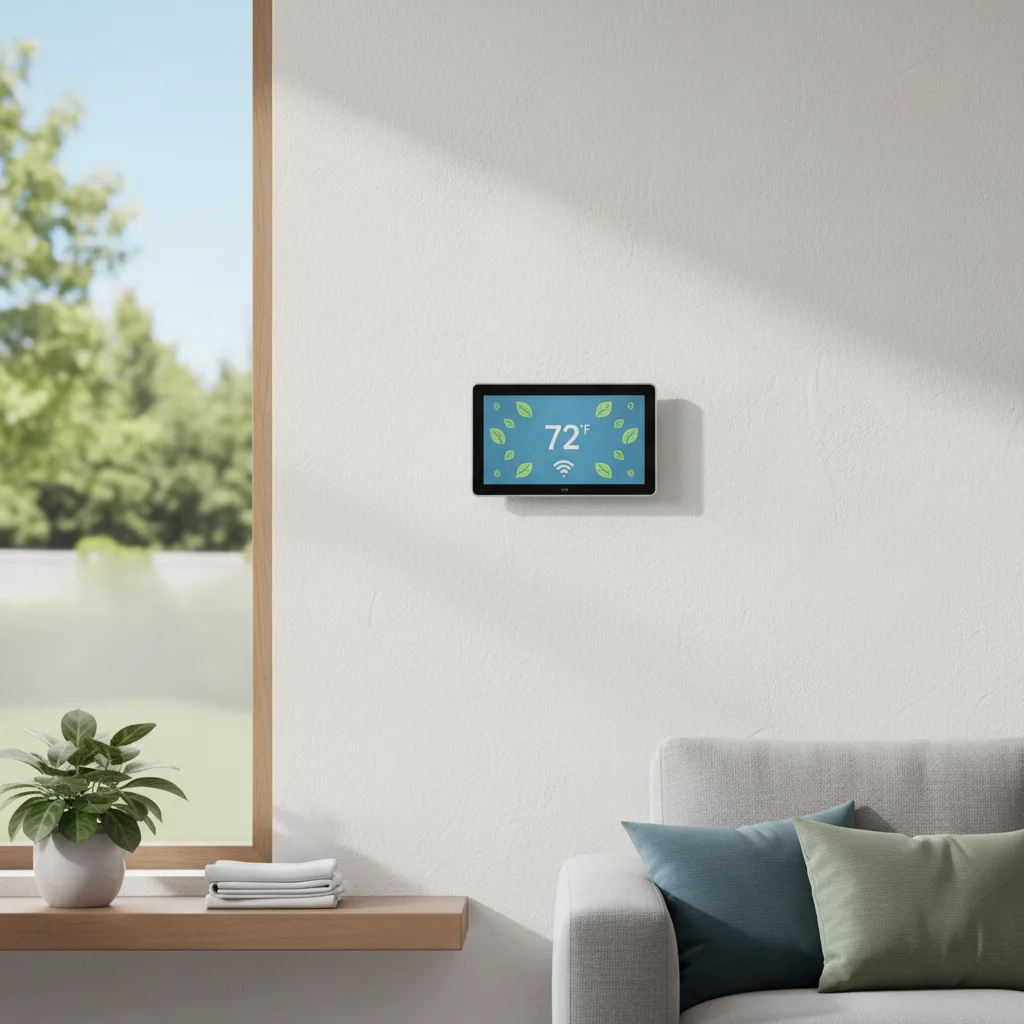
California homeowners who installed wifi thermostats in 2025 left $11.8 million in unclaimed utility rebates on the table. And most didn't know they qualified for federal tax credits worth up to $150 on the same device. The deadline to claim 2026 rebates from California's three largest utilities—PG&E, SDG&E, and SoCal Edison—ends December 31st, and applications submitted after mid-November face processing delays that push payments into the following tax year.
What WiFi Thermostat Rebates Are Available Right Now?
California's investor-owned utilities offer wifi thermostat rebates ranging from $75 to $125 per device in 2026. PG&E provides $100 for ENERGY STAR certified models through its Home Upgrade program. SDG&E offers $125 for smart thermostats that integrate with demand response programs. SoCal Edison pays $75 for qualifying devices purchased through approved retailers. The federal Energy Efficient Home Improvement Credit (Section 25C) ended for property placed in service after December 31, 2025 (IRS FS-2025-05). Federal tax credits for this work have ended, but state, local and utility rebates may still apply; check what is available at your address with the DuloCore rebate calculator.
Municipal utilities like SMUD and LADWP operate separate programs with different amounts and timelines. SMUD pays $100 for wifi thermostats that participate in its Peak Conserve program. LADWP offers $85 rebates but requires a two-year commitment to automated temperature adjustments during high-demand periods. And the California Public Utilities Commission approved $18 million in additional funding for 2026, expanding eligibility to include renters with landlord permission.
But not all wifi thermostats qualify. The device must appear on the utility's approved product list, which includes brands like Nest, Ecobee, Honeywell Home, and Emerson Sensi. Thermostats must connect to the utility's demand response platform and allow remote temperature adjustments during grid events. Installation must be completed by a licensed HVAC contractor or documented with timestamped photos if self-installed. Federal tax credits no longer apply (IRS FS-2025-05); see energy tax credits for details.
How Much Can You Save With a WiFi Thermostat Rebate?
The average California homeowner saves $284 in the first year from the utility rebate plus energy savings. A $229 Nest Learning Thermostat qualifies for PG&E's $100 rebate, reducing net cost to $129. The thermostat then cuts cooling costs by 12% and heating costs by 15%, saving $184 annually for a 1,800-square-foot home with $1,200 in baseline HVAC costs.
So the total five-year value reaches $1,204 after accounting for upfront incentives and ongoing energy savings. Homes in California's Central Valley see higher savings of $312 annually due to extreme summer temperatures that trigger 47 cooling days above 95°F. Coastal homes save less—an average of $156 per year—because milder climates require less temperature regulation. Use our free rebate calculator to estimate your specific savings.
And demand response payments add another layer. PG&E's SmartRate program pays $50 to $175 annually for allowing automated thermostat adjustments on 9 to 15 high-demand days. SDG&E's Reduce Your Use Rewards offers $0.75 per kilowatt-hour saved during events, averaging $68 per summer. But participation requires wifi connectivity and GPS-based auto-adjust features that older programmable thermostats lack.
What Are the Eligibility Requirements for WiFi Thermostat Rebates?
California utility rebates require homeowners to be active residential customers with an account in good standing. The home must have an existing central HVAC system—window units and portable heaters don't qualify. The thermostat must replace a manual or programmable model that's at least five years old. And customers can't have received a thermostat rebate from the same utility within the past three years.
The federal Energy Efficient Home Improvement Credit (Section 25C) ended for property placed in service after December 31, 2025 (IRS FS-2025-05).
But landlords face additional restrictions. California's AB 802 allows property owners to claim utility rebates only if tenants provide written consent and receive 50% of the energy savings for 12 months after installation. Review smart thermostat rebates for multi-family dwelling rules.
When Is the Deadline to Apply for WiFi Thermostat Rebates?
PG&E accepts applications until December 31, 2026, but funding depletes by late October in high-demand years. The utility allocated $4.2 million for thermostat rebates in 2026, enough for approximately 42,000 devices. Applications submitted after November 15th enter a waitlist and receive payment from the following year's budget. SDG&E operates on a first-come basis with no formal deadline, but its $1.8 million budget typically exhausts by September.
SoCal Edison requires pre-approval before purchase. Homeowners must submit an application, receive a confirmation number, buy an approved thermostat within 90 days, and submit proof of purchase within 30 days of installation. Missing any deadline voids the rebate. And the utility rejects 23% of applications due to incomplete documentation or expired confirmation numbers.
Form 5695 only covers qualifying work completed by December 31, 2025 and claimed on a 2025 return; the federal 25C and 25D credits ended after that date (IRS FS-2025-05). The federal Energy Efficient Home Improvement Credit (Section 25C) ended for property placed in service after December 31, 2025 (IRS FS-2025-05).
Can You Stack WiFi Thermostat Rebates With Other Energy Incentives?
California prohibits combining rebates from multiple utilities; federal tax credits no longer apply (IRS FS-2025-05). A PG&E customer receives $100 for a wifi thermostat, for $100 in total incentives on a $229 device. But that same customer can't apply for SMUD's $100 rebate after moving to Sacramento—the three-year lookback period follows the customer, not the address.
And pairing thermostat rebates with heat pump rebates creates compounding savings. Homeowners who install a $12,000 heat pump in 2026 get no federal tax credit; the federal Energy Efficient Home Improvement Credit (Section 25C) ended for property placed in service after December 31, 2025 (IRS FS-2025-05). California's TECH Clean California initiative offers an additional $3,000 point-of-sale discount for heat pump installations.
How Do You Apply for a WiFi Thermostat Rebate?
PG&E customers submit applications through the online Home Upgrade portal at pge.com/en/save-energy-and-money/energy-saving-programs.html. The process requires uploading a dated receipt showing purchase price and model number, a photo of the installed thermostat displaying the serial number, and a screenshot of the wifi connection confirmation in the thermostat's mobile app. Applications process in 6 to 8 weeks, with payment issued as a bill credit or check based on customer preference.
SDG&E uses a different system. Customers create an account at sdge.com/residential/savings-center/home-improvement-rebates, complete a pre-installation questionnaire that verifies HVAC system compatibility, receive approval within 48 hours, and submit post-installation documentation within 60 days. The utility requires a W-9 form for all rebates over $50, adding a step that PG&E doesn't mandate. Payment arrives in 4 to 6 weeks as a check mailed to the service address.
So documentation standards vary by utility. SoCal Edison accepts smartphone photos but rejects screenshots from online retailers—customers must photograph the physical receipt. SMUD requires participation in its Peak Conserve program before approval, which involves installing firmware that allows the utility to adjust temperature settings during grid emergencies. And municipal utilities like LADWP conduct random in-home inspections on 5% of applications to verify installation.
Form 5695 only covers qualifying work completed by December 31, 2025 and claimed on a 2025 return; the federal 25C and 25D credits ended after that date (IRS FS-2025-05).
"ENERGY STAR certified smart thermostats can save about $50 a year on heating and cooling costs. These devices automatically adjust temperature settings based on occupancy and weather forecasts." — ENERGY STAR Smart Thermostats
Official Sources
- U.S. Department of Energy Save Energy — Federal guidance on energy efficiency rebates and tax credits for home improvements (note: the federal 25C and 25D credits ended for projects completed after December 31, 2025)
- DSIRE USA — Comprehensive database of state and utility energy incentive programs
- IRS Energy Incentives for Individuals — Official tax credit eligibility requirements and filing instructions (note: the federal 25C and 25D credits ended for projects completed after December 31, 2025)
Related Reading: Learn more about Energy Star Rebate Program and Free Weatherization Program.
Frequently Asked Questions
What are the eligibility requirements for wifi thermostat rebate programs?
Eligibility requires active utility service in California, a central HVAC system at least five years old, and purchasing an ENERGY STAR certified wifi thermostat. The device must appear on your utility's approved product list and connect to its demand response platform. Homeowners can't have received a thermostat rebate from the same utility within three years. Form 5695 only covers qualifying work completed by December 31, 2025 and claimed on a 2025 return; the federal 25C and 25D credits ended after that date (IRS FS-2025-05).
How much money can you get back from a wifi thermostat rebate?
California utility rebates range from $75 to $125 per device in 2026, with PG&E paying $100, SDG&E offering $125, and SoCal Edison providing $75. The federal Energy Efficient Home Improvement Credit (Section 25C) ended for property placed in service after December 31, 2025 (IRS FS-2025-05). The utility rebate on a $229 thermostat returns $100 to $125, reducing net cost to $104 to $129. And ongoing energy savings average $184 annually for California homes.
What is the process for claiming a wifi thermostat rebate?
Submit an online application through your utility's website with a dated receipt, photo of the installed thermostat showing the serial number, and proof of wifi connectivity. PG&E and SDG&E process applications in 4 to 8 weeks. SoCal Edison requires pre-approval before purchase. Form 5695 only covers qualifying work completed by December 31, 2025 and claimed on a 2025 return; the federal 25C and 25D credits ended after that date (IRS FS-2025-05). Keep the manufacturer's ENERGY STAR certification for three years.
Are wifi thermostat rebates still available in 2026?
California's three largest utilities—PG&E, SDG&E, and SoCal Edison—offer wifi thermostat rebates through December 31, 2026, subject to budget depletion. PG&E allocated $4.2 million and typically runs out by October. The federal Energy Efficient Home Improvement Credit (Section 25C) ended for property placed in service after December 31, 2025 (IRS FS-2025-05).
What is the difference between wifi thermostats and smart thermostats for rebate purposes?
Utilities use the terms interchangeably and require the same core features: remote connectivity, auto-scheduling, and demand response integration. ENERGY STAR certification defines "smart" as having wifi, GPS-based auto-adjust, and energy reporting that meets Version 4.0 specifications. Programmable thermostats without wifi don't qualify, even if they have scheduling features. And thermostats that connect via Bluetooth instead of wifi fail eligibility because they can't integrate with utility demand response platforms.
Ready to claim your wifi thermostat rebate? Use our free rebate calculator to estimate your total savings from utility programs. Get your personalized rebate amount in 60 seconds.
Updated: April 14, 2026 — fact-checked by DuloCore Research. About our editorial process.
Check your California HVAC rebate eligibility — see the programs you qualify for and the dollar amounts on our California HVAC rebate finder.