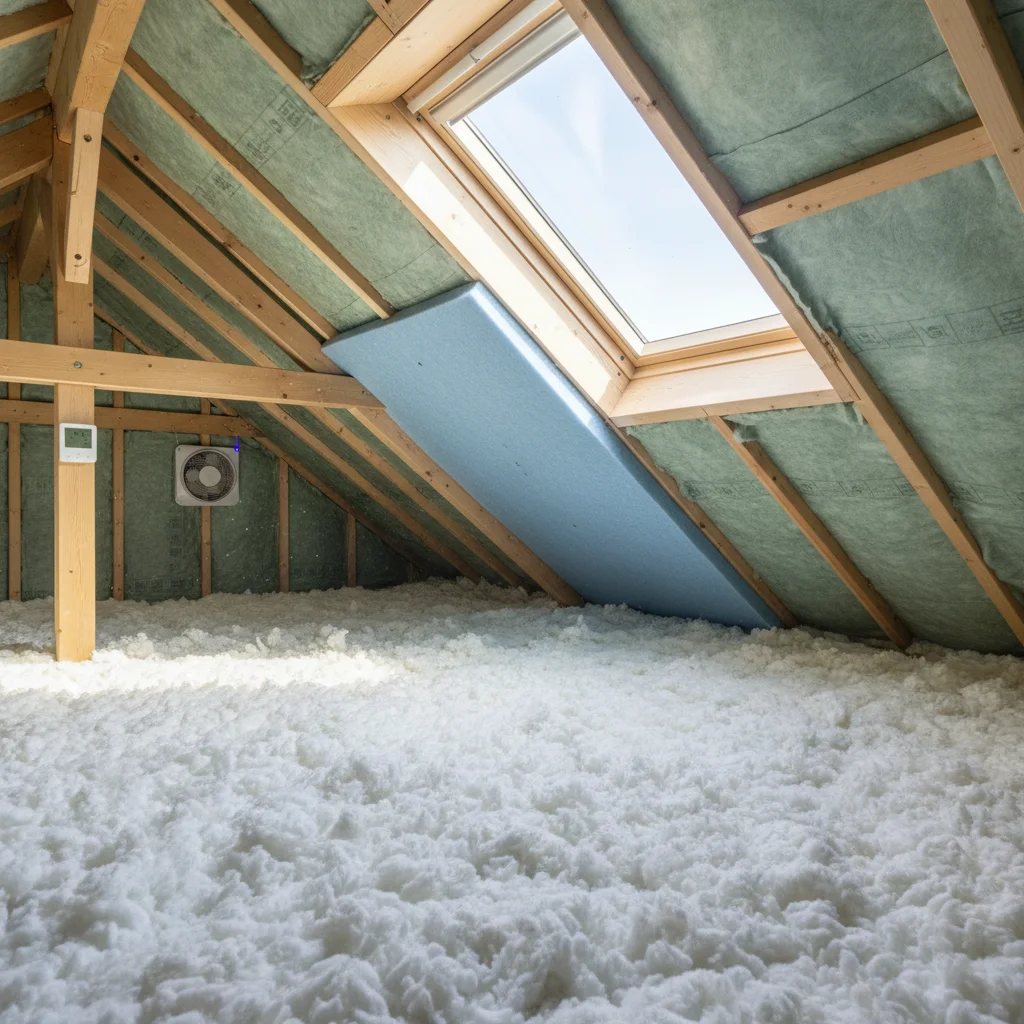
Homeowners who upgraded their attic insulation in 2025 saved an average of $400-$600 annually on heating and cooling bills, according to the Department of Energy. And those savings compound over the 15-20 year lifespan of modern insulation materials. But the upfront cost remains the biggest barrier: most California homes require $1,500-$3,500 for a complete attic insulation retrofit, depending on square footage and material choice.
How Much Does Attic Insulation Cost in 2026?
Attic insulation installation costs $1.50-$3.50 per square foot in California as of 2026, with blown-in fiberglass averaging $1.50-$2.25, spray foam reaching $3.00-$3.50, and cellulose falling between $1.75-$2.50. A typical 1,200-square-foot attic requires $1,800-$4,200 for materials and professional installation, though DIY blown-in kits start at $600 for materials alone.
The price depends on four factors: existing insulation thickness, desired R-value (thermal resistance), material type, and labor rates in your region. So homes with zero existing insulation pay more than those upgrading from R-19 to R-38. And spray foam costs twice as much as fiberglass but delivers superior air sealing that reduces HVAC runtime by 15-20%, according to Oak Ridge National Laboratory.
But here's the tension: California's Title 24 building codes require R-38 minimum for most climate zones, yet 68% of homes built before 1980 have R-19 or less. The gap between code compliance and current performance creates a $2,000-$3,500 upgrade cost for the average household—money that pays itself back through lower utility bills in 6-9 years.
Which Attic Insulation Brands Qualify for Federal Rebates?
Owens Corning, Johns Manville, CertainTeed, Knauf Insulation, and GreenFiber manufacture products that meet the 2026 Inflation Reduction Act's energy efficiency criteria for federal tax credits. The federal Energy Efficient Home Improvement Credit (Section 25C) ended for property placed in service after December 31, 2025 (IRS FS-2025-05). Federal tax credits for this work have ended, but state, local and utility rebates may still apply; check what is available at your address with the DuloCore rebate calculator.
The IRA replaced the old Section 25C credit that expired January 1, 2026. And the new framework doesn't require specific brand certification—just documented R-value performance and installation by a certified contractor. So homeowners who install qualifying insulation in 2026 can claim 30% of material and labor costs, up to the $1,200 annual cap, on their federal tax return.
"Insulation must meet or exceed the values in the International Energy Conservation Code (IECC) to qualify for the residential energy efficiency credit." — IRS Energy Incentives for Individuals
But not all products from these brands automatically qualify. The insulation must achieve minimum R-values specified by climate zone: R-49 for attics in California's colder regions (zones 3-4), R-38 for moderate coastal areas (zone 2). Use our free rebate calculator to confirm your project's eligibility and estimated credit value.
What's the Energy Efficiency Rating System for Attic Insulation?
R-value measures thermal resistance per inch of material thickness, with higher numbers indicating better insulation performance. Spray foam delivers R-6 to R-7 per inch, fiberglass batts provide R-3.2 to R-3.8 per inch, and blown-in cellulose offers R-3.6 to R-3.8 per inch as of 2026 industry standards.
California Title 24 mandates R-38 minimum for attic insulation in most climate zones, which translates to 10-12 inches of fiberglass or cellulose, or 6-7 inches of closed-cell spray foam. And the state's Energy Commission updated requirements in 2025 to include air sealing verification: contractors must conduct blower door tests before and after installation to document leakage reduction of at least 15%.
| Material | R-Value Per Inch | Cost Per Sq Ft | Lifespan |
|---|---|---|---|
| Fiberglass batts | R-3.2 to R-3.8 | $1.50-$2.25 | 15-20 years |
| Blown-in cellulose | R-3.6 to R-3.8 | $1.75-$2.50 | 20-30 years |
| Spray foam (closed-cell) | R-6 to R-7 | $3.00-$3.50 | 30+ years |
But R-value alone doesn't predict real-world performance. Or rather, it predicts conductive heat loss but ignores air leakage, which accounts for 25-40% of total heat loss in most attics. So the Department of Energy now recommends air sealing before adding insulation—a $300-$600 additional cost that improves the effective R-value by 20-30%.
How Long Does Attic Insulation Last Before Needing Replacement?
Fiberglass batts maintain their R-value for 15-20 years, blown-in cellulose lasts 20-30 years, and closed-cell spray foam performs for 30+ years without degradation, according to manufacturer warranties and Department of Energy testing data. But these lifespans assume dry conditions: moisture from roof leaks or condensation reduces effectiveness by 50% within 3-5 years.
The replacement timeline depends on three factors: material type, moisture exposure, and compression from attic foot traffic or stored items. And fiberglass loses R-value faster than cellulose when compressed—stepping on a fiberglass batt reduces its thickness by 30-40% permanently, while cellulose rebounds to 90% of original thickness.
"Wet insulation can lose more than 50% of its insulating value and should be removed and replaced." — Energy.gov Insulation
So homeowners should inspect attic insulation every 3-5 years for water stains, compression, or animal damage. Or hire an energy auditor for thermal imaging scans that reveal cold spots indicating deteriorated performance—a $300-$500 service that identifies problems before they show up as higher utility bills.
What's Your Payback Period for Attic Insulation Installation?
California homeowners recoup their insulation investment in 6-9 years on average through reduced heating and cooling costs, with faster payback in extreme climates and slower returns in mild coastal regions. A $2,500 attic insulation upgrade saves $350-$450 annually in the Central Valley (zone 3-4) but only $200-$300 in coastal San Diego (zone 1), based on 2026 electricity rates of $0.28-$0.32 per kWh.
The payback calculation changes when you factor in the 30% federal tax credit from the Inflation Reduction Act. And California's energy tax credits stack on top of federal incentives: utilities like PG&E offer $500-$1,200 rebates for insulation upgrades that meet energy savings thresholds verified through CalTRACK protocols.
So the effective payback period drops to 4-6 years when homeowners claim all available incentives. Or even faster when pairing insulation with other efficiency upgrades: homes that add attic insulation plus air sealing see 25-35% HVAC cost reductions, compared to 15-20% for insulation alone.
How Does Attic Insulation Compare to Other Home Energy Solutions?
Attic insulation costs $1,500-$3,500 and saves $350-$450 annually, compared to heat pump installations at $8,000-$15,000 saving $600-$900 annually, or solar panels at $15,000-$25,000 saving $1,200-$2,000 annually after incentives. But insulation delivers the fastest payback period of 4-6 years when including the 30% federal credit (these federal credits ended for projects completed after December 31, 2025), beating heat pumps at 8-12 years and solar at 10-15 years.
The cost-per-kilowatt-hour-saved metric reveals the hierarchy: insulation saves energy at $0.03-$0.05 per kWh, air sealing at $0.04-$0.06 per kWh, LED lighting at $0.02-$0.03 per kWh, and heat pumps at $0.08-$0.12 per kWh. And California utility rebate programs reflect this efficiency: insulation rebates require smaller energy savings thresholds (15% reduction) compared to heat pump rebates (20% reduction).
But the comparison shifts when you consider lifetime savings. Or more precisely, insulation's 20-30 year lifespan accumulates $7,000-$13,500 in total savings, while heat pumps with 15-20 year lifespans save $9,000-$18,000, and solar systems with 25-30 year lifespans save $30,000-$60,000. So the optimal strategy stacks all three: insulation first to reduce load, then heat pumps to electrify efficiently, then solar to power the system.
Official Sources
- Energy.gov Insulation Guide — Federal energy efficiency guidance on insulation types, installation, and R-value requirements
- IRS Residential Energy Credits — Tax credit eligibility criteria and documentation requirements for home energy improvements (note: the federal 25C and 25D credits ended for projects completed after December 31, 2025)
- DSIRE California Programs — Database of state and utility rebate programs for insulation and energy efficiency upgrades
Related Reading: Learn more about Insulation R Value Chart and Insulation Roi Calculator.
Frequently Asked Questions
How much does attic insulation cost?
Attic insulation costs $1,500-$3,500 for a typical 1,200-square-foot California home in 2026, with blown-in fiberglass averaging $1.50-$2.25 per square foot, cellulose at $1.75-$2.50, and spray foam reaching $3.00-$3.50. DIY materials start at $600 for blown-in kits, but professional installation includes air sealing and code compliance verification that DIY projects often miss.
What factors affect the price of attic insulation?
Five factors determine final cost: existing insulation thickness (removing old material adds $0.50-$1.00 per square foot), desired R-value (R-38 requires 10-12 inches of fiberglass versus 6-7 inches of spray foam), attic accessibility (low clearance increases labor costs by 20-30%), climate zone (colder regions require higher R-values), and air sealing requirements (blower door testing adds $300-$500).
Is attic insulation cost tax deductible?
The federal Energy Efficient Home Improvement Credit (Section 25C) ended for property placed in service after December 31, 2025 (IRS FS-2025-05). The credit covers both materials and labor when installed by a certified contractor and meeting minimum R-value thresholds of R-38 for most California climate zones. And utility rebates from PG&E, SCE, or SDG&E stack on top of federal credits—check eligibility through our rebate calculator.
How long does attic insulation last?
Fiberglass batts last 15-20 years, blown-in cellulose performs for 20-30 years, and spray foam maintains R-value for 30+ years under dry conditions. But moisture from roof leaks reduces effectiveness by 50% within 3-5 years, and compression from attic storage or foot traffic permanently degrades fiberglass by 30-40%. Homeowners should inspect every 3-5 years for water damage or settling.
What's the average ROI on attic insulation installation?
California homeowners see 6-9 year payback periods through reduced utility bills, dropping to 4-6 years after claiming the 30% federal tax credit and utility rebates. Annual savings range from $200-$300 in mild coastal climates to $400-$600 in hot Central Valley or cold mountain regions, based on 2026 electricity rates of $0.28-$0.32 per kWh. And lifetime savings accumulate to $7,000-$13,500 over 20-30 years.
Ready to calculate your insulation savings and available rebates? Use our free rebate calculator to find federal tax credits, California utility rebates, and your personalized payback period based on your home's location and current insulation levels.
Updated: April 14, 2026 — fact-checked by DuloCore Research. About our editorial process.
Check your California insulation rebate eligibility — see the programs you qualify for and the dollar amounts on our California insulation rebate finder.