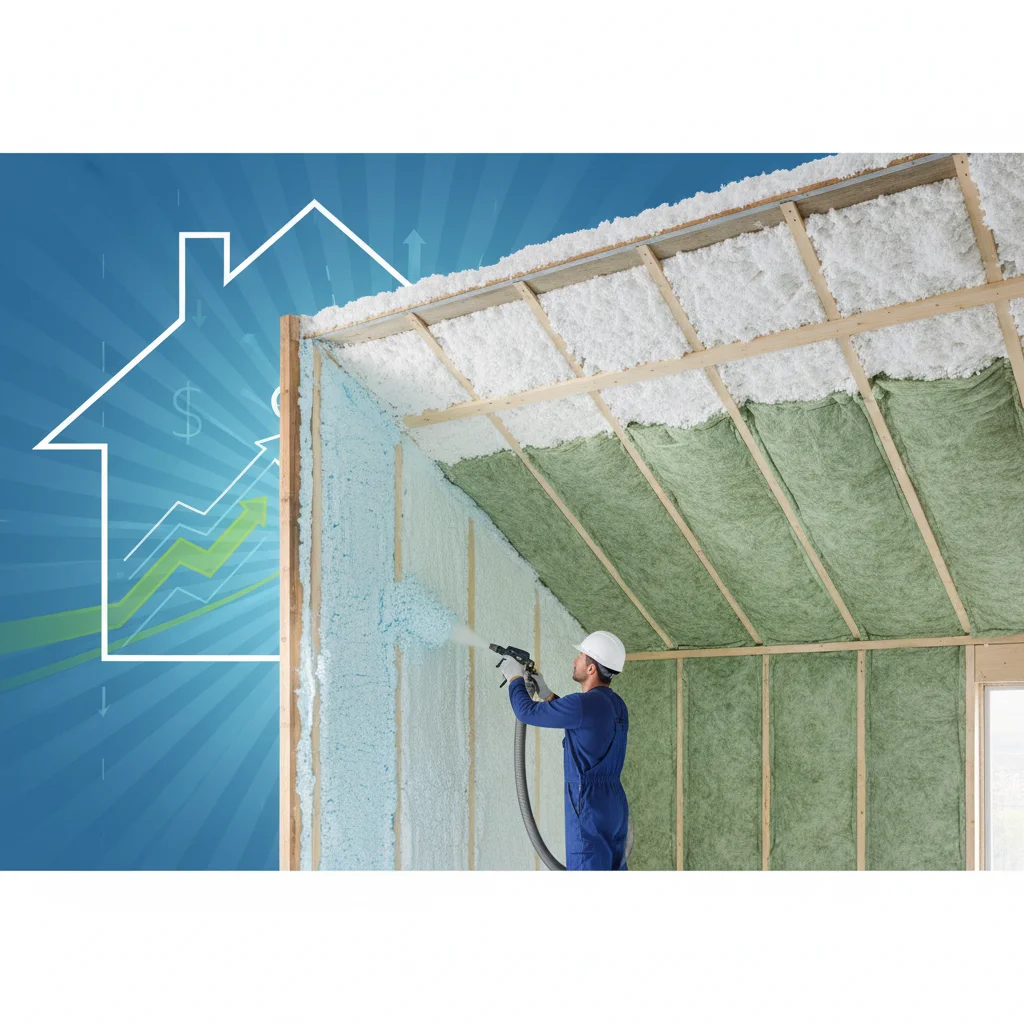
California's new construction market left $47 million in insulation rebates unclaimed in 2025, according to the California Energy Commission. And most builders don't know that federal IRA credits stack with state programs in 2026, creating potential savings of $4,000 to $12,000 per home for qualifying projects.
How Much Can You Save with New Construction Insulation Rebates?
New construction insulation rebates in California range from $500 to $8,000 per home in 2026, depending on equipment type and household income. The federal Inflation Reduction Act provides a 30% tax credit (this federal credit ended for property placed in service after December 31, 2025) on qualifying insulation materials and installation costs, capped at $1,200 annually for most projects. But low-to-moderate income households qualify for enhanced rebates through California's TECH Clean California program, which offers up to $4,000 for whole-home insulation upgrades in new construction. And these amounts stack with utility incentives from PG&E, SCE, and SDG&E, which add $200 to $1,500 per project.
The federal Energy Efficient Home Improvement Credit (Section 25C) ended for property placed in service after December 31, 2025 (IRS FS-2025-05).
What Types of Insulation Equipment Qualify for Rebates?
Spray foam insulation with an R-value of R-30 or higher qualifies for the maximum federal tax credit of $1,200 in 2026. Blown-in cellulose, fiberglass batts, and rigid foam boards qualify if they meet ENERGY STAR insulation requirements and achieve R-values of R-38 for attics, R-19 for walls, or R-30 for floors. California's Title 24 building standards require specific R-values by climate zone, and rebate programs prioritize closed-cell spray foam and reflective radiant barriers in climate zones 10-16. So builders in hot inland areas like Fresno and Bakersfield see the highest rebate amounts for reflective insulation systems.
Are There Income Limits That Affect Your Rebate Eligibility?
Households earning less than 80% of area median income qualify for enhanced rebates of $4,000 to $8,000 through TECH Clean California in 2026. For a family of four in Los Angeles County, that income threshold sits at $92,400 annually. And moderate-income households earning 80-150% of area median income still qualify for standard rebates of $500 to $2,000. The federal Energy Efficient Home Improvement Credit (Section 25C) ended for property placed in service after December 31, 2025 (IRS FS-2025-05). Federal tax credits for this work have ended, but state, local and utility rebates may still apply; check what is available at your address with the DuloCore rebate calculator. California's programs verify income through tax returns or paystubs submitted with rebate applications.
Learn more about eligibility requirements in our guide to insulation rebates.
What's the Step-by-Step Process to Apply for New Construction Insulation Rebates?
Builders submit applications through the California Hub for Energy Efficiency Financing (CHEEF) portal before construction begins. The process requires a Title 24 compliance report, contractor license verification, and equipment specifications showing R-values and ENERGY STAR certification. And applications must include pre-installation photos, proof of purchase receipts, and a completed W-9 form. So most builders work with a HERS rater who handles documentation and submits the application on their behalf. Payment arrives 6-8 weeks after final inspection, distributed via direct deposit or paper check. Use our free rebate calculator to estimate your total savings before applying.
When Are the Application Deadlines and Is Funding Still Available?
California's 2026 new construction insulation rebate programs accept applications on a rolling basis until funds exhaust. TECH Clean California allocated $89 million for 2026, and as of April 2026, $67 million remains available. But the program operates first-come, first-served, so applications submitted after July typically face longer processing times of 10-12 weeks. The federal Energy Efficient Home Improvement Credit (Section 25C) ended for property placed in service after December 31, 2025 (IRS FS-2025-05). PG&E's program reached capacity in October 2025, so builders in PG&E territory should verify current funding status before starting projects.
| Program | Rebate Amount | Income Limit | 2026 Deadline | Funding Status |
|---|---|---|---|---|
| Federal IRA Tax Credit | Ended Dec 31, 2025 | — | Ended Dec 31, 2025 | — |
| TECH Clean California | $500-$8,000 | 150% AMI | Rolling basis | 75% Available |
| PG&E New Construction | $200-$1,000 | None | June 30, 2026 | 23% Available |
| SCE Builder Incentives | $300-$1,500 | None | Dec 31, 2026 | 58% Available |
Can You Stack Insulation Rebates with Other Incentives?
California allows stacking of federal IRA tax credits with state and utility rebates in 2026, but the combined amount can't exceed total project costs. A builder installing $10,000 in spray foam insulation claims the federal 30% credit ($3,000) plus TECH Clean California's $4,000 rebate plus SCE's $800 incentive, totaling $7,800. But if rebates exceed costs, the excess gets forfeited. And federal tax credits reduce the cost basis for state rebate calculations, so builders claim the IRA credit first, then apply for state programs. Check our guide to energy tax credits for detailed stacking rules.
What Contractor Requirements Must Your Builder Meet to Claim Rebates?
Contractors must hold an active California C-2 (Insulation and Acoustical) license to install qualifying insulation for rebate programs. And installers need BPI Building Analyst certification or equivalent training documented through the California Contractor State License Board. TECH Clean California requires contractors to register in the program portal and complete a 45-minute online training before submitting applications. So builders should verify contractor credentials before signing contracts, checking license status at cslb.ca.gov. Most rebate programs also require contractors to provide a 5-year warranty on insulation installation and materials.
Official Sources
- U.S. Department of Energy - Energy Saver — Federal guidance on IRA tax credits and energy-efficient insulation standards (note: the federal 25C and 25D credits ended for projects completed after December 31, 2025)
- Database of State Incentives for Renewables & Efficiency — Comprehensive database of California insulation rebate programs and eligibility requirements
- California Energy Commission — Title 24 building standards and state rebate program information
Frequently Asked Questions
What types of insulation qualify for new construction rebates?
Spray foam, blown-in cellulose, fiberglass batts, and rigid foam boards qualify if they meet ENERGY STAR requirements and achieve minimum R-values of R-38 for attics, R-19 for walls, or R-30 for floors. California programs prioritize closed-cell spray foam and reflective radiant barriers in climate zones 10-16. And all materials must comply with Title 24 building standards for the specific climate zone where construction occurs.
How much money can you get from new construction insulation rebates?
Combined federal, state, and utility rebates total $4,000 to $12,000 for qualifying new construction projects in California in 2026. The federal IRA tax credit provides 30% of costs up to $1,200, TECH Clean California offers $500 to $8,000 based on income, and utility programs add $200 to $1,500. But actual amounts depend on household income, equipment type, and available funding at application time.
Are new construction insulation rebates different from retrofit rebates?
New construction rebates require compliance with Title 24 building codes and pre-installation applications, while retrofit rebates focus on upgrading existing homes and allow post-installation submissions. New construction programs offer lower rebate amounts because baseline efficiency requirements already mandate insulation in new homes. So retrofit programs targeting older homes with minimal insulation provide rebates of $2,000 to $4,000 higher than new construction incentives.
What is the deadline to apply for new construction insulation rebates?
The federal Energy Efficient Home Improvement Credit (Section 25C) ended for property placed in service after December 31, 2025 (IRS FS-2025-05). California's TECH Clean California accepts applications on a rolling basis until the $89 million allocation exhausts, expected in late 2026. And utility programs from PG&E, SCE, and SDG&E operate on annual cycles with deadlines ranging from June 30 to December 31, 2026. Builders should apply 4-6 weeks before construction starts to secure funding.
Do new construction insulation rebates require a licensed contractor?
California requires contractors to hold an active C-2 (Insulation and Acoustical) license and BPI Building Analyst certification to install qualifying insulation for rebate programs. And TECH Clean California mandates contractor registration and completion of online training before submitting applications. Homeowner DIY installations don't qualify for state or utility rebates, but they qualify for federal IRA tax credits if materials meet ENERGY STAR requirements and R-value minimums.
Ready to Calculate Your Savings?
Find out exactly how much you qualify for with California's new construction insulation rebate programs. Our rebate calculator shows federal, state, and utility incentives available for your project in 2026.
Last updated April 14, 2026 — reviewed by DuloCore Editorial. About our authors.
Check your California insulation rebate eligibility — see the programs you qualify for and the dollar amounts on our California insulation rebate finder.