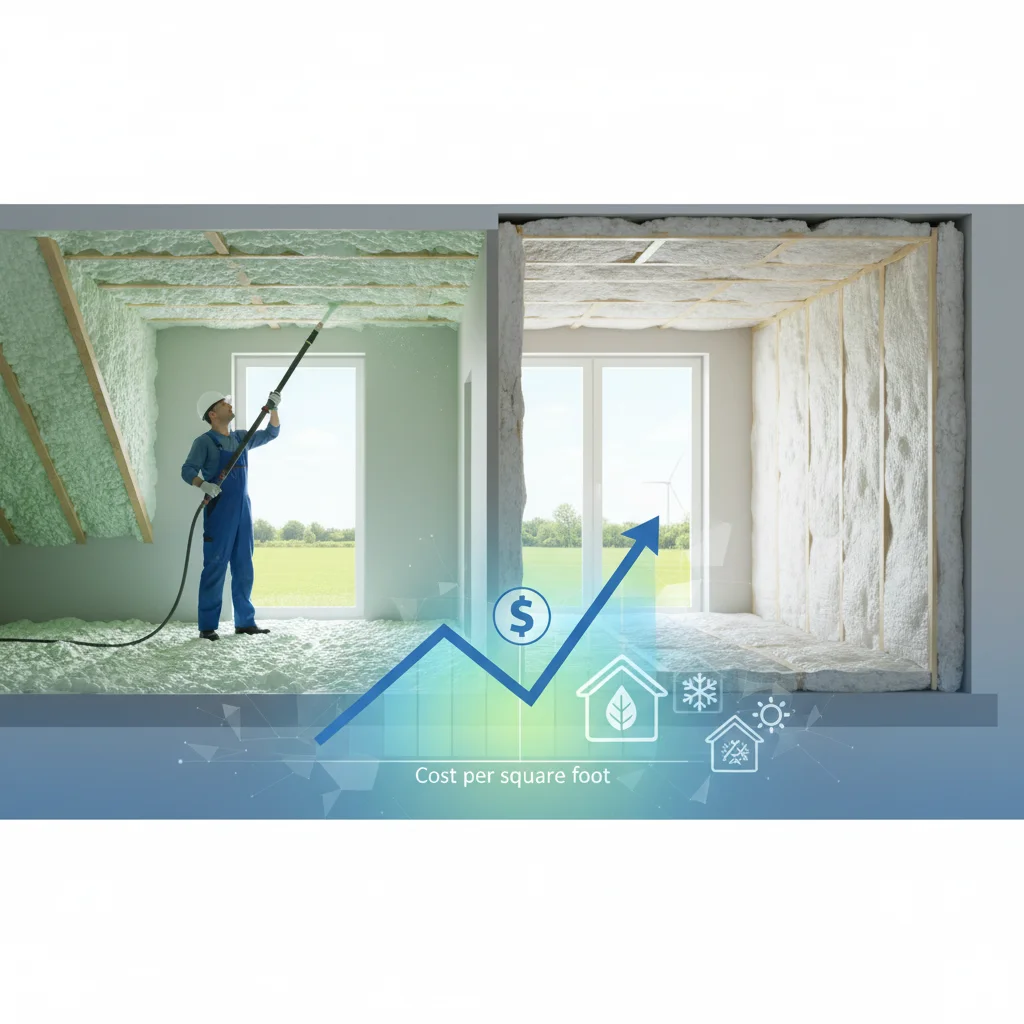
American homeowners lose $400 annually through under-insulated walls and attics, and 90% of homes built before 1980 don't meet current thermal performance standards. The federal Energy Efficient Home Improvement Credit (Section 25C) ended for property placed in service after December 31, 2025 (IRS FS-2025-05). Federal tax credits for this work have ended, but state, local and utility rebates may still apply; check what is available at your address with the DuloCore rebate calculator.
How Much Does Insulation Cost Per Square Foot in 2026?
Insulation costs range from $0.50 to $6.00 per square foot installed, depending on material type and installation method. Blown-in cellulose averages $0.75-$1.50 per square foot, spray foam runs $2.00-$6.00 per square foot, and fiberglass batts cost $0.50-$1.50 per square foot. Labor accounts for 40-60% of total project costs.
So homeowners face a real tension: cheaper materials like fiberglass save $2,000-$3,000 upfront but deliver lower R-values per inch, while spray foam costs 3-4 times more but seals air leaks and delivers R-6.5 per inch compared to fiberglass's R-3.2.
Material costs break down by thermal performance. Fiberglass batts (R-13 to R-38) cost $0.30-$0.80 per square foot for materials alone. Cellulose (R-3.6 per inch) runs $0.40-$0.90 per square foot. Spray foam polyurethane (R-6.5 per inch) costs $1.20-$3.50 per square foot for materials. But installation complexity drives final pricing: attic blow-in takes 3-5 hours for 1,200 square feet, while wall cavity foam injection requires 8-12 hours due to precision drilling and filling requirements.
Which Insulation Types Qualify for Rebates?
The federal Energy Efficient Home Improvement Credit (Section 25C) ended for property placed in service after December 31, 2025 (IRS FS-2025-05).
California's TECH Clean California program offers $500-$2,000 for whole-home weatherization including insulation upgrades. New York's EmPower+ provides free insulation to income-qualified households. Massachusetts offers $0.50-$2,000 rebates through Mass Save depending on square footage treated. Use our free rebate calculator to find your state savings.
| Program | Maximum Credit | Eligibility Requirement | Valid Through |
|---|---|---|---|
| IRA Federal Tax Credit | Ended Dec 31, 2025 | — | Ended Dec 31, 2025 |
| California TECH Clean | $2,000 | Whole-home weatherization audit | Dec 31, 2026 |
| Mass Save | $2,000 | Income ≤80% area median, 1,000+ sq ft treated | Ongoing |
What's the Energy Efficiency Rating System and How Does It Affect Price?
R-value measures thermal resistance per inch of material thickness, with higher numbers indicating better insulation performance. Spray foam polyurethane delivers R-6.5 per inch at $2.00-$6.00 per square foot, while fiberglass batts provide R-3.2 per inch at $0.50-$1.50 per square foot. Climate zones determine minimum R-value requirements ranging from R-30 to R-60 for attics.
The Department of Energy divides the United States into eight climate zones with specific R-value recommendations. Zone 1 (Southern Florida, Hawaii) requires R-30 attic insulation. Zone 7 (Northern Minnesota, Montana) requires R-60. And California spans three zones: coastal areas (Zone 3) need R-38, Central Valley (Zone 4) needs R-49, and mountain regions (Zone 5) need R-49. So a 1,500-square-foot attic in Sacramento requires 7,350 R-value-feet (1,500 sq ft × R-49) compared to 4,500 R-value-feet for the same home in San Diego.
Material thickness drives installation costs. Achieving R-49 with fiberglass batts (R-3.2 per inch) requires 15.3 inches of material at $1,125-$2,250 for 1,500 square feet. Spray foam (R-6.5 per inch) needs only 7.5 inches at $3,000-$9,000. But spray foam's air-sealing properties eliminate infiltration losses that reduce fiberglass's effective R-value by 20-40% in real-world conditions.
How Long Does Insulation Last and What Maintenance Do You Need?
Fiberglass and cellulose insulation last 80-100 years when protected from moisture, while spray foam maintains thermal performance for 80+ years without degradation. Homeowners inspect insulation every 5 years for moisture damage, pest intrusion, and settling that reduces effective R-value by 10-30% over time.
And maintenance costs differ by material type. Blown-in cellulose settles 15-20% in the first decade, requiring topping-off at $0.40-$0.80 per square foot to restore rated R-values. Fiberglass batts compress when wet, losing 50% of thermal resistance until fully dried. Spray foam requires zero maintenance unless structural damage creates air gaps, which happens in less than 2% of installations over 50 years according to Spray Polyurethane Foam Alliance data.
Moisture protection extends insulation lifespan. Roof leaks, ice dams, and plumbing failures cause 60% of premature insulation replacements. So homeowners install vapor barriers in humid climates, maintain roof drainage systems, and address water intrusion within 48 hours to prevent mold growth that requires complete insulation removal and replacement at $2.00-$4.00 per square foot.
Which Insulation Brands Offer the Best ROI and Payback Period?
Owens Corning fiberglass batts ($0.50-$1.20 per sq ft) deliver 8-12 year payback periods in moderate climates, while Icynene spray foam ($3.00-$6.00 per sq ft) achieves 10-18 year payback despite higher upfront costs. Johns Manville cellulose ($0.60-$1.30 per sq ft) falls between these extremes with 7-10 year payback in cold climates where R-60 attic insulation generates $800+ annual heating savings.
ROI calculations depend on baseline conditions and energy prices. A Sacramento home upgrading from R-19 to R-49 attic insulation (1,200 sq ft) saves $420 annually at California's $0.28 per kWh electricity rate. Blown-in cellulose costs $900-$1,560 installed, yielding 2.1-3.7 year payback.
Brand-specific performance data shows variation. CertainTeed fiberglass maintains rated R-values in -40°F to 150°F temperatures. Knauf EcoBatt uses 80% recycled content while matching traditional fiberglass thermal performance. Demilec Heatlok Soy spray foam combines bio-based materials with R-6.8 per inch performance, exceeding petroleum-based competitors by 4.6%. Check our guide on insulation rebates for brand-specific incentive programs.
How Does Climate Zone Impact Insulation Cost and Performance?
Northern climate zones (6-7) require R-60 attic insulation at $2.00-$4.50 per square foot installed, while southern zones (1-2) need R-30 at $1.00-$2.25 per square foot. Heating-dominated regions achieve 5-8 year payback periods compared to 10-15 years in cooling-dominated areas due to natural gas ($1.50/therm) being cheaper than electricity ($0.28/kWh) on a BTU basis.
California's climate diversity creates regional cost variations. Coastal Zone 3 homes spend $1,800-$3,600 for R-38 attic insulation (1,200 sq ft), saving $280-$420 annually on HVAC. Mountain Zone 5 homes spend $2,400-$5,400 for R-49 requirements, saving $600-$900 annually due to longer heating seasons and greater temperature differentials. And the Central Valley's 100°F+ summer temperatures create attic temperatures exceeding 140°F, where radiant barriers combined with R-49 insulation save an additional 15-20% over insulation alone.
Humidity levels affect material selection and costs. Southeastern states require vapor barriers and mold-resistant materials, adding $0.20-$0.40 per square foot. Desert climates skip vapor barriers entirely. So identical 2,000-square-foot homes in Phoenix and Atlanta pay $400-$800 different total costs for the same R-value due to moisture control requirements.
"Climate zones determine recommended R-values: Zone 1 requires R-30 to R-49 for attics, while Zone 7 requires R-49 to R-60." — Department of Energy Insulation Fact Sheet
Official Sources
- DOE Energy Saver — Federal energy efficiency guidance and insulation R-value requirements by climate zone
- ENERGY STAR Federal Tax Credits — IRA insulation tax credit eligibility and certification requirements (note: the federal 25C and 25D credits ended for projects completed after December 31, 2025)
- DSIRE USA — State and utility rebate database with current program details and application deadlines
Related Reading: Learn more about Insulation Cost Per Square Foot 2026.
Related Reading: Learn more about Cellulose Insulation Cost Per Square Foot.
Frequently Asked Questions
How much does insulation cost per square foot?
Insulation costs $0.50-$6.00 per square foot installed in 2026. Fiberglass batts run $0.50-$1.50, blown cellulose costs $0.75-$1.50, and spray foam ranges $2.00-$6.00. Labor adds 40-60% to material costs. A typical 1,200-square-foot attic project costs $1,200-$7,200 total depending on material choice and climate zone R-value requirements.
What factors affect the cost of insulation installation?
Material type, R-value requirements, installation method, and project accessibility determine costs. Spray foam's R-6.5 per inch costs 3-4 times more than fiberglass's R-3.2 but requires half the thickness. Attic blow-in takes 3-5 hours, while wall cavity injection requires 8-12 hours. Climate zone requirements range from R-30 to R-60, directly affecting material quantities and labor.
Is insulation eligible for tax credits or rebates?
The federal Energy Efficient Home Improvement Credit (Section 25C) ended for property placed in service after December 31, 2025 (IRS FS-2025-05). State programs like California TECH Clean offer additional $500-$2,000 rebates. Calculate your combined savings with our rebate calculator.
How long does it take to install insulation?
Attic blow-in insulation takes 3-5 hours for 1,200 square feet. Wall cavity foam injection requires 8-12 hours due to drilling and precision filling. Crawl space insulation spans 4-8 hours depending on accessibility. So whole-home projects typically complete in 1-2 days for blown materials or 2-4 days for spray foam applications requiring multiple coat applications and curing time.
What type of insulation is most cost-effective?
Blown-in cellulose delivers the best cost-to-performance ratio in most climates at $0.75-$1.50 per square foot with 7-10 year payback periods. Fiberglass batts cost less upfront ($0.50-$1.20) but deliver lower air-sealing performance. Spray foam costs 3-4 times more but achieves 10-18 year payback through superior thermal resistance and air infiltration control. Climate zone, baseline insulation, and energy costs determine optimal material choice.
Ready to lower your energy bills? Use our free rebate calculator to find state rebates for your insulation upgrade. Calculate your savings in 60 seconds.
Last updated: April 14, 2026. Reviewed by the DuloCore Editorial Team. About our authors.
Check your California insulation rebate eligibility — see the programs you qualify for and the dollar amounts on our California insulation rebate finder.