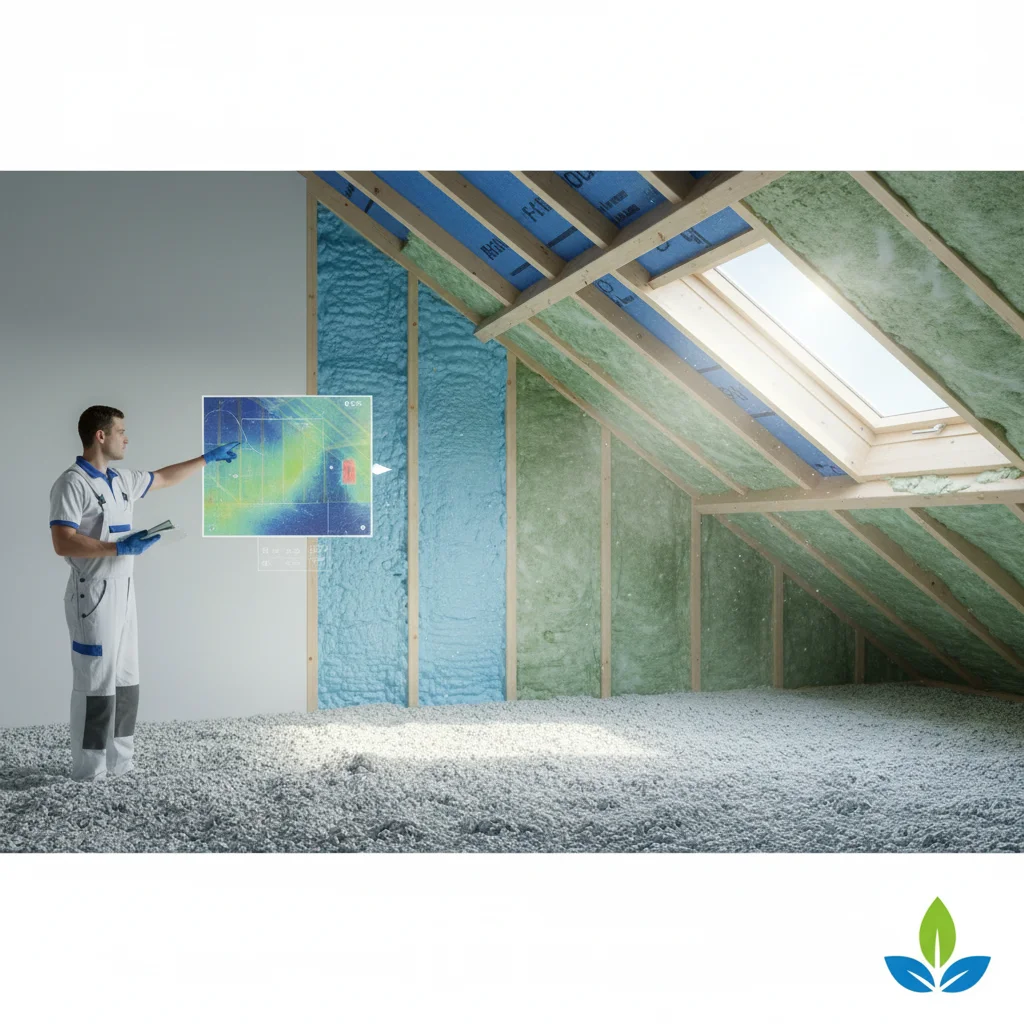
California homeowners who skipped energy audits in 2025 left $847 million in rebates unclaimed—most didn't realize audits unlock access to federal, state, and utility incentives worth $2,000-$8,000 per household. And the requirements changed in 2026 when the IRA framework replaced the expired Section 25C and 25D credits.
What Does an Insulation Energy Audit Cost and What's Included?
Professional energy audits for insulation rebates cost $300-$500 in California, though many utility companies offer free or subsidized assessments for customers applying for efficiency programs. The audit includes blower door testing to measure air leakage (measured in cubic feet per minute at 50 pascals pressure differential), infrared imaging to identify thermal bridging and missing insulation, and combustion safety testing for gas appliances. Auditors produce a detailed report with current R-values (thermal resistance ratings) for attic, wall, and floor insulation, plus recommended upgrades to meet program requirements. Most audits take 2-3 hours for a 2,000 square foot home.
"Comprehensive home energy assessments identify the most cost-effective improvements and are required for many rebate programs under the Inflation Reduction Act." — Department of Energy
Which Insulation Types Qualify for Rebates and Tax Credits in 2026?
The federal Energy Efficient Home Improvement Credit (Section 25C) ended for property placed in service after December 31, 2025 (IRS FS-2025-05). Federal tax credits for this work have ended, but state, local and utility rebates may still apply; check what is available at your address with the DuloCore rebate calculator. But the insulation must meet specific R-value thresholds: attics require R-49 to R-60 in California climate zones, walls need R-13 to R-21, and crawl spaces demand R-25 to R-30. State programs like TECH Clean California add $2,000-$4,000 for whole-home retrofits that include insulation upgrades paired with heat pump rebates or energy tax credits. So verify current program rules at DSIRE USA before purchasing materials.
How Do Insulation Efficiency Ratings Affect Your Energy Savings and ROI?
Homes that upgrade from R-11 wall insulation to R-21 reduce heating and cooling costs by 15-25%, saving $300-$600 annually in California's coastal and inland valley climate zones. And attic insulation upgrades from R-19 to R-49 cut energy bills by 20-30% in homes with central air conditioning. The payback period for a $3,500 insulation project with a $1,400 federal tax credit and $800 utility rebate is 3-5 years at current electricity rates of $0.28-$0.34 per kWh. But actual savings depend on existing insulation levels, home age (pre-1980 homes see larger gains), and HVAC system efficiency (SEER ratings above 16 maximize insulation benefits).
Use our free rebate calculator to estimate your project savings based on your home's specifications and available incentives.
What's the Typical Installation Cost for Different Insulation Materials?
Blown-in cellulose costs $1.50-$2.50 per square foot installed, making it the most affordable option for attic spaces and retrofitting existing walls. Fiberglass batts run $0.75-$1.50 per square foot but require accessible cavities, limiting use to unfinished attics and new construction. Spray foam insulation costs $3.00-$7.00 per square foot depending on open-cell (R-3.5 per inch) versus closed-cell (R-6.5 per inch) application. So a 1,500 square foot attic insulation upgrade from R-19 to R-49 costs $2,250-$3,750 with blown-in cellulose, $4,500-$10,500 with spray foam. Labor accounts for 50-60% of total project cost in California markets.
How Long Does Insulation Last and What Maintenance Do You Really Need?
Fiberglass and mineral wool insulation maintain R-value performance for 80-100 years when protected from moisture and physical damage, requiring zero maintenance in properly ventilated attics and wall cavities. But cellulose settles 10-20% over 15-20 years, reducing effective R-value by 2-4 points and potentially requiring top-up installation. Spray foam lasts 80+ years with no settling or degradation. And all insulation types lose effectiveness when compressed (reducing R-value by 50% when packed to half-thickness) or exposed to water intrusion (fiberglass loses 50% of R-value when wet, cellulose requires replacement after water damage). Annual visual inspections in attics catch problems before they compromise energy savings.
Insulation vs. Air Sealing vs. HVAC Upgrades: Which Gives the Best Return?
Air sealing delivers $1.50-$3.00 in energy savings per dollar spent, the highest ROI of any efficiency measure, by stopping infiltration that accounts for 25-40% of heating and cooling losses. Insulation upgrades return $1.00-$1.50 per dollar invested when combined with air sealing but only $0.50-$0.80 when installed alone. And HVAC replacements with high-efficiency heat pumps (SEER 18-22, HSPF 10-13) return $0.80-$1.20 per dollar over equipment lifetime. So the optimal sequence is air sealing first ($800-$1,500), then insulation ($2,500-$5,000), then HVAC upgrades ($8,000-$15,000) to maximize savings and avoid oversizing new equipment. Learn more about comprehensive upgrades at insulation rebates.
| Program | Insulation Rebate | Air Sealing Rebate | Energy Audit Required | 2026 Deadline |
|---|---|---|---|---|
| IRA Federal Tax Credit | Ended Dec 31, 2025 | Ended Dec 31, 2025 | — | Ended Dec 31, 2025 |
| TECH Clean California | $2,000-$4,000 | $500-$1,000 | Yes | December 31, 2026 |
| PG&E Home Upgrade | $1,500-$2,500 | $400-$800 | Yes | Ongoing (annual budget) |
| SoCalGas Energy Savings | $1,200-$2,000 | $300-$600 | Yes | December 31, 2026 |
Official Sources
- Department of Energy Save Energy, Save Money — Federal guidance on home energy upgrades and IRA tax credits (note: the federal 25C and 25D credits ended for projects completed after December 31, 2025)
- DSIRE Database of State Incentives — Comprehensive directory of state and utility rebate programs
- ENERGY STAR Home Upgrade — EPA recommendations for insulation and air sealing standards
Related Reading: Learn more about Landlord Energy Audit Requirements.
Frequently Asked Questions
What are the requirements for an energy audit before installing insulation?
Most utility and state rebate programs require a certified BPI (Building Performance Institute) or RESNET HERS rater to conduct the audit using calibrated equipment. The audit must document current insulation R-values, air leakage rates measured with blower door testing, and combustion appliance safety. And the report must be submitted with rebate applications within 6-12 months of the audit date depending on program rules.
How much does an energy audit cost for insulation rebates?
Professional energy audits cost $300-$500 for homes under 3,000 square feet in California markets. But PG&E, SoCalGas, and SDG&E offer free or $50 co-pay audits for customers applying for rebates through utility programs. And some contractors bundle audit costs into project pricing when performing insulation installation, effectively waiving the separate fee.
Are energy audits required to qualify for insulation tax credits?
The federal Energy Efficient Home Improvement Credit (Section 25C) ended for property placed in service after December 31, 2025 (IRS FS-2025-05). But state programs like TECH Clean California and utility rebates from PG&E and SoCalGas mandate professional audits to verify existing conditions and confirm post-installation R-values meet program thresholds of R-49 to R-60 for attics.
Can I get an insulation rebate without a professional energy audit?
Federal tax credits allow homeowners to self-certify insulation R-values using manufacturer specifications and installation photos, requiring no third-party audit. But California utility rebates worth $1,200-$2,500 require BPI-certified auditors to verify pre- and post-installation R-values with infrared imaging and blower door tests. So skipping the audit means leaving $2,000-$4,000 in utility and state rebates unclaimed while still qualifying for the 30% federal credit (this federal credit ended for property placed in service after December 31, 2025).
How long does an energy audit take for insulation eligibility?
Most residential energy audits take 2-3 hours for homes under 2,500 square feet, including blower door setup (30 minutes), infrared scanning (45 minutes), attic and crawl space inspection (45 minutes), and combustion safety testing (30 minutes). And auditors deliver written reports within 5-7 business days with recommended R-values and rebate program eligibility verification. Scheduling typically requires 1-2 weeks' notice during peak season from October through March.
Ready to find out how much you can save? Use our rebate calculator to get personalized estimates based on your home's current insulation levels, local utility programs, and federal tax credits. Enter your zip code, home size, and planned upgrades to see your total incentive amount in under 60 seconds.
Last reviewed: April 14, 2026. Reviewed by DuloCore Energy Specialists. About the team.
Check your California insulation rebate eligibility — see the programs you qualify for and the dollar amounts on our California insulation rebate finder.