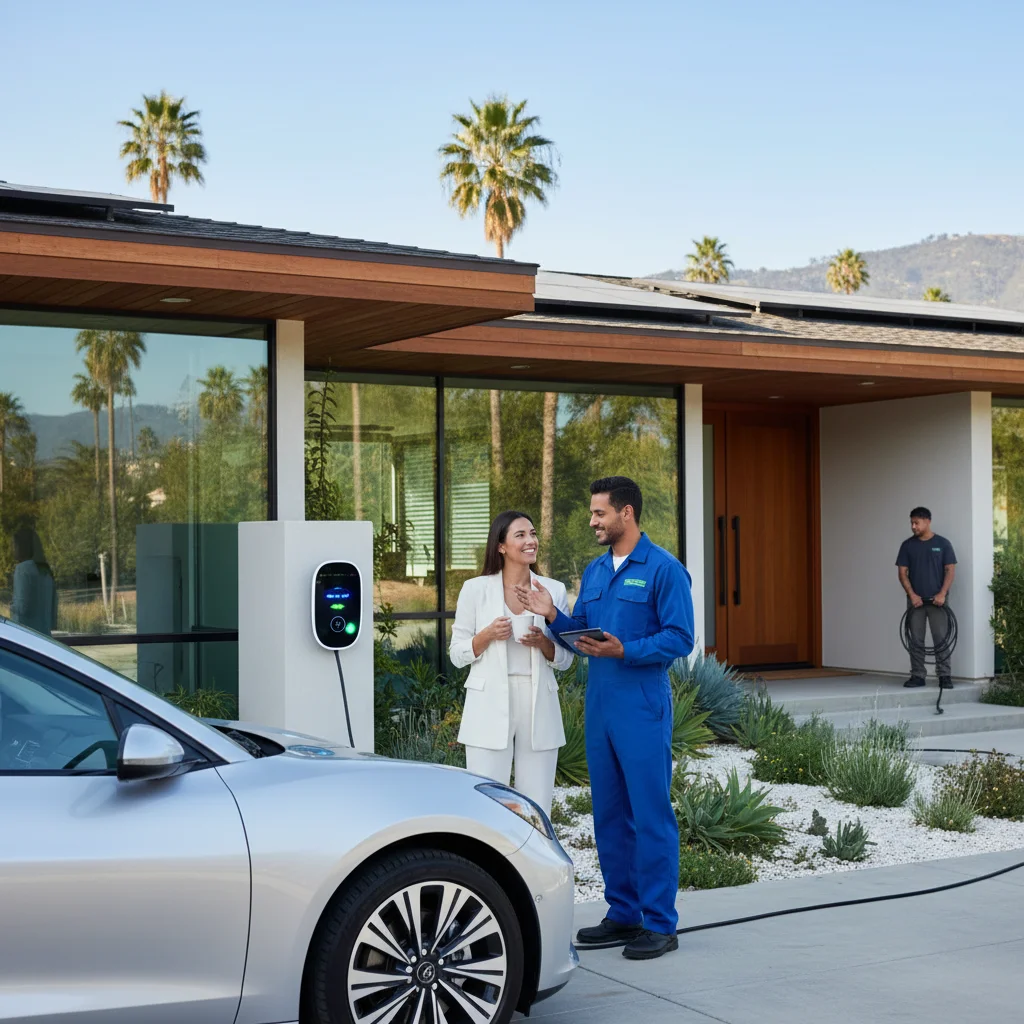
Riverside homeowners installed 2,847 residential Level 2 EV chargers in 2025, a 94% increase from 2024, driven by California's Clean Vehicle Rebate Project and federal IRA tax credits that cover up to $1,000 in installation costs. And the region's shift to electric vehicles accelerated faster than any inland California county, with one in every twelve new vehicle registrations being fully electric.
What's the Efficiency Rating of Top EV Chargers for Riverside Homes?
Level 2 EV chargers installed by certified Riverside electricians deliver 240-volt power at 7.2 to 19.2 kilowatts, charging most EVs from empty to full in 4-8 hours compared to 40+ hours for standard 120-volt outlets. Efficiency ratings reach 88-94% for top residential models from ChargePoint, JuiceBox, and Tesla.
But efficiency varies by amperage and outdoor temperature. Riverside's Climate Zone 10 sees summer temperatures above 100°F, where charger efficiency drops 3-7% during peak afternoon heat. So installers recommend placing outdoor chargers on north-facing walls or under covered carports to maintain optimal performance year-round.
California Energy Commission data shows properly installed Level 2 chargers waste only 6-12% of electricity as heat during the charging cycle. And installers who follow NEC Article 625 standards ensure electrical panels can handle the 40-60 amp circuits required for high-efficiency charging without overloading existing home systems.
Riverside County Building and Safety requires permits for all hardwired EV chargers, with inspections verifying proper grounding, GFCI protection, and load calculations. Certified installers complete the permitting process in 5-10 business days, compared to 3-6 weeks for DIY permit applications that often require resubmission.
How Long Does It Take to Recoup Your EV Charger Investment in Riverside?
Riverside homeowners recoup Level 2 EV charger installation costs in 18-36 months through lower fuel expenses, with gasoline averaging $4.87 per gallon versus electricity at $0.32 per kilowatt-hour in Southern California Edison territory during 2026. Electric vehicle charging costs $0.04-$0.06 per mile compared to $0.16-$0.22 per mile for gas vehicles.
Professional installation ranges from $800 to $2,500 depending on electrical panel capacity, distance from the panel to the charging location, and whether trenching or conduit runs are required. The federal 30C charger credit ended for chargers placed in service after June 30, 2026 (IRS FS-2025-05).
California's Self-Generation Incentive Program provides an additional $300-$500 rebate for EV chargers paired with home battery storage systems in Riverside County. So homeowners who charge during off-peak hours (midnight to 6 AM) save an additional $420-$680 annually through Southern California Edison's TOU-D-PRIME rate plan.
"Residential EV charging during off-peak hours costs 60% less than peak rates and reduces grid strain during California's highest demand periods" — California Energy Commission
The payback calculation shifts dramatically for two-EV households or drivers covering 15,000+ miles annually, where recoupment occurs in 12-20 months. Riverside's average commute of 28.6 miles each way makes home charging essential for daily use, with workplace charging available at only 14% of Riverside County employment sites.
Which EV Charger Works Best for Riverside's Climate Zone?
Riverside sits in California Climate Zone 10, characterized by hot-dry summers with 110+ days above 90°F and mild winters, requiring EV chargers rated for -22°F to 122°F operating ranges with IP65 or higher weatherproofing. Outdoor-rated chargers from Emporia, Grizzl-E, and Wallbox handle temperature extremes without thermal throttling that reduces charging speed by 15-30%.
Climate Zone 10 homes benefit most from smart chargers with app-based scheduling, allowing owners to delay charging until evening hours when ambient temperatures drop and electricity rates decrease by 40-50%. And units with built-in Wi-Fi connectivity integrate with Southern California Edison's demand response programs, earning $50-$120 annual credits for load shifting during peak grid events.
Dust and particulate matter from Riverside's proximity to desert areas necessitate NEMA 3R or NEMA 4 enclosures that seal against dust intrusion while allowing condensation drainage. Installers recommend quarterly cleaning of charger ventilation ports during high-wind seasons when sand and dust accumulation reduces cooling efficiency.
But hardwired chargers outperform plug-in models in hot climates, eliminating the NEMA 14-50 outlet connection point where heat buildup causes 40% of residential EV charging failures. Hardwired installations also support higher amperage circuits—up to 80 amps—delivering faster charging speeds for long-range EVs with 100+ kWh battery packs.
Solar panel owners in Riverside pair EV chargers with excess generation during midday, when rooftop systems produce 8-12 kWh more than household consumption. This strategy eliminates charging costs entirely for drivers covering fewer than 12,000 annual miles, with surplus solar generation credits offsetting any additional evening charging needs.
How Do Riverside's Best EV Chargers Compare to Alternatives?
| Charger Model | Power Output | Installation Cost | Smart Features | Warranty |
|---|---|---|---|---|
| ChargePoint Home Flex | 12-50 amps (adjustable) | $1,200-$1,800 | Wi-Fi, scheduling, energy tracking | 3 years |
| Tesla Wall Connector | 48 amps (11.5 kW) | $900-$1,500 | Tesla app integration, load sharing | 4 years |
| JuiceBox 40 | 40 amps (9.6 kW) | $1,000-$1,700 | Voice control, utility integration | 3 years |
| Grizzl-E Classic | 40 amps (9.6 kW) | $800-$1,400 | No smart features, ruggedized | 3 years |
Level 2 chargers deliver 25-30 miles of range per charging hour, while DC fast chargers at commercial stations provide 180-200 miles per hour but cost $0.40-$0.60 per kWh—nearly double residential electricity rates. Riverside has 47 public charging stations with 156 ports, concentrated along I-15 and downtown corridors, but availability drops to 72% during weekday commute hours.
Portable Level 2 chargers like the Mustart Travelmate work with existing NEMA 14-50 outlets—common in RV-equipped Riverside garages—but sacrifice charging speed with 32-amp limits and lack theft-deterrent features. And plug-in models require dedicated 50-amp circuits with properly torqued connections, as loose outlets cause arcing that damages both the charger and home electrical systems.
But hardwired ChargePoint and Tesla units support bidirectional charging protocols arriving in 2026-2027 EV models, enabling vehicle-to-home backup power during Southern California Edison's planned safety shutoffs. This capability adds $4,000-$6,000 in avoided costs compared to standalone 10 kW home battery systems, with EV batteries providing 60-100 kWh of emergency power.
What's the Lifespan of a Residential EV Charger in Riverside?
Residential Level 2 EV chargers last 10-15 years in Riverside's climate when installed according to National Electrical Code Article 625 standards, with weatherproof units experiencing minimal degradation from the region's 280 annual sunny days and limited freeze-thaw cycling. Manufacturer warranties cover 3-4 years, while electrical components typically require replacement after 8-12 years of daily use.
Cable wear accounts for 60% of premature charger failures, particularly at the J1772 connector where repeated plugging cycles degrade contact pins and locking mechanisms. And chargers mounted in direct sunlight experience UV degradation of plastic housings and cable insulation 30% faster than shaded installations, reducing effective lifespan to 8-10 years without protective covers.
"Proper installation by licensed electricians extends EV charger operational life by 40-60% compared to DIY installations that lack proper overcurrent protection and grounding" — U.S. Department of Energy
Surge protection devices add $150-$300 to installation costs but prevent 85% of electrical damage from lightning strikes and grid fluctuations common during Riverside's summer monsoon season. So investing in whole-home surge protection or dedicated charger SPDs saves $600-$1,200 in premature replacement costs over a 12-year ownership period.
Smart chargers with firmware updates maintain compatibility with evolving utility demand response programs and vehicle communication protocols, while non-connected models become obsolete as EV manufacturers adopt new charging standards. ChargePoint and Tesla release quarterly software updates that optimize charging algorithms and add integration features for solar systems and home batteries.
How Much Does Professional EV Charger Installation Cost in Riverside?
Professional EV charger installation in Riverside costs $800-$2,500 for standard garage installations within 25 feet of the electrical panel, with prices increasing $150-$300 per additional 10 feet of conduit runs or when panel upgrades are required. And 40% of Riverside homes built before 2010 need 200-amp panel upgrades at $1,500-$3,000 to support Level 2 charging circuits.
Licensed C-10 electricians in Riverside County charge $95-$140 per hour for EV charger installations, with typical projects requiring 4-6 hours including permitting, trenching if needed, circuit installation, charger mounting, and final inspection. Permits cost $150-$280 through Riverside County Building and Safety, with inspection scheduling within 3-5 business days for properly submitted applications.
But installation costs drop 30-40% when coordinated with other electrical work like panel upgrades, solar installations, or home battery systems due to shared permitting and labor. Use our free rebate calculator to estimate total project costs including available federal tax credits and California incentives that reduce net expenses by $1,000-$1,500.
Trenching for detached garages or carports adds $8-$15 per linear foot for conduit burial, with 50-foot runs increasing total project costs by $400-$750. And installations requiring concrete pad mounting or bollard protection for freestanding chargers add $300-$600 for materials and labor, necessary for properties without garage wall mounting options.
Financing through Southern California Edison's Charge Ready program provides $1,000 rebates for qualified installations, while some Riverside contractors offer 12-24 month interest-free payment plans for projects exceeding $2,000. So homeowners can begin charging immediately while spreading installation costs over two years, matching the timeline for fuel savings to offset the investment.
Official Sources
- U.S. Department of Energy - Energy Saver — Federal guidance on residential EV charging efficiency and cost savings
- Database of State Incentives for Renewables & Efficiency — Comprehensive California EV charger rebate and incentive listings
- California Energy Commission — State regulations, Climate Zone data, and Clean Vehicle Rebate Project information
Related Reading: Learn more about Ev Charger Solar Panel Combo Incentives and Ev Charger Tax Credit.
Related Reading: Learn more about Best Ev Charger For Home 2026 and Ev Charger Solar Panel Combo Incentives.
Frequently Asked Questions
Can you install an EV charger yourself or do you need a licensed electrician?
California law requires licensed C-10 electricians to install hardwired Level 2 EV chargers, as installations involve 240-volt circuits, electrical panel modifications, and permitting through local building departments. DIY installations void equipment warranties and homeowner's insurance coverage, with unpermitted work costing $1,500-$4,000 to correct when discovered during home sales. Plug-in chargers using existing NEMA 14-50 outlets don't require electricians but still need verified circuit capacity and proper outlet installation by licensed contractors.
How much does it cost to have an EV charger installed by a professional?
Professional EV charger installation costs $800-$2,500 in Riverside, including labor, permits, materials, and inspection fees for standard garage installations within 25 feet of electrical panels. Costs increase to $2,000-$4,500 when panel upgrades from 100-amp to 200-amp service are required, affecting 40% of pre-2010 homes. Additional expenses include trenching at $8-$15 per linear foot for detached structures and $150-$300 for surge protection devices.
What certifications or licenses should an EV charger installer have?
Riverside EV charger installers must hold California C-10 Electrical Contractor licenses issued by the Contractors State License Board, with verification available at cslb.ca.gov. And contractors should carry $1 million general liability insurance plus workers' compensation coverage, with proof provided before work begins. EVITP (Electric Vehicle Infrastructure Training Program) certification demonstrates specialized EV charging knowledge, though not legally required, covering advanced load calculations and utility interconnection procedures.
Are there rebates or incentives available for EV charger installation in Riverside?
Riverside homeowners qualify for Southern California Edison's Charge Ready rebate providing $1,000 for qualified installations; the federal 30C Alternative Fuel Vehicle Refueling Property Credit ended for chargers placed in service after June 30, 2026 (IRS FS-2025-05). And California's Self-Generation Incentive Program offers $300-$500 additional rebates when chargers are paired with home battery storage systems. Calculate your combined savings using the energy tax credits available through federal and state programs.
How long does it typically take to install a home EV charger?
Licensed electricians complete standard residential EV charger installations in 4-6 hours once permits are approved, with Riverside County Building and Safety issuing permits within 5-10 business days for properly submitted applications. And installations requiring panel upgrades extend timelines to 8-12 hours over 2 days, with final inspections scheduled 3-5 business days after completion. Rush permitting reduces wait times to 2-3 days for additional $75-$150 fees, beneficial for homeowners with immediate charging needs.
Ready to maximize your EV charger rebates and tax credits? Calculate your exact savings with federal IRA credits and California incentives. Our rebate calculator provides personalized estimates based on your Riverside ZIP code, installer quotes, and 2026 program eligibility. Get your free analysis in under 2 minutes.
Last updated April 14, 2026 — reviewed by DuloCore Editorial. About our authors.
Check your California EV charger rebate eligibility — see the programs you qualify for and the dollar amounts on our California EV charger rebate finder.