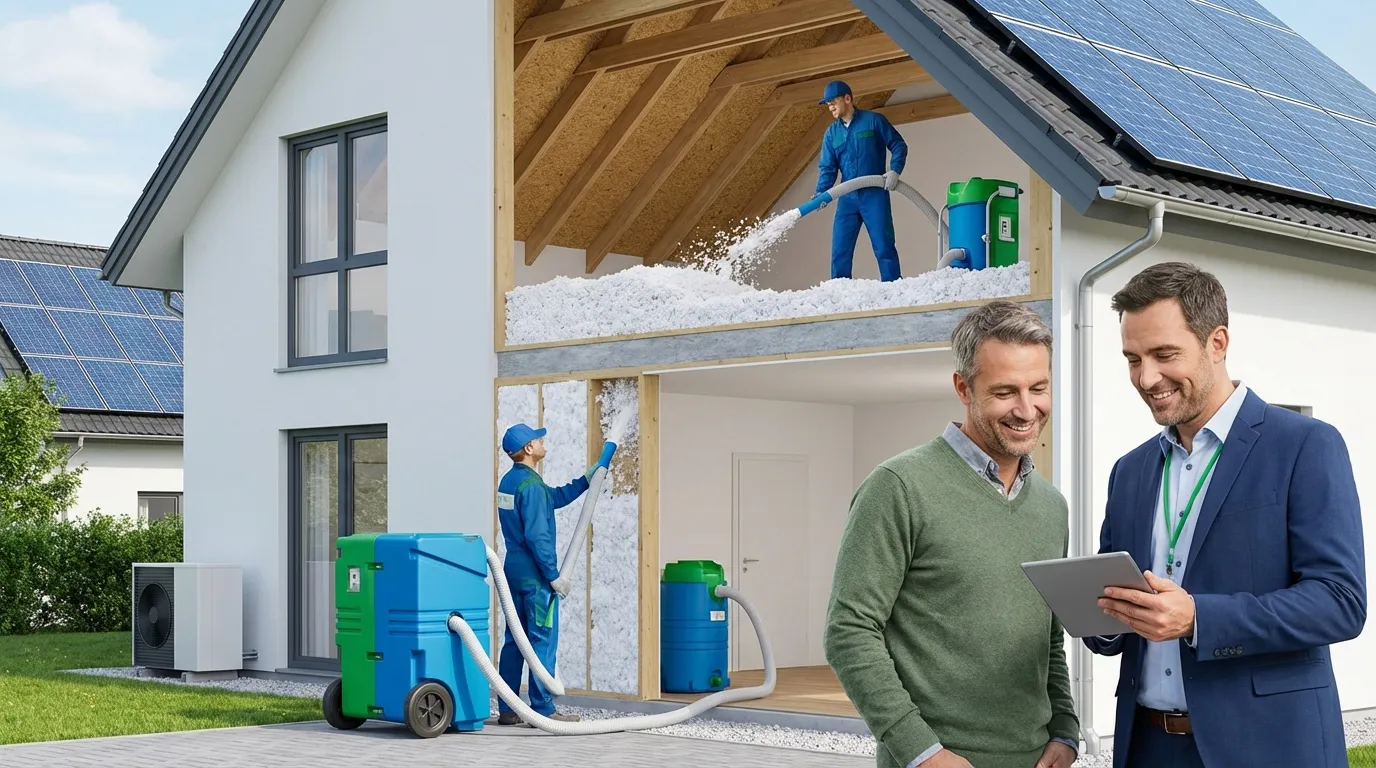
Up to 90% of U.S. homes are under-insulated, leading to an average energy loss of 25-30% through attics and walls alone. This isn't just a comfort issue; it's a direct drain on your bank account every single month. So, homeowners are now leveraging a suite of government and utility programs designed to offset the cost of fixing this exact problem, turning a necessary home improvement into a financially savvy investment.
How Much Can You Save: Unpacking Blown-In Insulation Rebate Amounts and Eligible Equipment?
Blown-in insulation rebates are financial incentives from federal, state, and utility programs that reduce the net cost of insulation projects. The federal Energy Efficient Home Improvement Credit (Section 25C) ended for property placed in service after December 31, 2025 (IRS FS-2025-05). Federal tax credits for this work have ended, but state, local and utility rebates may still apply; check what is available at your address with the DuloCore rebate calculator.
The federal Energy Efficient Home Improvement Credit (Section 25C) ended for property placed in service after December 31, 2025 (IRS FS-2025-05). And state-level programs, administered through entities like NYSERDA or Mass Save, offer additional point-of-sale rebates or mail-in checks, often ranging from $200 to over $1,600. So, the total savings depend on your location and income. But utility companies frequently provide their own rebates, sometimes calculated per square foot of insulation installed, adding another layer of savings. Eligible equipment typically includes cellulose, fiberglass, or mineral wool blown-in insulation, and comprehensive air sealing measures must often be completed by a certified professional. These combined incentives can reduce the total project cost by 50% or more for qualified households. More information is available on general insulation rebates.
The core tension for homeowners is balancing the upfront installation cost, which averages $1,500 to $3,500, against long-term energy savings. So what? This matters because proper insulation isn't just about comfort; it's a direct financial countermeasure to rising energy prices. The U.S. Department of Energy states that air sealing and insulating the "shell" of a home is often the most cost-effective way to improve energy efficiency, saving homeowners an average of 15% on heating and cooling costs.
Am I Eligible? Understanding State, Utility, and Income Limits for Insulation Rebates
Eligibility for blown-in insulation rebates is determined by your geographic location, utility provider, and household income. Federal tax credits are broadly available to homeowners, but state and utility programs often have specific income thresholds, such as earning below 80% or 150% of the Area Median Income (AMI).
Your eligibility hinges on several factors. And the federal tax credit has no income limit, making it accessible to most homeowners who own their primary residence. But state-administered programs, like those funded by the Inflation Reduction Act, are income-dependent. So, low-to-moderate-income households (typically defined as below 150% of the Area Median Income) often qualify for higher rebate amounts, sometimes covering 100% of the project cost up to a certain cap. Utility rebates are tied to being a customer of that specific provider, such as Con Edison or PG&E. Many programs also require a pre-installation energy audit to identify the most critical areas for improvement. You can check your state's specific requirements on the DSIRE database.
"Energy efficiency tax credits are available for specific improvements to your main home." — Internal Revenue Service
What's the Application Process and Do I Need a Specific Contractor for My Rebate?
The application process for blown-in insulation rebates requires homeowners to work with program-approved contractors and submit detailed documentation post-installation. Most programs mandate using certified professionals, like those with Building Performance Institute (BPI) credentials, to ensure the work meets specific energy-saving standards and qualifies for the incentive.
The process typically begins with finding a participating contractor through your state or utility's online portal. And this step is critical, as work done by uncertified installers is often ineligible for rebates. So, the contractor performs an energy assessment, provides a quote, and helps you complete any pre-approval paperwork. But after the blown-in insulation is installed, you or the contractor must submit the final invoice, proof of payment, and any required rebate forms to the program administrator. For federal energy tax credits, you'll claim the credit on IRS Form 5695 when you file your annual taxes. The turnaround time for direct rebates varies from 4 to 12 weeks.
Blown-In Insulation Rebate Program Comparison
| Program Name | Typical Amount | Key Eligibility Requirement | Typical Deadline |
|---|---|---|---|
| Federal Tax Credit (25C (now expired, replaced by the Energy Efficient Home Improvement Credit)) | 30% of cost, up to $1,200 | Must be primary residence; no income limit | Ended Dec 31, 2025 |
| State Rebate (e.g., Mass Save) | Up to 75-100% of cost | Income-based (e.g., <80% AMI); must use approved contractor | Varies by state; often annual funding cycles |
| Utility Rebate (e.g., Duke Energy) | $0.20-$0.50 per sq. ft. | Must be a customer of the utility; often requires pre-audit | Varies by utility; funding is first-come, first-served |
When Do Blown-In Insulation Rebates Expire, and Is Funding Still Available?
Blown-in insulation rebate deadlines are program-specific, with federal tax credits extending through 2032 while state and utility funds are subject to annual renewal. Funding is generally available but operates on a first-come, first-served basis, making prompt application essential before annual budgets are depleted for the year.
The federal Energy Efficient Home Improvement Credit (Section 25C) ended for property placed in service after December 31, 2025 (IRS FS-2025-05). So, homeowners have a clear, multi-year window to plan their projects and claim this credit. But state and utility programs are different. And their funding is allocated annually and can be exhausted before the end of the year, especially in regions with high demand. So, it's crucial to check the funding status on your local program's website before starting a project. Many programs reset their funding at the beginning of the calendar or fiscal year. Acting early in the year increases the likelihood that funds are still available to claim.
"Save money on your utility bills by making your home more energy efficient. We have tips, articles, and resources to help you save." — U.S. Department of Energy
Can I Combine Blown-In Insulation Rebates with Other Energy Efficiency Programs?
Yes, homeowners can combine, or "stack," blown-in insulation rebates with other energy efficiency programs to maximize savings. Federal tax credits can typically be applied alongside state and local utility rebates, though specific state rules may prevent stacking multiple state-level incentives for the same project.
Stacking incentives is a powerful strategy for reducing out-of-pocket costs. And a homeowner can claim the 30% federal tax credit on the insulation cost after a state or utility rebate has been applied. For example, if a $4,000 insulation project receives a $1,000 utility rebate, the homeowner's net cost is $3,000. The federal Energy Efficient Home Improvement Credit (Section 25C) ended for property placed in service after December 31, 2025 (IRS FS-2025-05). But always verify the rules for your specific state program, as some prohibit combining their funds with other offers. This stacking principle often applies to other upgrades, allowing you to combine insulation savings with heat pump rebates for a whole-home efficiency overhaul.
Frequently Asked Questions
What are the eligibility requirements for blown-in insulation rebates?
Eligibility primarily depends on your location, income, and utility provider. Federal tax credits are widely available to homeowners for their primary residence without an income cap. But state and utility rebates often require you to be a customer in a specific service area and meet income thresholds, such as being at or below 80% or 150% of the Area Median Income (AMI).
How much can I expect to save with blown-in insulation rebates?
Savings vary. The federal Energy Efficient Home Improvement Credit (Section 25C) ended for property placed in service after December 31, 2025 (IRS FS-2025-05). State and utility rebates can add another $200 to $1,600 or more, with some income-qualified programs covering up to 100% of the installation cost. So, combining programs can reduce your total project expense by 50% or more.
What is the application process for blown-in insulation rebates?
The process involves selecting a program-approved contractor, who often handles the paperwork. And it typically requires a pre-installation assessment, completion of the work, and submission of an itemized invoice and rebate form to the program administrator. Form 5695 only covers qualifying work completed by December 31, 2025 and claimed on a 2025 return; the federal 25C and 25D credits ended after that date (IRS FS-2025-05).
Are there deadlines for blown-in insulation rebate applications?
Yes. The federal Energy Efficient Home Improvement Credit (Section 25C) ended for property placed in service after December 31, 2025 (IRS FS-2025-05). But state and utility programs operate on annual funding cycles and are first-come, first-served. So, these funds can run out before the end of the year, making it important to apply early.
Can blown-in insulation rebates be combined with other energy efficiency programs?
Yes, in most cases. You can typically combine, or "stack," a federal tax credit with a state or local utility rebate. For example, after a utility rebate lowers your initial cost, you can claim the 30% federal credit (this federal credit ended for property placed in service after December 31, 2025) on the remaining balance. But always check your local program’s rules, as some prohibit stacking.
Calculate Your Rebates with our free rebate calculator.
Ready to Save on Your Home Improvement?
Use our free rebate calculator to find every federal, state, and utility incentive you qualify for.
Official Sources
Updated: April 14, 2026 — fact-checked by DuloCore Research. About our editorial process.
Check your California insulation rebate eligibility — see the programs you qualify for and the dollar amounts on our California insulation rebate finder.