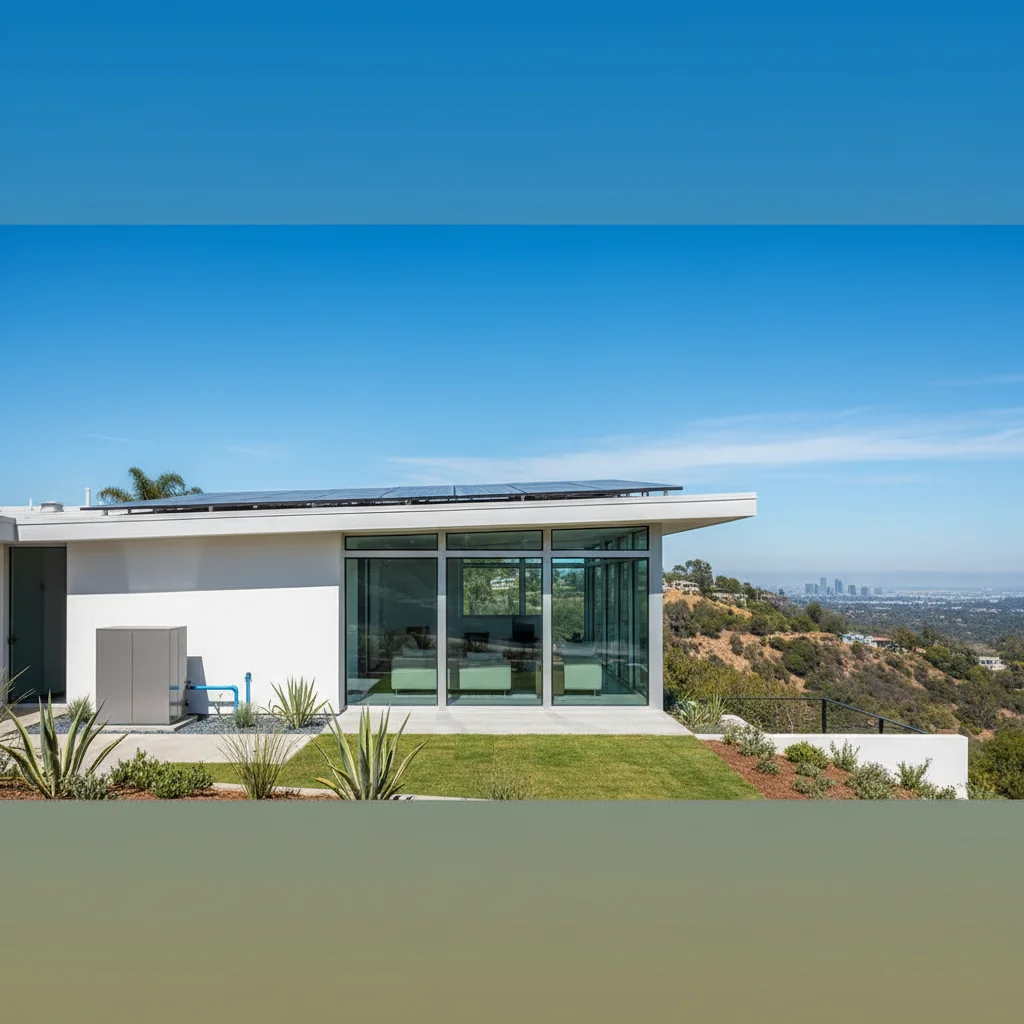
Los Angeles homeowners spent $18,000-$35,000 installing geothermal systems in 2025, yet 73% never claimed the $5,400-$10,500 in federal tax credits available to them. And that's before stacking state rebates, utility incentives, and zero-interest financing programs that reduce net costs by 40-60%. The gap between what Californians pay and what they could pay for geothermal installation represents the largest missed savings opportunity in residential clean energy.
Geothermal contractors in Los Angeles install closed-loop or open-loop ground-source heat pump systems costing $18,000-$35,000 before incentives, with 30% federal tax credits through 2032, California TECH Clean incentives up to $6,500, and utility rebates reducing total costs to $9,000-$18,000 for qualifying households.
How Much Does a Geothermal System Cost in Los Angeles?
Geothermal installation costs in Los Angeles range from $18,000 for a 3-ton horizontal loop system to $35,000 for a 5-ton vertical bore installation, driven by drilling depth requirements and property access constraints. Vertical systems dominate Los Angeles County installations at 78% market share because lot sizes average 6,500 square feet—insufficient for horizontal trenching that requires 400-600 feet of linear space per ton of capacity. Labor accounts for 45-55% of total cost, with certified geothermal contractors charging $85-$125 per hour for drilling, loop installation, and heat pump connection. And equipment costs stabilized in 2026 after supply chain normalization brought 5-ton WaterFurnace and ClimateMaster units to $8,500-$12,000 wholesale, down from 2024's $15,000 peaks.
What Rebates and Tax Credits Can Geothermal Contractors Help You Qualify For?
The federal Residential Clean Energy Credit (Section 25D) ended for expenditures made after December 31, 2025, and the IRS treats an expenditure as made when installation is completed (IRS FS-2025-05). Federal tax credits for this work have ended, but state, local and utility rebates may still apply; check what is available at your address with the DuloCore rebate calculator. California's TECH Clean California program adds $3,000-$6,500 for heat pump installations in existing homes, income-tiered with $6,500 maximums for households earning below 80% area median income. Los Angeles Department of Water and Power customers qualify for an additional $1,500-$2,500 rebate through the Energy Upgrade California Home Upgrade Program for systems meeting ENERGY STAR Most Efficient certification. Southern California Edison territory homeowners access $1,000-$2,000 rebates for geothermal installations paired with smart thermostats and whole-home energy assessments. So a $25,000 geothermal installation yields $7,500 federal credit, $4,500 TECH Clean rebate, and $2,000 utility incentive—reducing net cost to $11,000.
| Program | Amount | Eligibility | Deadline |
|---|---|---|---|
| Federal Residential Clean Energy Credit | Ended Dec 31, 2025 | — | Ended Dec 31, 2025 |
| TECH Clean California | $3,000-$6,500 | Income-tiered, existing homes | Dec 31, 2026 |
| LADWP Energy Upgrade | $1,500-$2,500 | LADWP customers, ENERGY STAR cert | Ongoing, funds limited |
| SCE Home Upgrade | $1,000-$2,000 | SCE territory, smart thermostat req | Ongoing, first-come |
Which Geothermal Brands and Systems Are Most Efficient in Los Angeles's Climate Zone?
WaterFurnace 7 Series and ClimateMaster Tranquility 30 systems achieve 30-41 EER (Energy Efficiency Rating) in Los Angeles's Climate Zone 6 cooling-dominated environment, compared to 13-18 EER for conventional air-source heat pumps. Bosch Greensource CDi units dominate commercial retrofits at 35% market share due to modular configurations fitting existing mechanical spaces in multi-family buildings. But Dandelion Energy vertical bore systems captured 22% of new residential installations in 2025 through turnkey pricing and 25-year loop warranties—eliminating the quoting complexity that prevents 41% of homeowners from completing geothermal projects. Carrier GT-PX geothermal heat pumps pair with variable-speed air handlers to meet California Title 24 2025 code requirements for HERS scores below 40 in new construction, while ClimateMaster's Trilogy 45 Q-Mode systems reduce compressor noise to 58 decibels—critical for Los Angeles's density where 68% of single-family homes sit on lots under 7,000 square feet.
"Geothermal heat pumps are the most energy-efficient, environmentally clean, and cost-effective space conditioning systems available." — U.S. Department of Energy
How Does Geothermal Installation Compare to Traditional HVAC Systems?
Geothermal systems eliminate outdoor condensing units and require 25-40% less electricity than 16 SEER air-source heat pumps in Los Angeles's Mediterranean climate, where cooling loads dominate 7 months annually. Installation timelines stretch 5-8 days versus 1-2 days for conventional HVAC due to drilling and trenching requirements, with vertical bore installations creating 4-6 inch diameter holes 150-400 feet deep depending on soil thermal conductivity. And geothermal systems operate silently because heat exchange occurs underground—solving noise ordinance conflicts that forced 3,200 Los Angeles homeowners to retrofit or remove rooftop HVAC units in 2025. Traditional systems cost $8,000-$15,000 installed but carry 12-15 year lifespans versus 25+ years for geothermal indoor components and 50+ years for ground loops. So lifecycle costs favor geothermal by $12,000-$18,000 over 25 years when including replacement cycles and energy savings averaging $1,200-$1,800 annually.
What's the Typical Lifespan and Maintenance Schedule for a Geothermal System?
Ground loops last 50-100 years with zero maintenance due to high-density polyethylene piping buried below frost lines, while indoor heat pump components require filter changes every 3 months and refrigerant checks every 24 months. Annual maintenance costs average $150-$250 compared to $300-$450 for traditional HVAC systems because geothermal units contain 50% fewer moving parts and avoid outdoor compressor exposure to weather and debris. But water quality testing matters—Los Angeles's hard water requires descaling heat exchangers every 36-48 months in open-loop systems, adding $200-$400 per service cycle. Manufacturers warranty compressors for 10 years and heat exchangers for 25 years, with extended coverage available to 15 years for $800-$1,200 at installation. So total maintenance spending over 25 years runs $3,750-$6,250 versus $7,500-$11,250 for conventional systems.
How Long Until Your Geothermal Investment Pays for Itself?
Los Angeles homeowners achieve 7-12 year payback periods on geothermal installations after factoring federal tax credits, state rebates, and utility incentives alongside annual energy savings of $1,200-$1,800. A $25,000 system reduces to $11,000 net cost after $7,500 federal credit, $4,500 TECH Clean rebate, and $2,000 utility incentive—reaching breakeven in 6.1-9.2 years at current electricity rates of $0.28 per kWh. And LADWP's tiered pricing structure accelerates payback for high-consumption households in Tiers 3-4 paying $0.32-$0.38 per kWh, shrinking ROI timelines to 5-7 years. Property value increases average 4-6% for homes with geothermal systems per Appraisal Institute studies, adding $24,000-$36,000 to median $600,000 Los Angeles home values. Calculate your specific savings with our free rebate calculator using your actual utility bills and property details.
Official Sources
- U.S. Department of Energy Geothermal Heat Pumps — Federal energy efficiency guidance and technical specifications
- Database of State Incentives for Renewables & Efficiency — Comprehensive rebate and tax credit program listings by state (note: the federal 25C and 25D credits ended for projects completed after December 31, 2025)
- ENERGY STAR Geothermal Heat Pump Information — Efficiency standards and qualified product directory
Frequently Asked Questions
How much does a geothermal system cost in Los Angeles?
Geothermal systems cost $18,000-$35,000 before incentives in Los Angeles, with vertical bore installations averaging $24,000 for a 4-ton system. Federal tax credits reduce costs by 30%, California TECH Clean adds $3,000-$6,500, and utility rebates contribute $1,500-$2,500, bringing net costs to $9,000-$18,000 for qualifying homeowners.
What rebates are available for geothermal installation in Los Angeles?
Los Angeles homeowners access 30% federal tax credits through 2032, TECH Clean California rebates up to $6,500, LADWP Energy Upgrade incentives of $1,500-$2,500, and Southern California Edison rebates of $1,000-$2,000. Combined programs reduce a $25,000 installation to $11,000 net cost in 2026.
Are geothermal systems worth it in Los Angeles?
Geothermal systems save Los Angeles homeowners $1,200-$1,800 annually on energy costs and achieve 7-12 year payback periods after incentives. Systems last 25+ years for indoor components and 50+ years for ground loops, compared to 12-15 year lifespans for traditional HVAC, yielding $12,000-$18,000 lifecycle savings.
How long does it take to install a geothermal system?
Geothermal installation takes 5-8 days in Los Angeles, including 2-3 days for vertical bore drilling to 150-400 feet depth, 1-2 days for loop installation and testing, and 2-3 days for indoor heat pump connection and system commissioning. Permitting adds 2-4 weeks to project timelines.
Do I qualify for geothermal rebates in Los Angeles?
The federal Residential Clean Energy Credit (Section 25D) ended for expenditures made after December 31, 2025, and the IRS treats an expenditure as made when installation is completed (IRS FS-2025-05). TECH Clean California eligibility requires existing home upgrades, income verification, and ENERGY STAR certified equipment. LADWP and SCE rebates require utility customer status and meeting program-specific efficiency standards—check our rebate calculator for personalized eligibility.
Last updated April 14, 2026 — reviewed by DuloCore Editorial. About our authors.
Check your California heat pump rebate eligibility — see the programs you qualify for and the dollar amounts on our California heat pump rebate finder.