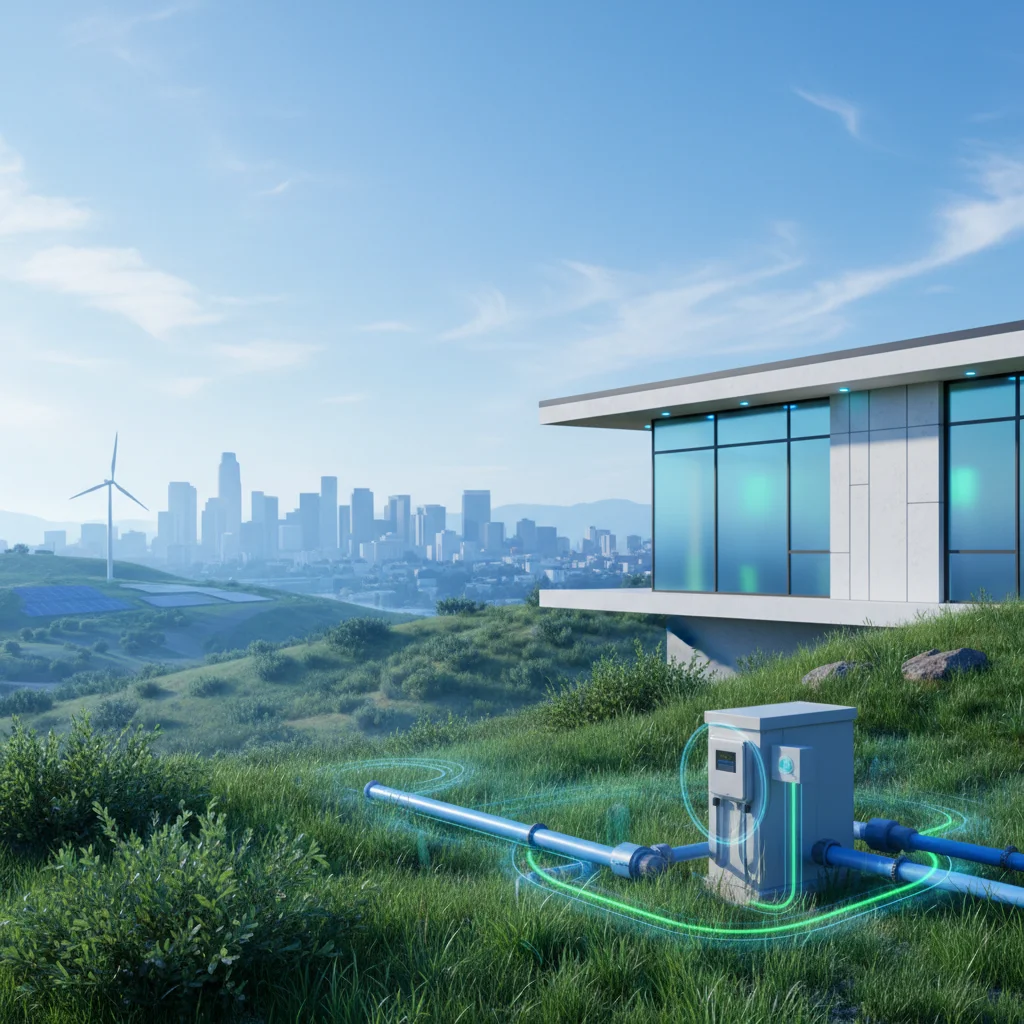
San Jose homeowners paid $31,400 on average for geothermal installations in 2025, then recovered $9,420 through federal credits and utility rebates within 90 days of filing tax returns. That net cost of $21,980 now competes directly with high-efficiency gas furnace replacements, flipping the economics of ground-source heat pumps in Silicon Valley's moderate climate.
San Jose geothermal contractors install closed-loop systems for $28,000-$35,000 in 2026, with homeowners recovering 30% through the federal Residential Clean Energy Credit (Section 25D) and $2,000-$4,000 from TECH Clean California rebates. And licensed contractors must carry C-20 HVAC or C-61 D-3 geo-loop drilling certification to pull permits.
How Much Does a Geothermal Installation Cost in San Jose?
San Jose installations range from $28,000 for a 3-ton vertical loop system to $35,000 for a 5-ton horizontal configuration across quarter-acre lots. Drilling costs drive regional pricing: vertical boreholes reach 200-400 feet in Santa Clara County's clay soils at $18-$25 per linear foot, while horizontal trenching spans 4-6 feet deep across 1,500-2,500 square feet at $12-$18 per foot. Equipment accounts for $8,000-$12,000 (heat pump, ground loop piping, installation labor), with permitting and inspection fees adding $1,200-$1,800 through San Jose's Building Department.
So the all-in cost before incentives breaks down as: drilling $7,200-$12,000, equipment and labor $15,000-$20,000, permits $1,200-$1,800. But the federal geothermal tax credit covers 30% of total project costs through 2032, reducing that $31,000 median price to $21,700 after credits.
Which Geothermal Systems Qualify for California Rebates and Tax Credits?
The federal Residential Clean Energy Credit (Section 25D) ended for expenditures made after December 31, 2025, and the IRS treats an expenditure as made when installation is completed (IRS FS-2025-05). Federal tax credits for this work have ended, but state, local and utility rebates may still apply; check what is available at your address with the DuloCore rebate calculator. TECH Clean California adds $2,000-$4,000 for single-family replacements of gas furnaces or electric resistance heat, stacking with the federal credit for combined savings of $10,600-$14,500 on a $32,000 installation. And the Bay Area Air Quality Management District offers $3,000 for qualifying heat pump upgrades in its jurisdiction covering San Jose.
Equipment must meet AHRI certification standards with ground-loop heat exchangers tested to NSF/ANSI 358 for closed-loop systems. Or open-loop configurations require California Department of Water Resources well permits demonstrating 3 GPM minimum flow rates during peak heating and cooling loads.
| Program | Amount | Eligibility | 2026 Status |
|---|---|---|---|
| Federal Section 25D Credit | Ended Dec 31, 2025 | — | Ended Dec 31, 2025 |
| TECH Clean California | $2,000-$4,000 | Gas furnace replacement | Active, income-qualified tiers |
| BAAQMD Heat Pump Incentive | $3,000 | Air district residents | Active through June 30, 2026 |
What's the Energy Efficiency Rating of Modern Geothermal Systems?
Ground-source heat pumps deliver 4.0-5.2 COP in heating mode and 18-30 EER (Energy Efficiency Ratio) in cooling across San Jose's 62°F average ground temperature. That translates to 400-520% heating efficiency compared to electric resistance baseboard's 100% and gas furnaces' 95% AFUE. And cooling efficiency exceeds conventional air conditioners' 14-16 SEER ratings by 40-80%, cutting summer electricity consumption from 2,400 kWh to 1,200-1,500 kWh for a typical 2,000-square-foot home.
But performance varies by loop configuration: vertical closed-loop systems maintain 4.8-5.2 COP year-round in stable subsurface temperatures, while horizontal installations dip to 4.0-4.4 COP during extreme weather as shallow soil temperatures fluctuate 8-12°F seasonally. So contractors recommend vertical loops for lots under 0.4 acres where trenching space limits horizontal field sizing.
Which Geothermal Brands Offer the Best Performance in San Jose's Climate?
ClimateMaster Tranquility 27 series achieves 5.3 COP and 41 EER in two-stage configurations sized for San Jose's 500-700 annual heating degree days and 200-400 cooling degree days. WaterFurnace 7 Series delivers 5.1 COP with variable-speed compressors reducing cycling losses during mild spring and fall months when homes need minimal conditioning. And Bosch IDS 2.0 systems integrate desuperheaters capturing waste heat for domestic hot water at 3.5 COP, offsetting 60-80% of water heating energy.
Carrier GT-PX and Trane TEM6 models qualify for ENERGY STAR Most Efficient designation at 4.5+ COP, meeting minimum thresholds for federal credits and utility rebates. But premium brands command $1,200-$2,400 more than base models, paid back through 8-12% higher seasonal efficiency over 20-year equipment life.
How Long Until a Geothermal System Pays for Itself?
San Jose installations recoup upfront costs in 7-11 years through combined energy savings and incentive recovery. A $31,000 system claims $9,300 in federal credits and $3,000 in TECH rebates, reducing net cost to $18,700. And annual energy savings of $1,800-$2,400 (replacing gas furnace and central AC) deliver payback in 8-10 years at 2026 PG&E rates of $0.38 per kWh and $2.35 per therm.
Or households financing installations at 6.5% APR over 15 years pay $270 monthly while saving $150-$200 on utility bills, creating net monthly costs of $70-$120 until loan payoff. So the break-even point arrives when cumulative savings exceed financing costs, typically year 11-13 for financed projects versus year 8-9 for cash purchases.
Calculate your specific savings and payback timeline with our free rebate calculator using your home's square footage and current energy bills.
Geothermal vs. Air Source Heat Pumps: Which Is Right for Your Home?
Ground-source systems cost $28,000-$35,000 installed compared to air-source heat pumps' $8,000-$14,000 for ducted whole-home configurations. But geothermal delivers 25-35% higher efficiency year-round, saving $600-$900 annually over air-source equipment in San Jose's climate. And ground loops last 50+ years versus air-source outdoor units' 15-20 year lifespan, amortizing the $18,000 cost premium across 30-35 additional service years.
Air-source heat pumps make economic sense for homes under 1,400 square feet where lower absolute savings extend geothermal payback beyond 15 years. Or properties with limited yard space for trenching or drilling default to air-source ductless mini-splits avoiding ground loop installation. But larger homes above 2,000 square feet with available land area see geothermal's superior efficiency compound into $20,000-$35,000 lifetime savings over air-source alternatives.
For more on air-source options, see heat pump rebates covering ducted and ductless configurations.
What's the Typical Lifespan and Maintenance Schedule for Geothermal Systems?
Ground loops last 50-100 years in closed-loop configurations using high-density polyethylene piping rated for 200 PSI and buried 4-6 feet below frost lines. Heat pump equipment operates 20-25 years with biennial filter changes, annual refrigerant pressure checks, and quinquennial ground-loop fluid testing for pH and antifreeze concentration. And desuperheaters and auxiliary electric resistance coils require inspection every 3-5 years, adding $150-$250 to routine HVAC maintenance contracts.
So total lifecycle costs include $3,000-$5,000 in maintenance over 25 years plus $8,000-$12,000 for heat pump replacement at year 20-25, while ground loops remain functional indefinitely. Or extended warranties covering compressor and refrigerant leaks for 10 years cost $800-$1,400 upfront, purchased through installing contractors.
San Jose Permit Requirements
Building permits cost $800-$1,200 through San Jose's Building Department, requiring stamped mechanical and plumbing plans from licensed engineers. And well permits for open-loop systems add $400-$600 through Santa Clara County Environmental Health, with quarterly monitoring reports mandating groundwater temperature and discharge volume logs.Official Sources
- U.S. Department of Energy Geothermal Heat Pumps — Federal guidance on system types, efficiency ratings, and installation considerations
- ENERGY STAR Save Energy Save Money — Tax credit eligibility checker and rebate program directory (note: the federal 25C and 25D credits ended for projects completed after December 31, 2025)
- DSIRE USA California Programs — Comprehensive database of state and utility incentives with 2026 updates
Frequently Asked Questions
Can geothermal systems qualify for California tax credits in San Jose?
The federal Residential Clean Energy Credit (Section 25D) ended for expenditures made after December 31, 2025, and the IRS treats an expenditure as made when installation is completed (IRS FS-2025-05). And TECH Clean California provides $2,000-$4,000 in point-of-sale rebates for gas furnace replacements, stacking with federal credits for combined savings of $10,600-$14,500 on typical $32,000 installations. Check current energy tax credits for multi-system bundling strategies.
How much does a geothermal installation cost in San Jose?
San Jose installations range $28,000-$35,000 for whole-home systems, with vertical loops costing $3,000-$5,000 more than horizontal configurations due to drilling depth requirements in Santa Clara County's clay soils. After the 30% federal credit (this federal credit ended for expenditures made after December 31, 2025) and $2,000-$4,000 TECH rebates, net costs drop to $17,600-$22,500. So a median $31,000 project becomes $21,700 after incentives, comparable to premium gas furnace and central AC combinations.
What permits do I need for a geothermal system in San Jose?
Building permits through San Jose's Department of Planning Building and Code Enforcement cost $800-$1,200, requiring mechanical and plumbing plan reviews with engineered stamped drawings. And C-20 HVAC or C-61 D-3 drilling contractor licenses must appear on permit applications, with electrical rough-in inspections preceding ground loop pressure testing at 150 PSI for 24 hours before backfilling trenches or boreholes.
How long does a geothermal installation take in San Jose?
Drilling and installation span 3-5 days for vertical closed-loop systems: 1-2 days for borehole drilling to 250-400 feet, 1 day for heat pump and duct connections, and 1-2 days for loop flushing, pressure testing, and startup calibration. Horizontal installations require 4-6 days for trenching 1,800-2,400 linear feet of ground loop piping across 0.25-0.5 acre lots, plus 2 days for equipment installation and commissioning.
Are there geothermal contractors near me in San Jose that offer free estimates?
C-20 licensed HVAC contractors specializing in geothermal installations provide free on-site assessments measuring lot dimensions, soil composition, and existing ductwork compatibility for ground-source heat pump sizing. And most contractors offer multiple financing options through Dividend Finance or Mosaic at 5.99-7.99% APR for qualified borrowers, with estimates breaking down drilling costs, equipment pricing, and projected utility savings over 20-year system life.
Ready to see how much you can save? Use our rebate calculator to estimate your federal tax credits, state rebates, and 20-year energy savings based on your home's size and current heating system. Get a personalized geothermal cost breakdown in under 60 seconds.
Updated: April 14, 2026 — fact-checked by DuloCore Research. About our editorial process.
Check your California heat pump rebate eligibility — see the programs you qualify for and the dollar amounts on our California heat pump rebate finder.